Can a Mini Split Heat a Whole House? When It Works and When It Doesn't
October 21, 2026

Yes, but rarely with just one indoor unit. A mini split heats the space it sits in, and that warmth fades around corners and behind closed doors.
Plan on one indoor head for each open area, plus one for each room you close off, sized from a heat-loss calculation. In cold climates, choose a cold-climate model or keep backup heat.
Take the quick quiz below to find the setup that fits your home.
Shop mini split systems Take the setup quiz
Filterbuy single-zone systems: rated to heat down to 5°F, 12,000–24,000 BTU, free 2‑day delivery, 7‑year compressor warranty.
How many heads does your home need?
Answer a few quick questions and we’ll match you to a mini split setup.
TL;DR
Yes, a mini split can heat a whole house, but rarely with a single indoor unit. Mini splits excel in the room they sit in, so whole-house heat needs an insulated, open layout with heads or a ducted unit for closed rooms, sized from a heat-loss calculation. Cold climates also call for a cold-climate model or backup heat.
Key Takeaways
One ductless mini split heats an open area well, but closed rooms usually need their own indoor unit or a ducted mini split.
Whole-house success depends on heat loss, floor plan, climate, and how many rooms you close off, so Filterbuy counts closed doors first.
In a U.S. Department of Energy Building America field study of Massachusetts homes, a bedroom suite kept behind closed doors fell into the high 50s °F.
Can a Mini Split Heat a Whole House?
Yes, as long as the system matches the home's heat loss and warm air reaches every room you live in. A ductless mini split is almost always a heat pump that carries heat through refrigerant lines to wall-mounted indoor units, no ductwork required. One head can handle a small, open, tight home, and ENERGY STAR says certified mini split heat pumps use up to 60% less energy than standard electric radiators.
Filterbuy manufactures air filters in the USA and sells Filterbuy-brand single-zone mini splits, while its HVAC Solutions team services ductless systems in Florida and Texas homes. Our takeaway: a mini split is a point-source heater. It heats brilliantly where it blows and less so around corners, as our pros and cons of mini split systems guide explains.
“The question we hear most is whether a mini split can be a home’s only heat, and the honest answer starts with the spec sheet, not the sales page.”
— Michelle Wan, Brand Manager and Air Quality Writer, Filterbuy
When Does a Mini Split Work as a Primary Heat Source?
A mini split makes a good primary heat source in a tight, open home, provided the system is rated for your winters.
Filterbuy's Closed Door Test: Walk your home at night and count the rooms where people sleep or work with the door shut. Each usually needs a dedicated heat source, so the count roughly equals the indoor units or ducted runs you need.
When Does a Mini Split Struggle to Heat a Whole House?
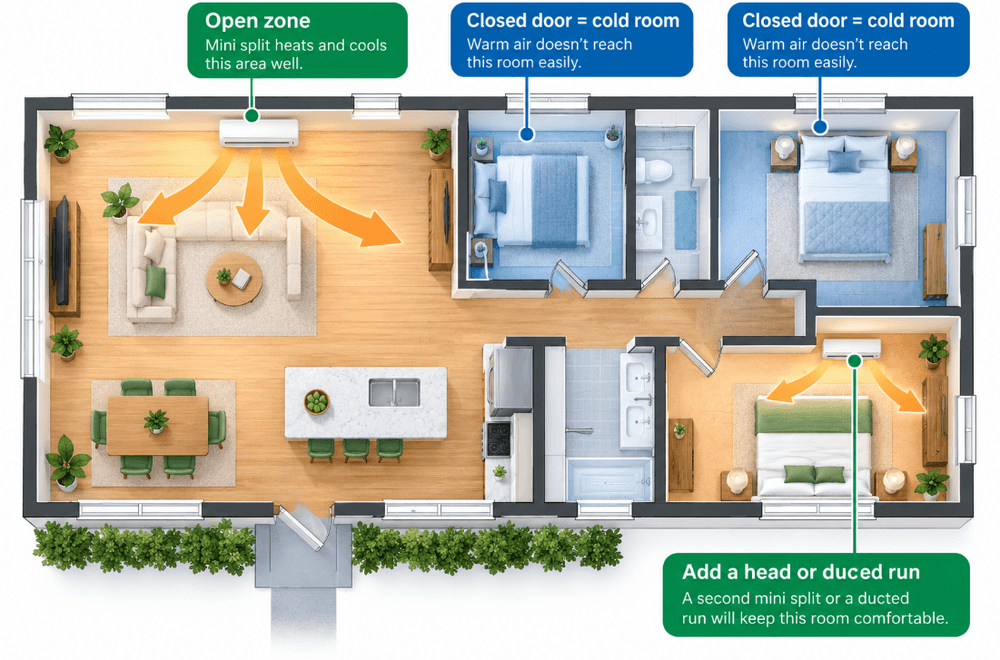
Trouble starts when heat must travel from one head into rooms it can't reach. Closed bedrooms, far-off bathrooms, upstairs rooms, and leaky older construction are the usual culprits.
In a U.S. Department of Energy (DOE) Building America study, Building Science Corporation monitored mini splits in eight high-performance Massachusetts homes. In one house, during extended winter periods with doors closed, the bedroom suite fell into the high 50s °F and a bonus room into the high 40s °F. ACCA, the Air Conditioning Contractors of America, recommends no more than a 4°F spread between rooms. The cause was heat distribution rather than undersizing, and adding heads in all three bedrooms fixed it.
Those were well-built homes, so an older, draftier house usually shows wider gaps.
How Many Mini Splits Do You Need to Heat a House?
Most homes need one indoor unit for each closed-off room or open zone, not one per house. A heat-loss calculation sets the total capacity, and the floor plan sets the number of heads.
Worked example: a three-bedroom ranch. Here is a rough plan for a 1,400-square-foot ranch with bedroom doors closed at night (planning numbers, not a quote).
1. Count delivery points. The Closed Door Test turns up three closed bedrooms and one open living area, so four spaces need heat.
2. Size the main head. Using the 20–25 BTU per square foot cross-check, a 700-square-foot living area needs roughly 14,000–17,500 BTU, which points to an 18,000 BTU head.
3. Check it on your coldest night. If that head only meets the 70% cold-climate floor, it delivers roughly 12,600 BTU/h at 5°F. A Manual J load calculation confirms whether that is enough.
4. Decide how the bedrooms get heat. Give each bedroom a head, or let a ducted unit serve bedrooms that sit side by side, with backup heat for nights below the head's rating.
Bigger isn't better: the DOE warns that oversized or poorly placed indoor units can short cycle, which wastes energy and hurts comfort. Filterbuy's mini split sizing guide has the details.
How Cold Is Too Cold for Mini Split Heating?
Most mini splits lose heating capacity as temperatures drop, but a cold-climate model holds most of it. ENERGY STAR defines a cold-climate heat pump as one that holds a COP of at least 1.75 and at least 70% of its rated heating capacity at 5°F.
We hold our own line to this rule. Size a primary heat source for your local design temperature, not its 47°F rating. Our own single-zone units are rated for reliable heating down to 5°F, so if one will be your main heat in climate zone 5 or colder, pair it with backup heat or choose a cold-climate model. Filterbuy's cold-climate mini split rankings compare real 5°F output.
“A nameplate rating is a lab number taken at 47 degrees. It tells you almost nothing about the coldest morning of the year. The first thing I want on a proposal is published capacity at the design temperature. Without it, the sizing is a guess dressed up as a spec.”
— David Clark, Licensed HVAC Technician, Filterbuy HVAC Solutions
Whole-House Heating Options Compared
The right setup depends on your ducts and your winters. For costs, see our single-zone vs. multi-zone mini split guide.
What to Do Instead: Build a Hybrid Plan
When one mini split can't heat the whole house, Filterbuy's answer for many homes is a hybrid plan rather than a bigger unit. Let the mini split carry the main living area, and keep your furnace, boiler, or baseboards as backup heat for the coldest days.
Run it steadily: Building America researchers found a constant setpoint produced the most even temperatures, while deep setbacks widened room-to-room swings.
The federal 25C credit was terminated for systems placed in service after Dec 31, 2025; check state and utility rebates, and confirm eligibility with a tax professional.
Don't Forget the Filters in a Whole-House Mini Split System
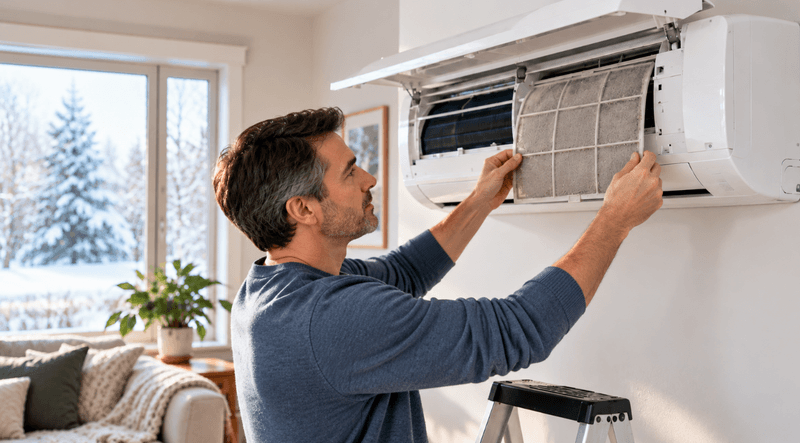
Every indoor head has a filter, so a whole-house system means several washable mesh screens to keep clean. In Filterbuy's service data, an unchecked filter is the most common cause of ductless problems, and a dirty one cuts efficiency by 5–30%. By our math, four heads cleaned every two to four weeks year-round add up to roughly 50 to 100 cleanings a year, about 10 minutes each. The EPA also notes that standard mini split filters protect the equipment from lint and pet hair but do not capture fine particles.
Pro tip from Filterbuy: Clean each head's mesh filter every two to four weeks during heating season, and if you keep a furnace as backup, change its filter on schedule too. The mesh pre-filter protects the coil; a whole-home filter, like the standard return-air filter in a ducted unit or furnace, does the heavy lifting for air quality. See how to clean mini split filters.
Supporting Statistics
1. Heating and cooling use 52% of home energy. That was the U.S. household share for space heating and air conditioning in 2020.
Source: U.S. Energy Information Administration
2. Poor installation can add about 30% to heating and cooling energy use. A three-year National Institute of Standards and Technology (NIST) heat pump study traced that extra energy to errors such as oversizing and incorrect airflow.
Source: NIST (2014)
3. A cold-climate heat pump covered over 90% of a Minneapolis home's annual heat. In a monitored 1,600-square-foot, 1924 bungalow, it met more than 90% of the heating load and cut energy use by over half, though running costs rose versus gas.
Source: Center for Energy and Environment, Minnesota (2018)
Frequently Asked Questions
Can one mini split heat a 2,000 square foot house?
Rarely evenly, because closed bedrooms and second floors run cold. Plan on several heads or a ducted unit.
Do mini splits need backup heat?
Yes, whenever cold weather pushes past the unit's rated output; many homeowners keep their existing furnace.
Is it cheaper to heat a house with a mini split?
Usually, compared with electric baseboard heat. Against gas, oil, or propane, local prices decide.
How much does whole-house mini split heating cost?
Filterbuy's mini split cost guide puts installed systems at $2,000–$7,000 per zone, or $10,000–$18,000+ for a whole home.
Is a ducted mini split better than several wall heads?
Often, for small adjoining bedrooms: one hidden air handler serves nearby rooms through short ducts, while wall heads show in each room.
Glossary
Mini split (ductless mini split heat pump): A heat pump linking outdoor and indoor units by refrigerant lines, without ductwork.
Head (indoor unit): The wall, ceiling, or floor unit that blows air into a room.
Point-source heater: A heater whose warmth fades with distance and closed doors.
Ducted (concealed) mini split: A hidden mini split air handler feeding short ducts.
Cold-climate heat pump: A heat pump ENERGY STAR verifies to keep 70% capacity and a 1.75 COP at 5°F.
COP (coefficient of performance): Heat delivered divided by energy used.
BTU (British thermal unit): A unit of heat; mini split capacity is rated in BTU/h.
Manual J: ACCA's room-by-room load calculation.
Design temperature: The coldest local outdoor temperature a heating system is sized for.