Mini Split vs Central Air: Which Is Right for Your Home?
July 14, 2026
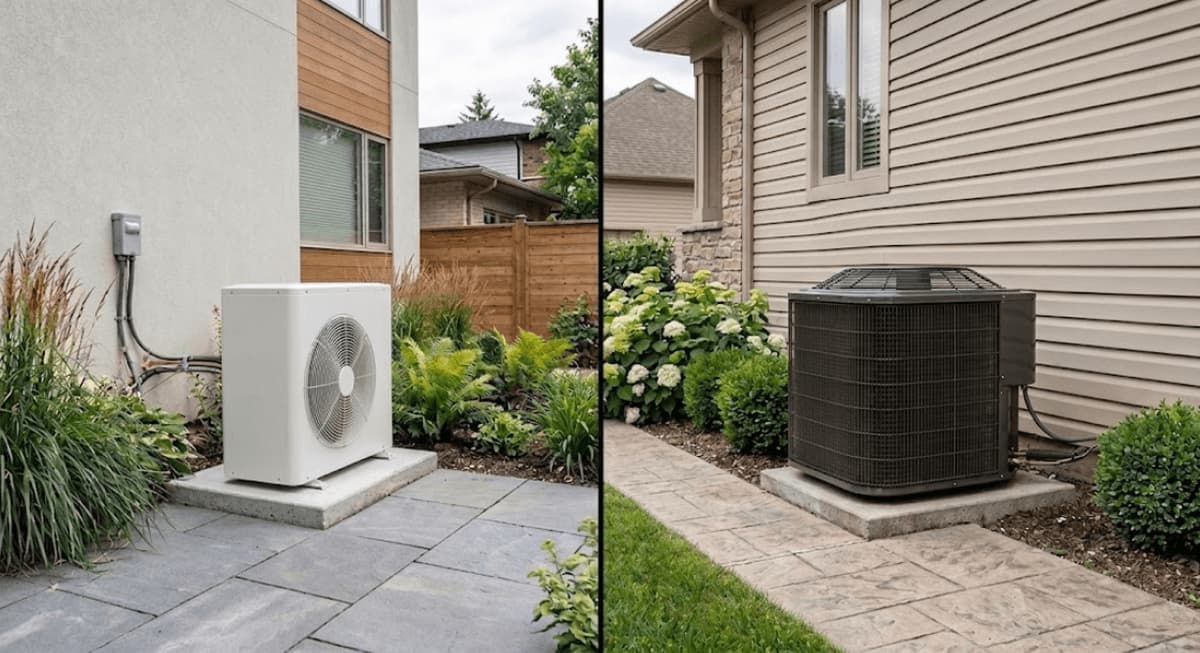
Choose a mini split for additions, older homes, garages, and rooms you want to control on their own. Choose central air when your home already has ducts in good shape and you want one temperature throughout.
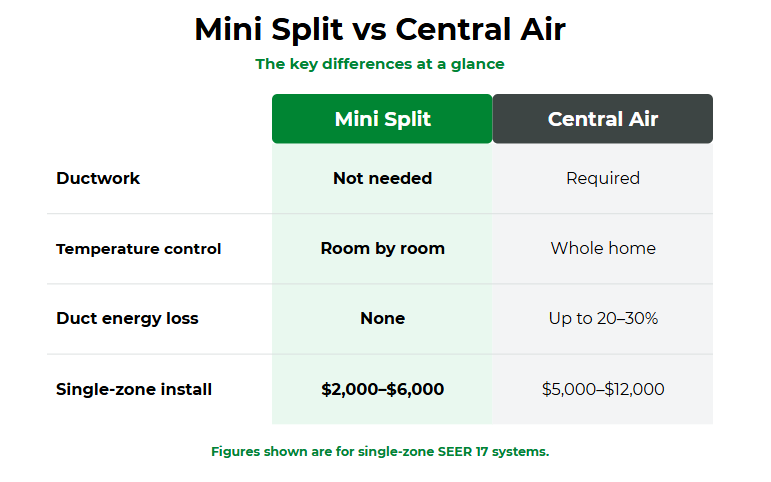
Mini splits run on refrigerant lines instead of ducts, so no conditioned air escapes through duct leaks — a loss that can reach 20–30% with central air. Single-zone mini splits also cost less to install.
Ductwork: none for a mini split; required for central air.
Control: room by room vs. one setting for the whole home.
Duct energy loss: none vs. up to 20–30%.
Single-zone install: $2,000–$6,000 vs. $5,000–$12,000.
Not sure which fits your space? Answer 3 quick questions and we'll match you to the right SEER 17 mini split.
Choosing between a mini split and central air can feel overwhelming. Both systems heat and cool your home, but they work in fundamentally different ways.
Central air relies on ductwork to distribute conditioned air throughout your entire home from a single unit. Mini splits, on the other hand, deliver targeted comfort room by room without ducts.
The right choice for your home depends on several factors: your home's layout, whether ductwork already exists, your renovation plans, your budget, and your energy-saving goals. This guide breaks down the key differences to help you make an informed decision.
Key Takeaways:
Mini splits don't require ductwork
Ducts can lose 20–30% of conditioned air through leaks
SEER 17 mini splits use inverter technology for better efficiency
Central air costs more if ducts need installation
Zoned cooling with mini splits lowers energy bills
Filterbuy offers 12K, 18K, and 24K BTU SEER 17 mini splits
What Is a Mini Split System?
A mini split is a ductless heating and cooling system that consists of two main components: a wall-mounted indoor unit and an outdoor condenser connected by refrigerant lines.
Here's what makes mini splits different:
No ductwork required: refrigerant lines run through a small hole in the wall
Inverter-driven compressor: adjusts speed continuously rather than cycling on and off
SEER 17 efficiency rating: higher than many traditional systems
Uses R32 refrigerant: more environmentally friendly
Provides both heating and cooling: one system handles year-round comfort
Zoned comfort: control each room independently
Lower installation disruption: no major construction needed
Filterbuy offers three sizes to match different room dimensions:
12,000 BTU — ideal for 400–550 square feet
18,000 BTU — suitable for 550–800 square feet
24,000 BTU — best for 800–1,200 square feet
Each unit delivers efficient, quiet operation with independent temperature control.
What Is Central Air?
Central air conditioning uses a single outdoor condenser unit connected to an indoor air handler that distributes cooled (or heated) air through a network of ducts throughout your home.
Key characteristics include:
Single outdoor condenser: handles cooling for the entire home
Indoor air handler: typically located in an attic, basement, or closet
Ductwork distribution: air travels through metal or flexible ducts to each room
Single thermostat control: one setting for the whole house
Efficiency ratings vary: older systems often rate 13–16 SEER, newer ones can reach 17+ SEER
Single-stage or multi-stage: affects how the system modulates temperature
The efficiency of central air depends heavily on duct condition. Leaking or poorly insulated ductwork can reduce system efficiency by 20–30%, even if the unit itself has a high SEER rating.
Mini Split vs Central Air: Key Differences at a Glance
| Feature | Mini Split (SEER 17) | Central Air (SEER 17) |
|---|---|---|
| Ductwork Required | No | Yes |
| Zoning | Independent room control | Whole-home |
| Energy Loss | No duct loss | 20–30% duct loss possible |
| Install Cost | $2,000–$6,000 (single-zone) | $5,000–$12,000 |
| Operating Cost | $200–$250/year | $260–$300/year |
| Ideal For | Additions, older homes, garages | Fully ducted homes |
Energy Efficiency Comparison
Energy efficiency is where mini splits really shine, particularly SEER 17 inverter models.
How Inverter Technology Works
Traditional HVAC systems operate like a light switch — they're either on at full capacity or completely off. This constant cycling creates energy spikes and temperature fluctuations.
Inverter compressors work differently. They adjust their speed continuously to match your cooling or heating needs. Think of it like a dimmer switch that maintains consistent comfort while using less energy.
Real-World Energy Savings
The benefits of inverter technology include:
Reduced energy spikes: no surges from constant on/off cycles
Better humidity control: longer, lower-speed runs remove more moisture from the air
Improved dehumidification: especially important in humid climates like Florida
No duct leakage losses: every bit of conditioned air reaches its destination
Let's look at actual costs. For a typical home running 2,000 cooling hours annually at $0.13 per kWh:
A SEER 17 mini split typically saves 20–30% compared to standard central air systems. This difference comes from two sources: the inverter's variable-speed efficiency and the elimination of duct losses.
Zoned Cooling Advantage
Mini splits offer another efficiency boost through zoning. You can cool occupied rooms while leaving empty spaces at higher temperatures. Central air cools your entire home whether you're using those rooms or not.
Installation Costs & Renovation Requirements
Installation costs vary significantly depending on whether your home has existing ductwork.
Central Air Installation
Installing central air involves:
Ductwork installation: expensive in homes without existing ducts
Major construction: cutting into drywall, navigating attic spaces, potentially modifying framing
Higher upfront cost: $5,000–$12,000 for complete installation
Longer installation time: several days to a week
Best for homes already ducted: replacement costs are lower when infrastructure exists
Older homes without ductwork face the highest installation costs. Retrofit duct installation can require extensive carpentry and drywall work.
Mini Split Installation
Mini split installation is comparatively straightforward:
No ductwork needed: refrigerant lines run through a small 3-inch hole
Faster installation: often completed in one day
Less invasive: minimal impact on existing structures
Lower labor cost: particularly for single-zone systems
Multi-zone options: add units as needed without major renovations
Single-zone mini split installation typically ranges from $2,000–$6,000, depending on the unit size and installation complexity.
Both systems require professional licensed HVAC installation to ensure proper refrigerant handling, electrical connections, and optimal performance.
Comfort & Temperature Control
How a system maintains comfort affects your daily experience at home.
Mini Split Comfort Features
Mini splits excel at consistent temperature control:
Independent room control: set each space to your preferred temperature
No hot or cold spots: direct airflow where needed
Whisper-quiet operation: around 30 decibels, quieter than a library
"Follow Me" feature: some models adjust based on the remote control location
Stable temperatures: inverter technology eliminates temperature swings
You can keep your bedroom cool at night while maintaining a warmer temperature in unused guest rooms.
Central Air Comfort Characteristics
Central air provides whole-home climate control:
One thermostat: single temperature setting for the entire home
Potential uneven cooling: rooms farther from the air handler may be warmer
Louder operation: airflow through ducts creates more noise
Uniform approach: consistent temperature throughout (if ducts are balanced properly)
Central air works well when you want every room at the same temperature, but struggles with individual preferences or rooms with different heating and cooling needs.
Indoor Air Quality Comparison
Air quality impacts health and comfort, making it an important consideration.
Mini Split Air Quality Advantages
Mini splits offer several air quality benefits:
55°C self-cleaning function: high-temperature cycle prevents mold and bacteria growth
Integrated filtration: captures dust, pollen, and other particles
Filter-cleaning reminders: alerts when maintenance is needed
No dusty ductwork: eliminates a common source of airborne contaminants
Fewer circulation issues: air doesn't pass through potentially contaminated ducts
Each indoor unit filters the air for its specific zone, providing localized air quality control.
Central Air Quality Considerations
Central air quality depends heavily on system maintenance:
Duct cleanliness matters: dirty ducts can circulate allergens and dust
Professional duct cleaning: recommended every 3–5 years
Whole-home filtration system: can be added for better air quality
Single filter point: typically at the air handler
Properly maintained central air systems with quality filters can provide excellent air quality, but require more vigilant duct maintenance than ductless systems.
When a Mini Split Makes More Sense
Certain situations make mini splits the clear winner:
Garage conversions: Add comfortable climate control without extending existing ductwork. The 12,000 BTU unit handles most single-car garages perfectly.
Sunrooms: These spaces often have different heating and cooling needs than the rest of your home. Independent control prevents overcooling adjacent rooms.
Basements: Finished basements benefit from separate temperature control, especially if they're used as home offices or entertainment spaces.
Home additions: Adding square footage doesn't require expanding your existing duct system. A mini split provides immediate comfort.
Older homes without ducts: Retrofit ductwork installation is expensive and disruptive. Mini splits deliver modern comfort without major renovation.
Small apartments: Single-zone systems provide efficient heating and cooling for compact spaces.
Open-concept layouts: Zoning different areas within open floor plans improves comfort and efficiency.
Room-specific upgrades: Cool or heat specific problem areas without replacing your entire system.
Choose the right size for your space:
12K BTU for 400–550 sq ft
18K BTU for 550–800 sq ft
24K BTU for 800–1,200 sq ft
When Central Air Might Be Better
Central air remains the better choice in some scenarios:
Large homes with existing ductwork: If your ducts are in good condition, replacing a central air system is straightforward and cost-effective.
Whole-home replacement projects: When replacing an entire HVAC system in a fully ducted home, central air may offer better value.
Uniform cooling preference: Some homeowners prefer maintaining the same temperature throughout their home.
Large consistent floor plans: Open floor plans or homes with consistent heating and cooling needs benefit from centralized distribution.
Central air makes sense when the infrastructure already exists and serves your needs well.
Which System Is Right for You?
The best choice depends on your specific situation.
Consider a SEER 17 ductless mini split from Filterbuy if you want:
Zoned comfort with independent room control
Lower renovation costs without ductwork installation
Inverter efficiency that adapts to your needs
No ductwork in your home or addition
Better humidity control in humid climates
Heating and cooling from one system
Mini splits shine in renovations, additions, older homes, and spaces requiring independent temperature control. They deliver superior energy efficiency through inverter technology and eliminate duct losses that waste up to 30% of conditioned air.
Ready to upgrade your comfort? Explore Filterbuy's SEER 17 mini split options or use our sizing guide to find the perfect match for your space.
Frequently Asked Questions
Is a mini split more energy efficient than central air?
Yes, particularly in homes with duct losses. SEER 17 inverter mini splits typically reduce energy consumption by 20–30% compared to standard central air systems. This efficiency comes from variable-speed inverter technology and the elimination of duct leakage.
How much does it cost to install a mini split vs central air?
Mini splits typically cost $2,000–$6,000 for single-zone installation. Central air ranges from $5,000–$12,000, especially if ductwork installation is required. Homes with existing ducts see lower central air installation costs.
Do mini splits work for whole homes?
Yes, with multi-zone systems. You can install multiple indoor units connected to one outdoor condenser to cool or heat an entire home. However, costs increase compared to single-zone setups.
Are mini splits good for garages?
Absolutely. Mini splits are ideal for garages because they require no ductwork and provide independent temperature control without affecting your home's main HVAC system. A 12,000 BTU unit handles most single-car garages comfortably.
How long does a SEER 17 mini split last?
With proper maintenance, including regular filter cleaning and annual professional service, a SEER 17 mini split typically lasts 15–20 years. Quality installation by licensed HVAC professionals extends system lifespan.
Do mini splits qualify for rebates?
Many SEER 17+ systems qualify for IRA (Inflation Reduction Act) rebates and state energy incentives. Eligibility depends on your location, income level, and specific system efficiency ratings. Check with local utilities and state energy offices for current rebate programs.