
Which States Get the Most Winter Storm Warnings?
October 23, 2026
Alaska and the Rockies top the U.S. for winter storm warnings, because high latitude and elevation bring a longer, snowier season. North Dakota leads for blizzards, with South Dakota and western Minnesota close behind. The Northeast and Mid-Atlantic take the costliest hits.
Days of nonstop heating can load a furnace filter in about 30 days instead of the usual 60 to 90. Take the quick quiz below to find your filter before the next storm.
Already know your filter size?
Where winter storms hit hardest
And what each one means for your home
Most warnings
Alaska and the Rockies
Nonstop heat loads filters fast
Most blizzards
The Northern Plains
Drifts can bury furnace vent pipes
Costliest storms
Northeast and Mid-Atlantic
Ice and snow can cut power for days
In storm-heavy states
Check your filter monthly, December–March
Answer a few quick questions and we'll match you to the right furnace filter for storm season.
Alaska and the Rocky Mountain West get more winter storm warnings than anywhere else in the U.S. Blizzards belong to the northern Plains, and the costliest winter storms keep landing on the Northeast and Mid-Atlantic. Filterbuy has made furnace filters in its own U.S. plants since 2013, so we read each warning from the furnace closet: which homes will run their heat nonstop, and which vent pipes are about to disappear under a drift.
TL;DR
Winter storm warnings come most often in Alaska and the Rocky Mountain West. Blizzards cluster in North Dakota, South Dakota, and western Minnesota, a region researchers call "Blizzard Alley." The most damaging storms, though, hit the Northeast and Mid-Atlantic, and 21 of the nation's 24 billion-dollar winter storms since 1980 reached New York. In Filterbuy's experience, blizzards threaten your vents while ice storms threaten your power, so plan for the storm your state actually gets.
Key Takeaways
Alaska and the Rockies lead in winter storm warnings. National Weather Service (NWS) offices there issued the most from 2012 to 2021, according to Iowa Environmental Mesonet (IEM) maps reported by The Weather Channel.
New York leads in billion-dollar winter storms. The National Oceanic and Atmospheric Administration (NOAA) counts 21 of the 24 since 1980 in New York, with Pennsylvania (20) and Virginia (19) close behind.
Blizzards average about 13 a year nationwide, mostly in North Dakota, South Dakota, and western Minnesota.
Storms load filters fast. Filterbuy has pulled February filters from customers' homes that turned black after 30 days of heavy run time, so we recommend monthly checks in high-warning states.
Which States Get the Most Winter Storm Warnings?
Alaska and the Rocky Mountain states get the most winter storm warnings. High latitude and elevation bring heavy snow over a longer season, and NWS offices in northern Alaska and the Rockies issued the most warnings from 2012 to 2021, according to IEM maps reported by The Weather Channel. At the other extreme, Florida and the Gulf Coast rarely see them.
Warning counts tell you how often storms arrive, though, not how much damage they do. For that, NOAA's National Centers for Environmental Information (NCEI) tracks every U.S. winter storm since 1980 that caused at least $1 billion in losses, and those storms have hit the crowded Northeast and Mid-Atlantic hardest (NOAA NCEI).
States Hit By The Most Billion-Dollar Winter Storms, 1980–2024
Source: NOAA National Centers for Environmental Information, U.S. Billion-Dollar Weather and Climate Disasters state summaries, 1980–2024 (inflation-adjusted). A storm counts for every state it affected. Frequency is Filterbuy's calculation: 45 years divided by each state's count.
In practice, a New York homeowner can expect a billion-dollar winter storm about every two years. Frequent isn't the same as costly, though: Minnesota, in the middle of Blizzard Alley, sees one about every 15 years (3 since 1980). That gap shapes Filterbuy's rule of thumb for blizzard warning vs. winter storm warning: a blizzard warning is a vent problem, and a winter storm warning is a power problem.
"In my experience, winter storm warnings bring more no-heat calls than blizzards, because ice takes the power out for days and a furnace with a clogged filter often trips its limit switch the moment it restarts."
— David Clark, Licensed HVAC Technician, Filterbuy HVAC Solutions
How Many Blizzards Happen Each Year, by State?
The U.S. averages about 13 blizzards a year, most of them on the northern Plains. A study of 55 winter seasons of NOAA Storm Data counted 713 blizzards between 1959 and 2014 (Climate Signals summary of Coleman & Schwartz, 2017). Traill and Cass counties in eastern North Dakota topped the study with 111 blizzards, the most in the Lower 48 (FOX Weather).
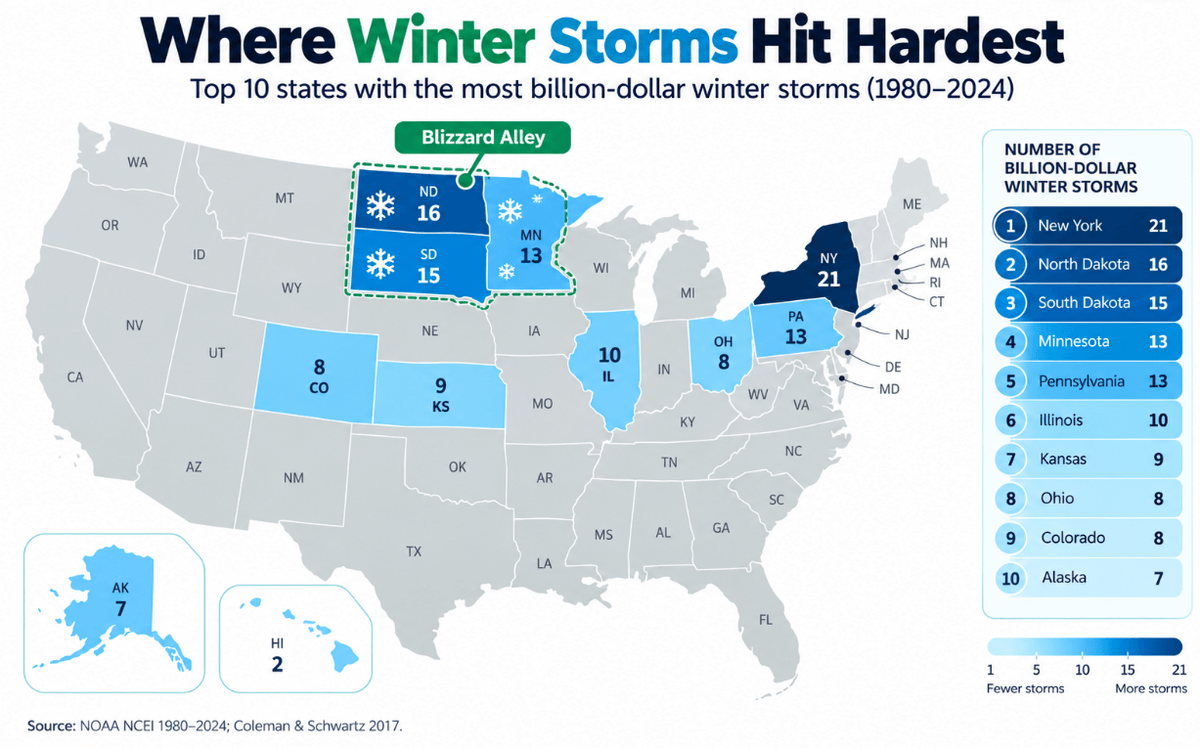
Where Blizzard Alley is centered, 1959–2014
Source: Coleman and Schwartz, Journal of Applied Meteorology and Climatology (2017), as reported by FOX Weather.
Wind explains the pattern. A blizzard warning depends on wind and visibility rather than snowfall, so blowing snow alone can qualify, and the open, flat Plains give the wind plenty of room. At the other end, a Ball State review of 1959–2000 found no recorded blizzards at all in Alabama, Florida, Mississippi, Arkansas, or Louisiana (Ball State via Newswise).
Why Don't Warning Counts Match Snowfall Totals?
A winter storm warning count reflects how often local forecasters expect dangerous winter weather, not how much snow falls. Each of the 122 NWS offices sets its own threshold, and because 2 inches of snow disrupts Dallas far more than Detroit, Southern offices warn at lower totals (The Weather Channel).
Thresholds vary by office. Sources: NWS Peachtree City and Raleigh criteria; WGME for NWS Gray.
Ice can also trigger a warning with little or no snow, and since 2023 many offices base warnings on event totals over as long as 48 hours (Spectrum News). Filterbuy's winter storm warning map covers more regional thresholds.
Which Metros Get the Most Blizzards?
Fargo, North Dakota, is the metro most likely to see a blizzard, with a 76% chance in any given year, according to Ball State University's review of 1959–2000 records.
Source: Ball State University climatologist Robert Schwartz, review of U.S. blizzards, 1959–2000 (via Newswise).
Filterbuy Storm-Frequency Tiers: What Your State's Storm Risk Means at Home
Filterbuy's Storm-Frequency Tiers turn your state's storm risk into a home heating routine built on what our team sees every winter. Days of nonstop heating can load a filter in about 30 days instead of the usual 60 to 90. For a Storm-Heavy home, December through March runs about 120 days, which works out to as many as four filters in a season, compared with one or two in a mild winter. Stock two before the first storm and let Filterbuy auto-delivery handle the rest.
"Most storm checklists stop at batteries and bottled water. I read a winter warning from the furnace closet, because the filter is the one part you can fix in two minutes before the roads close."
— Michelle Wan, Brand Manager and Air Quality Writer, Filterbuy
Tier groupings and routines are Filterbuy recommendations.
Not sure which storm to plan for? Two quick checks will tell you:
Look for two white PVC pipes on an outside wall. They mean you have a high-efficiency furnace, and blizzard drifts can bury them, so plan to keep them clear.
Think about which warnings your area usually gets. If ice and heavy snow show up more often than blizzards, plan for long outages first. Filterbuy's winter storm tracker shows what's active right now.
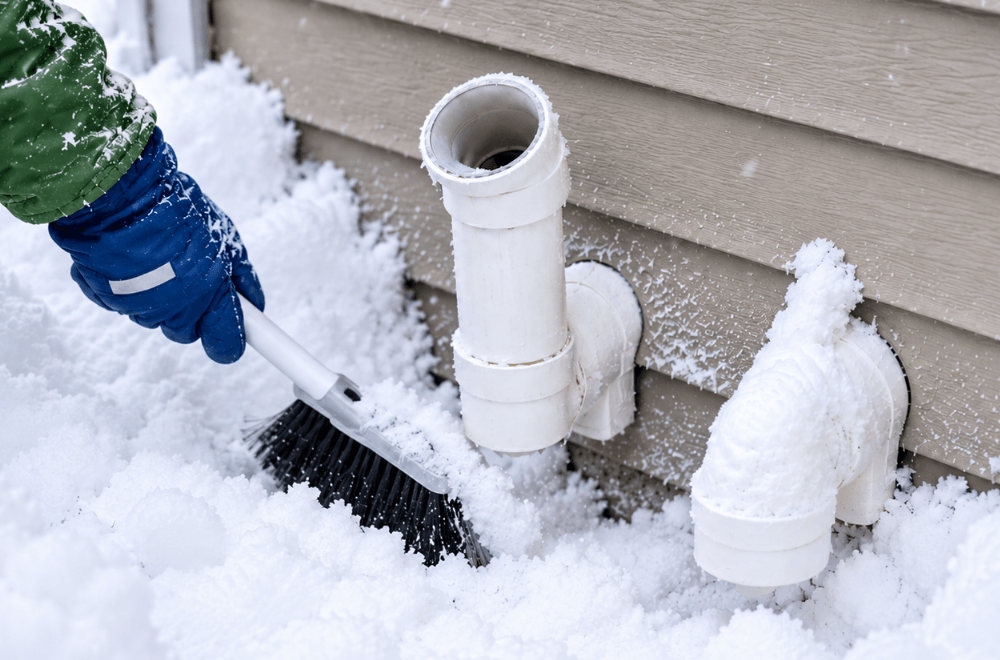
Whatever your tier, keep snow off your high-efficiency furnace's vent pipes. A blocked exhaust can push carbon monoxide (CO) back indoors, and Filterbuy's guide shows how to clear a frozen furnace vent pipe. Run generators outdoors, at least 20 feet from doors and windows. The CDC reports that CO poisoning kills more than 400 Americans each year (CPSC), and as a filter maker, we'll be direct: no air filter removes it. "Carbon monoxide is a gas, so filtration is the wrong tool entirely," says Filterbuy founder and CEO David Heacock. Only a working CO alarm can warn you, and our winter carbon monoxide safety guide covers alarm placement.
For a full storm timeline, see Filterbuy's winter storm emergency plan.
Supporting Statistics
Winter storms caused 24 billion-dollar U.S. disasters from 1980 to 2024. They cost $104.2 billion (inflation-adjusted) and killed 1,463 people. The December 2022 storm alone put more than 200 million people under winter weather advisories or warnings and left more than a million customers without power. Source: NOAA National Centers for Environmental Information
Cold and winter weather killed an average of 66 Americans a year from 2015 to 2024. NWS records show 38 cold-related and 28 winter-weather deaths a year. Source: National Weather Service fatality statistics
Winter home fires are 8% of U.S. fires but 30% of fire deaths. Source: U.S. Fire Administration
Winter Storm Warning Frequency FAQ
Which State Gets the Most Winter Storm Warnings?
Alaska and the Rocky Mountain states get the most. Colorado's Flattops zone logged 130 warnings from late 2005 to early 2014, the most of any zone (Iowa Environmental Mesonet). For costly storms, New York leads.
What State Has the Most Blizzards?
North Dakota has more blizzards than any other state, especially in the Red River Valley along the Minnesota border, with South Dakota and western Minnesota close behind.
How Many Blizzards Happen in the U.S. Each Year?
About 13 on average. A Ball State University study of NOAA Storm Data counted 713 blizzards over 55 winters from 1959 to 2014, from a single blizzard in 1980–81 to 32 in 2007–08. Seasonal counts climbed to about 21 or 22 by 2013–14, partly because reporting improved.
What Should I Do at Home When a Winter Storm Warning Is Issued?
Stay home, keep your furnace's outdoor vent pipes clear during and after the storm, and swap in a fresh filter if it's due, ideally when the watch goes out. If the power fails, run generators outdoors at least 20 feet from doors and windows, and count on a working CO alarm, since no air filter removes carbon monoxide.
How Often Should I Change My Furnace Filter in a High-Warning State?
Filterbuy recommends checking your filter monthly during peak storm season and replacing it once light barely passes through. Our guide to how often to change your air filter has more detail.
Get Ready Before Your State's Storm Season
Filterbuy cuts more than 600 filter sizes to order in Talladega, Alabama. Find your furnace filter size or set up auto-delivery so a fresh filter is waiting before the first warning.
Glossary
National Weather Service (NWS): The NOAA agency that issues official U.S. weather warnings.
Winter Storm Warning: An NWS alert that heavy snow, sleet, or ice is expected or occurring.
Blizzard Warning: An NWS alert for 35+ mph winds and blowing snow that cut visibility below a quarter mile for 3+ hours.
Filterbuy: A U.S. air filter manufacturer that cuts HVAC filters to order in its own plants.
Carbon monoxide (CO): A colorless, odorless, deadly gas produced by burning fuel.
Sources
The Weather Channel, Where the Most Weather Warnings Are Issued in the U.S.
Climate Signals, An Updated Blizzard Climatology of the Contiguous U.S. (1959–2014)
FOX Weather, Blizzard Alley in the Northern Plains
Newswise / Ball State University, U.S. Averages 11 Blizzards Annually, Most in Upper Plains
Spectrum News, National Weather Service Updates Its Winter Storm Warning Criteria
U.S. Consumer Product Safety Commission, Protect Your Family During the Catastrophic Winter Storms