
Heat Pump Balance Point and Lockout Temperature, Explained
October 24, 2026
What Is a Heat Pump Balance Point and Lockout Temperature?
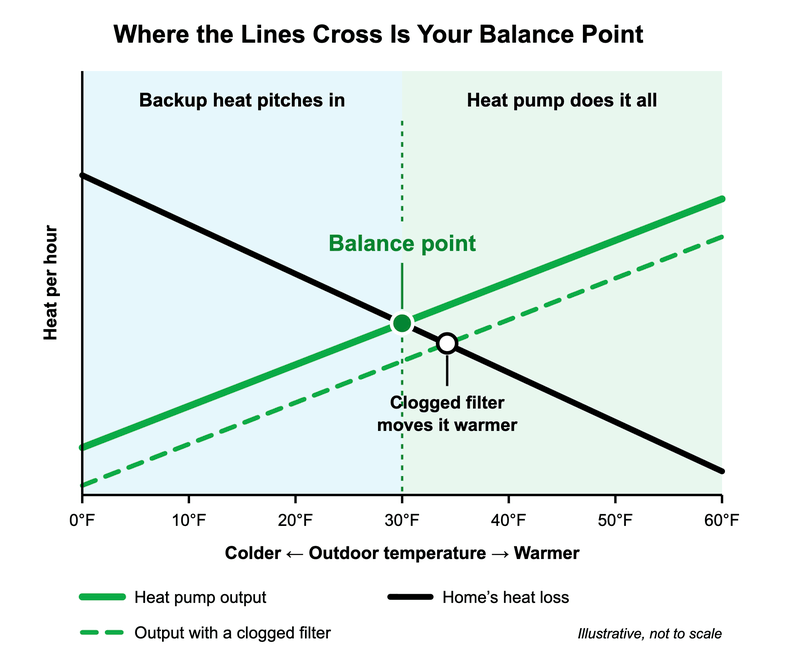
A heat pump balance point is the outdoor temperature where your heat pump’s output equals your home’s heat loss. Below it, backup heat pitches in, and lockout temperatures tell your thermostat when each heat source may run. A clogged filter cuts airflow, so backup heat can kick on sooner than you planned.
Filterbuy’s 3-Number Winter Check
Balance point: Usually 25°F to 35°F on standard heat pumps, and below 10°F on right-sized cold-climate models.
Lockout pair: On dual fuel systems, keep the aux heat lockout at least 5°F above the compressor lockout.
Filter date: Check your filter monthly from November through March.
Running a mini split? Take the quick quiz below to match it with the right filter.
Find the Right Filter for Your Mini Split
Answer a few quick questions and we’ll match you to your filter.
TL;DR
A heat pump balance point is the outdoor temperature where your heat pump's output matches your home's heat loss; below it, backup heat has to pitch in. Lockout temperatures tell the thermostat when the compressor and backup heat may run. In a dual fuel system, set switchover at or above the balance point, and higher when gas is cheap. Filterbuy's 3-Number Winter Check adds one more number: your filter date.
Key Takeaways
The thermal (capacity) balance point is the outdoor temperature where heat pump capacity equals the home's heat loss.
The economic balance point is where a heat pump and a gas or propane furnace cost the same to run, so it moves whenever utility rates do.
A compressor lockout keeps the heat pump off below a set outdoor temperature, while an aux heat lockout keeps backup heat off above one.
Filterbuy's 3-Number Winter Check covers your balance point, your lockout pair, and your filter date, since a clogged filter can pull backup heat on early.
Filterbuy's Take: Treat Your Balance Point as a Moving Target
Many guides treat the balance point as a fixed number set at installation, but it shifts as winter goes on. At Filterbuy, we've built air filters to order in our own U.S. plants since 2013, so we look at heat pumps from the airflow side. As utility rates drift and filters load up, the temperature where backup heat takes over drifts too.
Every winter heat pump check comes down to three numbers: your balance point, your lockout pair, and the date on your filter. Get all three right and the 'Aux' light stops being a mystery.
Michelle Wan, Brand Manager and Air Quality Writer, Filterbuy
Filterbuy calls this the 3-Number Winter Check, and the sections below take each number in turn.
What Is a Heat Pump Balance Point?
A heat pump balance point is the outdoor temperature at which the heat pump produces exactly as much heat as the house loses. Above it, the heat pump handles the whole load. Below it, electric strips or a furnace make up the difference.
Three balance points are worth knowing before you touch any settings:
Table 1: The Three Heat Pump Balance Points
Source: ComEd Switchover Guide.
Thermal reflects what your equipment can do, economic reflects cost, and only dual fuel homes have an economic balance point.
How Do You Find Your Home's Balance Point?
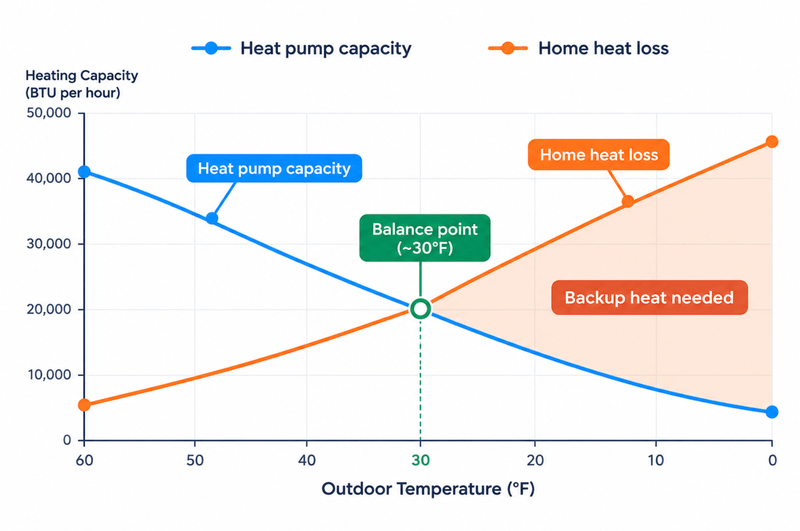
You find your home's thermal balance point by plotting its heat loss against your heat pump's heating capacity across outdoor temperatures; where the lines cross is your balance point. It's the first number in Filterbuy's winter check. Standard single-speed heat pumps usually cross between 25°F and 35°F; right-sized cold-climate models can go below 10°F.
Get your heat loss. A Manual J load calculation, the ACCA standard for residential heating loads, gives your home's heat loss in Btu per hour at your local design temperature.
Get your capacity data. Look up your model's extended performance table in the manufacturer's data or on the NEEP Cold Climate Air Source Heat Pump Product List, and note its maximum heating capacity at 47°F, 17°F, and 5°F.
Plot both lines. Heat loss climbs as it gets colder; capacity drops.
Read the crossing. The temperature where they meet is your thermal balance point.
Pro Tip: No load calculation? Building scientist Allison Bailes suggests a real-world test: on a steady cold night, note the outdoor temperature when backup heat first kicks on. It's a fair field estimate.
What Is a Heat Pump Lockout Temperature?
A lockout temperature is an outdoor-temperature limit, set in the thermostat or control board, that keeps a heat source from running. Lockouts are the second number in the winter check, and they come in a pair:
Compressor lockout (smart thermostat maker ecobee calls it "Compressor Min Outdoor Temperature"): below this temperature, only backup heat runs. In a dual fuel system, this setting is your switchover temperature.
Aux heat lockout ("Aux Heat Max Outdoor Temperature" on ecobee): above this temperature, backup heat stays off.
The overlap band between the two is where both can run at once. Ecobee's dual fuel setup guidance requires the aux heat limit to sit at least 5°F above the compressor limit.
Factory defaults can idle a capable heat pump: ecobee's threshold settings list a 35°F default compressor minimum.
How Do You Set a Dual Fuel Switchover Temperature?
Set your dual fuel switchover at whichever is warmer, your thermal balance point or your economic balance point. To find the economic balance point, calculate a break-even COP (coefficient of performance) from your utility rates and compare it with your heat pump's COP.
ComEd, the Illinois electric utility, gives this break-even COP formula in its switchover guide:
Break-even COP = (electric rate in $/kWh × 29.3 × furnace efficiency) ÷ gas price in $/therm
The 29.3 converts therms to kWh; leave fixed monthly fees out of your rates. Your economic switchover is the outdoor temperature where your heat pump's COP falls to that number.
Filterbuy ran ComEd's formula across common U.S. rate combinations: with the same heat pump, the electric-to-gas price ratio alone can move switchover by 40°F or more.
Table 2: Break-Even COP at Common U.S. Rates
Assumes a 95% efficient furnace and ComEd's example heat pump (COP 3.61 at 47°F, 2.67 at 17°F, 2.22 at 5°F).
For propane, swap 29.3 for 26.8 (kWh per gallon) and use your price per gallon. At $0.16/kWh and $2.75/gallon, break-even COP is about 1.5, which most heat pumps beat even in deep cold, so ComEd recommends setting propane systems at the thermal balance point.
Pro Tip: Utility rates change every year, so pair your fall filter change with a switchover check.
Recommended Starting Settings by System Type
The right lockout and switchover settings depend on your backup heat source.
Table 3: Starting Lockout Settings by System Type
Sources: ComEd switchover guide and ecobee setup guidance. Confirm settings with your installer.
Why Winter Filter Changes Affect Your Balance Point
A dirty air filter restricts airflow across a heat pump's indoor coil, so backup heat can kick in sooner than your lockout settings intend. It's the third number in Filterbuy's winter check, and the one we think most guides miss. The U.S. Department of Energy reports that a well-maintained heat pump can use 10% to 25% less energy than a badly neglected one.
Filters load up faster in winter, and the DOE's air-source heat pump guide calls for about 400–500 cubic feet per minute per ton, with performance dropping below roughly 350.
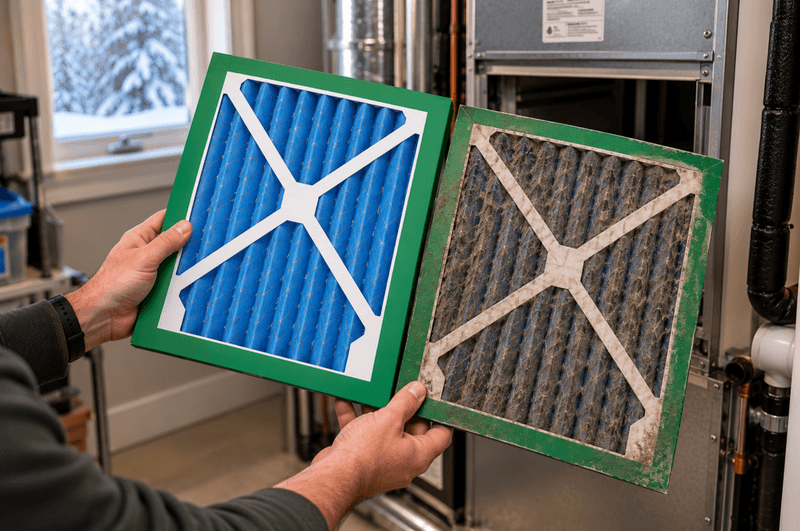
As a filter maker, Filterbuy sees one more link: the capacity tables behind your balance point assume rated airflow, so a loaded filter makes your real balance point warmer than the one on paper. It's also the cheapest fix in this guide: a $10–$30 filter versus a $75–$200 tune-up, per Filterbuy's heat pump maintenance cost guide.
Check your filter monthly from November through March. A pleated MERV 8 to MERV 11 filter suits most systems unless your installer approves a higher rating, and Filterbuy's MERV rating chart explains the airflow trade-off. Filterbuy makes 600+ filter sizes and ships them on auto-delivery before the next cold snap. See our heat pump filters guide.
What Is Your Thermostat Telling You?
Before booking a service call, match what you notice to the likely setting behind it.
Table 4: Winter Heat Pump Symptoms and Likely Settings
Sources: U.S. DOE, NEEA, ecobee. Confirm changes with your installer.
Supporting Statistics: What the Research Shows
52% of household energy goes to heating and cooling. The U.S. Energy Information Administration reported it in its 2020 home energy survey. (Source: EIA)
About 3,000 kWh ($459) saved per year. A Northeast Energy Efficiency Partnerships study cited by the DOE found cold-climate heat pumps saved roughly that much yearly versus electric resistance heat, the backup a high aux lockout calls on. (Source: U.S. DOE)
Gas use cut in half with a 5°F change. In a 2025 Northwest Energy Efficiency Alliance model of a Portland home, lowering the dual fuel switchover from 40°F to 35°F cut gas use from 309 to 154 therms a year and saved $70. (Source: NEEA)
Frequently Asked Questions
What Is a Normal Balance Point for a Heat Pump?
Most standard heat pumps land between 25°F and 35°F, and right-sized cold-climate models can reach below 10°F.
Should I Set My Heat Pump Lockout Temperature as Low as Possible?
Only in an all-electric home with equipment rated for it. In a dual fuel home, a very low lockout can cost more than burning gas. Ecobee's dual fuel setup guide suggests starting with a 30°F compressor minimum and a 40°F aux limit. Never go below the manufacturer's minimum.
How Often Should I Change My Heat Pump Filter in Winter?
The DOE recommends every three months or as the manufacturer directs. In winter, check monthly and replace it sooner if it looks gray. Filterbuy's guide on how often to change your HVAC filter has more detail.
Glossary
Thermal (capacity) balance point: The outdoor temperature where a heat pump's maximum heating output equals a home's heat loss.
Economic balance point: The outdoor temperature where a heat pump and a fossil-fuel furnace cost the same per unit of heat.
Comfort balance point: A switchover set above the economic balance point because heat pump air feels too cool.
ComEd: Commonwealth Edison, the Illinois electric utility that publishes a dual fuel switchover guide.
Compressor lockout: The outdoor temperature below which a heat pump's compressor will not run.
Auxiliary (aux) heat: Backup heat, usually electric strips or a furnace.
Defrost cycle: A brief reverse run that melts frost off the outdoor coil.
Dual fuel system: A heat pump paired with a gas, propane, or oil furnace for cold weather. Filterbuy's heat pump vs. furnace guide compares the options.
Switchover temperature: The outdoor temperature where a dual fuel system shifts from heat pump to furnace.
COP (coefficient of performance): Heat delivered per unit of electricity; a COP of 3 delivers three times the energy it uses.
Break-even COP: The heat pump COP where electric heating costs the same as the backup fuel.
Manual J: The Air Conditioning Contractors of America (ACCA) method for calculating home heating loads.
NEEA: Northwest Energy Efficiency Alliance, a regional nonprofit that studies dual fuel systems.
NEEP: Northeast Energy Efficiency Partnerships, the nonprofit behind the cold-climate heat pump product list.
MERV: Minimum Efficiency Reporting Value, a 1–16 rating of filter particle capture.