
Should You Cover Your AC Unit or Heat Pump in Winter?
October 23, 2026
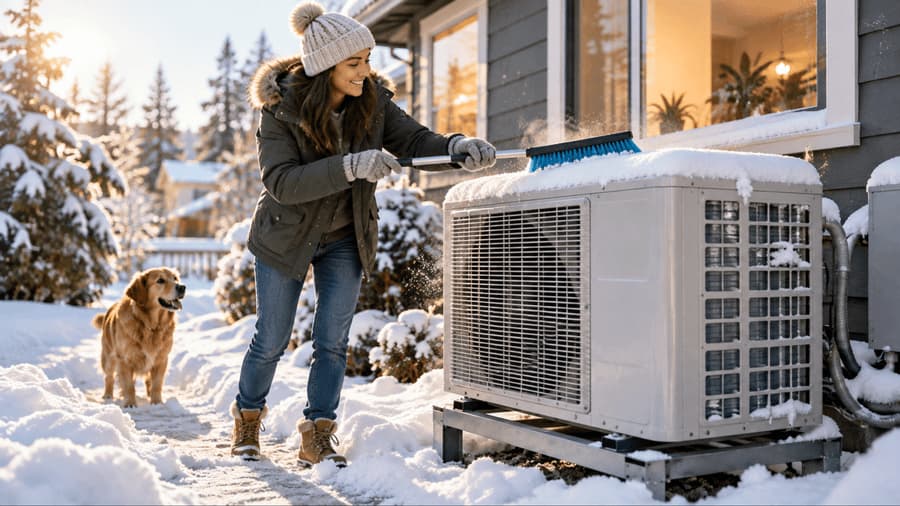
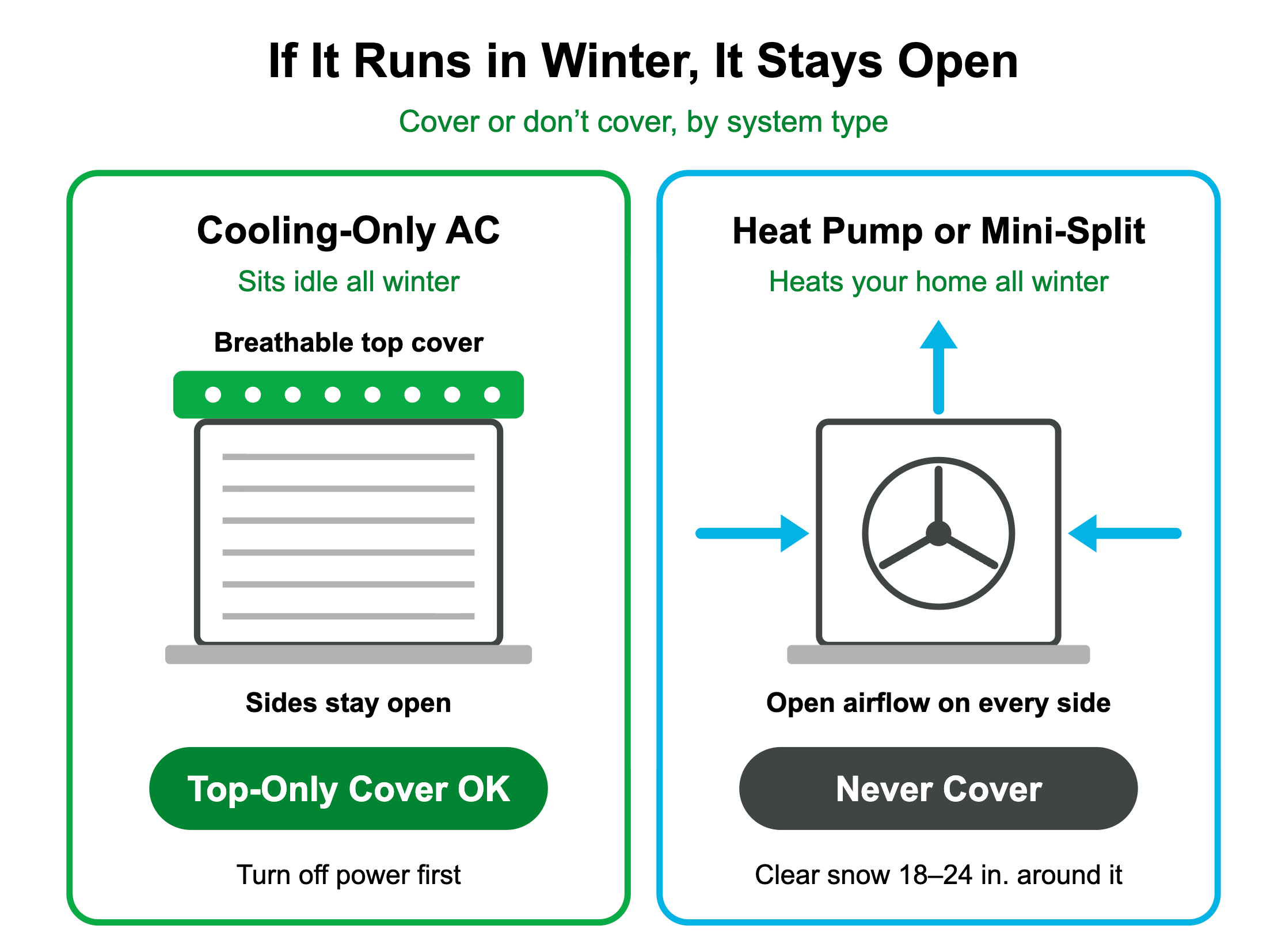
Don’t wrap either one. A cooling-only AC can wear a breathable, top-only cover if ice or leaves fall on it. A heat pump heats your home all winter, so it has to stay uncovered. Ductless mini-splits that heat and cool follow the same rule.
Central AC (cooling only): Top cover only, sides open.
Heat pump: Never cover. Clear snow and ice instead.
Mini-split: Never cover. Same care as a heat pump.
Window AC: Remove it and store it indoors.
Your system works hardest indoors, too. A fresh filter before the cold-weather rush keeps air moving all season.
Have a Mini-Split? Find Your Filter Match
Answer a few quick questions and we’ll match you to the right filter for your mini-split.
TL;DR
Don't wrap either one. A cooling-only AC can wear a breathable top-only cover if ice or leaves tend to fall on it. A heat pump is different: it heats your home all winter, so it has to stay uncovered.
Key Takeaways
A cooling-only AC condenser doesn't need a winter cover. A breathable top-only cover is optional if falling ice or leaves are a problem.
Never cover a heat pump in winter. Its outdoor unit needs open airflow to pull heat from outside air.
Heat pump snow protection means clearing snow off the unit and away from its base after every storm, without blocking airflow.
At Filterbuy, a U.S. air filter manufacturer, we've shipped filters to homes in all 50 states since 2013. In nearly every December heat pump complaint we hear, two culprits show up: a filter nobody has touched since spring and an outdoor unit packed with leaves. A cover fixes neither, so start with a simpler question: does your outdoor unit only cool, or does it heat your home too?
Cover or Don't Cover? The Quick Answer by System Type
Whether to cover your outdoor unit depends on what it does in winter, not on how exposed it looks. A cooling-only AC sits idle and can take a breathable top cover, while a heat pump runs all winter and must stay open. Filterbuy's rule of thumb is simple: if it runs in winter, it stays open.
Always follow your owner's manual for model-specific winter guidance.
How to Tell If Your Outdoor Unit Is an AC or a Heat Pump
Because a heat pump heats and cools with the same outdoor unit, it keeps running all winter. These four checks will tell you which one you have.
Look at the outdoor unit on a cold day. If the fan is spinning or steam is rising while your heat is on, you have a heat pump.
Read the data plate. Search the model number printed on the side label. The results will say "heat pump" or "air conditioner."
Check the thermostat. A setting labeled "Emergency Heat" or "Aux Heat" points to a heat pump.
Have a furnace too? Look again. In a dual-fuel system, the outdoor unit is a heat pump that handles milder days and hands off to the furnace when temperatures drop. That unit still runs in winter.
Should You Cover Your AC Unit in Winter?
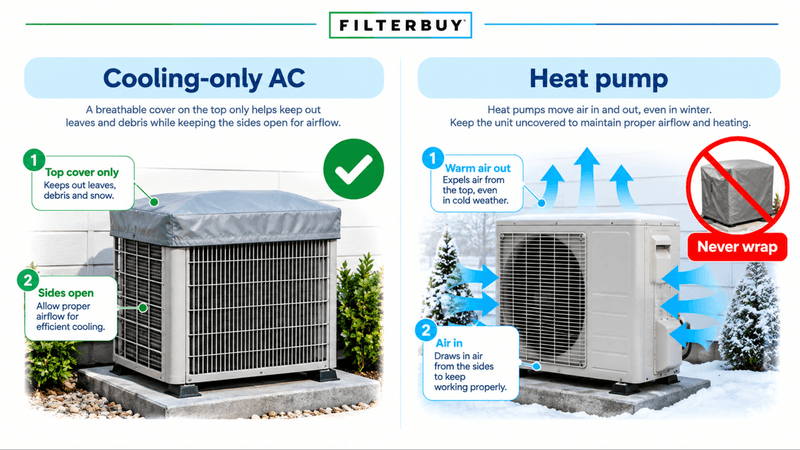
In most cases, you don't need to cover a cooling-only AC unit in winter. Outdoor condensers are built to sit outside through winter weather, and a full wrap usually does more harm than good by trapping moisture against the coil. The one safe exception is a breathable cover that protects only the top, for units that sit where ice or leaves fall.
Lennox, a leading U.S. HVAC manufacturer, points out that full covers can lead to rust, damaged electrical parts, mold, nesting rodents, and, with some manufacturers, warranty problems. Filterbuy takes the same position: protect the top if you need to, but never wrap the whole unit.
If your AC sits under a tree or below a roofline that drops ice, check these four things before you buy a cover:
Coverage: Choose top-only protection, or a cover that leaves at least the bottom half of the sides open. A manufacturer-approved top shield is the best option.
Material: Mesh or vented fabric works best. Skip tarps and other plastic or vinyl covers, since they trap moisture.
Fit: Straps should hold the cover in wind without blocking the side grilles.
Power: Never leave a cover on a unit that still has power. A warm day could switch it on.
Should You Cover Your Heat Pump in Winter?
No, a heat pump should never be covered in winter. It warms your home by pulling heat from outdoor air through its coil, even below freezing, and that only works with steady airflow. A heat pump cover for winter blocks that airflow and can damage the system if the unit runs covered.
The New York State Energy Research and Development Authority (NYSERDA) tells heat pump owners to keep the outdoor unit clear of leaves, snow, ice, and roof runoff, and the U.S. Department of Energy recommends professional heat pump maintenance at least once a year.
Frost or steam on a heat pump usually isn't a problem. Most "something's wrong with my heat pump" calls the Filterbuy team fields turn out to be a clogged filter or a defrost cycle the homeowner mistook for a malfunction. Light frost on the coil is normal in cold, damp weather. The system clears it by briefly reversing refrigerant flow to warm the coil, which is where the steam comes from. Thick ice that lingers for hours calls for a technician. If ice forms on the indoor side instead, read why a heat pump filter can freeze in winter.
How to Winterize an AC Unit in 6 Steps
Winterizing a cooling-only AC unit keeps it protected until spring. Skip them for heat pumps, which stay powered and uncovered all winter.
Turn off power at the outdoor disconnect. That way, the AC can't switch on during a warm spell.
Clear debris. Remove leaves and clippings from the top and base.
Rinse the coil gently. Use a garden hose on a low setting rather than a pressure washer, then let the unit dry fully.
Check the refrigerant line insulation. Replace any cracked or missing foam on the copper lines to the house.
Add a top-only cover if you need one. After your last cooling day, use a breathable cover or a manufacturer shield, and leave the sides open.
Set a spring reminder. Uncover the unit and restore power at least 24 hours before your first cooling day, or follow your manual. Some units have a crankcase heater that needs that time to warm the compressor.
Heat Pump Snow Protection: 6 Ways to Keep It Running
Heat pump snow protection is about keeping snow and ice off the outdoor unit without ever blocking its airflow. A buried or iced-over unit defrosts more often and leans harder on costly backup heat.
Clear snow after every storm. Brush off the top and sides with a soft broom and keep 18 to 24 inches of open space on every side, or whatever clearance your installation manual lists. Filterbuy's heat pump winter prep checklist covers the rest of the routine.
Keep the base clear. Meltwater from defrost needs somewhere to drain, or it can refreeze and lock up the fan.
Never chip at ice. Ice picks and shovels can puncture the coil. If the ice won't clear on its own, switch the thermostat to Emergency Heat and call a technician.
Redirect roof runoff. Fix gutters that drip onto the unit, and watch for snow sliding off a metal roof. Dripping water freezes into a solid cap on top.
Raise the unit. In heavy-snow areas, a pro-installed stand or bracket keeps the unit above typical snow depth.
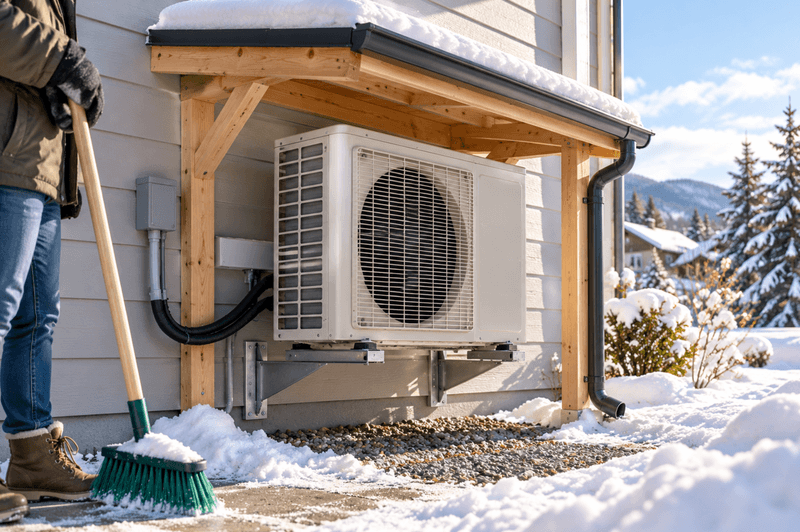
Add an open shelter. A small roof or overhang a few feet above the unit, open on all sides, deflects snow without trapping air. Ask your installer about a snow hood or wind baffle.
What Millions of Filterbuy Deliveries Have Taught Us
In our experience shipping filters to millions of households since 2013, the homeowners who never face a surprise winter breakdown aren't doing anything fancy. They change the filter on schedule, and they keep the outdoor unit clear. That's the playbook.
Filterbuy HVAC Team
We see the same pattern with icing. Roughly seven out of ten "my heat pump is icing up" calls our team fields trace back to a clogged filter that takes about fifteen minutes to replace. As Michelle Wan puts it:
I don't want anyone to feel like they need an HVAC license just to pick the right filter. My job is to give you the straight answer, explain why it matters, and let you get back to your day.
Michelle Wan, Brand Manager and Air Quality Writer, Filterbuy
Supporting Statistics
88% of U.S. households use air conditioning, and two-thirds rely on central AC or a central heat pump. Source: U.S. Energy Information Administration, "Nearly 90% of U.S. households used air conditioning in 2020"
16.1 million U.S. homes, about 13%, heat mainly with a central heat pump. The share climbs to 41% in South Carolina, 39% in Alabama, and 38% in North Carolina. Source: U.S. Energy Information Administration, 2020 RECS Highlights for Space Heating by State (PDF)
A properly installed air-source heat pump can deliver up to 3 times more heat energy than the electricity it uses. The Department of Energy also notes that performance drops when airflow falls much below 350 cubic feet per minute per ton. That's indoor-coil airflow, so a clean filter matters too. Source: U.S. Department of Energy, Air-Source Heat Pumps
Don't Forget the Part That Works Hardest Indoors
With the house sealed up for heating season, your system recirculates the same indoor air for months, and the filter does double duty.
ENERGY STAR, the joint EPA and Department of Energy efficiency program, recommends checking your filter every month during heavy-use months and changing it whenever it looks dirty, or at least every 3 months. The Department of Energy says a well-maintained heat pump can use 10% to 25% less energy than a severely neglected one. See how often to change your HVAC filter and why it pays to replace your HVAC filter before winter.
Filterbuy makes filters to order in our own U.S. plants, in 600+ standard sizes plus custom air filters. Then set up air filter auto-delivery and a fresh filter will arrive before the cold-weather rush.
Frequently Asked Questions
Can I Put a Heat Pump Cover on for Winter if I’m Not Using It?
Only if the heat pump is fully shut off for the season and the manufacturer allows it. Most heat pumps run all winter, so leave them uncovered.
Is It Ok to Put a Tarp Over My AC Unit in Winter?
No. A tarp traps moisture against the coil and cabinet, which invites rust and mold. If your cooling-only AC needs protection from falling debris, use a breathable top-only cover instead.