Shop by
September 9, 2026
By Michelle Wan, Brand Manager and Air Quality Writer | Reviewed by David Clark, Licensed HVAC Technician | Published September 9, 2026 | Updated September 9, 2026
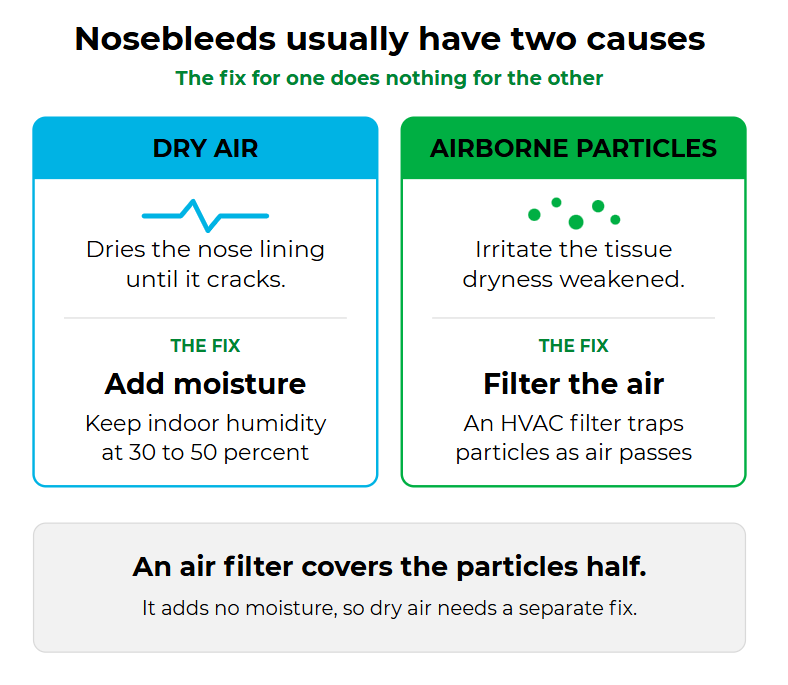
Air pollution can contribute to nosebleeds, but dry air is the better-established driver. Dryness cracks the thin lining inside the nose, and airborne particles then irritate tissue that is already fragile. Treat them as two separate factors, because the fix for one does nothing for the other.
Dry air — add moisture. The EPA recommends keeping indoor relative humidity between 30 and 50 percent.
Airborne particles — filter them. An HVAC air filter captures particles moving through your system, and it adds no moisture.
Not sure which half is driving yours? Take the quick match below to find the right filter for your system.
Answer 3 quick questions and we will match you to your filter.
Air pollution can contribute to nosebleeds, though the honest answer is more specific than a simple yes. Dry air is the better established driver, cracking the thin lining inside the nose until fragile blood vessels sit exposed. Particles then work as a second irritant on tissue that dryness has already weakened. Treat the two as separate factors, because the fix for one does nothing at all for the other.
Dry air is the most commonly cited environmental cause of nosebleeds, because moving air dries the membranes lining the nose until crusts form and bleed when disturbed.
Airborne particles are a documented irritant of the nose and upper airway, and fine smoke particles produce burning eyes and a runny nose.
Published research links outdoor particulate levels to nosebleed visits, but findings differ by pollutant, age group, and season, so particles are a contributing irritant rather than a proven cause.
The EPA recommends keeping indoor relative humidity between 30 and 50 percent.
An HVAC filter reduces particles moving through the system but adds no moisture, so filtration and humidity control address different halves of one problem.
Air pollution can contribute to nosebleeds. Researchers have measured associations between airborne particulate levels and nosebleed visits in several countries. Air pollution is not usually the sole cause. Most nosebleeds begin when the lining inside the nose dries and cracks, and polluted or smoky air then irritates tissue that is already fragile.
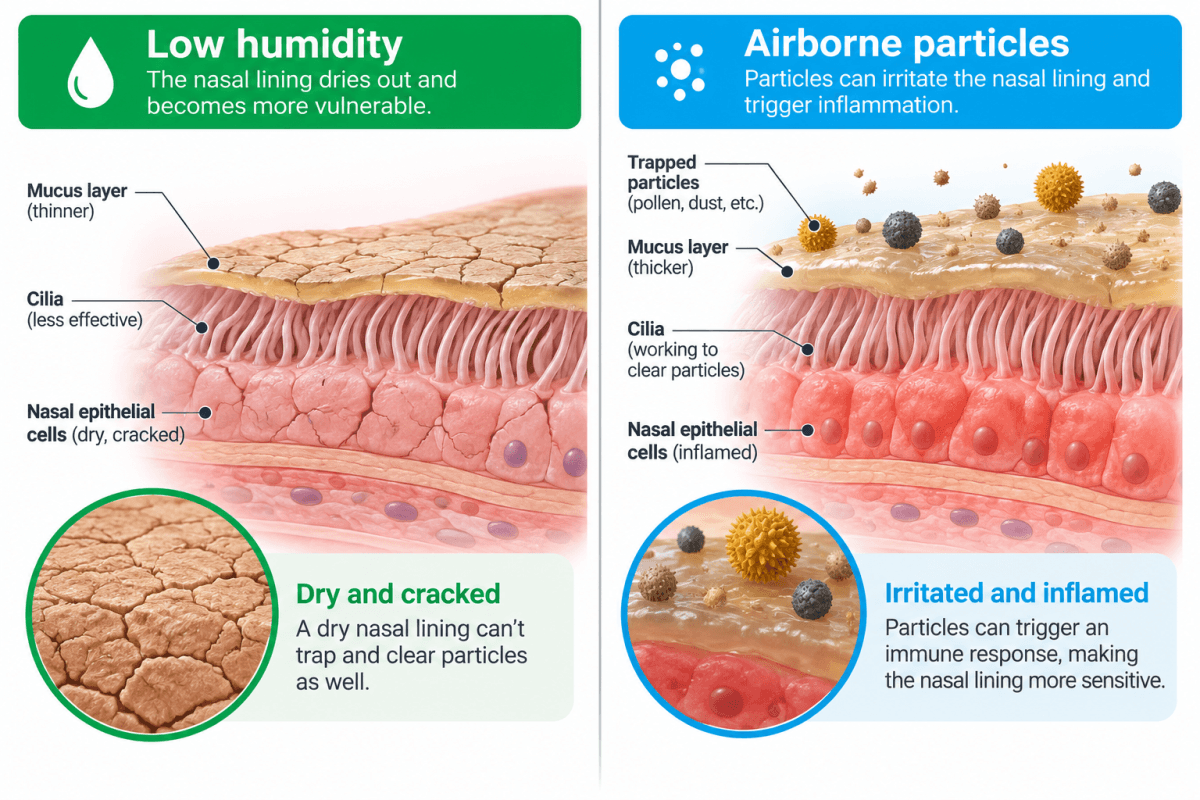
The lining inside the nose is a thin mucous membrane with blood vessels close to the surface. Air moving through dries those membranes until crusts form, and the crusts bleed as soon as they are rubbed, picked, or blown. That is why nosebleeds happen more often in winter, when indoor air runs drier and colds are circulating, as the MedlinePlus overview of nosebleeds explains.
Particles lay a second layer of irritation on top of that dryness. Fine particles produced when wood and other organic material burns reach the eyes and respiratory system, where they bring on burning eyes and a runny nose, according to AirNow guidance on fires and your health. Since inflamed tissue bleeds more readily than calm tissue, a lining that is both dry and irritated has two strikes against it rather than one.
Filterbuy parts company with most search results here, because nearly every page answering the question says yes and stops there. The research is messier than that. Some studies find higher particulate levels tracking with more nosebleed visits, while others find the relationship shifting by pollutant, flipping between children and adults, or changing with the season, and at least one found its strongest signal in ozone rather than particles. Reporting that as a settled yes is convenience rather than accuracy.
Dry air and airborne particles injure the nasal lining in two different ways. Low humidity draws moisture out until the tissue cracks, while particles inflame the surface that is left. Neither one needs the other to cause a nosebleed, but they overlap through winter heating season and smoke events, and that overlap is when households tend to notice nosebleeds arriving in clusters.
Winter is where the two factors stack up. Cold outdoor air carries little moisture to begin with, and heating it indoors pushes relative humidity lower still, while wood stoves, fireplaces, and stagnant air under an inversion drive particle counts the other way. A household can end up running its driest air and its heaviest particle load in the same week.
We built this check at Filterbuy because no page we could find separates the two factors. Dryness-driven bleeding tracks the heating season and brings chapped lips and a dry throat. Particle-driven bleeding tracks smoke and high AQI days and brings burning eyes and a runny nose. Read the column your pattern matches, then act on that half first.
Two cautions come with the table. Plenty of households show both patterns at once, so overlap is normal rather than a sign you misread it. Nostril count will not sort the cause either, since bleeding from a single nostril is the usual presentation whatever the trigger.
Some people reach the bleeding threshold sooner because their nasal lining is already compromised, their blood clots more slowly, or the air around them is unusually dry. These groups carry higher baseline risk when humidity drops or particle counts climb, and they overlap with the groups named in CDC guidance on how wildfire smoke affects the body.
Children, who have delicate nasal tissue and who rub and pick more often
Older adults, whose mucous membranes tend to be drier
People taking blood thinners or aspirin, which lengthen bleeding once it starts
People with allergies, colds, or sinus problems, and frequent users of decongestant nasal sprays, which inflame or dry the lining
Residents of arid climates and high-elevation areas, where ambient humidity stays low
People with a deviated septum, which channels airflow unevenly and dries one side faster
Reducing indoor triggers means working both halves at once. Add moisture so the nasal lining stops cracking, and cut the particle load so irritation drops. The steps run in priority order, starting with the measurement that tells you which half matters most.
Measure indoor relative humidity with a hygrometer placed in a main living area away from vents, and track it for several days before changing anything.
Target the range in EPA guidance on indoor air quality, which puts indoor relative humidity between 30 and 50 percent. Our guide to winter indoor humidity levels covers cold-weather adjustments.
Add moisture during heating season with a humidifier or vaporizer, cleaned on the manufacturer's schedule so it does not become a mold source.
Close windows and doors on smoky or high AQI days, and switch the system off fresh-air intake so it stops pulling outdoor particles in.
Run the HVAC fan continuously rather than on auto, so air keeps cycling through the filter between heating and cooling calls.
Match filtration to your particle load and equipment. Filterbuy MERV 8 filters capture 90 percent of airborne particles, MERV 11 filters capture 95 percent, and MERV 13 air filters capture 98 percent. Read how MERV ratings work first, and confirm your system handles the rating.
Change the filter on schedule and more often during smoke events, and skip indoor combustion while smoke lasts. Fireplaces, gas logs, and candles add particles to air already carrying them.
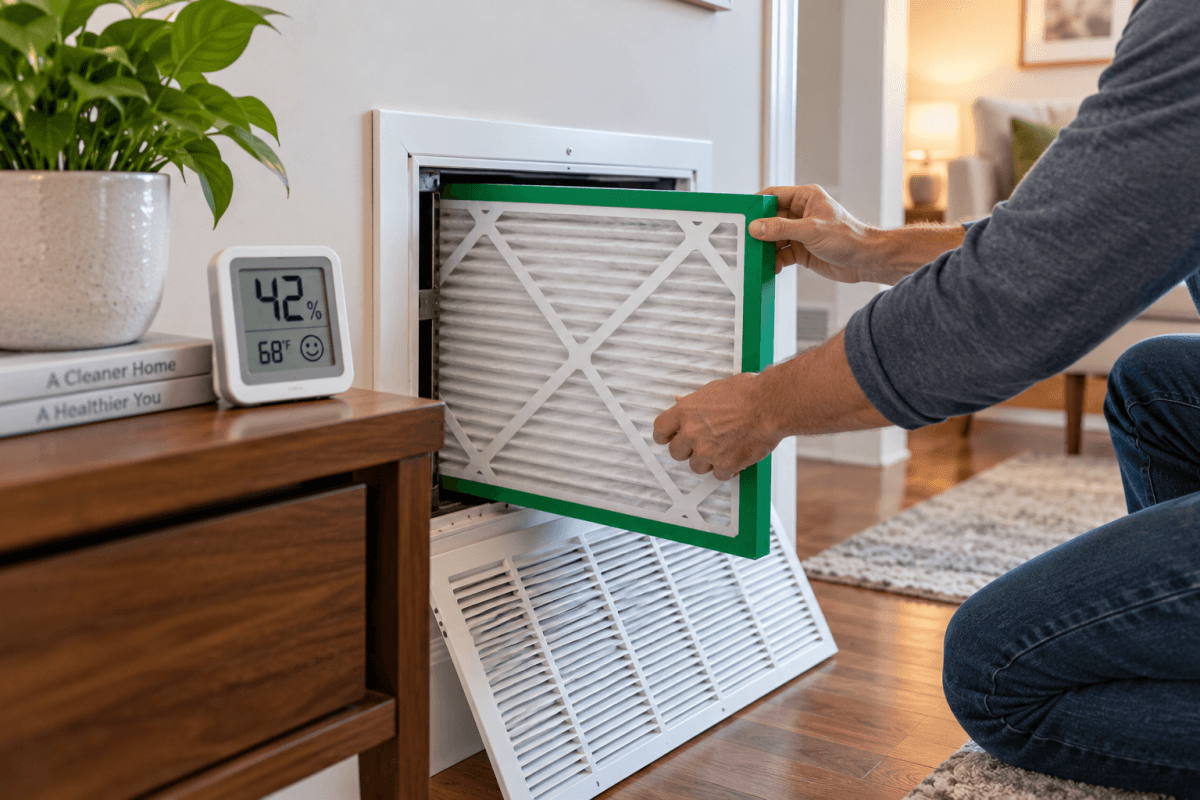
An HVAC filter reduces the particles circulating through your heating and cooling system, and that is the whole of what it does, Filterbuy's pleated filters included. It adds no moisture, it will not seal a leaky house, and it does not treat a nosebleed. Filtration handles the particle half of the problem while humidity control handles the moisture half, which is why recurring seasonal nosebleeds usually need both.
Filterbuy sells air filters, so read this next part with that in mind. If dryness dominates in your home, a filter upgrade on its own will not stop the bleeding, and you will walk away concluding that filtration failed when the real gap was moisture. Measure humidity first, then decide whether a filter is the right purchase at all.
A second point of accuracy. A pleated MERV-rated filter is not a HEPA filter, and MERV 13 is not equivalent to True HEPA. The Filterbuy chart on how HEPA and MERV standards compare sets out where each standard applies. MERV-rated media captures particles rather than gases, so it does not remove ozone. That matters because some nosebleed studies found the strongest signal with ozone, and no filter addresses it.
Filtration also only captures what reaches the return, so air leaking in around windows and doors sits outside what any filter can do about it. If smoke is a recurring problem where you live, see wildfire smoke and the air quality index.
Most nosebleeds stop within 10 minutes of correctly applied pressure. Correctly is the operative word, because the technique most people reach for is the one that does not work. The steps below are standard clinical first aid. The escalation guidance after them is where an air quality page hands off to a clinician.
Sit upright and lean forward at the waist. Do not tilt your head back.
Pinch the soft part of the nose, just below the bony bridge.
Hold for a full 10 minutes without letting go. Breathe through your mouth.
Spit out any blood that reaches your throat rather than swallowing it.
Check only after the full 10 minutes. Peeking early restarts the clock.
Once bleeding stops, avoid blowing or sniffing for several hours.
The most common mistake by far is tilting the head back, which feels like the right instinct and is precisely the wrong one. Tilting sends blood down the throat, where it causes nausea and hides how much is actually being lost. Lean forward instead.
Seek emergency care if bleeding continues past 20 minutes, if the nosebleed follows a head injury, if the nose may be broken, or if you take medication that prevents clotting. Contact a provider if nosebleeds are frequent, if they are not tied to a cold or obvious irritation, or if they follow sinus surgery. Repeated nosebleeds can point to conditions unrelated to air quality, so frequency is worth reporting rather than managing at home.
This page is educational and is not medical advice. No air filter or humidifier treats a bleeding disorder or any other diagnosed condition.
Three findings put the scale of this problem in context. Each supports a claim made above.
61.5 million people in the United States live in counties graded F for short-term particle pollution spikes.
Short-term spikes are the episodic days this page describes: smoke days, high AQI days, stagnant-air days.
Across all measures, 152.3 million people, or 44 percent of the country, live where the air failed.
For children the share is higher: 46 percent.
Source: American Lung Association, State of the Air 2026 key findings. Data from 2022 through 2024.
88 percent of United States households use air conditioning. Two-thirds use central air conditioning or a central heat pump.
Central filtration only reaches the two-thirds running ducted equipment.
For the rest, the EPA points to a portable air cleaner in the room you use most.
This is why the Filterbuy guidance above carries a condition, not a blanket instruction.
Source: U.S. Energy Information Administration, 2020 Residential Energy Consumption Survey. Sample of 18,496 households.
Wildfires burned 5,131,474 acres across the United States in 2025. The ten-year average is 7,553,704 acres.
Acreage ran below average in 2025, but the fire count of 77,850 ran above both the five-year and ten-year averages.
Smoke season is annual, not occasional, which is why this page treats it alongside heating season.
Source: National Interagency Fire Center, Wildland Fire Summary and Statistics Annual Report 2025.
Wildfire smoke can contribute to a nosebleed, and a nosebleed on a bad air quality day is a common pairing. Fine particles in smoke, largely PM2.5, irritate the eyes, nose, and respiratory system, and irritated tissue bleeds more readily. Smoke seasons also run dry, so both factors tend to arrive at once.
Winter nosebleeds usually trace to low indoor humidity. Cold outdoor air carries little moisture, and heating it indoors drops relative humidity further, drying the lining until it cracks. Circulating colds add nose-blowing and inflammation on top.
A humidifier addresses dryness by raising indoor relative humidity toward 30 to 50 percent, which helps keep the nasal lining from cracking. It does nothing about airborne particles, and it does not treat nosebleeds stemming from medication, injury, or a diagnosed condition.
Filtration reduces the airborne particles that irritate the nasal lining, addressing one of the two factors. It adds no moisture, so filtration alone will not resolve nosebleeds driven mainly by dry air. Filterbuy filters run MERV 8 through MERV 13, and none of them changes indoor humidity. Seasonal nosebleeds usually need both.
Yes, and nose irritation is far more common than bleeding. A burning or runny nose, sneezing, and a scratchy throat are typical responses to elevated particle levels. Most people notice irritation well before any bleeding.
Nasal mucosa. The thin, moist membrane lining the inside of the nose. It holds blood vessels close to the surface, which is why it bleeds easily when it dries or cracks.
Relative humidity. Water vapor in the air as a percentage of the maximum air holds at its current temperature. Indoor levels fall in winter because heating expands that capacity while the cold outdoor supply carries little moisture.
Particulate matter (PM2.5). Airborne particles measuring 2.5 micrometers or smaller. Wildfire smoke and combustion are common sources.
AQI. The Air Quality Index, a color-coded 0 to 500 scale used in the United States to report outdoor air conditions.
MERV. Minimum Efficiency Reporting Value, the ASHRAE scale for how efficiently an air filter captures airborne particles. Filterbuy pleated filters run MERV 8, MERV 11, and MERV 13.
HEPA. High Efficiency Particulate Air, a separate standard used in portable air cleaners. HEPA is not the same standard as MERV, and the two are not interchangeable.
Hygrometer. An inexpensive instrument that measures relative humidity in a room.
U.S. Environmental Protection Agency, Care for Your Air: A Guide to Indoor Air Quality. https://www.epa.gov/indoor-air-quality-iaq/care-your-air-guide-indoor-air-quality
MedlinePlus, National Library of Medicine, Nosebleed. https://medlineplus.gov/ency/article/003106.htm
AirNow, U.S. EPA, Fires and Your Health. https://www.airnow.gov/air-quality-and-health/fires-and-your-health/
Centers for Disease Control and Prevention, How Wildfire Smoke Affects Your Body. https://www.cdc.gov/wildfires/risk-factors/index.html
American Lung Association, State of the Air 2026, Key Findings. https://www.lung.org/research/sota/key-findings
U.S. Energy Information Administration, Residential Energy Consumption Survey 2020. https://www.eia.gov/todayinenergy/detail.php?id=52558
National Interagency Fire Center, Wildland Fire Summary and Statistics Annual Report 2025. https://www.nifc.gov/sites/default/files/NICC/2-Predictive%20Services/Intelligence/Annual%20Reports/2025/annual_report_2025_0.pdf
This article is educational and is not medical advice. Contact a licensed health care provider about frequent or severe nosebleeds.
