Shop by
September 7, 2026
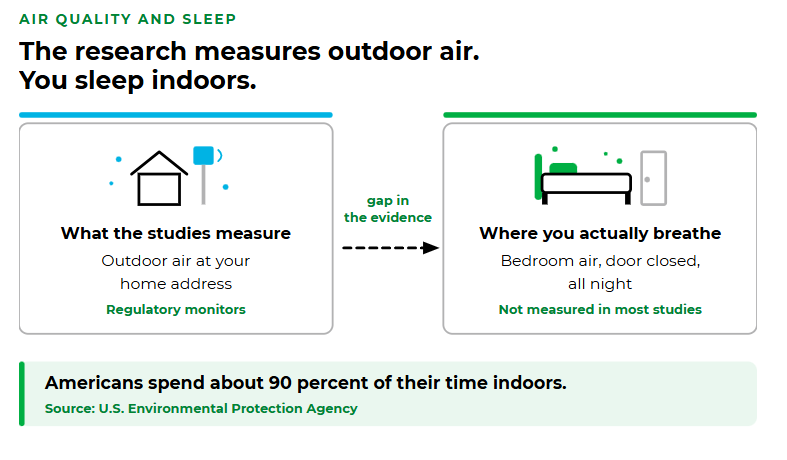
Yes. Poor air quality is linked to worse sleep. Large observational studies tie higher long-term exposure to fine particulate matter and nitrogen dioxide to lower sleep efficiency and higher odds of obstructive sleep apnea. These studies show association, not cause. Nearly all of them measure outdoor air at your home address rather than the air in the room where you actually sleep.
Multi-Ethnic Study of Atherosclerosis, 2019: among 1,974 U.S. adults, each 10 parts per billion of annual nitrogen dioxide carried 39 percent greater adjusted odds of sleep apnea.
Sleep Medicine Reviews, 2025: a meta-analysis of 25 studies and 1.26 million adults found long-term exposure to PM1, PM2.5, PM10, and nitrogen dioxide negatively associated with sleep.
U.S. EPA: Americans spend about 90 percent of their time indoors, where concentrations of some pollutants are often 2 to 5 times higher than outdoors.
One limit worth stating plainly: pleated MERV-rated filters capture airborne particles. They do not capture nitrogen dioxide or ozone, because those pollutants are gases rather than particles. No published trial has yet shown that upgrading a residential air filter improves measured sleep outcomes.
Not sure which filter fits the system that feeds your bedroom?
Answer a few quick questions and we will match you to the right filter for your setup.
Prefer to browse first? Shop Filterbuy air filters, made in the USA in more than 600 standard sizes plus custom.
Air quality affects sleep. Large observational studies link higher long-term exposure to fine particulate matter and nitrogen dioxide with lower sleep efficiency and higher odds of obstructive sleep apnea. Nearly all of that research, however, measures outdoor air at a home address rather than the air in the room where a person actually sleeps. Filterbuy's reading is that this makes the effect look smaller than it is.
In the Multi-Ethnic Study of Atherosclerosis, a cohort of 1,974 United States adults, each 10 parts per billion of annual nitrogen dioxide carried 39 percent greater adjusted odds of sleep apnea, and each 5 micrograms per cubic meter of fine particulate matter 60 percent greater odds.
Americans spend approximately 90 percent of their time indoors, where concentrations of some pollutants are often 2 to 5 times higher than typical outdoor concentrations, according to the United States Environmental Protection Agency.
In 2024, 30.5 percent of United States adults slept less than 7 hours on average in a 24-hour period, according to the National Center for Health Statistics.
The bedroom concentrates exposure more than any other room, holding the longest unbroken block of time in one place with the breathing zone inches from bedding.
Pleated MERV-rated air filters capture airborne particles. They do not capture nitrogen dioxide or ozone, because those pollutants are gases rather than particles.
Yes, and the evidence is more consistent than most people expect. Peer-reviewed research links higher exposure to fine particulate matter and nitrogen dioxide with reduced sleep efficiency, meaning the share of time in bed actually spent asleep, along with more nighttime awakenings and higher odds of obstructive sleep apnea. Those associations survive adjustment for age, weight, income, smoking, and neighborhood.
That matters because sleep is already fragile for much of the population. Federal survey data for 2024 put short sleep at 30.5 percent of United States adults and trouble staying asleep at 18.1 percent. Of everything pushing those numbers, air quality is one of the few a household can change directly.
Three bodies of evidence carry most of the weight on this question. They measured different outcomes in different populations, and they all point the same way.
| Study | Population | Exposure | Sleep Outcome | Reported Association |
|---|---|---|---|---|
| MESA sleep apnea, Annals ATS, 2019 | 1,974 US adults, avg age 68 | Annual nitrogen dioxide and fine particulate matter | Sleep apnea, apnea-hypopnea index 15 or higher | 39 percent greater adjusted odds per 10 ppb nitrogen dioxide, 60 percent per 5 micrograms per cubic meter of fine particulate matter |
| MESA sleep disruption, ATS conference, 2017 | 1,863 US adults, six cities | Five-year nitrogen dioxide and fine particulate matter | Low sleep efficiency, seven-day actigraphy | Highest nitrogen dioxide group about 60 percent more likely to have low sleep efficiency, highest particulate group about 50 percent |
| Meta-analysis, Sleep Medicine Reviews, 2025 | 25 studies, 1.26 million adults | PM1, PM2.5, PM10, and nitrogen dioxide | Pooled poor sleep health | Pooled poor sleep health prevalence 43.7 percent, long-term exposure to all four pollutants negatively associated with sleep |
These are observational findings rather than controlled experiments, so they establish association rather than cause. What makes them persuasive as a group is that the direction holds regardless of country or measurement method.
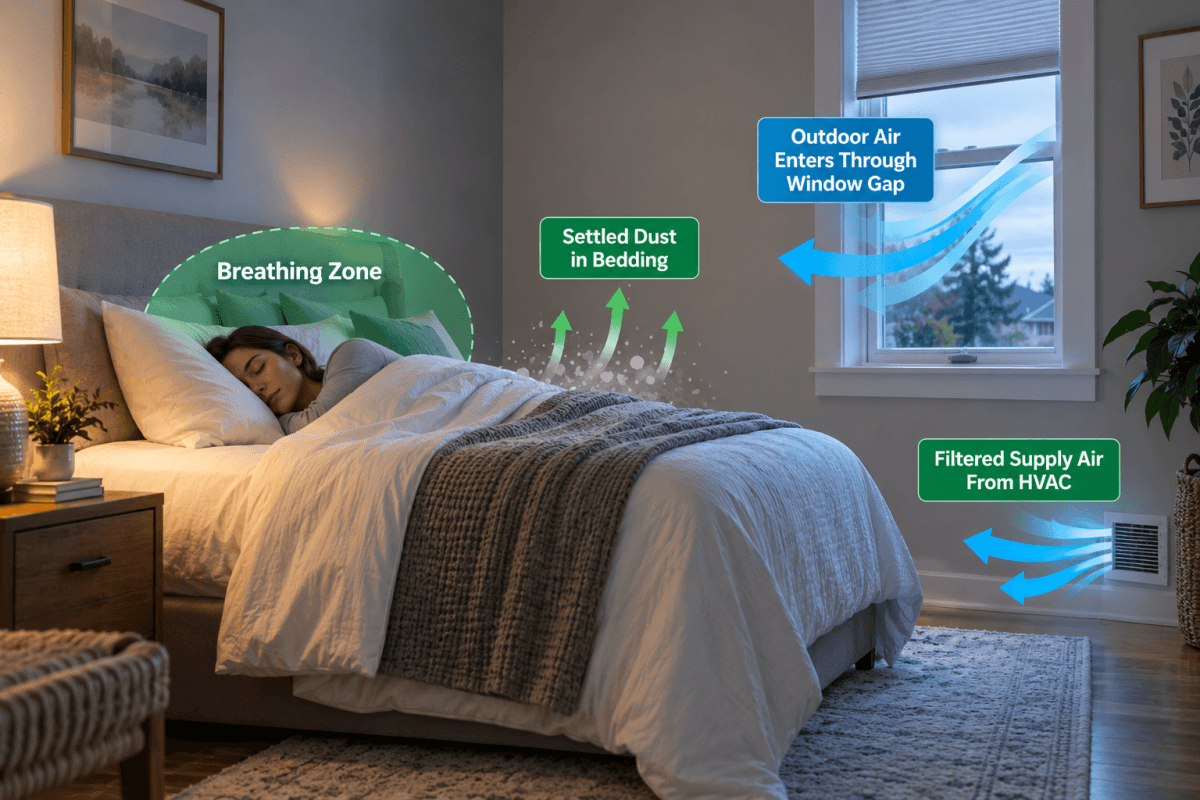
Three structural facts make the bedroom the room where indoor air quality matters most. It holds the longest unbroken block of time anyone spends in a single room, and for all of those hours the breathing zone sits inches from bedding rather than across the room from it. The door is usually shut the whole time, which limits how much air moves between the bedroom and the rest of the house.
Indoor air researchers call this space the sleep microenvironment, meaning the mattress, pillows, bedding, bed frame, and the air around a sleeping person. Chamber studies in Building and Environment documented that ordinary body movements in bed resuspend particles that have settled into bedding, raising concentrations right where you are breathing. Rolling over is a small ventilation event inches from the face.
Outdoor pollution reaches the bedroom too. Federal guidance notes that outdoor pollutants enter through open doors and windows, ventilation systems, and cracks in the structure. A house does not filter the outdoors out on its own.
Researchers propose two pathways. The first is irritation. Martha E. Billings, the University of Washington sleep medicine physician who led the MESA analyses, has described air pollution as causing upper airway irritation, swelling, and congestion, and a narrower airway collapses more easily once you are asleep. The second is neurological, since pollution may also affect the brain regions that govern breathing. Neither has been isolated in a controlled human trial.
Air pollution is associated with both, though the evidence is stronger for sleep apnea than for clinical insomnia. Insomnia is a formal diagnosis requiring persistent difficulty falling or staying asleep plus daytime impairment. Most air quality studies measure something adjacent, such as sleep efficiency or self-reported sleep difficulty.
For sleep apnea the picture is clearer. The 2019 MESA analysis found higher adjusted odds of moderate to severe apnea among adults with higher annual exposure, in a cohort where 48 percent already had the condition. Air quality does not appear to create the condition on its own. It appears to be one more factor pushing an already vulnerable airway toward obstruction.
Anyone who snores loudly, gasps during sleep, or wakes unrefreshed should raise it with a physician. Sleep apnea is diagnosable and treatable, and no air filter substitutes for that evaluation.
One gap in the evidence deserves naming. Nearly every large study linking air quality to sleep estimates exposure from outdoor regulatory monitors tied to a home address, and very few measure the air in the bedroom on the night the sleep was measured. The authors of the 2025 Sleep Medicine Reviews meta-analysis said so themselves, calling for studies that pair indoor and outdoor sensors.
Filterbuy's position is that the gap cuts in one direction. If outdoor estimates already show these associations, and people are indoors roughly 90 percent of the time, the outdoor figure is a blurry proxy for the exposure that actually occurred. Sharper indoor measurement would most likely strengthen these findings rather than overturn them. We hold that as a position, not a finding, and no controlled trial has yet shown that upgrading a residential air filter improves measured sleep outcomes.
Filterbuy frames bedroom filtration around three conditions that have to be true at once. The media has to be efficient enough to catch what is in the air. The system has to move air through that media without choking on it. And the blower has to be running while you are asleep.
Most filter advice covers the first condition and ignores the third, which is why a MERV 13 filter sitting in a system that stays idle from midnight to six does nothing during the only hours that matter for sleep. Runtime is why the list below starts where it does.
Four actions follow from the research, ordered by how much air each one affects.
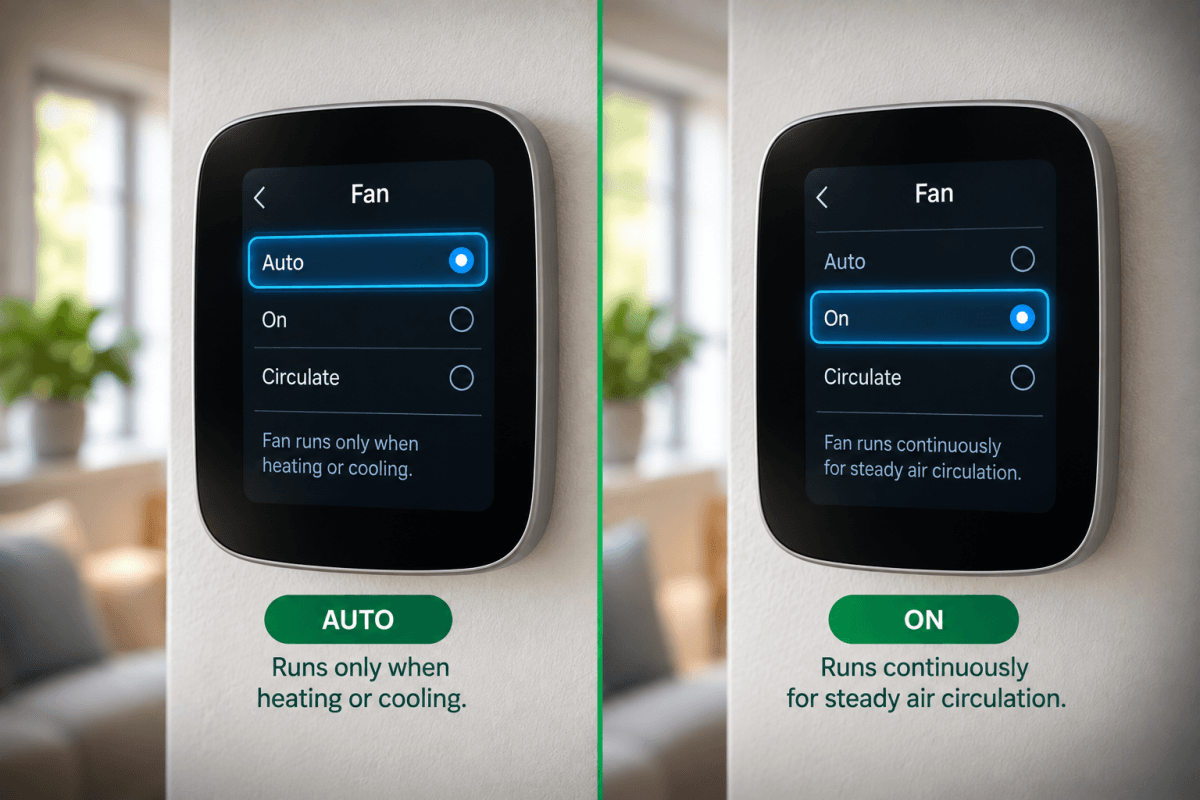
Run the HVAC fan overnight rather than on auto. Continuous or circulate mode keeps bedroom air moving through the filter all night.
Match the filter grade to the household. Higher MERV numbers capture a larger share of airborne particles, so it is worth understanding how MERV ratings work first. Check the manual or ask an HVAC technician before moving up a grade, because a filter must suit the system it sits in.
Change the filter on schedule. A loaded filter restricts airflow, reducing the volume of air being cleaned. Ninety days is a common interval for one-inch pleated filters, and homes with pets or recurring smoke need a shorter one.
Wash bedding in hot water on a regular schedule. This targets the settled dust that body movement returns to the breathing zone, the one exposure pathway no HVAC filter reaches.
| Filter Grade | Captures | Generally Suited For |
|---|---|---|
| MERV 8 | 90 percent of airborne particles | Baseline dust control, no allergy or asthma concerns |
| MERV 11 | 95 percent of airborne particles | Homes with pets or moderate allergy concerns |
| MERV 13 | 98 percent of airborne particles | Homes where an occupant has asthma or allergies, or where outdoor particle pollution recurs |
Filterbuy manufactures MERV 13 pleated air filters and MERV 11 pleated air filters in standard and custom sizes. The size that matters most for sleep is whichever one feeds the bedroom.
One limit deserves stating plainly. Pleated MERV-rated media captures particles. Nitrogen dioxide is a gas, not a particle, and pleated filtration does not remove it. The same is true of ozone. For particles, a duct filter and a portable cleaner cover different ground, which is why MERV 13 and true HEPA work together rather than competing.
44 percent of Americans breathe unhealthy air. That is 152.3 million people in counties with failing grades for ozone or particle pollution. Source: American Lung Association, State of the Air 2026, grading federal data from 2022 through 2024.
Two in three adults with sleep apnea symptoms never get evaluated. Only 34.2 percent sought medical evaluation. Source: Healthy People 2030, objective SH-02, data from 2017 through 2020.
Sleep is now a cardiovascular health metric. The American Heart Association set 7 to 9 hours nightly as the ideal adult range. Source: Life's Essential 8, adopted 2022.
Yes. Field experiments in student dormitories, published in the journal Indoor Air, found that objectively measured sleep quality improved when bedroom carbon dioxide levels were lower, as did next-day sleepiness, concentration, and performance on a logical thinking test. Bedroom carbon dioxide indicates how much fresh air reaches the room.
It depends on the outdoor air that night. An open window increases ventilation, which lowers carbon dioxide and generally improves sleep quality. When outdoor particle levels are elevated by wildfire smoke, traffic, or an inversion, that same window brings those particles into the breathing zone. Check the evening Air Quality Index and decide.
A filter reduces airborne particle concentrations in the air passing through it, and lower concentrations are associated with better sleep in observational research. No published trial has yet shown that upgrading a residential air filter improves measured sleep outcomes. The mechanism is reasonable and the direct evidence is not in.
Written by Michelle Wan, Brand Manager and Air Quality Writer at Filterbuy. Technically reviewed by David Clark, Licensed HVAC Technician. Reviewed for accuracy against the cited primary sources on September 8, 2026.
Air Quality Index (AQI): The EPA scale from 0 to 500 reporting daily outdoor air quality.
Apnea-hypopnea index (AHI): Breathing pauses and shallow-breathing events per hour of sleep. Fifteen or higher is moderate to severe apnea.
Fine particulate matter (PM2.5): Airborne particles 2.5 micrometers or less in diameter, a regulated criteria pollutant.
MERV: Minimum Efficiency Reporting Value, the ASHRAE scale rating how well a filter removes airborne particles. Filterbuy makes pleated residential filters in MERV 8, MERV 11, and MERV 13.
Nitrogen dioxide (NO2): A gaseous pollutant produced mainly by combustion. Particle filtration does not capture it.
Obstructive sleep apnea (OSA): A disorder in which the upper airway repeatedly narrows or closes during sleep.
Sleep efficiency: The share of time in bed actually spent asleep, measured by actigraphy or polysomnography.
Sleep microenvironment: The research term for the bed, its bedding, and the surrounding air.
This article is for general education. It is not medical advice and it is not a substitute for evaluation by a physician. Anyone with symptoms of a sleep disorder should speak with a clinician.
