Shop by
September 8, 2026
By Michelle Wan, Brand Manager and Air Quality Writer · Reviewed by David Clark, Licensed HVAC Technician · Published September 8, 2026 · Updated September 8, 2026
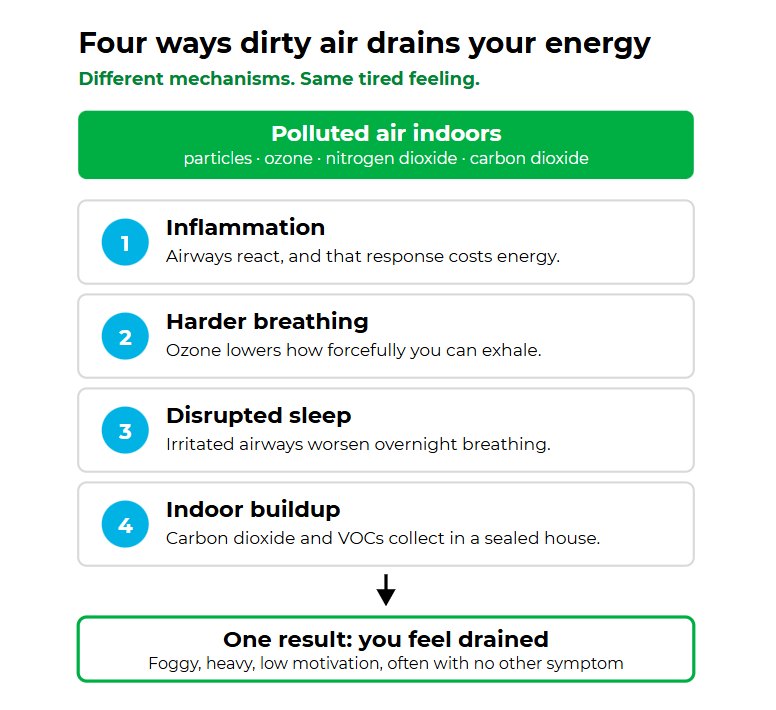
Yes. Bad air quality can make you tired, and it works through four separate routes: airway inflammation, harder breathing, disrupted sleep, and carbon dioxide building up in a sealed-up house. The EPA's Report on the Environment lists fatigue, alongside headaches and dizziness, among the effects associated with indoor air pollutants.
Indoor air is also where you have the most leverage. The EPA reports levels of some pollutants run 2 to 5 times higher indoors than outdoors, and Americans spend roughly 90% of their time inside. The quiz below matches you to the filter your system can actually take.
Answer 3 quick questions and we'll match you to the right filter for your system.
Prefer to browse instead? Find your size at Filterbuy — 600+ standard sizes plus custom dimensions, built in the USA since 2013.
Bad air quality can make you tired, and the mechanism is real physiology rather than imagination. Polluted air inflames your airways and makes your lungs work harder for the same oxygen. It costs you sleep that night, and in a sealed-up house carbon dioxide builds on top of all of it. Four paths, one result. The effect lands hardest on people with asthma, allergies, or an existing health condition, and since Americans spend roughly 90% of their time indoors, the exposure you can actually do something about is the air inside your house.
Air pollution fatigue is a documented physiological response, not a mood. In a two-year study of 422 Los Angeles adolescents published in Scientific Reports, participants reported more fatigue on days when nitrogen dioxide was higher, and again the next day.
The EPA lists fatigue as a health effect of indoor air pollution. Its Report on the Environment names headaches, dizziness, and fatigue among the effects associated with indoor air pollutants.
Ozone inflames healthy airways at levels the EPA considers acceptable. Adults breathing 0.07 ppm ozone for 6.6 hours showed reduced lung function and nearly double the airway inflammatory cells versus clean air.
Polluted air degrades sleep, producing next-day tiredness. The Multi-Ethnic Study of Atherosclerosis linked higher long-term nitrogen dioxide exposure with greater odds of sleep apnea.
Indoor air is the bigger lever. The EPA reports concentrations of some pollutants run 2 to 5 times higher indoors than outdoors.
Above AQI 100, the EPA’s guidance is layered filtration: a MERV 13 filter in your HVAC system, plus a portable HEPA air purifier in each room you occupy.
Ozone days and particle days need opposite responses. Filters remove particles and do almost nothing for ozone. On an ozone day the building envelope and your air conditioning are the intervention, not the filter.
Yes. Bad air quality causes fatigue, and it does so through four separate routes: inflammation, harder breathing, worse sleep, and carbon dioxide building up indoors. When you inhale fine particulate matter, ozone, or nitrogen dioxide, the lining of your airways responds with an inflammatory reaction. Inflammation is metabolically expensive. Your body diverts energy to the immune response, and the resulting cytokine activity produces the same worn-out, heavy-limbed feeling you get in the early stages of a cold. That is why a high-AQI day can leave you drained without a single obvious respiratory symptom.
The tiredness is usually vague rather than dramatic. People describe feeling foggy, or unmotivated, or simply off, which is exactly why air quality so rarely gets blamed for it.
Most explanations stop at inflammation. That is accurate but incomplete. Four mechanisms operate at once, and they produce different sensations.
The fourth pathway is the one homeowners miss. In a controlled study of office workers published in Environmental Health Perspectives, Harvard researchers led by Joseph Allen found that a 400-ppm increase in indoor carbon dioxide was associated with roughly a 21% decrease in cognitive test scores. Closing your windows on a smoky day solves one problem and can quietly create another.
Fatigue has dozens of causes and air quality is only one. Nobody can tell you from the outside which one you have. But air-quality fatigue leaves a distinctive pattern, and you can spot it yourself in about two weeks at no cost.
Signals that point toward the air:
It tracks bad-air days rather than your workload. You feel worst on hazy or smoky days and better on clear ones.
It lifts within a day or two of the air clearing, rather than dragging on regardless.
It comes with a scratchy throat, gritty eyes, a dry cough, or a headache, with no infection behind any of it.
Someone else in the house feels it on the same days you do.
Signals that point somewhere else:
It persists through stretches of clean air.
It is getting steadily worse over weeks rather than moving up and down.
It arrives with unexplained weight change, fever, breathlessness at rest, or chest pain. Those need a doctor, not a filter.
The method: for two weeks, write down two things each evening. Your energy that day on a 1 to 5 scale, and your local AQI. That is the whole method. If the two move together, you have your answer, and a filter is a reasonable first response. If they do not, you have saved yourself a purchase and learned something worth mentioning to a doctor. Filterbuy put this together because nobody else offers a way to test the premise before spending money, and it borrows the within-person design the Los Angeles diary study used, run on a sample of one. It works for the reason that study did. You are your own comparison.
Most articles on this topic assert flatly that PM2.5 makes you tired. The evidence is more specific than that.
The strongest same-day evidence points to traffic gases rather than particles. In the Scientific Reports study, Emma Armstrong-Carter and colleagues linked 9,696 daily self-reports from 422 Los Angeles County adolescents to EPA air-quality data. Fatigue rose on days with higher nitrogen dioxide and carbon monoxide, and again the day after nitrogen dioxide was elevated, in every participant rather than only those with existing symptoms. PM2.5, PM10, ozone, and sulfur dioxide were not associated with daily fatigue in that dataset.
The particle evidence runs through sleep instead. The Multi-Ethnic Study of Atherosclerosis, published in the Annals of the American Thoracic Society, found that a 10-ppb increase in annual nitrogen dioxide exposure was associated with 39% greater odds of sleep apnea. The same study put a 5 µg/m³ rise in PM2.5 at 60% greater odds, though that particular estimate was imprecise enough that chance cannot be ruled out. An earlier conference presentation of the same cohort reported worse sleep efficiency at higher exposures, but the peer-reviewed paper found no association there once the models were fully adjusted. The honest version is narrower than the headlines it generated: sleep apnea is the link that held. Our guide to how indoor air quality affects sleep covers the bedroom side of this.
Ozone is the clearest case of the three, because it has been tested directly rather than inferred. EPA researchers exposed 38 healthy adults to 0.07 ppm ozone, the current national standard, for 6.6 hours with moderate exercise. Lung function declined, respiratory symptoms rose, and inflammatory cells in sputum climbed from 18.6% to 33.4% versus clean air. The EPA’s summary of ozone health effects in the general population describes the same pattern: symptoms, lung function decrements, and airway inflammation.
The honest synthesis: the biology connecting polluted air to fatigue is well documented, and short-term exposure measurably inflames healthy lungs. What is not established is a clean dose-response curve between a given AQI number and how tired you will feel. Individual response varies enormously, and people with asthma, COPD, allergies, or heart conditions react at exposures healthy adults tolerate.
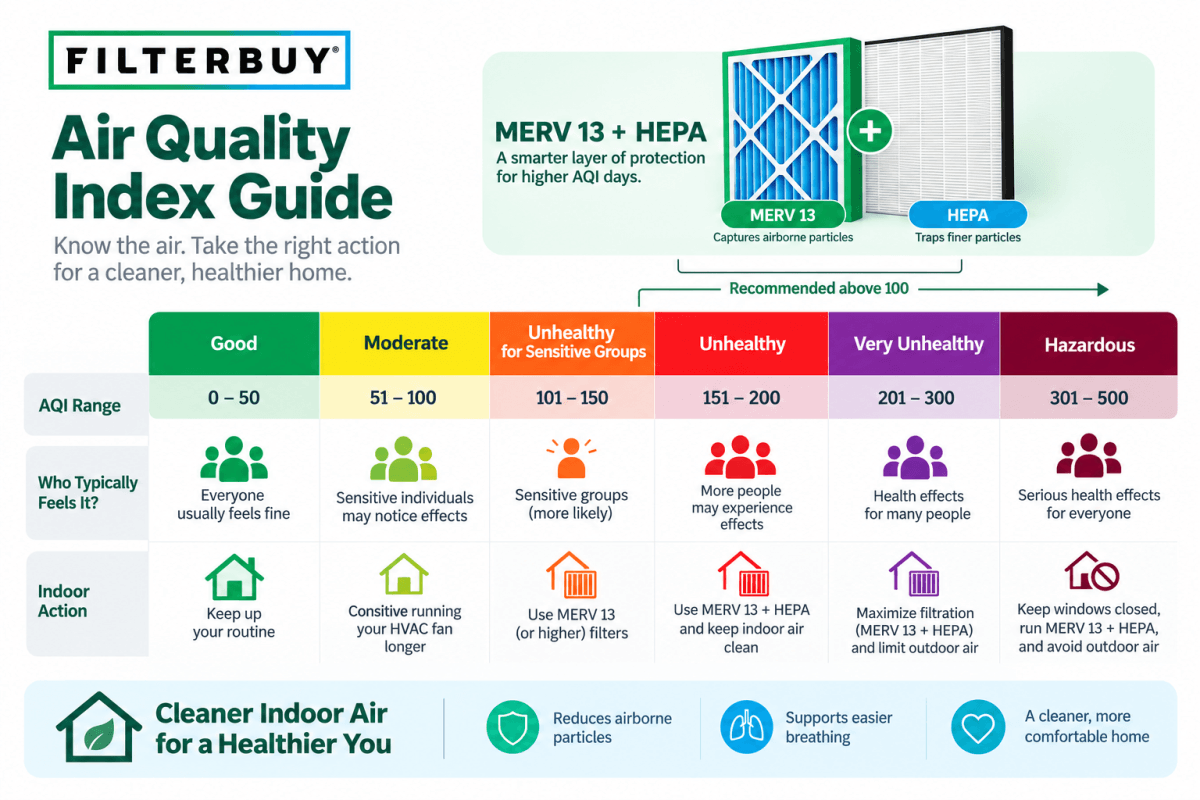
Knowing the mechanism is one thing; knowing what to do on a given Tuesday is another. Once the AQI passes 100, one action matters more than any other, which is to run both layers of filtration at once. Put a MERV 13 filter in your HVAC system if it has one, and run a portable HEPA air purifier in each room you actually occupy. They work on different scales. The HVAC filter cleans the whole house every time the blower runs; a HEPA unit scrubs the single room you are sitting or sleeping in, where your exposure is concentrated. Households without central HVAC should rely on HEPA purifiers room by room. For settings and run times, see when and how to run an air purifier during high AQI.
Above AQI 100, the EPA advises a MERV 13 filter in the HVAC system, replaced whenever it looks dark, plus a portable HEPA air cleaner sized to the room. Most systems handle MERV 13, but an HVAC technician can confirm yours.
Here is the thing almost every article on this topic gets wrong, including ones that sell filters. “High AQI” is not one condition. The number on your app is whichever pollutant scored worst today, and the two usual winners call for different actions. Your AQI source names the dominant pollutant. Check it before you decide what to do.
On a particle day (PM2.5, smoke, soot), filtration is the whole game. Fine particles infiltrate your home and stay airborne for hours, and a MERV 13 filter plus a HEPA purifier removes them. This is where your money does the most work.
On an ozone day, a filter does almost nothing, and we would rather say so. Ozone is a gas. Pleated particulate media does not capture it, and activated carbon has only limited capacity for it. Filterbuy makes an activated-carbon Odor Eliminator filter, and it is the right tool for cooking smells, pet odors and VOCs rather than for ozone. We would rather point you to the fix that works than sell you the one that does not. What does work is the building itself: the EPA reports that indoor ozone typically runs between 20% and 80% of outdoor levels depending on whether windows are open and air conditioning is running. Closing up and running the AC is genuinely the intervention on an ozone day, even though it sells no filters. Timing matters too, because ozone builds through hot, sunny afternoons and falls off in the evening. Move the run or the yard work to early morning.
While you are choosing equipment, there is one category to skip outright. Some air cleaners generate ozone on purpose, and the EPA advises against them. Ozone is the irritant you are trying to get away from, so producing it indoors in order to clean the air trades one problem for a worse one.
Most homeowners assume that closing the windows settles it. It helps less than they think. Fine particles infiltrate through gaps and the building envelope, and once inside they stay suspended for hours. Meanwhile, the EPA reports that levels of some pollutants run 2 to 5 times higher indoors than outdoors, and Americans spend approximately 90% of their time inside. The same EPA Report on the Environment lists fatigue, alongside headaches and dizziness, among the documented health effects of indoor air pollutants.
That combination is actually good news. Outdoor air quality is not something you control. Indoor air quality is.
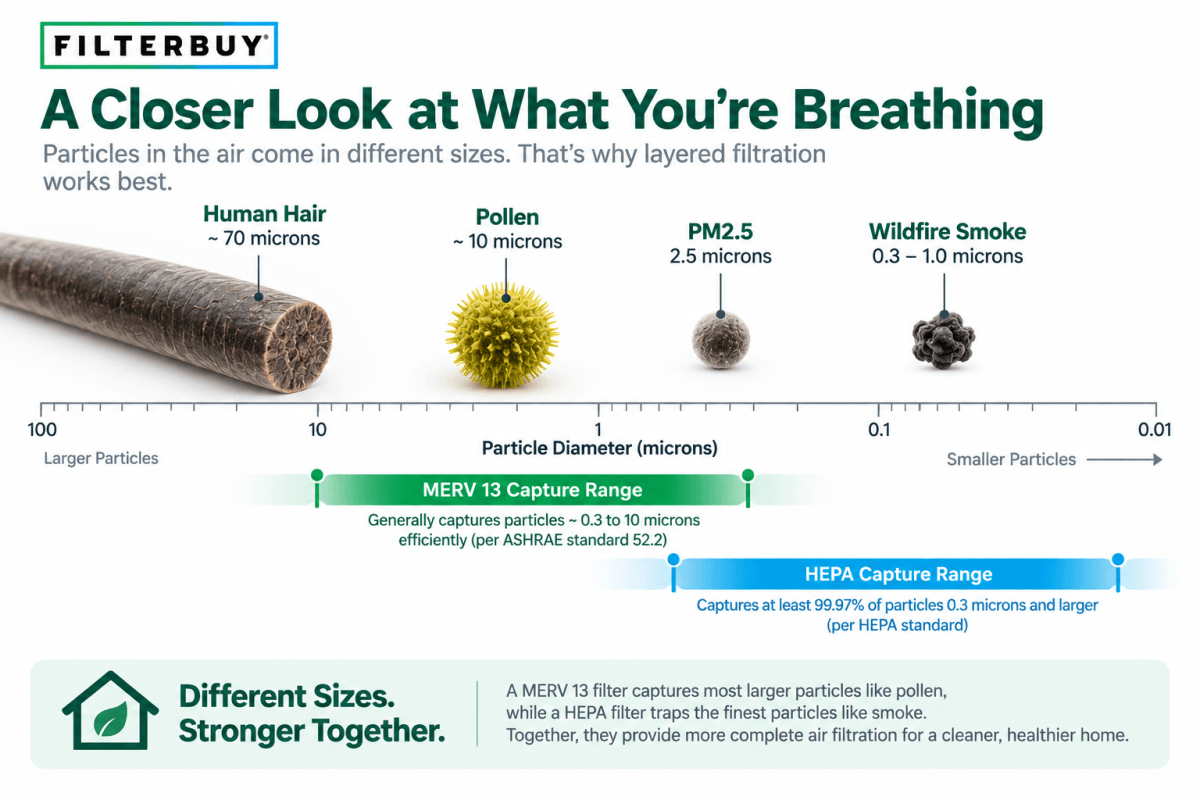
The filter is the part that matters. MERV 13 is the lowest MERV rating that ASHRAE Standard 52.2 requires to capture at least 50% of particles in the 0.3 to 1.0 micron range, plus at least 85% in the 1.0 to 3.0 micron range. That smallest band is where wildfire smoke, combustion soot, and cooking particles live. A basic fiberglass filter, rated MERV 1 to 4, does essentially nothing at those sizes. It exists to protect your equipment, not your lungs. If the scale itself is unfamiliar, start with our explainer on what MERV ratings actually measure.
Here is something we run into constantly, and almost nobody explains it. You will see two very different numbers quoted for MERV 13, and they are not in conflict. The 50% figure is the ASHRAE floor, the minimum a filter must clear to earn the rating at all, and it is not a performance claim. Filterbuy tests its own MERV 13 media at 98% capture for particles down to 0.3 microns, comfortably above that floor. Both numbers are true; they simply answer different questions. The rating tells you which bar a product cleared, while the manufacturer’s tested figure tells you what that particular filter does once it is in your system. Ask any brand for both, including us, because a filter that barely scrapes into MERV 13 and one that clears it easily carry the same number on the box.
A HEPA purifier is not a substitute, and neither is the reverse. True HEPA media is too restrictive for a residential furnace slot, so it belongs in a portable unit; MERV 13 is what a home blower can actually push air through. In its wildfire smoke guidance, the EPA notes that most furnaces and HVAC systems accommodate a MERV 13 filter without equipment problems provided it is replaced frequently, and advises choosing a portable air cleaner with a HEPA filter sized to the room. For the full comparison, see MERV 13 and HEPA do different jobs.
Filterbuy has built air filters in the United States since 2013, at factories in Alabama, Florida, Pennsylvania and Utah, and that vantage point turns up a pattern you will not find on a medical page. Orders for smoke-rated filters spike within hours of a fire igniting, which means the filter is already days late by the time anyone thinks to buy it. The households that get through a smoke week comfortably are almost never the ones who ordered when the sky turned orange. They are the ones who put a MERV 13 in the slot before fire season and kept a spare on the shelf.
That gap is the whole reason Filterbuy wrote this article. Fatigue is a lagging signal. By the time you feel tired enough to go searching for a cause, the exposure has already happened, and shipping windows tighten exactly when demand peaks. The cheapest version of this problem is the one you solve in July.
“During smoke season nobody calls me about a dirty filter. They call because the system is not keeping up. Then I pull a filter that has gone grey and the homeowner is genuinely surprised, because the calendar said six weeks left. Smoke does not read calendars. Look at the filter weekly during a fire event and change it when it is dark, not when the reminder pings.”
David Clark, Licensed HVAC Technician
Check the AQI before you plan the day. Move workouts indoors or to early morning, when ozone is lowest. Our guide to what to do when AQI is above 100 covers the thresholds.
Upgrade to a MERV 13 filter. This is the highest-leverage single change for whole-home particle exposure. Filterbuy builds MERV 13 in more than 600 standard sizes plus custom dimensions, so an odd filter slot is not a reason to stay on fiberglass. Shop Filterbuy MERV 13 filters.
Add a HEPA purifier in each room you use. Size it to the room using its CADR rating, and prioritise the bedroom first.
Switch your thermostat fan from AUTO to ON. This is the tip we find ourselves repeating most, because it costs nothing and almost nobody does it. Filtration only happens when air moves. On AUTO, your filter works only while the system is heating or cooling. On ON, it cycles the whole house continuously.
Change the filter more often in smoke season. Replace it when it looks dark rather than on a calendar date. See how often to change your filter when AQI is high, or set up Filterbuy auto-delivery so the replacement is already on the shelf when smoke season starts.
Stop adding particles. Skip candles, high-heat frying, and aerosols on high-AQI days.
Ventilate when the AQI drops. Sealed homes accumulate carbon dioxide and VOCs, so airing out during the cleanest hours resets both.
Persistent tiredness has many causes. See a healthcare provider if fatigue lasts more than a couple of weeks, doesn’t improve with rest, or comes with unexplained weight change, shortness of breath at rest, or chest discomfort.
One exception is urgent. Carbon monoxide poisoning presents as fatigue, headache, dizziness, and nausea, and worsens the longer you stay inside. Carbon monoxide is odorless, and neither a MERV filter nor a HEPA purifier removes it. If several people or pets in your home feel tired and headachy at once and improve when they leave, get outside and call 911. Every home needs working carbon monoxide detectors on each level.
Three numbers, three U.S. sources. None appears elsewhere on this page.
44% of Americans breathe failing-grade air. That is 152.3 million people in counties graded F for ozone or particle pollution. Bad air is not a regional problem. (American Lung Association, State of the Air 2026)
757 unhealthy air days in 2024. Across 35 major U.S. cities, the combined ozone and PM2.5 AQI hit Unhealthy for Sensitive Groups or worse on 757 days. In 2000 the count was 2,080. The air is cleaner. Bad days still come. (U.S. EPA, Our Nation’s Air: Trends Through 2024)
Nearly 1 in 3 adults sleeps under 7 hours. In 2024, 30.5% of U.S. adults averaged less than seven hours a night. Most people already carry a sleep deficit before air quality takes its share. (CDC, National Center for Health Statistics, Data Brief 559)
Sources: American Lung Association, State of the Air 2026 key findings · U.S. EPA, Our Nation’s Air: Trends Through 2024 · CDC / National Center for Health Statistics, Data Brief No. 559 (April 2026).
Bad air quality can make you tired, and on a high-AQI day the exposure you control is the one indoors. Start by checking what today’s number is actually made of, because that decides what helps. On a particle day, run a MERV 13 filter with a HEPA purifier in the rooms you spend time in. On an ozone day, close the house up, run the air conditioning, and move anything strenuous to the morning. And if you are not yet convinced the air is your problem at all, run the two-week check before spending a dollar. Filterbuy has manufactured filters in the United States since 2013, so when the answer does turn out to be filtration, the practical step is usually just finding your size and letting the replacements show up on schedule.
Yes. In the Scientific Reports study of 422 Los Angeles adolescents, participants reported greater fatigue the day after nitrogen dioxide levels were elevated, independent of same-day fatigue. Poor air quality also disrupts sleep, producing next-day tiredness through a second route.
Wildfire smoke commonly causes fatigue. Smoke is dominated by fine particles in the 0.3 to 1.0 micron range, which reach deep into the lungs and trigger the inflammatory response that produces tiredness. Headache, scratchy throat, and difficulty concentrating typically come with it. See our guide to running a HEPA purifier during smoke season.
For a healthy adult, fatigue from a short pollution episode usually clears within a day or two of the air itself clearing. Do not expect it to lift the moment the sky does, though. Ozone-driven airway inflammation has been measured 16 to 18 hours after exposure ended, so a lag is normal. Fatigue that runs past two weeks, or that keeps going through stretches of clean air, is worth a doctor’s visit rather than a filter.
Above AQI 100, yes, if you can. A Filterbuy MERV 13 filter cleans air throughout the house whenever the HVAC blower runs. A HEPA purifier cleans one room continuously, independent of your HVAC. Homes without central HVAC should use HEPA purifiers room by room instead.
AQI (Air Quality Index): The EPA’s 0-to-500+ scale reporting daily outdoor air pollution from ozone, particle pollution, carbon monoxide, sulfur dioxide, and nitrogen dioxide. Higher numbers mean greater health concern.
PM2.5 (fine particulate matter): Airborne particles 2.5 micrometers in diameter or smaller, small enough to reach the deepest parts of the lungs. Sources include wildfire smoke, vehicle exhaust, and cooking.
Ozone (O3): A reactive gas formed when sunlight drives reactions among vehicle and industrial emissions. Ground-level ozone inflames airway tissue and peaks on hot, sunny afternoons.
Nitrogen dioxide (NO2): A traffic-related gas from vehicles and combustion. It irritates airways and is the pollutant most consistently linked to same-day fatigue in daily-diary research.
MERV (Minimum Efficiency Reporting Value): The ASHRAE Standard 52.2 scale, 1 to 16 for residential filters, rating how effectively a filter captures particles of specific sizes.
MERV 13: The lowest MERV rating required to capture at least 50% of particles in the 0.3 to 1.0 micron range. That is the standard’s floor, not a performance ceiling; tested capture varies by manufacturer. Filterbuy builds its MERV 13 pleated filters in the United States.
HEPA (High-Efficiency Particulate Air): A filter standard capturing at least 99.97% of particles at 0.3 microns. Used in portable room air purifiers rather than residential HVAC systems, where the airflow resistance is too high.
CADR (Clean Air Delivery Rate): A rating showing how much filtered air a portable purifier delivers. Match the CADR to your room size so the unit can actually clean the space.
Dominant pollutant: The single pollutant driving today’s AQI number. The AQI reports the worst of six pollutants, not an average, so two days with identical AQI values can call for different actions.
Sleep efficiency: The percentage of time in bed actually spent asleep. Lower sleep efficiency produces next-day fatigue even when time in bed is adequate.
Michelle Wan is Brand Manager and Air Quality Writer at Filterbuy, where she translates MERV ratings, filtration, and HVAC efficiency into plain-English advice for homeowners. She works directly with Filterbuy’s U.S. manufacturing team across its Alabama, Florida, Pennsylvania, and Utah factories, basing her writing on how filters are built, tested, and used in real homes rather than on spec sheets. She holds a B.A. in Sociology from the University of California, Santa Cruz. Reviewed for technical accuracy by David Clark, Licensed HVAC Technician.
Filterbuy is a family-owned American manufacturer that has built air filters in the United States since 2013, offering 600+ standard sizes plus custom dimensions, shipped factory-direct.
Armstrong-Carter, E., et al. Scientific Reports 12, 17015 (2022).
Billings, M.E., et al. Annals of the American Thoracic Society (2019). MESA sleep apnea analysis.
U.S. EPA, Health Effects of Ozone in the General Population.
U.S. EPA, Preparing for Smoke and Heat (wildfire smoke course).
American Lung Association, State of the Air 2026, Key Findings.
This article is for general education and is not medical advice. Consult a healthcare provider about persistent fatigue.
