
Hamilton, ON Live Wildfire Smoke Map
Get Alerts For Wildfires In Your Area
The moment a wildfire starts near you, you'll get an instant alert and simple tips to reduce your smoke exposure.
What's In The Smoke
30xSmaller than a human hair
Fine enough to reach deep into the lungs. A MERV 13 is built to capture it.
How Far It Travels


It Doesn't Stay Local
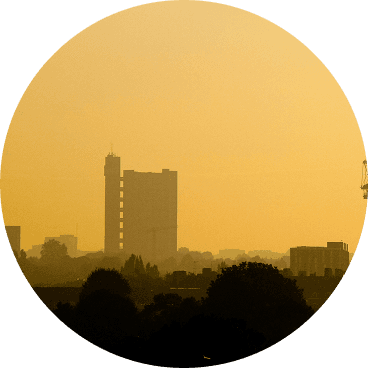
Smoke rides the wind far downwind — you can get smoky air with no fire nearby.
What To Do During A Smoke Event
Simple steps to reduce indoor exposure.
- Stay In, Close UpShut windows and doors to keep smoke out.
- Set Fan To "On"Keeps air cycling through your filter, not just when heating or cooling.
- Recirculate AirSwitch off fresh-air intake so you're not pulling smoke in.
- Run A MERV 13Built to capture the fine PM2.5 in smoke.
- Add A PurifierExtra filtration for the room you use most.
- Wear an N95 if OutsideFits snug to block fine particles — a cloth mask won't.


The Best Air Filter For Wildfire Smoke
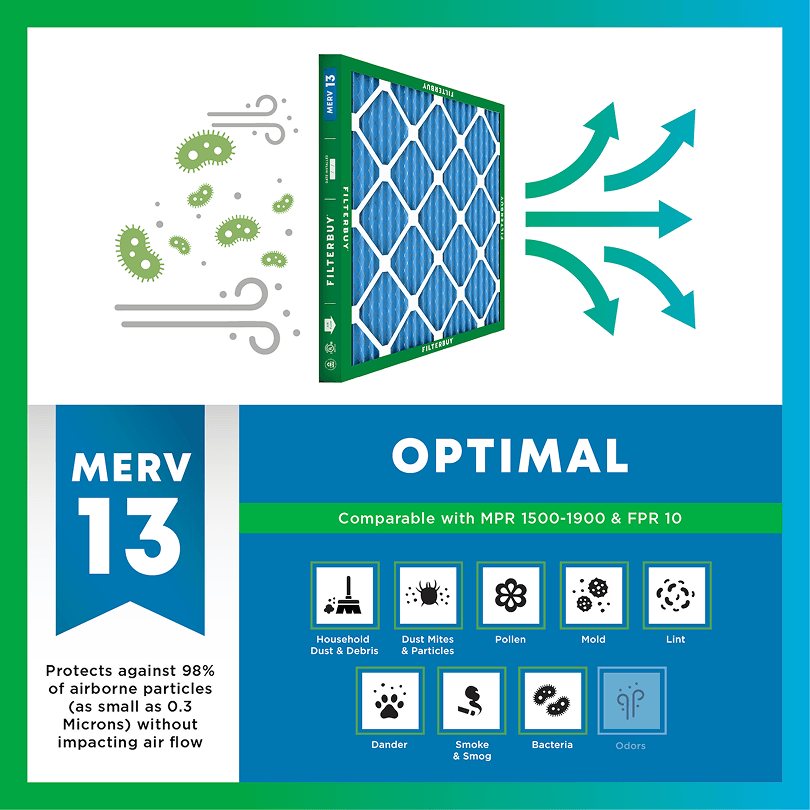
During smoke events, the EPA recommends upgrading to a MERV 13 filter — or the highest-rated filter your system can handle — to help reduce the fine particles smoke brings indoors. MERV 13 is the level most home HVAC systems can run while still capturing PM2.5, the fine particulate that makes up the bulk of wildfire smoke.
- Captures PM2.5 particles
- Blocks ash, soot, and smoke odor
- Keeps your indoor air safe—even when the outdoor air is dangerous
- Meets the EPA's recommended rating for filtering fine wildfire smoke particles.

Wildfire Smoke FAQs
Facts About Wildfires
Over 70,000 wildfires burn in the U.S. every year.
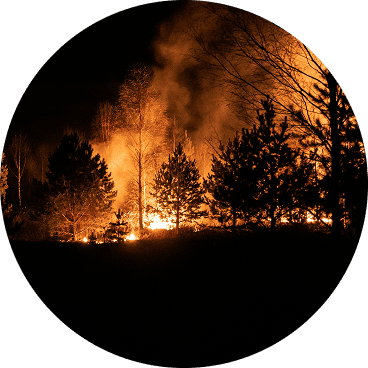
Wildfire smoke can travel 1,000+ miles, affecting states that aren't even near the blaze.
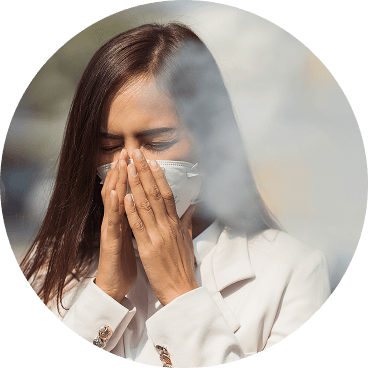
Exposure to wildfire smoke can worsen asthma, trigger heart issues, and lead to ER visits.
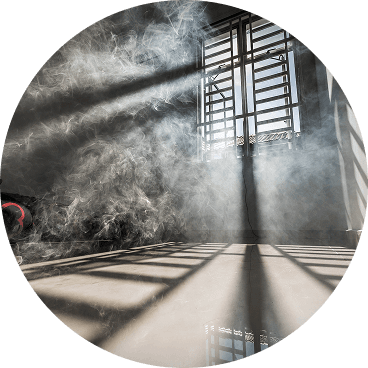
Indoor air can hold more fine particles during wildfire events unless it's properly filtered.
The EPA advises using MERV 13 filters or portable HEPA air cleaners during wildfire smoke events.
Don't Wait Until The Smoke's Inside.
Use the live wildfire smoke tracker and upgrade your air filters today to protect your lungs and your home.
Shop Filters For Smoke Protection
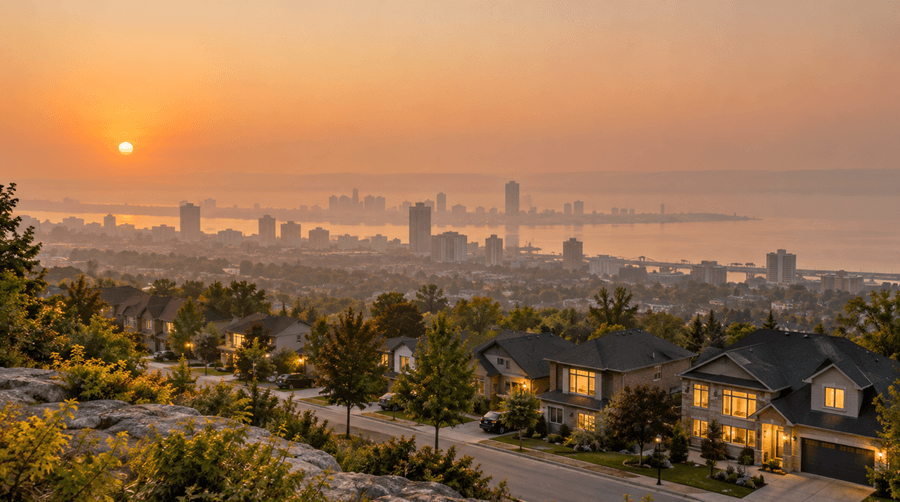
Live Hamilton, ON Forest Wildfire & Smoke Map Today: Local Air Quality Tracking & Indoor Protection Solutions
TL;DR
Wildfire smoke in Hamilton, Ontario almost always drifts in from forest fires hundreds of kilometres away. Use Filterbuy.ca's live wildfire map above to find current fires and smoke, then check Environment and Climate Change Canada's Air Quality Health Index (AQHI) for Hamilton and follow its alerts. At an AQHI of 7, Filterbuy recommends a MERV 13 furnace filter, the fan set to On, a portable HEPA air cleaner in each occupied room, and a closed-up house.
Key Takeaways
Hamilton's smoke is imported from fires far to the north.
Hamilton hit AQHI 10 in each of its last three major smoke events.
MERV 13 is the tier for smoke, in line with Health Canada guidance.
AQHI 7 is Filterbuy's action line for switching to MERV 13 and adding portable HEPA cleaners.
Is There Wildfire Smoke in Hamilton, ON Today?
Filterbuy's check takes two steps. The live map shows where smoke is, and the AQHI at Hamilton's stations (Hamilton Downtown, Hamilton Mountain, and Hamilton West) shows whether it has reached the ground. A hazy sky may just be smoke passing high overhead, so trust the AQHI.
Hamilton snapshot (September 23, 2026, 5 p.m. EDT): The Hamilton Downtown AQHI was 2 (low risk), with the same forecast for Thursday. Ontario had about 30 active fires, all in the Northwest.
Looking for a fire, not smoke? Call 911 for any fire in Hamilton, including wildland fires, as the Government of Ontario directs.
Where Are the Forest Fires Causing Smoke in Hamilton?
Hamilton's smoke comes from boreal forest fires in northern Ontario, Quebec, and the Prairies, so a live forest fire map for Hamilton is really a map of distant fires and wind.
Hamilton's Last Three Major Smoke Events
Event sources: June 2023, July 2025, July 2026, and the record 2026 season.
Filterbuy's read of the pattern: Each event started somewhere different, yet all peaked in June or July at AQHI 10, and two came with extreme heat.
How Do You Read a Hamilton Wildfire and Smoke Map?
A Hamilton wildfire and smoke map works in layers. The province's Interactive Forest Fire Map shows where forests are burning, FireWork shows where the smoke is heading, and the AQHI tells you how risky the air is right now.
Filterbuy Pro Tip: Check FireWork first. It gives a day or two to fit a fresh MERV 13 filter.
Why Can Wildfire Smoke Hit Hamilton Harder Than Nearby Cities?
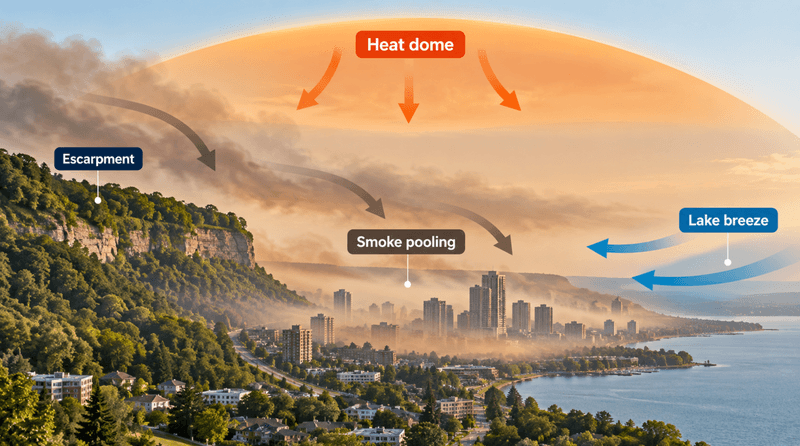
Hamilton's escarpment and lake breezes can trap smoke locally. Environment Canada climatologist David Phillips told CHCH News that changes in elevation can make smoky air sink and collect in low spots, which may help explain why 2023 readings varied across the city.
Tip: Follow your nearest station, and compare cities on our live Ontario air quality (AQI) map or the St. Catharines wildfire and smoke map.
What Does Hamilton's AQHI Mean for Your Home?
Filterbuy's action line is an AQHI of 7, the start of Environment Canada's High risk band. At 7 or higher, put a MERV 13 filter in your furnace, set the fan to On, run a portable HEPA air cleaner in each occupied room (bedrooms first), and close the house up. On AQI maps, our action line is AQI 100. A special air quality statement usually means an AQHI around 7, and a warning means 10+ for six straight hours, according to Environment Canada.
Outdoor guidance: Environment and Climate Change Canada AQHI health messages. Indoor steps and the AQHI 7 action line are Filterbuy recommendations, not Environment Canada guidance.
Environment and Climate Change Canada lists seniors, pregnant people, young children, and people with heart or lung conditions as higher risk. They should follow at-risk advice and ask a health professional about a smoke plan.
What if Smoke and Heat Hit Hamilton at the Same Time?
Smoke says close the windows, but heat says open them.
With central air, keep windows shut and run it on recirculate with a clean MERV 13 filter.
If you don't and it gets unsafely hot, go to a cooler public space such as a library. Environment and Climate Change Canada advises putting cooling first.
What Should You Do When Smoke Reaches Hamilton?
Follow Environment Canada alerts and local public health advice first. Filterbuy has built filters through more than a decade of smoke seasons. At AQHI 7, we recommend four steps, in this order.
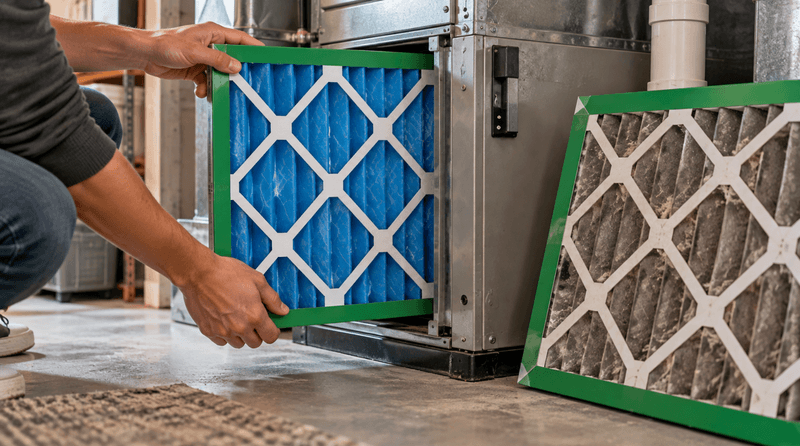
Put a MERV 13 filter in your furnace. Health Canada recommends MERV 13 or higher to remove PM2.5, the fine particles in smoke. It's the whole-home layer, and the U.S. EPA notes most furnaces can use MERV 13 without equipment problems when it's replaced often. Just confirm your size.
Set your thermostat fan to On. Auto filters only while the furnace heats or cools; On filters all day.
Run a portable HEPA air cleaner in each occupied room, bedrooms first. It treats one room harder than the furnace can, so use both layers. EPA sizing is a smoke CADR of at least two-thirds of the room's square footage: about 200 for a 300 sq ft bedroom. EPA and Health Canada advise against ozone-producing cleaners, so skip ionizers and ozone generators.
Close the house up. Keep windows and doors shut, reduce HRV or ERV fresh-air intake (ask your technician how), and avoid candles, frying, smoking, and non-HEPA vacuuming.
No central air or ductwork? In apartments and homes with window units, portable HEPA air cleaners are your main defence. HEPA never goes in a furnace slot; our MERV 13 vs. HEPA guide explains why.
Outdoors, Environment and Climate Change Canada advises a well-fitted N95 respirator.
Budget stopgap: EPA research found a box fan with a 20x20-inch MERV 13 filter reduces smoke; thicker or multiple filters do better. Use a certified 2012-or-newer fan and never leave it unattended. It's a stopgap, not a certified air cleaner.
Which Furnace Filter Is Best for Wildfire Smoke in Hamilton?
MERV 13. It's the tier Filterbuy recommends for wildfire smoke, because the fine particles in smoke slip through lower-rated filters.
Source: Health Canada, Guidance for Cleaner Air Spaces during Wildfire Smoke Events. The U.S. EPA notes most furnaces and HVAC systems can use MERV 13 without equipment problems when the filter is replaced often.
Smoke loads filters fast. During a smoke event, check yours often and replace it when it looks dark brown or black, which the U.S. EPA notes can be well before its normal interval. Keep spares on hand.
Our filters are made in the USA from 100% American-made components, and Filterbuy.ca carries 600+ sizes, including custom, with free shipping to Canada in CAD. Find your MERV 13 furnace filter size → or set up auto-delivery → before the next fire season.
Filterbuy's Take: What the Smoke Maps Can't Show
Closing windows alone isn't enough: the U.S. EPA estimates a closed-up home without air cleaning still holds about 55–60% of outdoor PM2.5 during smoke events. Filtration reduces what's left, but it doesn't make indoor air smoke-free, so official guidance always comes first.
Supporting Statistics From U.S. Research
75 million Americans were hit by Canadian smoke in June 2023, facing unhealthy or hazardous air, according to the American Lung Association.
Asthma ER visits rose 17%. A CDC study of the 2023 smoke episodes found asthma emergency visits ran 17% above expected over 19 smoke days.
Better filtration can cut indoor PM2.5 by about half. According to the U.S. Environmental Protection Agency, a high-efficiency filter with the fan running continuously may cut indoor PM2.5 about 50%, versus 24% for a basic one.
Frequently Asked Questions
What MERV Rating Do I Need for Wildfire Smoke?
MERV 13. Use Filterbuy's MERV 13 (Optimal) filter during smoke. Pleated filters capture particles, while odour comes from gases; Filterbuy's Odor Eliminator line is designed for odours, but its particle filtration is closer to MERV 10, so save it for after the smoke.
Is There a Forest Fire Near Hamilton, Ontario Right Now?
Rarely; the fires sending smoke here are far north. See our live Ontario forest wildfire and smoke map.
How Long Does Wildfire Smoke Usually Last in Hamilton?
It depends on the wind. In July 2025, most smoke was expected to clear the day after it arrived, while in July 2026 it was forecast to linger about three days.
When Is Wildfire Season in Ontario?
Ontario's legislated fire season runs from April 1 to October 31.
Glossary
AQHI (Air Quality Health Index): Canada's official 1-to-10+ outdoor air health-risk scale.
AQI (Air Quality Index): The U.S. EPA's 0–500 scale.
PM2.5: Fine particles 2.5 micrometres or smaller; the main hazard in wildfire smoke.
FireWork: Environment Canada's 72-hour smoke forecast.
CWFIS (Canadian Wildland Fire Information System): Natural Resources Canada's national fire map.
Special Air Quality Statement: An Environment Canada alert, usually issued when the AQHI nears 7.
MERV (Minimum Efficiency Reporting Value): A 1–16 rating of how well an HVAC filter captures particles.
HEPA filter: A high-efficiency filter built for portable air cleaners.
CADR (Clean Air Delivery Rate): A label rating of how much filtered air a portable air cleaner delivers.
Clean-air room: A closed, filtered room for sheltering from smoke.
Filterbuy: A U.S. furnace filter maker serving Canada through Filterbuy.ca.
HRV/ERV: Ventilators that swap stale indoor air for fresh outdoor air.
Sources
Environment and Climate Change Canada: Wildfire smoke, air quality and your health
Environment Canada: FireWork air quality model forecast maps
Health Canada: Guidance for Cleaner Air Spaces during Wildfire Smoke Events
Natural Resources Canada: CWFIS national wildland fire summary
American Lung Association: Why Wildfire Smoke Is Now a Nationwide Issue (July 2026)
U.S. EPA: Research on DIY Air Cleaners to Reduce Wildfire Smoke Indoors
CHCH News: Air quality warnings spread across Golden Horseshoe (July 15, 2026)