
Saint Jerome Real-Time AQI Tracker
What's Actually In Saint Jerome Air Today?
What High AQI Means for Your Lungs in Saint Jerome
How to Read AQI
The Air Quality Index (AQI) measures how polluted the air is and how it may affect your health.
0–50 (Good): Air quality is satisfactory.
51–100 (Moderate): Acceptable, but some pollutants may pose minor concerns.
101–150 (Unhealthy for Sensitive Groups)
151–200 (Unhealthy)
201–300 (Very Unhealthy)
301+ (Hazardous)
Moderate
Still okay for most, but if you have asthma or allergies, take it easy and avoid long outdoor workouts.
Shop MERV 11 filters→What's the Right Filter for Your AQI Level?




Live Air Quality Index AQI Map Saint-Jérôme, QC Today
TL;DR
The Filterbuy live air quality map at the top of this page shows Saint-Jérôme’s current AQI and PM2.5 (fine particles from smoke and combustion) readings every hour. The Laurentides have some of Québec’s cleanest air, but wood smoke and wildfire smoke can raise readings quickly. At AQI 100 or higher, Filterbuy recommends a MERV 13 furnace filter, the thermostat fan set to On, a portable HEPA air cleaner in each occupied room and the windows shut.
Key Takeaways
• Québec reports air quality with its own Air Quality Index (IQA): 1–25 is good, 26–50 acceptable and 51 or more poor.
• From 2017 to 2024, the Laurentides averaged 263 “good” air days a year, compared with 237 for southern Québec as a whole (Institut de la statistique du Québec).
• Info-Smog issues official forecasts for a dedicated Lachute – Saint-Jérôme zone (ECCC).
• MERV 13 (Optimal) is the Filterbuy tier we recommend for smoke, and AQI 100 is where we recommend switching.
Check Saint-Jérôme Air Quality Now: Start With the Live Map
The live map at the top of this page shows current AQI and PM2.5 levels in Saint-Jérôme, QC. It refreshes every hour and uses the U.S. EPA’s Air Quality Index. That scale runs from 0 to 500, from green (good) to maroon (hazardous).
Why Filterbuy built this page: we make furnace filters, not monitoring stations. So we pair the live map with the official Québec and federal sources we check ourselves. When we checked on 20 October 2026, the Info-Smog forecast for the Lachute – Saint-Jérôme zone called for good air through Wednesday (ECCC).
Saint-Jérôme sits on the Rivière du Nord, 45 km northwest of Montréal (Wikipedia). For the wider view, see Filterbuy’s live air quality map for Canada.
How Do I Read the AQI Numbers for Saint-Jérôme?
Three scales describe Saint-Jérôme’s air, each with different numbers. The live map uses the 0–500 AQI. Québec’s environment ministry (MELCCFP) publishes the hourly IQA from five pollutants: PM2.5, ozone, sulphur dioxide, nitrogen dioxide and carbon monoxide. The rest of Canada uses the AQHI, a 1–10+ scale issued in Québec only for Montréal, Québec City and Gatineau (Info-Smog).
Filterbuy’s take: when we lined the three scales up, the same air could read “acceptable” on the IQA and yellow on the map. That mismatch confuses people, so we built Table 1 to translate between them.
Table 1: Saint-Jérôme air quality scales compared
AQI categories and ranges are the U.S. EPA's. IQA and AQHI bands are approximate equivalents, not exact conversions. Saint-Jérôme is covered by Québec's IQA and Info-Smog forecasts; the AQHI is shown for comparison only.
What each level means for you:
• Good (0–50): keep your usual filter routine.
• Moderate (51–100): prepare. Put a MERV 13 filter in before smoke arrives and keep a spare.
• Unhealthy for Sensitive Groups and Unhealthy (101–200): take the four steps below. Check the filter more often.
• Very Unhealthy and Hazardous (201+): follow official guidance first, including any advice to stay indoors or leave. Then use your cleanest room. Filtration is one layer, not the whole answer.
Is the air quality bad in Saint-Jérôme today?
Air quality in Saint-Jérôme is bad if the live map reads 101 or higher, or the Québec IQA is 51 or higher. Poor-air days are uncommon here: the Laurentides averaged 263 “good” days a year from 2017 to 2024, third-best among Québec’s regions (ISQ). What stood out to us: a bad day here is usually an event, such as wildfire smoke or a still winter evening.
Filterbuy’s action line is AQI 100. At 100 or higher, switch to a MERV 13 filter in the furnace, set the thermostat fan to On, run a portable HEPA air cleaner in each occupied room (bedrooms first) and close the house up. This is our own rule, set one point before the next official category begins.
Official guidance comes first. Check the Info-Smog air quality forecast for southern Québec, which includes a Lachute – Saint-Jérôme zone, and Québec’s real-time IQA map, and follow instructions from local authorities.
What Affects Air Quality in Saint-Jérôme?
Four sources shape most of Saint-Jérôme’s air: wood heating, wildfire smoke, Autoroute 15 traffic and summer ozone. In our view, winter evenings deserve as much attention as summer smoke days, because wood smoke builds right in the neighbourhood.
• Residential wood heating (October to April): Wood heating is one of the main sources of air pollution in Québec (INSPQ). On cold, calm nights, a temperature inversion can trap smoke near the ground in the Rivière du Nord valley, so PM2.5 often rises in the evening.
• Wildfire smoke (April to October): Wildfire season typically runs from early April to October, and smoke can be carried thousands of kilometres from the fire zone (Health Canada).
• Autoroute 15 traffic: nitrogen dioxide is often highest near busy roadways such as Autoroute 15 (ECCC).
• Ground-level ozone (summer afternoons): a major part of summer smog (ECCC).
Supporting Statistics: What Canadian Research Shows
1. 4,000 premature deaths a year in Québec
– Air pollution is linked to 48 deaths per 100,000 people.
– That is the highest provincial rate in Canada.
– Fine particles (PM2.5) cause most of them.
– Source: Health Canada, 2021
2. 620–2,700 deaths a year from wildfire smoke (2013–2018)
– Impacts reached provinces far from the fires.
– Source: Science.gc.ca
3. About 90% of our time is spent indoors
– Indoor air is most of what Canadians breathe.
– The federal government recommends good indoor filtration and ventilation.
– Source: Environment and Climate Change Canada
Saint-Jérôme air quality by season
Saint-Jérôme’s air follows a seasonal pattern. With January averaging −11.4°C (Environment Canada climate normals), furnaces here run hard from October to April.
• Autumn (Sep–Oct): Install a fresh filter before daily heating begins.
• Winter (Nov–Mar): Wood smoke and inversions build. Check your filter regularly and replace it when it looks dirty. For household odours, try a Filterbuy Odour Eliminator filter.
• Spring (Apr–Jun): Pollen arrives and early wildfires are possible. MERV 11 Superior suits allergy season.
• Summer (Jun–Sep): Wildfire smoke and ozone peak. Put MERV 13 Optimal in before smoke arrives, and keep a spare.
What Should I Do When Saint-Jérôme Air Quality Is Poor?
At AQI 100 or higher, take these steps in order. If local authorities issue instructions, follow those first.
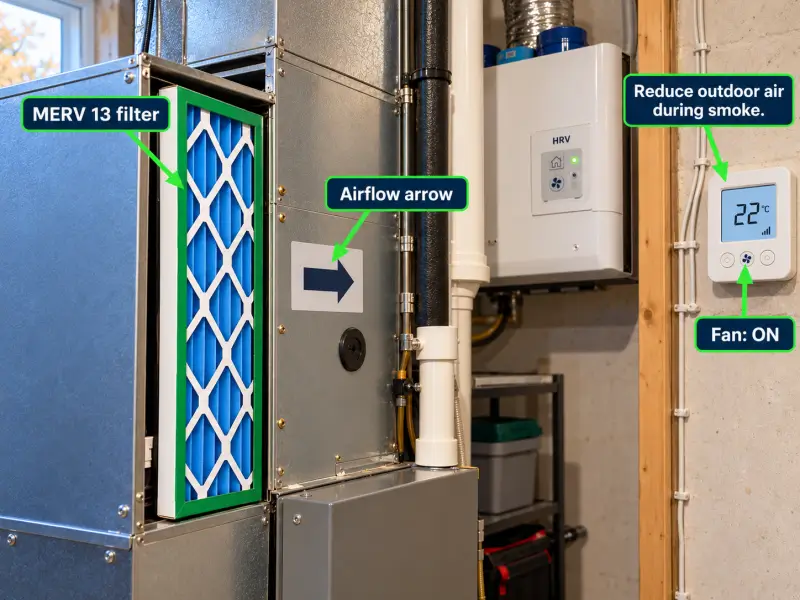
1. Switch to a MERV 13 filter in your furnace. This is the whole-home layer. The EPA notes that most furnaces and HVAC systems can use MERV 13 without equipment problems when the filter is replaced often (EPA).
2. Set the thermostat fan to On. Auto filters only while heating or cooling. On filters all the time.
3. Run a portable HEPA air cleaner in each occupied room, bedrooms first. It treats that room harder than the central system can. Choose one that does not produce ozone (Health Canada).
4. Close the house up. Keep windows and doors shut and the fireplace off. Skip candles, frying, smoking and vacuuming without a sealed unit.
5. With an air exchanger (HRV or ERV), reduce outdoor air intake, following the manufacturer’s instructions.
6. Check the filter often. Replace it when it looks dark brown or black, which can be well before the normal interval. Keep spares on hand.
If you or a family member has asthma or a heart or lung condition, talk to your doctor and follow official health messages.
Filterbuy’s Practical Tips for Saint-Jérôme Homes
Renting, or No Forced-Air Furnace?
• Without central HVAC, a portable HEPA air cleaner is your main defence, not a backup.
• Size it with Health Canada’s rule: the smoke CADR should be at least two-thirds of the room’s area. A 10 x 12 ft bedroom (120 sq ft) needs a CADR of at least 80.
• Ask your landlord which filter the building uses and when it was last changed.
Heating With Wood?
• Since 1 September 2009, only certified high-efficiency wood stoves (CSA B415.1 or U.S. EPA) can be sold in Québec (Gazette officielle du Québec). An older stove may not meet that standard.
• Québec asks residents to limit fireplace and wood stove use in winter (MELCCFP). Check the map, and skip the fire on still evenings.
Find Your Filter Size in Seconds
• The size is printed on the frame of your current filter. Order by that number (Filterbuy).
• Many homes have more than one return vent and filter.
Which Filterbuy Air Filter Is Right for a Saint-Jérôme Home?
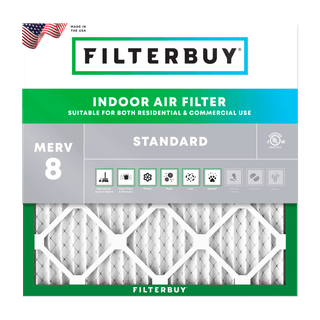
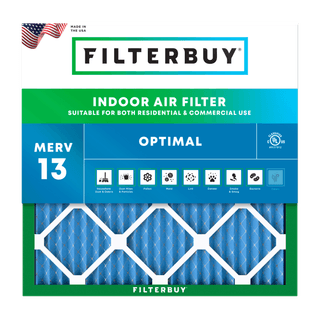
For wildfire and wood smoke, choose MERV 13 (Optimal). Filterbuy rates its MERV 13 tier: Captures 98% of Airborne Particles (product page).
Table 2: Filterbuy air filters compared for Saint-Jérôme homes
Most furnaces can use MERV 13 when the filter is replaced often (U.S. EPA). Confirm your size before ordering. Pleated filters capture particles, not odours or gases.
“The day a smoke advisory hits a region, our orders from that province jump. People feel the air change before they ever look at a number. … Most people are running a filter that’s a step or two too low. So check the map, then check the date on your filter.”
Indoor Air Quality Specialist, Filterbuy (Filterbuy Canada air quality map)
Frequently Asked Questions
What Is the Air Quality in Saint-Jérôme Today?
Check the live map at the top of this page; it updates every hour.
What MERV Rating Do I Need for Wildfire Smoke?
MERV 13. Install it before smoke season and keep a spare on hand.
What PM2.5 Level Is Unhealthy in Saint-Jérôme?
Québec rates air quality as poor when fine particles (PM2.5) exceed 35 µg/m³ averaged over three hours (MELCCFP).
Can I Use a MERV 13 Filter All Year?
Yes, for most homes. The EPA notes most furnaces can use MERV 13 without problems when the filter is replaced often. Confirm your size, as with any filter.
Where Does the Live Map Data Come From?
The Filterbuy map refreshes every hour and uses the U.S. EPA’s Air Quality Index. Compare it with Québec’s official IQA map and the Info-Smog forecast.
Glossary
AQI (Air Quality Index): The U.S. EPA’s index, used by many live maps. It runs from 0 to 500.
IQA (Indice de la qualité de l’air): Québec’s official air quality index, published hourly by the MELCCFP; 1–25 is good, 26–50 acceptable and 51 or more poor.
AQHI (Air Quality Health Index): Environment and Climate Change Canada’s 1–10+ health-risk scale, used across Canada except most of Québec.
Info-Smog: Québec’s joint federal-provincial air quality forecast and smog warning program.
PM2.5 (fine particulate matter): Airborne particles 2.5 micrometres or smaller, mainly from smoke and combustion, that can reach deep into the lungs.
MERV (Minimum Efficiency Reporting Value): A 1–16 rating for how well an HVAC filter captures particles; higher ratings capture smaller particles.
About the Author and Reviewer
Michelle Wan is Filterbuy’s Brand Manager and Air Quality Writer.
David Clark is a Licensed HVAC Technician with Filterbuy HVAC Solutions who reviewed this article for technical accuracy.