
Gatineau Real-Time AQI Tracker
What's Actually In Gatineau Air Today?
What High AQI Means for Your Lungs in Gatineau
How to Read AQI
The Air Quality Index (AQI) measures how polluted the air is and how it may affect your health.
0–50 (Good): Air quality is satisfactory.
51–100 (Moderate): Acceptable, but some pollutants may pose minor concerns.
101–150 (Unhealthy for Sensitive Groups)
151–200 (Unhealthy)
201–300 (Very Unhealthy)
301+ (Hazardous)
Moderate
Still okay for most, but if you have asthma or allergies, take it easy and avoid long outdoor workouts.
Shop MERV 11 filters→What's the Right Filter for Your AQI Level?




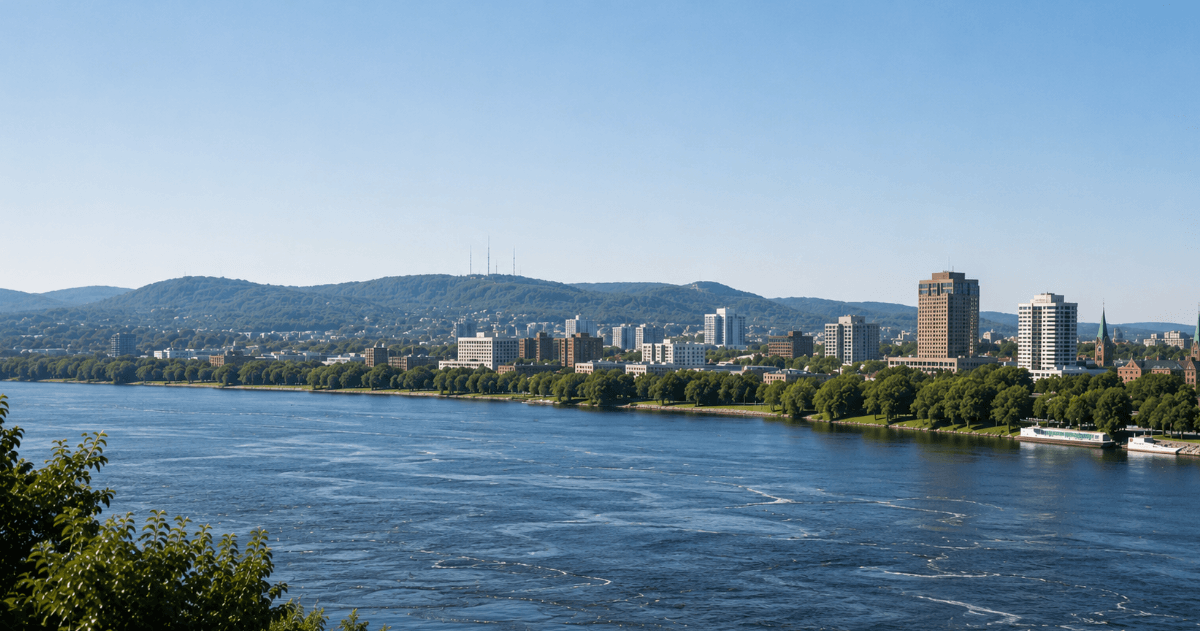
Check Today's Live Real Time Air Quality Index AQI Map in Gatineau, QC Now
By Michelle Wan · Reviewed by David Clark, Licensed HVAC Technician · Published 24 July 2026 · Updated 24 July 2026
TL;DR
Checked two apps and seen two different numbers for Gatineau? Nothing is broken. Gatineau's air is reported on three separate scales. The province publishes the Indice de la qualité de l'air (IQA). Ottawa publishes the Air Quality Health Index (AQHI, or Cote air santé). Most consumer apps show the U.S. AQI. Each uses a different range and answers a slightly different question. Gatineau is also one of only three Québec cities with its own AQHI forecast, and it shares an airshed with Ottawa while being reported by a different agency. Here is how to read each one.
Top Takeaways
Match the scale to the source before you worry about the number. Above 50 on Québec's IQA is "mauvais." AQHI 7 or higher means easing off outdoors. A 0–500 figure in an app is the U.S. scale.
Bookmark two pages, not one. Québec's IQA map for the official reading, and Ottawa's AQHI for when Gatineau's observed value is not calculated.
Use the forecast, not just today's number. Gatineau is one of three Québec cities that gets an AQHI forecast, which is enough notice to plan a weekend rather than react to the haze.
Closing the windows leaves indoor fine particles at 55–60% of outdoor levels. Running the HVAC fan continuously with a filter that catches fine particles is what moves it further.
Set the filter schedule to the season. Every 60 to 90 days through a Québec heating season, and check monthly once smoke arrives. Filterbuy carries every size, including custom, with free shipping to Canada.
What Is The Air Quality In Gatineau Today?
For the official Québec reading, check the Indice de la qualité de l'air (IQA) map published by Québec's environment ministry, which updates hourly from stations across the province. For the health-risk reading, check the Air Quality Health Index for Gatineau from Environment and Climate Change Canada. Between 1 May and 30 September the provincial map also layers in seasonal wildfire sensors and a 72-hour fine-particle forecast.
How to read whichever number you land on:
Hourly IQA data is unvalidated and may be revised after quality assurance. The AQHI has no upper limit.
Why Gatineau Shows Three Different Numbers
Québec's IQA is calculated hourly at each monitoring station. Each measured contaminant (PM2.5, ozone, sulphur dioxide, nitrogen dioxide and carbon monoxide) gets a sub-index: the measured concentration divided by a reference value, multiplied by 50. For PM2.5 the reference is 35 µg/m³ averaged over three hours, so a reading of exactly that produces a sub-index of 50. The highest sub-index becomes the station's IQA. Cross 50 and the air is officially classed "mauvais."
The AQHI takes a different approach. Rather than measuring against a threshold, it estimates combined short-term health risk from ozone, nitrogen dioxide and fine particles on a 1 to 10+ scale. It has no ceiling. During severe smoke it reads "10+."
The U.S. AQI is a 0–500 concentration scale used by most consumer apps. Data platforms convert Québec's IQA figures onto it so their maps stay consistent worldwide. That is why an app can show 61 while the provincial site shows something else for the same hour.
None of the three is wrong. They are answering different questions: how concentrated, how risky, and how does this compare internationally. Environment and Climate Change Canada's Info-Smog programme puts it plainly: the AQHI reflects health effects, while the IQA uses reference values Québec sets itself.
One practical wrinkle: Gatineau's federal AQHI page reliably publishes forecast maximums, but its observed current reading is often listed as not calculated. That gap is much of why residents reach for a third-party app.
The Ottawa River Effect: One Airshed, Two Reporting Systems
Smoke, ozone and fine particles do not stop at the Ottawa River. When smoke settles over the National Capital Region, it covers Hull, Aylmer, Vanier and Kanata alike. But the reporting splits at the provincial boundary. Ottawa's readings come through Ontario's monitoring network; Gatineau's come through Québec's RSQAQ. Even the alert vocabulary differs.
During the June 2023 smoke episode, Environment and Climate Change Canada issued smog warnings for areas north and east of Gatineau while eastern Ontario and western Québec received special air quality statements instead. Two vocabularies, one weather system.
The practical takeaway: if the Québec station nearest you is reporting sparse data during a fast-moving smoke event, the Ottawa-side readings a few kilometres south are a reasonable proxy. It is the same air.
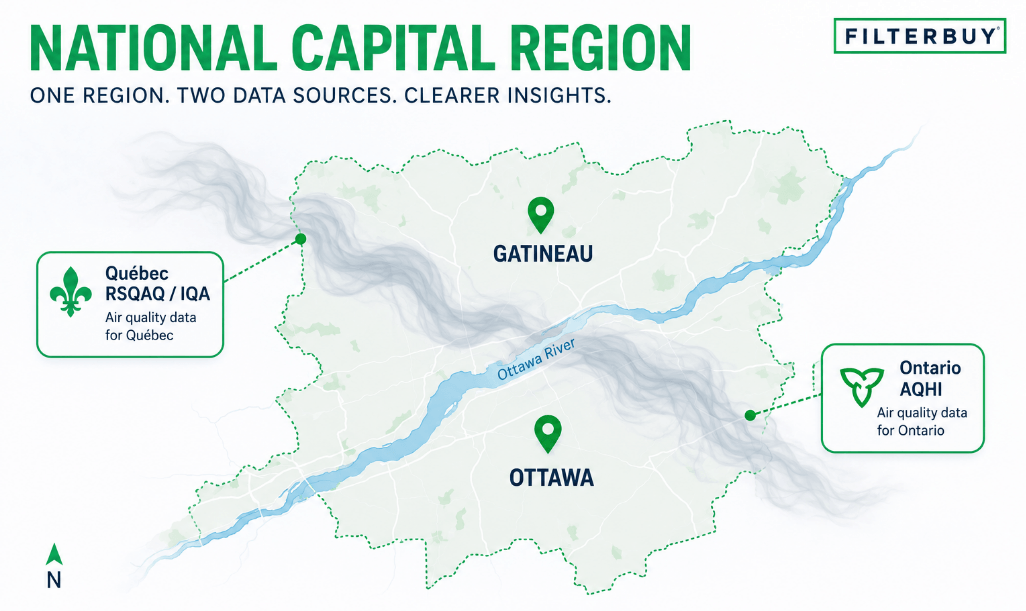
Where Gatineau's Readings Come From
Québec's Réseau de surveillance de la qualité de l'air (RSQAQ) operates roughly 60 stations province-wide, and Gatineau is served by more than one, including a station in the Hull sector. Nearly every station carries at least a PM2.5 and an ozone analyser, the two that matter most day to day.
Gatineau also holds a distinction: it is one of only three cities in Québec, alongside Montréal and Québec City, for which Environment and Climate Change Canada publishes an AQHI forecast. That means forward-looking air quality information most Québec communities do not get.
What Drives Gatineau's Air Quality Through The Year
The June 2023 episode remains the local reference point: the AQHI reached its 10+ ceiling and fine particle concentrations on the Ontario side of the river peaked around 267 µg/m³, roughly seven and a half times the level at which Québec classes air as "mauvais."
Our live Canadian wildfire and smoke map tracks where plumes are heading next.
What Today's Number Means For The Air Inside Your Home
Indoor air is not separate from outdoor air. Fine particles move through ordinary gaps around windows and doors, so when outdoor levels climb, indoor levels follow. Usually lower, and with a lag.
On a poor air quality day in Gatineau, three straightforward steps help:
Keep windows and doors closed, especially during smoke events and on high-ozone afternoons.
Run your HVAC fan rather than leaving it on "auto." A filter only captures particles when air is moving through it.
Check your filter more often. Filters load up faster during smoke episodes, and a clogged filter restricts airflow.
A furnace filter is not an air purifier, and no filter removes everything. But a good filter with the fan running is one of the most practical tools a household already has. We also compare MERV 13 against HEPA for wildfire smoke and explain how to read the AQI during a smoke event.
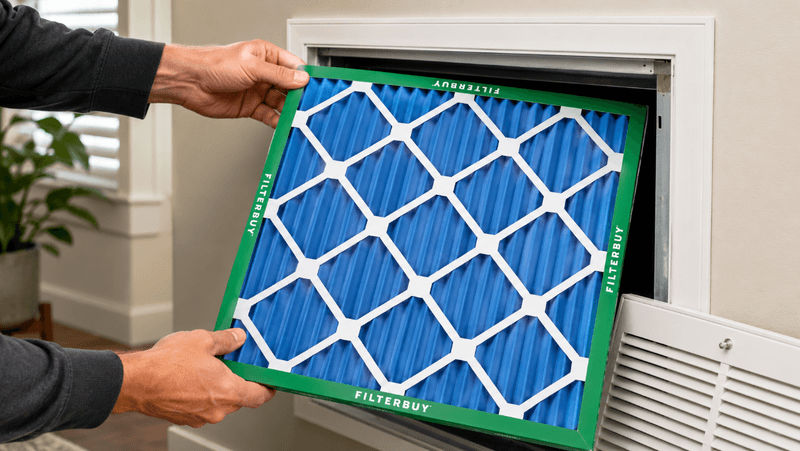
Choosing A Filter For Gatineau Conditions
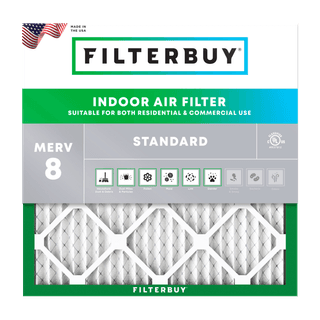
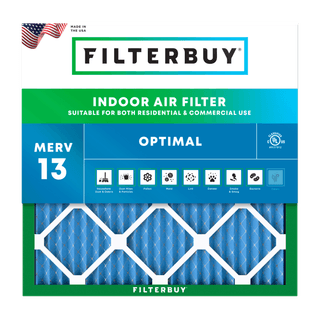
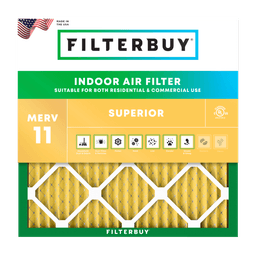
Filterbuy's colour-coded MERV system lets you identify your rating at a glance. New to the ratings? Start with our guide to what MERV ratings mean.
Every size available, including custom. Free shipping to Canada, prices in CAD.
Frequently Asked Questions
Shop MERV 8 Standard, MERV 11 Superior, MERV 13 Optimal, or the carbon Odour Eliminator. No standard size fits? Build a custom filter.
Québec furnaces run six to eight months a year, so most homes here do best changing filters every 60 to 90 days, and more often during smoke events.
Find Your Size | Subscribe & Save
Supporting Statistics
What independent research says happens to outdoor air once it is inside.
1. Closing the windows only gets you part of the way
During a smoke event, with doors and windows shut and no portable air cleaner running:
Indoor fine particles typically sit at 55–60% of outdoor levels
Across homes the range is wide: as low as 30%, as high as 100%
Newer homes and homes with air conditioning keep more of it out
Source: U.S. EPA, Strategies to Reduce Exposure Indoors
2. Running the fan does more than most people expect
High-efficiency filter, fan running continuously: about 50% less indoor PM2.5
Ordinary low-efficiency filter, fan running continuously: about 24% less
EPA recommends MERV 13 or higher during smoky periods
Source: U.S. EPA, Guide to Air Cleaners in the Home
3. Why the MERV rating matters
Fine particles are roughly 30 times smaller than a human hair
EPA identifies 2.5 microns and below as the greatest health concern
That size passes the body's natural defences and reaches deep into the lungs
It is also the size ordinary filters miss
Source: U.S. EPA, Wildfire Smoke - A Complex Mixture
Essential Resources for Checking Gatineau's Air Quality
Where to read today's air, where to see what is coming, and how to tell whether the number describes your street.
Québec's Official Hourly Reading: Indice de la qualité de l'air (IQA) Map
The provincial environment ministry publishes Gatineau's official reading every hour, station by station. Between 1 May and 30 September the map adds seasonal wildfire sensors and a 72-hour fine-particle forecast.
Your Health Risk, Tonight and Tomorrow: AQHI for Gatineau
Environment and Climate Change Canada rates short-term health risk from 1 to 10+ and forecasts day and night maximums. Gatineau is one of only three Québec cities that receives this forecast.
The Cross-River Check When Gatineau Goes Quiet: AQHI for Ottawa
Gatineau's page sometimes shows no observed reading while Ottawa's, a few kilometres south, reports normally. Same airshed and same scale, so it stands in reasonably well when your side has no current number.
Why Two Apps Show Two Different Numbers: Info-Smog
Info-Smog sets out the difference between Québec's IQA and the federal AQHI in plain language, and links the province's forecast bulletins. Start here if the readings you are seeing do not agree.
What to Actually Do at Each Level: Health Risks of Air Pollution
Health Canada and ECCC name who is most affected and give clear thresholds: ease off strenuous activity between 4 and 6, reschedule at 7 or above. It includes specific guidance for organisers of outdoor sport.
canada.ca - Health risks of air pollution
Whether Tomorrow Will Be Worse: FireSmoke Canada
The BlueSky model forecasts ground-level PM2.5 two days ahead, which is enough notice to plan a weekend or move a practice. It is experimental, and it excludes smoke drifting in from outside the model area.
Whether the Number Describes Your Neighbourhood: RSQAQ Station Map
Québec's network map shows where each station sits and which contaminants it measures. Urban stations represent dense areas only, so this tells you how closely your nearest reading reflects your own street.