
Waterloo Real-Time AQI Tracker
What's Actually In Waterloo Air Today?
What High AQI Means for Your Lungs in Waterloo
How to Read AQI
The Air Quality Index (AQI) measures how polluted the air is and how it may affect your health.
0–50 (Good): Air quality is satisfactory.
51–100 (Moderate): Acceptable, but some pollutants may pose minor concerns.
101–150 (Unhealthy for Sensitive Groups)
151–200 (Unhealthy)
201–300 (Very Unhealthy)
301+ (Hazardous)
Moderate
Still okay for most, but if you have asthma or allergies, take it easy and avoid long outdoor workouts.
Shop MERV 11 filters→What's the Right Filter for Your AQI Level?




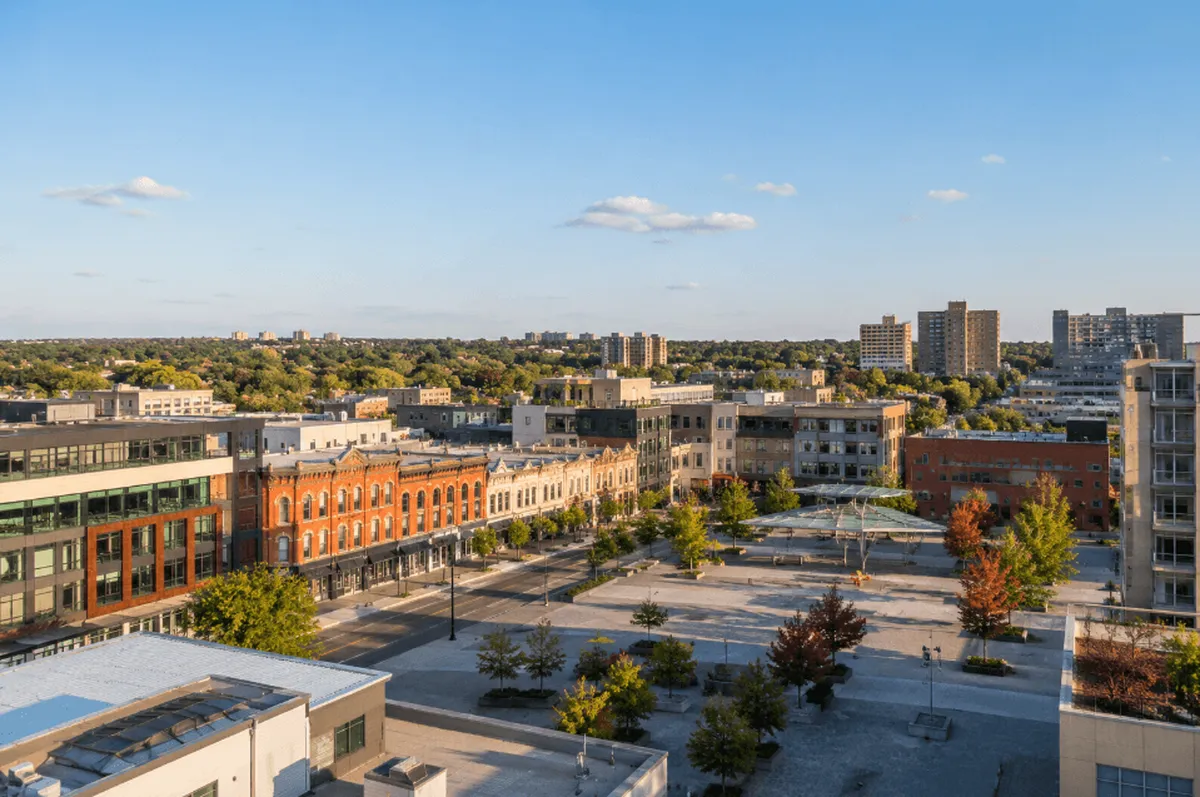
Check Today's Live Real Time Air Quality Index AQI Map in Waterloo, ON Now
By Michelle Wan, Brand Manager and Air Quality Writer, Filterbuy Canada
Published 31 August 2026 | Last updated 31 August 2026
TL;DR
Waterloo, Ontario has no air quality monitoring station. Its Air Quality Health Index (AQHI) comes from an Ontario government station in Kitchener that we measured at 2.5 km from Waterloo City Hall. That single reading is the official number for all of Waterloo Region. Check the live map above, then the scale below.
Key Takeaways
Waterloo's official air quality reading is measured in Kitchener, where the Ontario Ministry of the Environment, Conservation and Parks runs the one AQHI station serving the whole region.
That station sits 2.5 km from Waterloo City Hall and 4.6 km from the University of Waterloo, distances we measured from the ministry's coordinates.
Canada reports outdoor air quality on the AQHI scale of 1 to 10+, where 1 to 3 is low risk, 4 to 6 moderate, 7 to 10 high and above 10 very high.
The Kitchener station measures three pollutants: ozone (O3), PM2.5 and nitrogen dioxide (NO2). Pollen and indoor sources are not.
Cambridge, Woolwich, Wilmot, Wellesley and North Dumfries all share Waterloo's AQHI value, though Cambridge sits 18 km from the station.
What Is the Air Quality in Waterloo Today?
The live map at the top of this page, maintained by Filterbuy Canada, shows the current Air Quality Health Index for Waterloo. The AQHI is Canada's official outdoor scale and runs from 1 to 10+. Ontario's Ministry of the Environment, Conservation and Parks recalculates it hourly, so the number shifts through the day. Check it before you head out.
Beside the current reading, Ontario publishes an AQHI forecast for tonight and tomorrow. If today is bad, it tells you whether waiting a day helps.
Other maps show a Waterloo air quality index in the 0 to 500 range. That is the American AQI, built on different pollutants and breakpoints. Where the two disagree, follow the AQHI.
Where Waterloo's Air Quality Reading Actually Comes From
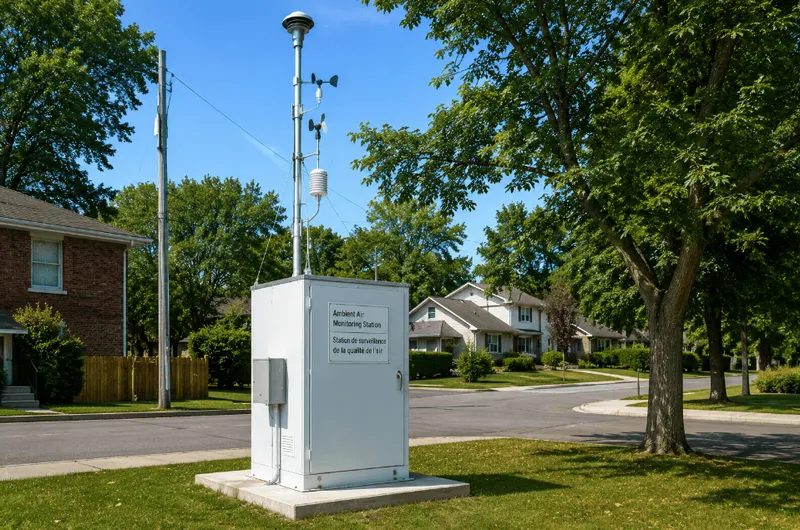
We went looking for Waterloo's monitoring station and found the city has none. Its AQHI comes instead from the Kitchener station, an urban site at West Ave. and Homewood Ave. that sits 325 metres above sea level and samples the air five metres up. It is one of 38 ambient monitoring stations Ontario runs, and the only one in Waterloo Region.
That sounds like a gap, and we expected one. For Waterloo it mostly is not. Rather than estimate, we took the latitude and longitude the ministry publishes and measured the distances ourselves: 2.5 km to Waterloo City Hall, 3.9 km to Wilfrid Laurier and 4.6 km to the University of Waterloo. Even the northern edge is only about 8.4 km out. For a city of 121,436 people, that is close coverage.
The gap turned up elsewhere. Cambridge reads the identical number from 18 km away, and so do Woolwich, Wilmot, Wellesley and North Dumfries. One instrument speaks for 587,165 residents across 1,370 square kilometres, and Waterloo happens to be the city it represents best.
That does not make the number wrong further out, only looser. A reading from 2.5 km away in similar terrain is a fair proxy for Uptown Waterloo, and a rougher one for Wellesley Township.
How to Read the Waterloo AQHI Scale
The AQHI expresses health risk rather than pollutant concentration, so a higher number means more risk to your breathing. Ontario publishes four bands, with separate guidance for the general population and for those at higher risk: anyone with a heart or breathing condition, children and older adults.
AQHI 1 to 3, low risk. Ideal conditions for outdoor activity, including for people at higher risk.
AQHI 4 to 6, moderate risk. Most people need not change plans unless they notice symptoms such as coughing or throat irritation. Those at higher risk should ease off.
AQHI 7 to 10, high risk. Consider reducing strenuous outdoor activity if you notice symptoms. Those at higher risk should reduce it, and children and older adults should take it easy.
AQHI above 10, very high risk. Reduce or reschedule strenuous outdoor activity, especially with symptoms. Those at higher risk should avoid outdoor exertion.
If you have a heart or lung condition, follow your doctor's advice. The AQHI is a guide, not medical direction.
What Moves Waterloo's Air Quality Through the Year
Three pollutants drive the Waterloo AQHI, and each has its own season.
Ozone peaks in summer. It forms when heat and sunlight work on precursor pollutants, which is why Waterloo's higher readings arrive on hot, still afternoons. It also drifts in from elsewhere, so a warm day with no local source can push the number up.
PM2.5 spikes with smoke, and of the three it moves fastest and furthest. Wildfire smoke carried into southern Ontario can lift Waterloo's PM2.5 within hours, the usual explanation for a summer reading well above normal.
NO2 tracks traffic and combustion. It rises near corridors such as the Conestoga Parkway, and again in winter as furnaces run harder. That stretch is long here: furnaces run six to eight months a year, and for most of it the air you breathe is indoor air. It is why we suggest timing a Filterbuy Canada filter subscription around the heating season rather than the calendar.
What the Waterloo AQHI Does Not Tell You
The AQHI is built from three measurements, so several things people assume it covers are missing.
Pollen is one, which is why a low risk spring day can still be miserable for allergy sufferers. Mould spores, radon and VOCs are absent too.
So is odour. Smoke you can smell is part particles and part gases, and only the particles show up in the reading.
Ontario adds a caveat. Hourly AQHI values come from automatically polled data that has not undergone final verification, so treat any single hour as a strong indication rather than a laboratory result.
Ontario's records show how far a station can be swayed by something close to it. The Kitchener station once briefly hit the very high risk band, and the ministry invalidated and removed those readings because a nearby fire had produced values unrepresentative of the Kitchener-Waterloo forecast region.
How to Sanity-Check a Waterloo Reading
None of this makes the reading useless. It means reading around the station's limits, and three checks will do it, using data Ontario publishes.
Compare Kitchener against Guelph, the next closest station at 23 km east. If both read high, the cause is regional, usually smoke or summer ozone. If only Kitchener is high, something nearer that instrument may be lifting it, and the number may overstate your street.
Read the pollutant, not the index. Ontario publishes hourly ozone, PM2.5 and nitrogen dioxide for every station. A high PM2.5 hour on a hazy day means smoke. A high ozone hour on a hot afternoon does not, and closing the windows helps less.
Weight the number by where you live. Uptown sits 2.5 km from the instrument and the north end nearer 8 km, so the further out you are, the more a borderline reading is an estimate than a measurement.
Supporting Statistics: What U.S. Research Shows
Three findings from United States federal research back the advice on this page. The figures are American, but the equipment and physics are the same in Waterloo.
1. A High-Efficiency Filter Cuts Indoor PM2.5 by About Half
50 percent: the drop in indoor PM2.5 from a high-efficiency HVAC filter when the system fan runs continuously.
24 percent: the drop from a typical low-efficiency filter running the same way.
This is the evidence behind switching the thermostat fan from Auto to On.
Source: U.S. EPA, Strategies to Reduce Exposure Indoors, citing Fisk and Chan 2017.
2. Wildland Fires Produce Most of the Fine Particulate in U.S. Air
52 percent: the share of all PM2.5 emitted in the United States from wildland fires.
It is why a Waterloo reading can climb with no fire anywhere nearby.
3. Air Quality Shifts Sharply Within a Few Hundred Metres
45 million: Americans living within 300 feet of a major road.
Motor vehicle pollutants run higher there than at background sites.
It is why one station cannot speak for every Waterloo street.
What to Do at Home When Waterloo's Air Quality Drops
When the Waterloo AQHI climbs into the moderate or high band, scale back strenuous activity outside and keep the windows shut. Indoors is where you have some control.
Set the thermostat fan to On rather than Auto. On Auto the blower runs only during heating or cooling cycles, so your air reaches the filter for part of the day.
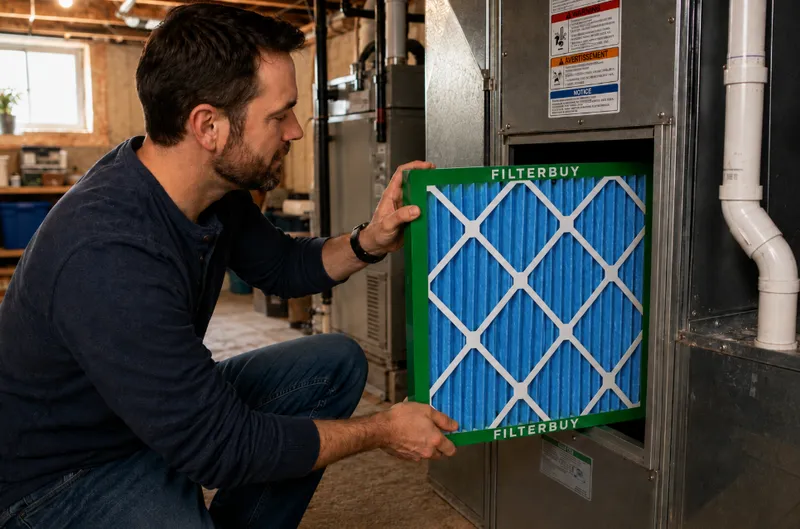
Check the filter rather than the calendar. Smoke loads one far faster than dust, so look at it during an event and replace it once the media turns dark. Close the slot cover firmly, since a gap around the frame undoes the upgrade.
Confirm what your system can handle before moving up a rating. Older equipment and low-static blowers struggle with denser media, and a licensed HVAC technician can advise.
Treat smoke odour separately. It is gas-phase, so pleated media passes straight over it. That takes activated carbon, which our Odour Eliminator filters use.
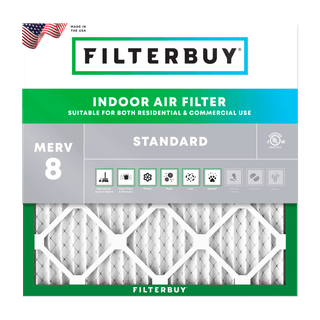
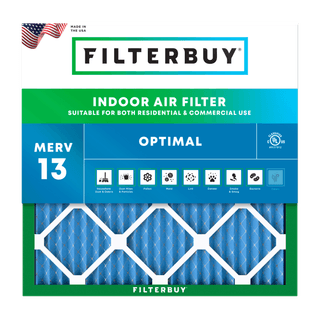
Filterbuy Canada carries pleated filters in over 600 sizes, including MERV 8, MERV 11 and MERV 13, with free shipping to Canada. Our MERV ratings guide covers the trade-offs, and our wildfire smoke guide covers the seasonal swap.
Frequently Asked Questions
Glossary
AQHI (Air Quality Health Index). Canada's official outdoor air quality scale, 1 to 10+. It expresses short-term health risk from ozone, fine particulate and nitrogen dioxide combined.
AQI (Air Quality Index). The United States scale, 0 to 500. It uses different pollutants and breakpoints, so it is not interchangeable with the AQHI.
PM2.5 (fine particulate matter). Airborne particles 2.5 micrometres or smaller. PM2.5 rises most sharply during wildfire smoke and travels deep into the lungs.
Ozone (O3) and nitrogen dioxide (NO2). The two gases in the AQHI. Ozone forms when heat and sunlight act on precursor pollutants. NO2 comes from engines, furnaces and industry.
Ambient air monitoring station. A fixed government installation sampling outdoor air continuously.
MECP (Ministry of the Environment, Conservation and Parks). The Ontario ministry that runs the province's 38 monitoring stations and publishes the hourly AQHI.
MERV (Minimum Efficiency Reporting Value). A standardised air filter rating under Standard 52.2 from ASHRAE, the American Society of Heating, Refrigerating and Air-Conditioning Engineers.
This page is general information about outdoor air quality and home air filtration. For questions about a health condition, speak with a qualified healthcare professional. For questions about what your HVAC system can handle, speak with a licensed HVAC technician.