
Mississauga Real-Time AQI Tracker
What's Actually In Mississauga Air Today?
What High AQI Means for Your Lungs in Mississauga
How to Read AQI
The Air Quality Index (AQI) measures how polluted the air is and how it may affect your health.
0–50 (Good): Air quality is satisfactory.
51–100 (Moderate): Acceptable, but some pollutants may pose minor concerns.
101–150 (Unhealthy for Sensitive Groups)
151–200 (Unhealthy)
201–300 (Very Unhealthy)
301+ (Hazardous)
Moderate
Still okay for most, but if you have asthma or allergies, take it easy and avoid long outdoor workouts.
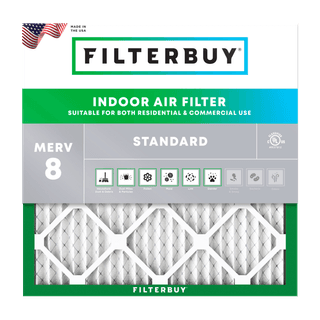
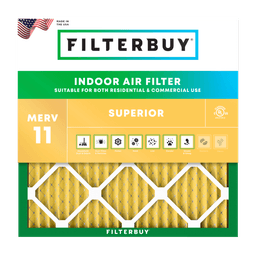
Shop MERV 11 filters→What's the Right Filter for Your AQI Level?




Check Today's Live Real Time Air Quality Index AQI Map in Mississauga, ON Now
On a smoky afternoon in June 2025, Environment and Climate Change Canada put Mississauga under a special air quality statement as wildfire haze drifted across the GTA. Most days here, the air is good. It can still turn within a few hours, though, which is why the number on the live map is worth a look before you open the windows or head out for a run. Pollen climbs through May. Ozone builds on hot afternoons across the Golden Horseshoe. And from October to April, the furnace runs for months, so your indoor air works hard for half the year. This page gives you the live AQI map for Mississauga, plus the steps that genuinely help.
TL;DR — Quick Answers
If you're in a hurry, here's the short version.
Today's Mississauga AQI: Check the live map at the top of this page. Readings update throughout the day.
AQI vs. AQHI: AQI (0–500) is the international scale. AQHI (1–10+) is Canada's official one, published for Mississauga by Environment and Climate Change Canada. Both read the same air.
Safe threshold: AQI 0–50 is good. Above 100, sensitive groups should limit outdoor time. Above 150, everyone should.
Main cause in summer: Wildfire smoke drifting into the GTA. PM2.5 is the pollutant that matters most.
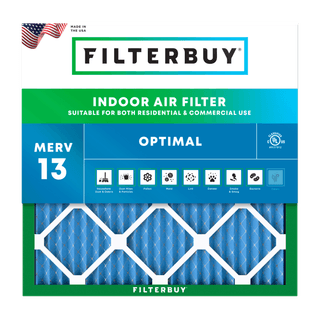
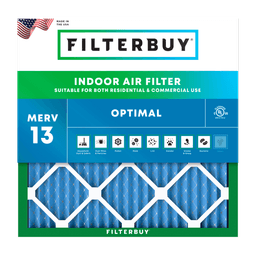
Best filter for smoke: MERV 13 (Optimal). For the smell that lingers afterward, the Odour Eliminator filter.
What to do today: Check the map. Close windows if AQI is above 100. Run the HVAC fan. Change the filter if it's been a while.
Top Takeaways
Check the map first. Mississauga's air is good most days, but it can shift within hours.
Two scales, same air. AQI (0–500) is what most maps use. AQHI (1–10+) is Canada's official scale.
Summer's main threat: wildfire smoke. The pollutant that matters most is PM2.5.
Above AQI 100: close windows, run the HVAC fan, and keep sensitive groups indoors.
Match the filter to the condition:
Wildfire smoke: Optimal (MERV 13)
Spring pollen: Superior (MERV 11)
Lingering smell: Odour Eliminator
What Today's Reading Actually Means
The map at the top of this page shows real-time air quality for Mississauga and the rest of the GTA, from the lakeshore up through the city centre and out toward Brampton and Oakville. Readings refresh throughout the day. The number on your screen captures how clean the outdoor air in your area is right at this moment.
On the international Air Quality Index (AQI) scale this map uses, 0 to 50 counts as good for most people. From 51 to 100, the air is generally fine, though unusually sensitive people may notice symptoms. Above 100, sensitive groups should start limiting time outdoors: children, older adults, and anyone with asthma or COPD. Above 150, it's a sensible day for everyone to stay in.
Canada also runs its own official scale, the Air Quality Health Index (AQHI), from 1 to 10+. Environment and Climate Change Canada publishes it and builds it around three pollutants: fine particulate matter (PM2.5), ground-level ozone (O₃), and nitrogen dioxide (NO₂). Mississauga's readings feed in through the provincial monitoring network. This page leans on AQI because that's the scale most people search for. For the official Canadian reading, the resources below point you to the AQHI.
What pushes Mississauga's number up changes with the season. Wildfire smoke from elsewhere in Canada has come to dominate summer readings, more so each of the last few years. Spring brings pollen and mould spores. Hot, sunny afternoons build ground-level ozone across the Golden Horseshoe. Every day, traffic on the 401, 403, and QEW, the activity around Pearson, and the industrial corridor near Clarkson and Lakeview all add a steady baseline. In winter, inversions can trap emissions closer to the ground through the long heating season. Knowing which one is driving today's reading is half the battle. It tells you whether to close the windows, change the filter, or carry on as normal.
Mississauga Air Quality Through the Year
Mississauga's air follows a fairly predictable rhythm across the year, even if any single day can still surprise you. Knowing the season's usual culprit helps you read the map faster and plan ahead. Here's what tends to drive the number in each part of the year.
| Season | What Usually Drives the Air | What It Means at Home |
|---|---|---|
| Winter (Nov–Mar) | The long furnace season is in full swing, and cold-weather inversions can trap traffic and industrial emissions closer to the ground. Late autumn into early winter often shows the year's highest monthly PM2.5. | Your furnace runs for months, so a clean filter matters most right now. Change it on schedule and keep the fan circulating. |
| Spring (Apr–Jun) | Pollen and mould spores climb as the city thaws and blooms, and the first warm, windy days stir up settled dust. | Allergy season. A Superior (MERV 11) filter handles pollen, dust mites, and mould spores comfortably. |
| Summer (Jun–Sep) | Wildfire smoke drifting in from fires elsewhere in Canada, plus ground-level ozone on hot, sunny afternoons across the Golden Horseshoe. | The season to watch the map closely. Close windows on smoke days, run the fan, and an Optimal (MERV 13) filter is your best in-home defence. |
| Autumn (Sep–Oct) | Often the cleanest stretch of the year, though it's also the run-up to furnace season. | A good time to stock up and start a subscription before the heating season kicks in. |
None of this is cause for worry. Mississauga's air is good more often than not. It just helps to know which lever to pull, and when.
Understanding the Pollutants Behind Today's Reading
The AQI is a single number, but several pollutants feed into it. In Mississauga, three matters most, and they don't all behave the same way, so the right response shifts with the season.
Fine Particulate Matter (PM2.5)
PM2.5 is fine particulate matter smaller than 2.5 micrometres, roughly thirty times thinner than a human hair. It sits behind most of Mississauga's higher readings, especially during wildfire smoke season, because the particles are small enough to travel deep into the lungs. It's also the one your furnace filter can do the most about. An Optimal (MERV 13) filter is built to catch the fine particles that lower ratings let pass.
Ground-Level Ozone (O₃)
High in the atmosphere, ozone protects us. At ground level, it's a pollutant. It forms when sunlight reacts with emissions from traffic and industry, which is why it peaks on hot, sunny summer afternoons across the Golden Horseshoe. A filter won't remove ozone, so on high-ozone days the practical move is to ease off strenuous outdoor activity during the afternoon peak, especially for children and anyone with a respiratory condition.
Nitrogen Dioxide (NO₂)
Nitrogen dioxide comes mainly from vehicle exhaust and combustion, so it runs higher near busy corridors like the 401, 403, and QEW, and around Pearson. It's one of the three pollutants Canada's AQHI is built around. Levels stay low across most of Mississauga, but it's a reminder that everyday traffic, not just the dramatic smoke events, shapes the air you breathe.
Together, these three are what the AQHI tracks. That's why this page points you to both the live AQI map above and the official AQHI reading in the resources section.
After years of service calls across Mississauga and the GTA, the pattern holds. The homeowners who get through smoke season comfortably aren't the ones with the priciest equipment. They're the ones who checked the map before opening the windows. A clean Optimal (MERV 13) filter, in a furnace left running on the fan setting, pulls more fine smoke from the air over a day than most people expect. The move is to do it early, before the smoke works into carpets and curtains. Once you can smell it indoors, you're already playing catch-up.
— Filterbuy Canada
7 Essential Mississauga Air Quality Resources Every Household Should Bookmark
The live map up top tells you what the air is doing right now. These are the sources we trust for everything else: what's coming, what it means for your family, and who to turn to here in the GTA. Save the ones that fit your home, and keep them somewhere easy to find before smoke season rolls around. You'll be glad you did.
Get the Official Federal Reading for Mississauga
When you want the official number, this is the one. Environment and Climate Change Canada keeps Mississauga's current AQHI and its 24-hour forecast updated all day, so you're reading the federal source rather than a third-party guess.
Best for: Confirming the official AQHI before you plan the day
Source: weather.gc.ca | Mississauga AQHI
See the Station-Level Data Behind the Number
If you like to dig a little deeper, Air Quality Ontario runs the local monitoring station that feeds Mississauga's AQHI. You get a pollutant-by-pollutant breakdown and recent history that the national summary skips over.
Best for: Seeing which pollutant is driving today's reading
Source: airqualityontario.com | Mississauga station 46108
Spot Wildfire Smoke Before It Reaches the GTA
The AQHI covers today. FireWork looks ahead. Environment and Climate Change Canada's FireWork model maps wildfire smoke across North America for the next 72 hours, so you can catch a plume drifting toward the GTA a day or two before it lands.
Best for: Knowing whether tomorrow will be a smoke day
Source: weather.gc.ca | FireWork smoke forecast
Cross-Check the Forecast With a Second Model
When a smoke event is building, it helps to have a second opinion. FireSmoke.ca runs the University of British Columbia's BlueSky forecast, with hourly ground-level smoke readings from across the country. Pair it with FireWork when you'd rather not rely on a single model.
Best for: Double-checking a forecast during an active smoke event
Source: firesmoke.ca | current smoke forecast
Know What to Do When the Number Climbs
When a reading climbs, this is the page that tells you what to do about it. Health Canada covers who's most at risk, how to keep your indoor air clean during a smoke event, and when to check in with a doctor. It's also the official source behind the advice to run the highest-rated filter your furnace can handle.
Best for: Turning a high reading into clear, calm action at home
Source: canada.ca | Wildfire smoke and your health
Get Guidance Tailored to Your Own Community
Peel Public Health looks after Mississauga, Brampton, and Caledon, so its advice is tied to your own backyard. They share local guidance and special air quality statements whenever smoke settles over the region.
Best for: Local alerts and advice meant for Mississauga
Source: peelregion.ca | Peel Region
Understand What the AQI Number Actually Means
New to the numbers? This overview breaks down how the AQI scale is worked out, and why Canada, the United States, and the EU each use a slightly different version. It's the clearest, no-jargon place to start.
Best for: Learning how the scale works, in plain language
Source: en.wikipedia.org | Air Quality Index
One habit ties all of these together. The air can change within the hour, so it's worth a quick look at the live reading before you head out, rather than trusting this morning's number. And if a high reading has you thinking about the air at home, a clean Optimal (MERV 13) filter in your furnace is the simplest, most effective change you can make during smoke season. No need to overthink it.
3 Numbers That Explain Why Air Quality Matters Here
These three figures come from different kinds of sources: peer-reviewed research, federal statistics, and a frontline health charity. You're not leaning on any single perspective.
-
115M
Hectares of Canadian Forest Burned in the 2023 Wildfire Season
The 2023 fire season was the worst in Canada's recorded history. Researchers writing in Nature Communications documented that roughly 15 million hectares burned, more than doubling the previous record set in 1989. Smoke from those fires reached population centres more than 1,000 kilometres away, including southern Ontario. That's why a fire in northern Saskatchewan can show up as a poor reading here in Mississauga.
Source: Nature Communications (2024)
-
21.9×
Urban Ontarians Breathe Nearly Twice the PM2.5 of Rural Canadians
Statistics Canada's national exposure analysis found residential PM2.5 averaged 8.03 µg/m³ in urban cores, compared with 4.32 µg/m³ in rural areas. That works out to roughly a 1.9× difference, and parts of southern Ontario carry some of the heaviest loads. If you live in the GTA, your baseline air quality works against you a little more than the national average does.
Source: Statistics Canada
-
3AQHI 4
Even a Moderate Reading Can Worsen Symptoms for People Living with Chronic Lung Conditions
The Canadian Lung Association notes that for anyone with a chronic lung condition such as asthma or COPD, an AQHI score of 4 can be enough to worsen symptoms. A 4 sits in the moderate range and counts as safe for the general public, which is exactly what makes it worth knowing if someone in your home has a respiratory diagnosis.
Source: Canadian Lung Association
Where We Stand: Our Take on Mississauga Air Quality
Here's the honest read. Mississauga's baseline air is good. Historically, it has sat right around the World Health Organization's annual target for fine particulate matter, and most days the map shows a comfortable number. The trend lines aren't entirely reassuring, though. Wildfire smoke events are becoming a regular part of GTA summers rather than the odd anomaly. Spring allergy seasons start earlier and run longer. And the furnace season, six to eight months in this part of Ontario, isn't getting any shorter. None of that calls for panic. All of it calls for paying a little more attention to indoor air than households did a decade ago.
Our view, after years of helping Canadian homeowners through smoke events: most people overspend on standalone air purifiers and underuse the filter already running through their HVAC for half the year. A well-chosen pleated filter in the furnace, changed on a sensible schedule, does a lot of quiet work. During wildfire smoke season, an Optimal (MERV 13) filter captures the fine PM2.5 particles that lower MERV ratings let pass. During spring allergy season, a Superior (MERV 11) filter handles pollen, dust mites, and mould spores comfortably. For the smoky smell that hangs around afterward, an Odour Eliminator filter does what its name suggests.
We won't oversell it. A furnace filter isn't a respirator, and it won't make outdoor smoke disappear. But for the air inside your home, where most of us spend close to 90% of our time through the long heating months, it's one of the highest-leverage things you can change. Cleaner filter, fan running, windows shut on high-AQI days. That's the playbook.
Your Next 10 Minutes: A Simple Plan for Today's Air
Practical steps you can take right now, depending on what today's reading is telling you.
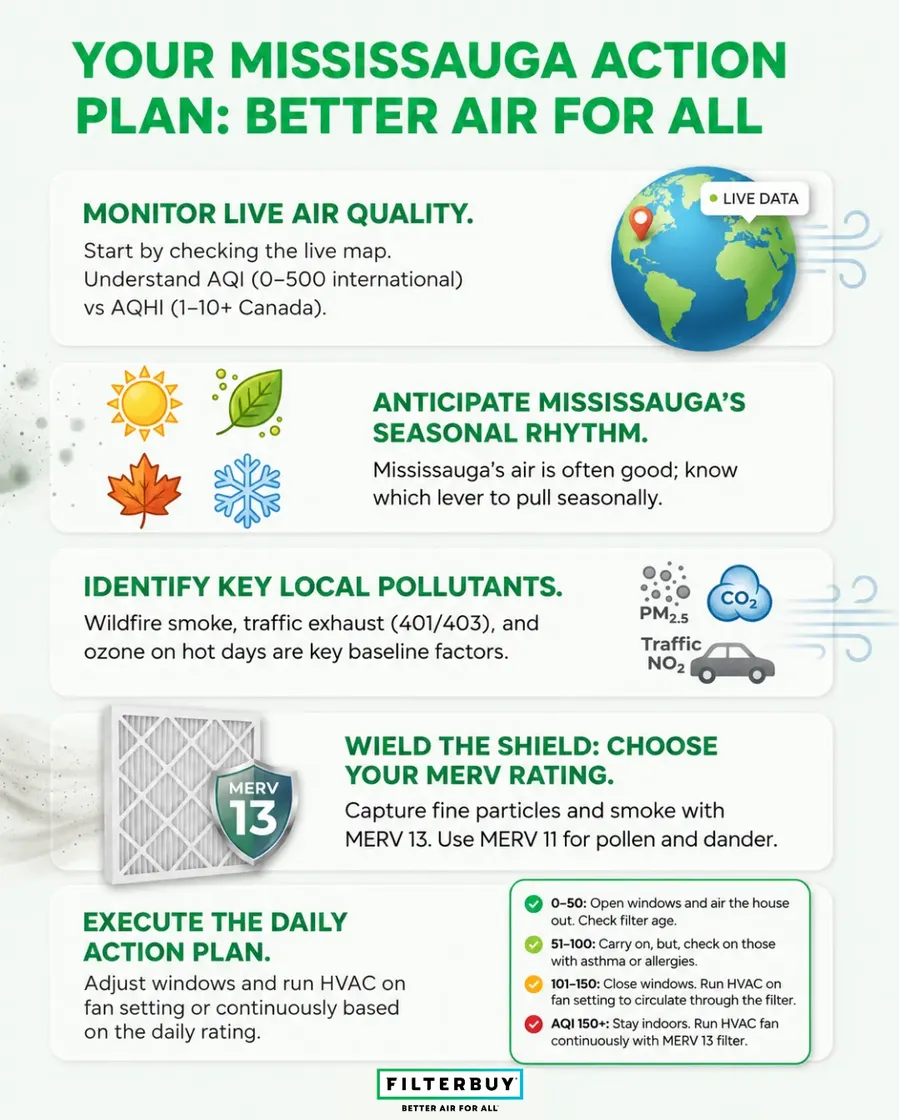
If AQI is 0–50 (Good)
Open the windows and air the house out if they've been closed.
Check when you last changed your furnace filter. If it's been more than 60 days, set a reminder.
If you don't have a subscription set up yet, this is a calm day to do it.
If AQI is 51–100 (Moderate)
Carry on as normal, but check on anyone in your household with asthma, COPD, or pollen allergies. Moderate days are often when symptoms show up before the number climbs.
If you're due for a filter change, do it today rather than waiting.
If AQI is 101–150 (Unhealthy for Sensitive Groups)
Close the windows. Switch your HVAC system to the fan setting so air keeps circulating through your filter.
Limit outdoor time for children, older adults, and anyone with a respiratory condition.
Check the filter. If it's visibly discoloured, replace it now.
If AQI is above 150
Stay indoors. Keep windows and doors closed. Run the HVAC fan continuously.
An Optimal (MERV 13) filter or an Odour Eliminator filter is your best in-home defence.
Check on neighbours, particularly older ones and those living alone.
If you or anyone in your home has chest tightness, a persistent cough, or shortness of breath, contact a healthcare provider or call Health811 (dial 811).
Frequently Asked Questions
Breathe Easier This Season
If today's reading has you thinking about the air inside your home, you're already a step ahead. Filterbuy ships pleated air filters in more than 600 sizes, including custom, straight from our own facilities to your door in Mississauga. Free shipping across Canada on every order, no minimum, with prices shown in CAD at checkout.
Not sure which filter you need? Our Superior (MERV 11) handles spring allergies and pet dander. Our Optimal (MERV 13) is the one we recommend for wildfire smoke season. Our Odour Eliminator clears the lingering smell that often outlasts the worst readings. A short guide on our shop page walks you through which fits your home in about a minute.
Subscribe and save with auto-delivery. Edit, skip, or cancel anytime. Or order a single pack today and see how it goes. We've earned more than 85,000 five-star reviews from customers across North America, and we'd rather earn your trust than push you toward the wrong product.