Shop by
June 4, 2026

You can find out how clean the air outside your home is right now, for free, in about the time it takes to pour a cup of coffee. Most people never check, and that’s a shame, because that one number tells you something the air itself works hard to hide. We’ve spent years at Filterbuy obsessed with exactly this, turning invisible air into something a family can see and act on. The outdoor reading is where it starts. Pull the number, learn to read it, and you’ll know what the air outside is doing to the air your family breathes inside, plus what to do about it.
Checking today’s outdoor air quality means looking up your local Air Quality Index, the color and number that tell you how clean or polluted the air is at this moment. You’ve got three free ways to do it, and none takes more than a minute:
Pull up AirNow.gov, the EPA’s official source, and type in your ZIP code or city for the current reading and the day’s forecast.
Glance at the weather app already on your phone, which usually shows an air quality number right beside the temperature.
Search “air quality near me” and read the live card at the top of the results.
Once that number’s in front of you, the next step is knowing what it means and what to do about it inside your home.
Checking today’s outdoor air quality takes under a minute and costs nothing.
The Air Quality Index runs from 0 to 500 across six color-coded categories, and a higher number always means worse air.
Once a reading climbs past 100, the people with asthma, heart conditions, and other sensitivities feel it first.
Outdoor air drifts inside through gaps, doors, and fresh-air intakes, so a rough day outside quietly becomes a rough day indoors.
A clean, well-rated filter and a sealed-up house are your two strongest tools for keeping indoor air healthy when the outdoor air quality climbs.
Three free tools cover almost every situation, and you’ve probably already got all three within reach.
We always start with AirNow.gov, because the EPA runs it and pulls readings from a national network of monitors. Type in your ZIP code or city and you’ll see the current number, the category it falls into, and a forecast for the rest of today and tomorrow. That forecast earns its keep. It tells you whether to take the afternoon run outside or move it indoors.
Your phone’s weather app is the fastest glance of all. Most of them now list an air quality number right next to the temperature, so you can check it the same way you check whether to grab a jacket.
A quick search for your city plus the words air quality pulls up a live card at the top of the page. That one’s handy when you’re traveling and want a fast read on a place you don’t know well.
Whatever tool you reach for, check it more than once on a rough day. Air quality shifts hour to hour, a lot like the weather, and a calm morning can turn into an unhealthy afternoon once wind, heat, or smoke moves in.

The number you’re looking at is the Air Quality Index, a scale that climbs from 0 to 500 and sorts into six categories, each with its own color. Higher means more pollution and more reason to pay attention. You can read the full background on how the Air Quality Index is built at Wikipedia, but here’s the short version that actually helps on a busy morning.
0 to 50, Green, Good. Clean air, no real health concern. Go do whatever you had planned outdoors.
51 to 100, Yellow, Moderate. Fine for most of us, though a few unusually sensitive folks might notice it.
101 to 150, Orange, Unhealthy for Sensitive Groups. Kids, older adults, and anyone with heart or lung conditions should ease off hard outdoor activity.
151 to 200, Red, Unhealthy. Everyone can start to feel it, and sensitive groups feel it more.
201 to 300, Purple, Very Unhealthy. A health alert. Most people should cut their time outdoors.
301 to 500, Maroon, Hazardous. Emergency conditions. Stay inside with the air sealed and filtered.
One more thing worth knowing. That single number reflects whichever pollutant is worst that day, usually ground-level ozone or the fine particles called PM2.5. On a smoky day, PM2.5 almost always drives the reading, and those are the tiny particles that ride deep into your lungs.
Here’s the part the air quality apps never mention. That outdoor number has a direct line to the air you’re breathing inside your house right now. Homes aren’t sealed boxes. Outdoor air slips in around windows and doors, through the gaps you’ll never spot, and sometimes straight through a fresh-air intake on your heating and cooling system. When the outdoor reading climbs, indoor levels tend to follow within an hour or two.
The fine particles behind most bad-air days are what worry us most. They’re small enough to ride those air currents indoors and small enough to reach deep into your lungs once they get there. You’ll never see them settling on the furniture. They do their work invisibly, which is exactly why a number on a screen helps so much. It drags a hidden problem into the open, where you can act on it.
Here’s the encouraging part, and it sits at the heart of what we do. You’ve got far more control over your indoor air than over the whole sky. Closing up the house cuts down on how much outdoor pollution drifts in. Switching your system to recirculate stops it from pulling more polluted air inside. And a clean, well-rated filter grabs a big share of the fine particles already floating around. Put those three moves together on a high-reading day, and your home turns into the cleaner-air refuge your family needs. For the full step-by-step routine, including thermostat settings and a two-minute filter check, follow our guide on what to do at home during an air quality alert.
“After manufacturing filters for over a decade and serving more than two million households, we’ve watched the same thing play out again and again. The families who stay calm on a bad-air day aren’t the ones with the priciest equipment. They’re the ones who already know how to check the number and already have a clean filter doing its quiet work in the background. That reading on your phone isn’t there to scare you. It’s there to hand you back some control over the air your family breathes.”
— Filterbuy Team
You can’t protect your family from air you can’t see, so these are the sources we lean on to make it visible and to act once you know the number. Bookmark the ones that fit your home, and the next bad-air day won’t catch you flat-footed.
AirNow is the EPA’s official source for current air quality, with your local number and the day’s forecast in one place. We start here every time, because everything else follows from knowing where the air stands.
Source: Current Air Quality (EPA AirNow)
The EPA’s air quality hub explains what the index measures and how the agency sets the categories, so the colors stop feeling like a foreign language.
Source: Air Quality and the AQI (EPA)
The American Lung Association lays out what each AQI category means for your health and the steps to take at each one, which turns worry into a plan in a couple of minutes.
Source: Air Quality Index Guide (American Lung Association)
The National Weather Service folds air quality into its daily safety guidance, handy when you’re planning outdoor time around the cleaner hours.
Source: Air Quality Safety (National Weather Service)
The CDC explains who’s most sensitive to particle pollution and how to protect them, with a steady reminder to check the AQI wherever you happen to be.
Source: About Air Quality and Your Health (CDC)
ENERGY STAR walks you through matching a portable air cleaner to your room using its Clean Air Delivery Rate, so you get the protection you need without paying for power you won’t use.
Source: How to Choose a Room Air Cleaner (ENERGY STAR)
If someone at home lives with asthma or allergies, the Asthma and Allergy Foundation of America has guidance built for exactly these high-pollution days.
Source: Air Pollution and Asthma (Asthma and Allergy Foundation of America)
We read the research closely. Here’s what the data says about why that outdoor number deserves a daily glance, and what years of working with indoor air have taught us.
The stat: The World Health Organization estimates that ambient outdoor air pollution caused roughly 4.2 million premature deaths worldwide in 2019. [VERIFY]
Why it matters: These are invisible particles, easy to shrug off right up until the health toll adds up.
Our take: A number that big is why we treat a high reading as a real signal, not background noise.
Source: Ambient Air Pollution Fact Sheet (World Health Organization)
The stat: The American Heart Association reports that fine particle pollution contributes to cardiovascular disease and death, and calls it a modifiable risk factor.
What that means: You can cut your exposure indoors starting right now.
Our take: Families who manage their indoor air tend to feel calmer, especially when someone at home has a heart or lung condition.
Source: Air Pollution and Cardiovascular Disease (American Heart Association)
The stat: Researchers have linked human-caused PM2.5 pollution to roughly 107,000 premature deaths in the United States in a single year.
Why it matters: PM2.5 lodges deep in the lungs and can pass into the bloodstream.
Our take: The tiniest particles are the hardest to catch, which is why a well-rated filter and a sealed home pay off.
Source: Fine Particle Pollution and Mortality (National Library of Medicine, NIH)
After years of obsessing over indoor air, we’ve landed on a pattern worth sharing. Checking the outdoor number is a small habit that pays back far more than it costs. A few seconds of your morning, and you know something true about the air your family is breathing. It turns a vague worry into a clear call. You don’t need to memorize the whole scale or track every pollutant. Glance at the number, know roughly what it means, and keep a clean filter in place for the days it runs high. Treat air quality like a weather check, part of how you look after your home, and the bad-air days stop sneaking up on you.
Check your local AQI on AirNow or your weather app, and note the category it lands in.
Read what that category means for the people under your roof.
If the number’s high, close up the house and set your system to recirculate.
Look at your filter and make sure it’s clean, correctly sized, and well-rated.
Bookmark AirNow or switch on air quality alerts in your weather app.
Keep a spare, well-rated filter on hand so you can swap one in fast.
Know who in your home is most sensitive and which symptoms to watch for.
Make the daily check a habit, the same way you check the forecast.
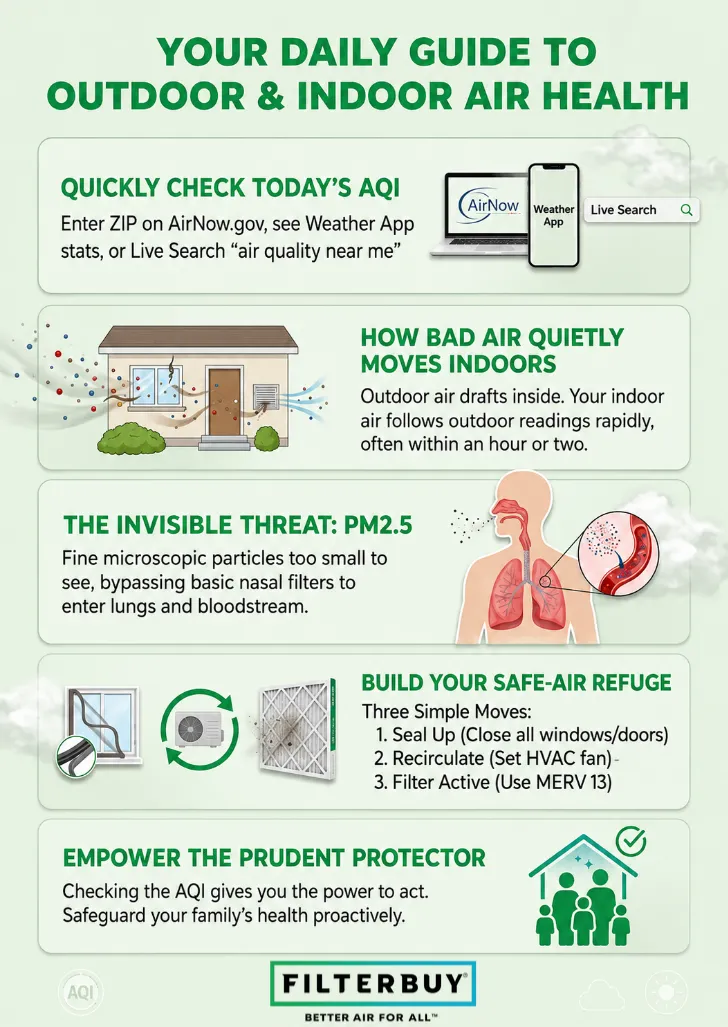
To find today’s air quality where you live, look up your local Air Quality Index on AirNow.gov, your phone’s weather app, or a quick “air quality near me” search. Each one hands you a current number, a color category, and usually a forecast, all in under a minute.
An AQI of 0 to 50 is Good, meaning clean air with no real health concern. Anything from 51 to 100 is Moderate and fine for most people. Once you climb past 100, sensitive groups should start taking precautions.
Air quality is Unhealthy for Sensitive Groups from 101 to 150, and Unhealthy for everyone from 151 to 200. Above 200 it turns Very Unhealthy, and above 300 it’s Hazardous. The higher the number, the more people it affects and the more reason to head indoors.
Yes, more than most people expect. Outdoor air leaks in around windows, doors, and fresh-air intakes, so indoor levels tend to track the outdoor reading within an hour or two. Sealing the house, recirculating your system, and running a clean filter all help keep that outdoor pollution from settling in.
Air quality shifts hour to hour, a lot like the weather. Heat, wind, traffic, and smoke can push a calm morning into an unhealthy afternoon, so it’s worth checking more than once on a rough day instead of trusting a single morning reading.
Close your windows and exterior doors, set your central system to recirculate with the fan running, and make sure a clean, well-rated filter is in place. Running a portable air cleaner in one room gives your family an extra-clean spot to rest. Together, those steps keep the bad air out and clean the air you already have.
Checking the outdoor number is a habit worth keeping. The steadiest protection, though, happens quietly in the background, every day of the year. With the right filter already installed, your home keeps cleaning its own air whether the reading outside is green or red. That everyday peace of mind is the confidence we love helping families build. When you’re ready to upgrade what your system breathes through, our MERV 13 filters catch the fine particles that matter most on high-AQI days.
