
Markham Real-Time AQI Tracker
What's Actually In Markham Air Today?
What High AQI Means for Your Lungs in Markham
How to Read AQI
The Air Quality Index (AQI) measures how polluted the air is and how it may affect your health.
0–50 (Good): Air quality is satisfactory.
51–100 (Moderate): Acceptable, but some pollutants may pose minor concerns.
101–150 (Unhealthy for Sensitive Groups)
151–200 (Unhealthy)
201–300 (Very Unhealthy)
301+ (Hazardous)
Moderate
Still okay for most, but if you have asthma or allergies, take it easy and avoid long outdoor workouts.
Shop MERV 11 filters→What's the Right Filter for Your AQI Level?




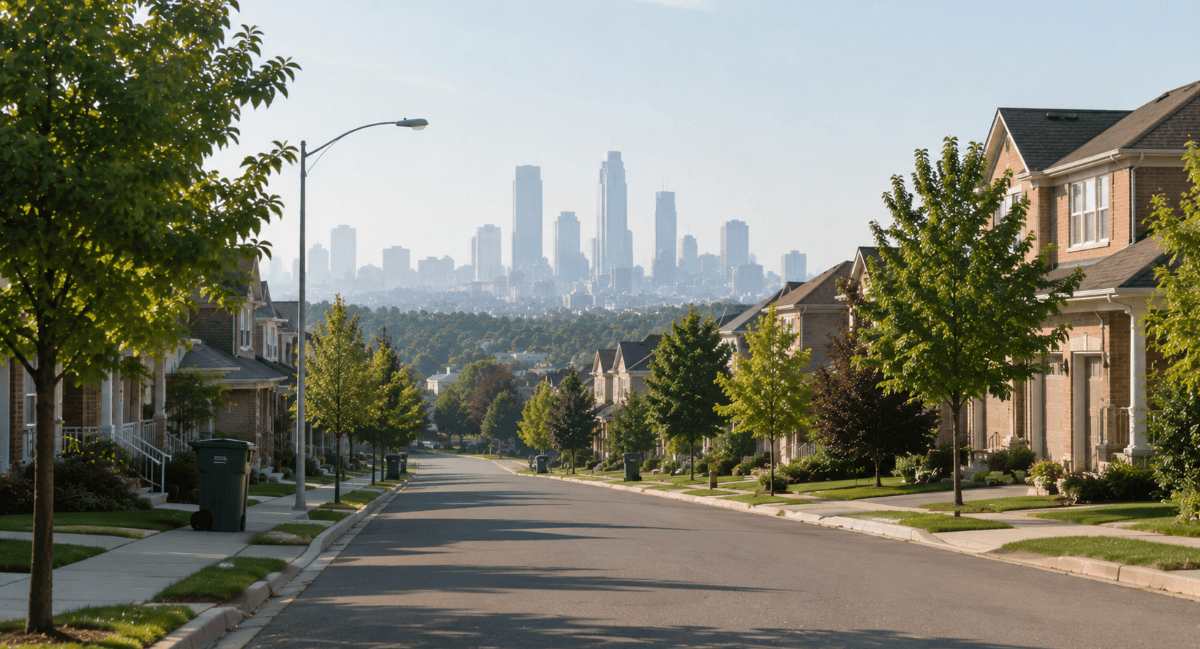
Check Today's Live Real Time Air Quality Index AQI Map in Markham, ON Now
By Michelle Wan · Reviewed by David Clark, Licensed HVAC Technician · Published 23 July 2026 · Updated 23 July 2026
TL;DR
Markham's air quality is reported two ways, which is why two apps can show two different numbers. Ontario and Environment and Climate Change Canada publish the Air Quality Health Index (AQHI) on a 1–10+ health-risk scale, while most consumer apps show the U.S. Air Quality Index (AQI) on a 0–500 concentration scale. Markham has no provincial monitoring station of its own, so its reading comes from stations 13 km or more away. Check the map below, then use the action table to decide what to do indoors.
Key Takeaways
Canada's official index is the AQHI, not the AQI. The Air Quality Health Index runs 1–10+ and is a health-risk scale, not a pollutant concentration reading.
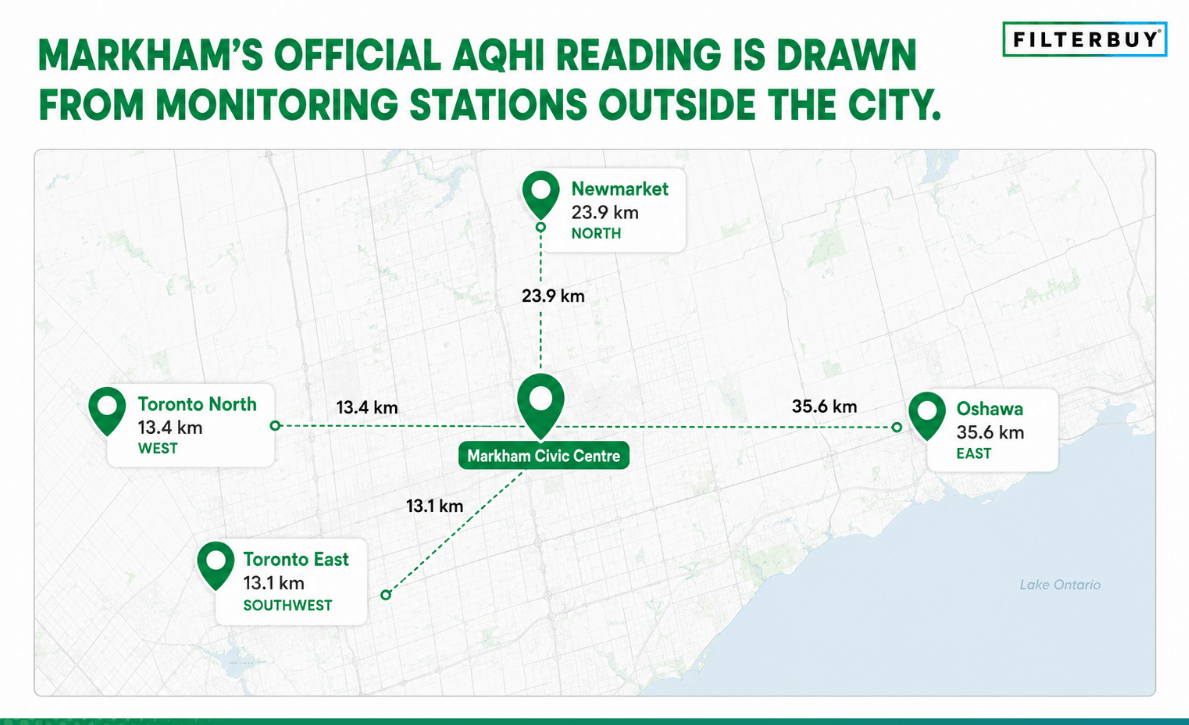
Markham has no provincial monitoring station. Nearest: Toronto East 13.1 km, Toronto North 13.4 km, Newmarket 23.9 km, Oshawa 35.6 km.
AQHI 7 is where the advice changes. Below 7, ECCC tells the general population to carry on unless symptoms appear. At 7 it asks at-risk groups to reduce strenuous activity outdoors.
Indoor air is what you control. Shut the windows and set the furnace fan to run, with a clean filter of the right rating in it.
What Is the Air Quality in Markham Today?
Markham's air quality appears on the map above as an Air Quality Health Index (AQHI) value from 1 to 10+; Table 1 explains what each band means. Outside wildfire season, Markham typically sits in the low band, climbing during smoke episodes and on hot, stagnant afternoons when ozone builds across the GTA. Check the province's live AQHI map for every Ontario station any time.
The AQHI measures health risk, not pollution levels. Environment and Climate Change Canada builds it from three pollutants at once, ground-level ozone, nitrogen dioxide, and fine particulate matter, using Canadian research on daily health outcomes.
AQHI or AQI? Why Markham Shows Two Different Numbers
Two apps can show two different, correct numbers because they use different scales. Ontario's official reading is an AQHI value; many popular apps use the U.S. Environmental Protection Agency's AQI instead, which runs 0–500 and reports the single worst pollutant rather than combining them.
The two indices aren't convertible: different pollutants, averaging windows, and math. Table 1 shows how the bands roughly line up, enough to reconcile two apps that disagree.
Table 1 AQHI and US AQI, side by side
The Markham column gives the general-population advice. At-risk groups follow a separate, earlier-triggering set, shown below. Band alignment with the US AQI is approximate; the two indices are not directly convertible.
At-risk groups act one band earlier. ECCC publishes a second message set for people with heart or breathing conditions, children, and older adults: ease strenuous outdoor activity at 4–6 if symptoms appear, reduce or reschedule it at 7–10 regardless of symptoms, and avoid outdoor exertion above 10.
For the math behind the number, Filterbuy's guide to how the air quality index is calculated explains the EPA formula.
Where Markham's Air Quality Reading Actually Comes From
Markham has no provincial air monitoring station. The province runs 38 ambient stations, and Markham isn't one of them. York Region Public Health directs residents to the Newmarket AQHI page when checking local air quality. That gap is why this page exists: every other result hands you a number; none says it was measured in another city.
Nearest monitoring stations to Markham
Straight-line distances from MECP coordinates to Markham Civic Centre. Verified 23 July 2026.
Readings for Toronto East, Toronto North, Newmarket, and Oshawa all feed the “Markham” number, so it describes regional air measured kilometres away, not the air on your street. ECCC notes that during smoke events, air quality can change over short distances and vary hour to hour; low-cost sensors inside Markham can read differently, and both can be accurate. Use the official AQHI for health guidance.
How to Read the Number Correctly
The AQHI is a rolling three-hour average, so it trails fast-moving smoke: a plume arriving mid-afternoon can still look moderate on the current reading. Two habits close that gap. Read the forecast maximum, not just the current value; ECCC publishes one for today, tonight, and tomorrow, which matters more than a morning observation if you're deciding about a 5 p.m. run. And check both Toronto stations and take the higher: Markham sits almost equidistant between Toronto East and Toronto North, so a plume can reach one before the other, and Toronto North's five-pollutant reading carries the fuller picture.
ECCC also notes that AQHI current-conditions data arrives in real time without detailed quality control and shouldn't be used for publishing. Treat the Filterbuy map above as a guide for your own decisions, not a record.
What Drives Air Quality in Markham Through the Year
Markham's air pollution follows a seasonal pattern:
Winter (Oct–Apr): traffic and home heating; cold-air inversions trap nitrogen dioxide low.
Spring (Apr–Jun): pollen and road dust, and the start of ozone season.
Summer (Jun–Sep): ozone on hot, stagnant afternoons, plus wildfire smoke from thousands of kilometres away.
Autumn (Sep–Oct): usually the cleanest stretch of the year.
Smoke is worth planning around: Markham has been named in special air quality statements alongside Richmond Hill, Vaughan, and Toronto. Filterbuy's live Ontario wildfire and smoke map tracks the plume over the next 72 hours.
What to Do Indoors at Each AQHI Level
You can't change the air outside; you can influence the air inside. Filterbuy, an air filter manufacturer shipping across Canada, pairs each AQHI band below with indoor steps for a forced-air furnace, following York Region Public Health's outdoor air quality guidance.
What to do indoors at each AQHI level
General guidance for a forced-air furnace. Confirm your system is rated for higher-MERV media before upgrading. During smoke, check the filter about every 30 days.
David Clark, the licensed HVAC technician who reviewed this page, adds a caution. Before moving to MERV 13, check what your furnace is rated to handle. Higher-efficiency media is denser, and on some older or undersized systems that added resistance can reduce airflow. If your system runs well on MERV 11, a clean one there often serves you better than a MERV 13 left in too long. Filters load faster during smoke, so check yours about every 30 days.
We have shipped filters through more than a decade of North American smoke seasons. The households that ride them out comfortably are almost never the ones reacting fastest. They are the ones who put a clean filter in before the haze arrived.
Filterbuy Indoor Air Quality Team
Choosing a Filter for a Markham Home
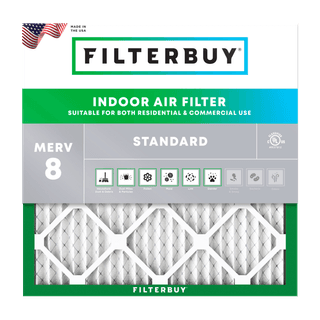
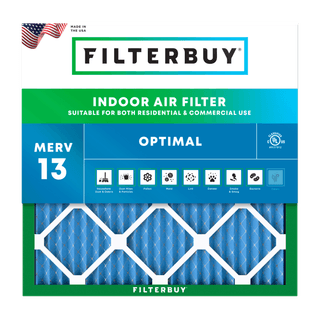
Markham furnaces run six to eight months a year. That long season, plus summer smoke, is why choosing the right MERV rating is worth a moment's thought: Standard (MERV 8) for everyday dust and pollen, Superior (MERV 11) for pets and seasonal allergies, Optimal (MERV 13) for fine allergens and smoke, and Odour Eliminator for cooking and smoke smells.
Filterbuy makes its own filters and ships to Canada in 600+ sizes, including custom, with prices in CAD and free shipping with no minimum. Your size is printed on the edge of the filter you have now, as height x width x depth in inches, such as 20x25x1. Subscribe & Save brings a fresh one on schedule.
Frequently Asked Questions
Supporting Statistics
Three U.S. federal findings support the indoor guidance above.
Indoors is where exposure happens: about 90% of time is spent indoors, where some pollutants run 2 to 5 times higher. Source: U.S. EPA, Report on the Environment.
Wildfire smoke now dominates fine-particle pollution: wildland fires produced 52% of U.S. PM2.5 in 2020, and those plumes reach Ontario. Source: U.S. EPA, Wildland Fire Research.
A filter plus a portable unit measurably cuts indoor smoke: in a 2020 wildfire, a furnace MERV 13 held indoor PM2.5 at 55% of outdoor; a portable air cleaner cut that to 22%. Source: Pollutants (2024), NIH PubMed Central.
These cover particle behaviour and filtration, which apply regardless of country. Air quality levels and index guidance come from Canadian sources.
Sources
Air Quality Ontario (MECP): AQHI data and health messages
Environment and Climate Change Canada: national AQHI
York Region Public Health: outdoor air quality
U.S. EPA AirNow: AQI basics
Glossary
AQHI: Canada's official air quality scale (Health Canada/ECCC), running 1 to 10+ to communicate health risk, not pollutant concentration.
AQI: The U.S. EPA scale, 0 to 500 across six categories from Good to Hazardous, reporting the highest single pollutant sub-index.
PM2.5: Fine particulate matter 2.5 micrometres or less across, small enough to reach deep into the lungs.
Ground-level ozone (O3): A gas formed when pollutants react in sunlight, peaking on hot, stagnant afternoons.
Nitrogen dioxide (NO2): A gas from traffic and combustion; one of the three AQHI pollutants.
MERV: The North American scale for how well a filter captures particles.
MECP: Ontario's Ministry of the Environment, Conservation and Parks, which runs the province's 38 ambient stations.
Air quality warning: A colour-coded ECCC/MECP notice: Yellow at a forecast AQHI of 7 to 10, Orange at 10+.
Filterbuy has this page reviewed by a licensed HVAC technician and updates it when Ontario's guidance changes. General information, not medical advice. If you have a heart or breathing condition, follow your doctor's advice about outdoor activity.
Last updated: 23 July 2026