
Chatham Kent Real-Time AQI Tracker
What's Actually In Chatham Kent Air Today?
What High AQI Means for Your Lungs in Chatham Kent
How to Read AQI
The Air Quality Index (AQI) measures how polluted the air is and how it may affect your health.
0–50 (Good): Air quality is satisfactory.
51–100 (Moderate): Acceptable, but some pollutants may pose minor concerns.
101–150 (Unhealthy for Sensitive Groups)
151–200 (Unhealthy)
201–300 (Very Unhealthy)
301+ (Hazardous)
Moderate
Still okay for most, but if you have asthma or allergies, take it easy and avoid long outdoor workouts.
Shop MERV 11 filters→What's the Right Filter for Your AQI Level?



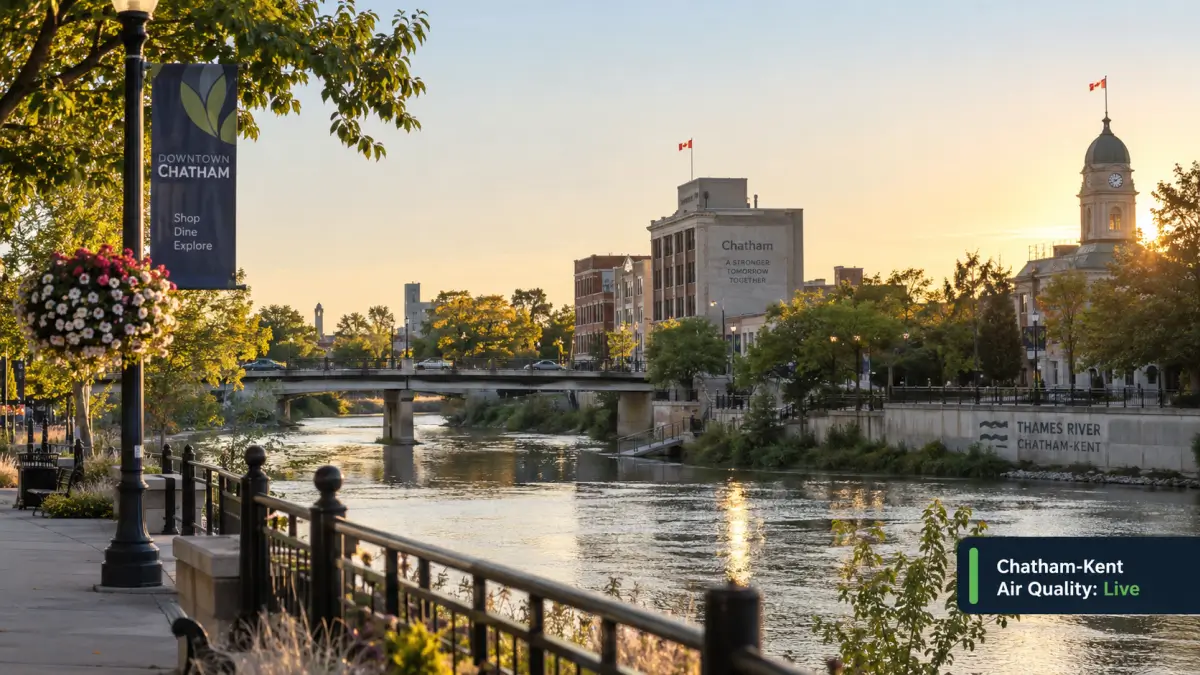
Live Air Quality Index AQI Map Chatham-Kent, ON Today
Author: Michelle Wan, Brand Manager and Air Quality Writer
Reviewer: David Clark, Licensed HVAC Technician
Published: 16 September 2026 | Updated: 16 September 2026
TL;DR
Chatham-Kent air quality is officially measured at the provincial monitoring station in Chatham, which reports Canada's hourly Air Quality Health Index (AQHI) on a 1 to 10+ scale. A reading of 1 to 3 is low risk, 4 to 6 moderate, 7 to 10 high, and above 10 very high. Filterbuy's view: check which pollutant is high first, because smoke is a filter problem and ozone is a timing problem.
Live AQHI Reading for Chatham-Kent
For real-time readings, check the live Chatham AQHI from Air Quality Ontario or the Environment Canada Chatham air quality forecast. To compare Chatham-Kent with nearby stations, open Air Quality Ontario's live AQHI map. At 9:00 a.m. EDT on 15 September 2026, the Chatham station reported an AQHI of 2 (low risk), with PM2.5 at 3 µg/m³ and ozone at 32 ppb against Ontario's 1-hour criterion of 80 ppb. No internet? Air Quality Ontario's recorded AQHI line is 1-800-387-7768.
Key Takeaways
• The Air Quality Health Index (AQHI) is Canada's official 1 to 10+ scale for the health risk of outdoor air, combining ozone, fine particulate matter (PM2.5), and nitrogen dioxide.
• Filterbuy's rule of thumb: on smoke (PM2.5) days, upgrade filtration; on ozone days, move outdoor plans to the morning, because furnace filters don't trap ozone.
• The Windsor–Essex–Chatham–Kent region received 11 special air quality statements between 2023 and 2025, according to Air Quality Ontario.
What Is the Air Quality in Chatham-Kent Today?
The current air quality in Chatham-Kent is calculated hourly at the Ontario Ministry of the Environment, Conservation and Parks monitoring station in Chatham.
The Chatham station at 435 Grand Ave. W. measures ozone, PM2.5, and nitrogen dioxide, per Air Quality Ontario's Chatham station page.
Chatham-Kent has one provincial station, so Filterbuy suggests residents near Wallaceburg or Dresden also check Sarnia, and those near Tilbury check Windsor.
How Do You Read the AQHI Scale?
The Air Quality Health Index (AQHI) runs from 1 to 10+ and describes the short-term health risk of outdoor air, with lower numbers meaning lower risk. Each band carries official advice in Air Quality Ontario's AQHI health messages. Filterbuy's action guide adds what to do at home, depending on which pollutant is high.
Recommendations are Filterbuy's. Risk levels come from Air Quality Ontario. People with heart or lung conditions should follow their doctor's advice.
Why Do Apps Show a Different AQI Number for Chatham-Kent?
Many weather apps show the U.S. Air Quality Index (AQI) on a 0 to 500 scale, while Ontario and Environment Canada report the Canadian AQHI on a 1 to 10+ scale. See Filterbuy's explainer on why AQI numbers differ between apps.
U.S. AQI ranges: good 0–50, moderate 51–100, unhealthy for sensitive groups 101–150, unhealthy 151–200, very unhealthy 201–300, hazardous 301+.
“Nobody writes to us on a clean-air day. The questions arrive when two screens disagree and somebody has to decide whether the kids play outside.” Michelle Wan, Brand Manager and Air Quality Writer, Filterbuy
Is the Air Quality Bad in Chatham-Kent Today?
Air quality in Chatham-Kent is considered poor when the AQHI reaches 7 or higher, or when Environment and Climate Change Canada issues a special air quality statement or warning for the area. Filterbuy's guide explains why air quality is bad today.
1. Check the number. A current or forecast AQHI of 7 or higher means you should plan ahead.
2. Check for alerts. In Ontario, a yellow air quality warning means the AQHI is forecast to reach 7 or higher, and an orange warning means 10+, per Air Quality Ontario's alert definitions.
3. Check the pollutant on the Chatham station page. High PM2.5 means close up and filter. High ozone means shift activity to the morning.
How Often Does Chatham-Kent Get Air Quality Statements?
The Windsor–Essex–Chatham–Kent forecast region received 11 special air quality statements from 2023 to 2025. Filterbuy compiled Air Quality Ontario's 2023, 2024, and 2025 records for this page. Our takeaway: bad-air years are uneven, so stock filters before May.
Source: Air Quality Ontario, Special Air Quality Statement statistics for the Windsor–Essex–Chatham–Kent forecast region, 2023–2025. Overlapping dates are separate statements in the source data.
What Affects Air Quality in Chatham-Kent?
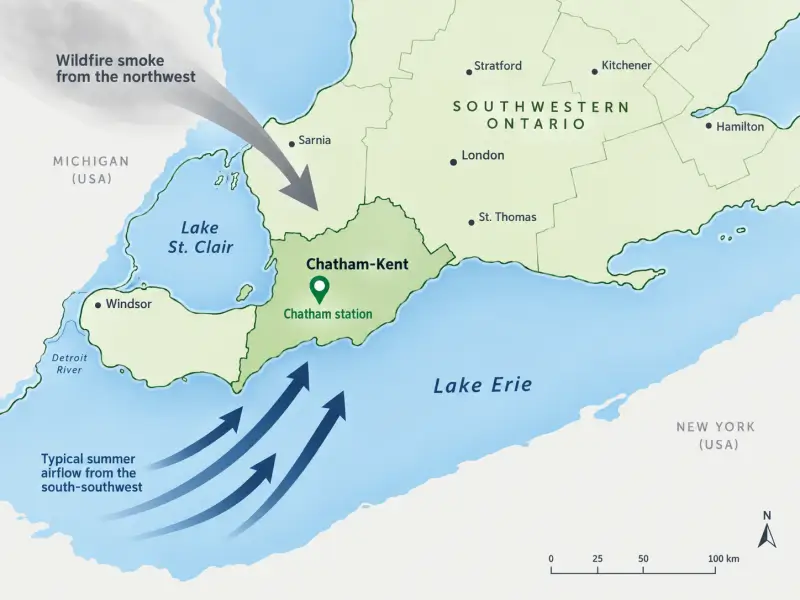
Air pollution in Chatham-Kent is largely carried in from outside the region, especially ozone and fine particles from U.S. sources and smoke from distant wildfires.
Transboundary pollution. The Air Quality in Ontario 2023 Report finds that U.S. and global background sources contribute over 60% of annual PM2.5 along southwestern Ontario's border areas. On high-ozone days, over 90% of the region's ozone comes from U.S. and global background sources.
Ozone vs. smoke: why the fix differs. Chatham-Kent's summer ozone is largely imported, and a gas passes through pleated filter media. Smoke is mostly fine particles, which higher-MERV filters are built to capture. Smoke also carries gases and odours, which pleated filters don't capture.
“Ozone is a gas. It does not smell like a campfire, and a pleated particle filter, ours included, does almost nothing to it. The honest advice is to move outdoor plans to the morning, not to buy a better filter.” David Clark, CEO of Filterbuy HVAC Solutions and Licensed HVAC Technician (Filterbuy AQI guide)
Wildfire smoke. On 15 July 2026, Environment Canada issued an orange air quality warning as northwestern Ontario wildfire smoke moved into Chatham-Kent (CKNX News Today).
What Should You Do on Smoke Days in Chatham-Kent?
Start with official guidance: check Environment Canada's Chatham air quality page and follow local public health advice. When smoke pushes Chatham-Kent's AQHI to 7 or higher, or a U.S. AQI app to 100, Filterbuy recommends four steps: MERV 13 in your HVAC system, the fan set to On, a portable HEPA air cleaner in each occupied room, and a closed-up house.
The U.S. EPA recommends a MERV 13 or higher filter in central HVAC systems during smoke events (EPA). Health Canada gives the same MERV 13 guidance (Health Canada). The AQHI 7 and AQI 100 triggers are Filterbuy's action lines.
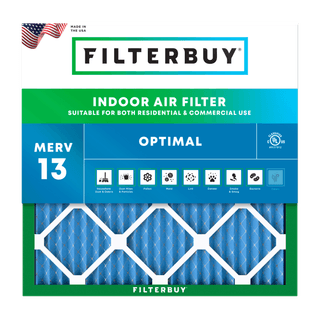
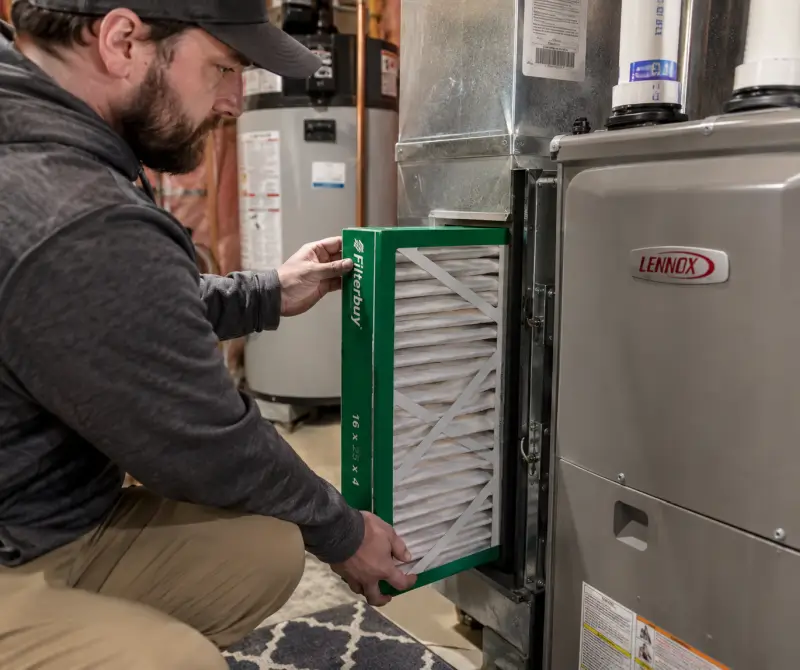
1. Put MERV 13 in your HVAC system. It filters the whole home. Confirm your size, the same quick fit check as always. See how to upgrade to a MERV 13 filter.
2. Set the thermostat fan to On. Auto only filters while the system heats or cools.
3. Run a portable HEPA air cleaner in each occupied room, bedrooms first. EPA sizing calls for a smoke CADR of at least two-thirds of the room's square footage, so a 300 sq ft bedroom needs a CADR of roughly 200. Avoid air cleaners that produce ozone. No central system? Portable HEPA cleaners are your main defence. HEPA belongs in portable units, not furnaces (MERV 13 vs HEPA).
4. Close up the house. Keep windows and doors shut. Skip candles, frying, smoking, and vacuuming without a HEPA vacuum. During extreme heat, staying cool comes first.
5. Check the filter while smoke lingers. EPA advises replacing it when it looks dark brown or black, which can be well before its usual interval. Keep a spare, then use our checklist to recover from wildfire smoke exposure.
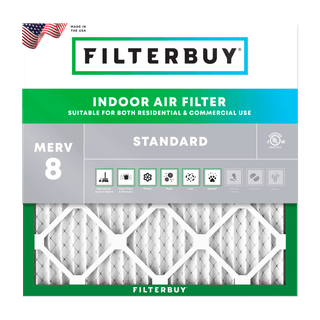
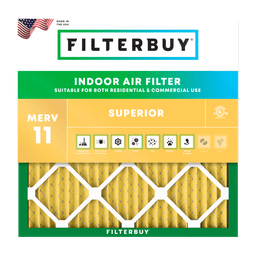
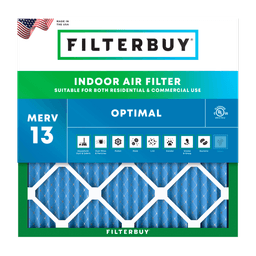
Choosing your Filterbuy filter. Smoke maps to MERV 13 on Filterbuy's ladder. Pleated filters capture particles, not the gases behind smoke odour, so odours route to the Odour Eliminator line. Compare tiers below or read MERV 11 vs MERV 13.
EPA notes that most furnaces and HVAC systems can accommodate MERV 13 when the filter is replaced often. Confirm your size, the same fit check as always.
Filterbuy filters are crafted in our own U.S. facilities and shipped free to Canada on every order, with no minimum. Our advice for Chatham-Kent: get MERV 13 filters in before spring and keep a spare, since statements arrived as early as 14 April in 2023. With over 600 sizes plus custom air filters, you can find your filter size or set up an air filter subscription you can edit, skip, or cancel anytime.
Supporting Statistics
1. Detroit Air Fails Next Door
• 9th worst U.S. metro area for year-round particle pollution.
• 6.8 unhealthy ozone days per year in Wayne County, Michigan.
• Local link: Detroit is under 100 km west of Chatham, and its pollution can drift across the border.
Source: American Lung Association, State of the Air 2026
2. Wildfire Smoke Hits Lungs Harder
• 1.3–10% more respiratory hospital admissions per 10 µg/m³ of wildfire PM2.5.
• About 1% for the same amount of PM2.5 from other sources.
• Smoke days: Better filtration matters more.
Source: Scripps Institution of Oceanography, UC San Diego
3. Most Exposure Happens Indoors
• 90% of time spent indoors by Americans, on average.
• 2 to 5 times higher indoor levels for some pollutants.
• At home: Your furnace filter shapes the air you breathe most.
Source: U.S. EPA, Report on the Environment
Frequently Asked Questions
Glossary
• Air Quality Health Index (AQHI): Canada's 1 to 10+ scale for the short-term health risk of outdoor air, developed by Health Canada and ECCC.
• Air Quality Index (AQI): The U.S. EPA's 0 to 500 scale, used by many weather apps.
• Air Quality Ontario: The Government of Ontario website publishing hourly AQHI readings, maps, and alerts.
• HEPA: High-efficiency particulate air, a filter standard used in portable air cleaners.
• Environment and Climate Change Canada (ECCC): The federal department issuing air quality forecasts, statements, and alerts.
• Special air quality statement: An ECCC notice that smoke or pollution is causing, or expected to cause, poor air quality.
• PM2.5: Fine particles 2.5 micrometres or smaller, a key part of smoke and haze.
• Ground-level ozone (O3): A gas formed when pollutants react in sunlight, highest on hot afternoons.
• MERV: Minimum Efficiency Reporting Value, a rating of how well an HVAC filter captures particles.
• Filterbuy: A U.S. manufacturer of pleated air filters in 600+ sizes, shipping free to Canada from filterbuy.ca.