
Saint John Real-Time AQI Tracker
What's Actually In Saint John Air Today?
What High AQI Means for Your Lungs in Saint John
How to Read AQI
The Air Quality Index (AQI) measures how polluted the air is and how it may affect your health.
0–50 (Good): Air quality is satisfactory.
51–100 (Moderate): Acceptable, but some pollutants may pose minor concerns.
101–150 (Unhealthy for Sensitive Groups)
151–200 (Unhealthy)
201–300 (Very Unhealthy)
301+ (Hazardous)
Moderate
Still okay for most, but if you have asthma or allergies, take it easy and avoid long outdoor workouts.
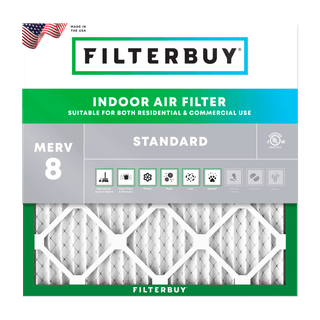
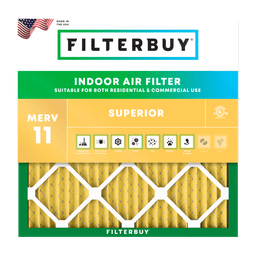
Shop MERV 11 filters→What's the Right Filter for Your AQI Level?




Check Today's Live Real Time Air Quality Index AQI Map in Saint John, NB Now
TL;DR
Saint John's official air quality reading is the Air Quality Health Index (AQHI), which Environment and Climate Change Canada publishes every hour on a 1 to 10+ scale. A reading of 1 to 3 is low risk, 4 to 6 moderate, 7 to 10 high, and anything above 10 very high. The live Saint John air quality map above shows today's reading, but most of the city's monitoring stations also track sulphur pollutants that the AQHI leaves out.
Key Takeaways
Saint John's AQHI is calculated hourly by Environment and Climate Change Canada from ozone, nitrogen dioxide, and fine particulate matter (PM2.5).
Saint John is New Brunswick's most monitored city, with four provincial and 10 industry-run stations.
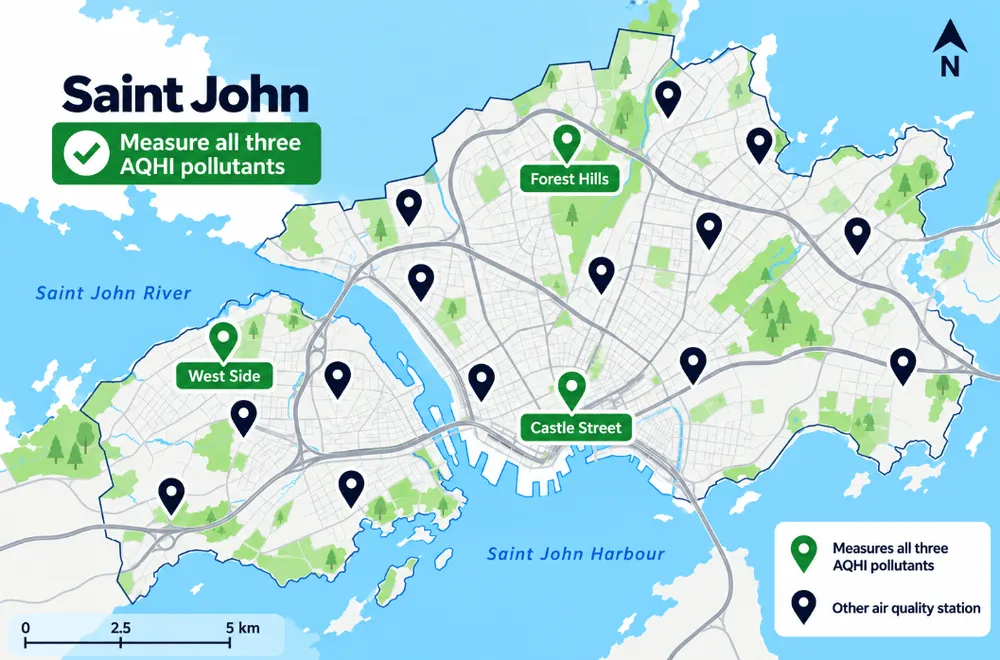
Only three of Saint John's 14 stations measure all three AQHI pollutants, while 11 measure sulphur dioxide and seven measure total reduced sulphur.
A low AQHI does not rule out a sulphur smell, because sulphur pollutants sit outside the AQHI formula.
New Brunswick's sulphur dioxide objectives are 50 percent stricter in Saint John, Charlotte, and Kings counties.
What Does Today's Saint John AQHI Reading Mean?
The Air Quality Health Index is Canada's health-based air quality scale, and it is the official reading for Saint John. Environment and Climate Change Canada calculates it every hour from three pollutants (ground-level ozone, nitrogen dioxide, and fine particulate matter) and issues forecasts twice a day, at 6 a.m. and 5 p.m. local time. The higher the number, the higher the health risk.
If your weather app shows a different number, it is probably using the American AQI, a 0 to 500 scale built on single-pollutant thresholds rather than combined health risk, so the two rarely match. During wildfire smoke events, the AQHI switches to a fine-particulate-only formula so it can respond faster as smoke moves in.
Source: Environment and Climate Cha
Why Is Saint John New Brunswick's Most Monitored City?
No city in New Brunswick is monitored more closely than Saint John. The provincial Department of Environment and Local Government lists four stations in the city, and large industrial facilities run another 10 as a condition of their approval under the provincial Clean Air Act.
That density follows the industry. Saint John is home to Canada's largest oil refinery, operated by Irving Oil, as well as two Irving paper mills and a working port, while NB Power's Coleson Cove Generating Station, the province's largest sulphur dioxide emitter, sits just outside the city. Filterbuy Canada compiled what each station measures from the provincial list.
Compiled from the Government of New Brunswick southern air zone station list. NO2 is nitrogen dioxide, SO2 sulphur dioxide, TRS total reduced sulphur.
Our count across all 14 Saint John stations: 11 measure sulphur dioxide, seven total reduced sulphur, six PM2.5, four nitrogen dioxide, and three ozone. Only Castle Street, West Side, and Forest Hills measure all three AQHI pollutants.
Which Station Should You Watch for Your Neighbourhood?
In Saint John, the station that matters most is usually the one downwind of the nearest emitter, not the one closest to the city centre. The 2025 sulphur dioxide study found that prevailing winds carry refinery emissions toward the northeast, which helps explain why Forest Hills records roughly double the annual sulphur dioxide of stations south of the refinery. Filterbuy Canada built this guide to help you choose which station to follow on the Air Quality Data Portal.
Neighbourhood groupings compiled from the provincial station list and the 2025 Atmospheric Environment study of sulphur dioxide monitoring gaps in Saint John.
What Does the AQHI Leave Out in Saint John?
The AQHI does not include sulphur dioxide, total reduced sulphur, or volatile organic compounds, even though these are the pollutants most closely tied to Saint John's heavy industry. A low AQHI is a good sign for smog, but it says nothing about a short sulphur episode in a single neighbourhood.
Provincial records show how much that gap matters here. In 2021, 14 of the 15 air quality exceedance events recorded across New Brunswick involved sulphur dioxide or total reduced sulphur, and 10 of those happened in Saint John, according to a 2025 study in the journal Atmospheric Environment by researchers affiliated with Dalhousie University. The same study modelled higher sulphur dioxide drifting on prevailing winds into northeast, north, and southeast Saint John, areas that have no sulphur dioxide monitor.
The province does set tighter rules for this area. Under New Brunswick's air quality objectives, sulphur dioxide limits in Saint John, Charlotte, and Kings counties are 50 percent stricter than elsewhere. Hydrogen sulphide, the main component of total reduced sulphur and the source of the familiar rotten-egg smell, carries a separate one-hour objective of 11 parts per billion. If an odour becomes a nuisance, the same page links the province's reporting guide.
How Does Saint John's Air Quality Change Through the Year?
Saint John's air shifts with the seasons, while its industrial sources keep running underneath all year. Across New Brunswick, the provincial environment department points to wood smoke, pollen, forest fire smoke, and long-range pollution as the most common challenges.
Smoke reaches the Maritimes too. New Brunswick's lung health charity, notes that Canada's 2023 wildfire season, the worst on record, brought smoky skies to every province, New Brunswick included. When smoke is in the forecast, the New Brunswick wildfire and smoke map shows where fires are burning, and the Filterbuy Canada guide to the best MERV filter for wildfire smoke covers what to do indoors.
How Can You Check Saint John's Air in Two Minutes?
The AQHI and the sulphur readings it leaves out come from two different places, so Filterbuy Canada recommends a quick routine that checks both.
Start with today's AQHI on the live map above and note the risk category.
Look at the 72-hour forecast maximums before you plan time outdoors.
If you smell sulphur, open the Air Quality Data Portal and check sulphur dioxide and total reduced sulphur at your nearest station.
Then match the reading to the indoor steps below, or set an alert in the federal WeatherCAN app.
What Can You Change Indoors When the Reading Climbs?
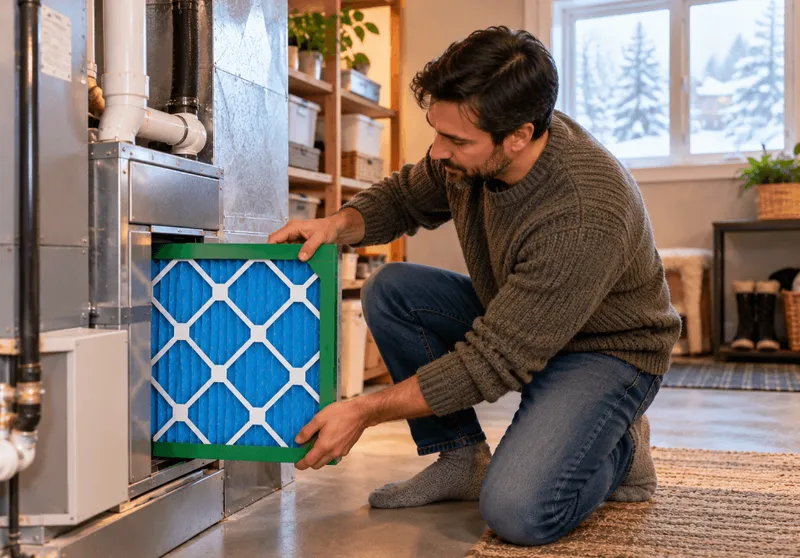
You cannot control the air outside, but you can control the air moving through your furnace. When the reading climbs, close the windows and switch the HVAC system to the fan setting so air keeps passing through the filter. Then check whether the filter is overdue.
Canadian furnaces often run six to eight months a year, so sticking to a winter furnace filter schedule pays off in Saint John. Filterbuy Canada carries pleated filters in more than 600 sizes, plus custom sizes, with free shipping to Canada and prices in CAD.
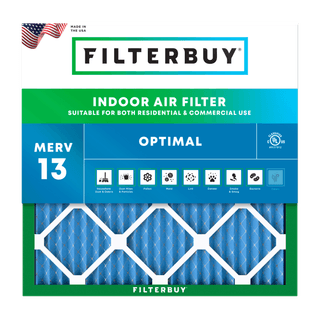
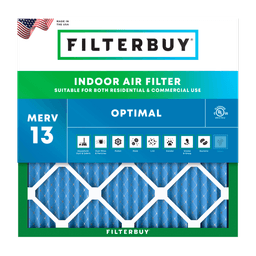
One limit we would rather tell you up front, especially in an industrial city: a pleated filter captures particles, not gases such as sulphur dioxide. Odour Eliminator carbon-infused filters help with household odours, but no furnace filter replaces a look at the station data when an industrial smell lingers. For smoke, MERV 13 Optimal filters are the usual choice, as long as your system supports MERV 13. The Filterbuy Canada guide to MERV ratings explains the differences, and Subscribe and Save times replacements around the heating season, with edit, skip, or cancel anytime.
What We Learned Researching Saint John's Air
Many cities in the Filterbuy Canada air quality series borrow their reading from a station kilometres away. Saint John is the opposite. When we lined up all 14 stations against the pollutants each one measures, a clear pattern emerged: the city's monitoring network is built around sulphur, while the AQHI is built around smog. That is why this page pairs the AQHI with station-level sulphur data rather than relying on a single number.
I don't want anyone to feel like they need an HVAC license just to pick the right filter. My job is to give you the straight answer, explain why it matters, and let you get back to your day.
Michelle Wan, Brand Manager and Air Quality Writer, Filterbuy Canada
Supporting Statistics
Hydrogen sulphide is detectable at 0.5 ppb. New Brunswick's one-hour objective is 22 times higher, at 11 ppb, so a rotten-egg smell can show up well below the limit. Source: U.S. Agency for Toxic Substances and Disease Registry.
The U.S. EPA's one-hour sulphur dioxide health standard is 75 ppb. Short-term exposure can make breathing difficult, especially for children with asthma, yet sulphur dioxide sits outside the AQHI. Sources: EPA Sulfur Dioxide Basics, EPA NAAQS Table.
High-efficiency HVAC filtration may cut indoor PM2.5 by about 50 percent during wildfire smoke when the fan runs continuously and windows stay closed. Source: U.S. EPA.
Frequently Asked Questions
What is the air quality in Saint John today?
The live map at the top of this page shows the current reading. The official Canadian measure for Saint John is the Air Quality Health Index, which Environment and Climate Change Canada publishes hourly on a 1 to 10+ scale, where 1 to 3 is low risk.
Is the air quality bad in Saint John today?
On the AQHI, 7 to 10 is high risk and anything above 10 is very high risk. At high risk, people at risk are advised to reduce or reschedule strenuous outdoor activity. Readings change hour to hour, so check the live map rather than assuming.
Why does Saint John sometimes smell of sulphur when the AQHI is low?
The AQHI is built from ozone, nitrogen dioxide, and fine particulate matter only. Sulphur dioxide and total reduced sulphur, which cause most sulphur and rotten-egg odours, are not part of it, but the provincial Air Quality Data Portal shows both hourly for each station.
Where can I see Saint John's PM2.5 today?
The New Brunswick Air Quality Data Portal publishes hourly fine particulate values for six Saint John stations: Castle Street, West Side, Forest Hills, Champlain Heights, Lorneville, and Manawagonish Road.
What filter rating helps on smoky days in Saint John?
MERV 13, sold as Optimal by Filterbuy Canada, is the usual choice for fine particles such as wildfire smoke.
Glossary
AQHI (Air Quality Health Index). Canada's health-based air quality scale, 1 to 10+, calculated hourly by Environment and Climate Change Canada from ozone, nitrogen dioxide, and PM2.5.
AQI (Air Quality Index). The American 0 to 500 scale used by most international apps. It reports the worst single pollutant, so its numbers do not match the AQHI.
PM2.5. Fine particulate matter smaller than 2.5 micrometres, from vehicles, industry, wood smoke, and forest fires.
Sulphur dioxide (SO2). A gas released by burning sulphur-containing fuels in refining, power generation, and shipping.
Total reduced sulphur (TRS). Sulphur compounds, mainly hydrogen sulphide, linked to refining and pulp and paper processes and to rotten-egg odours.
VOCs (volatile organic compounds). Carbon-based chemicals that evaporate readily, monitored routinely at Forest Hills and Champlain Heights.
Air Quality Data Portal. New Brunswick's website publishing hourly results from provincial and industry-run monitoring stations.
MERV. Minimum Efficiency Reporting Value, the ASHRAE rating for how well a filter captures particles. Higher numbers capture smaller particles.
About the Author
Author. Michelle Wan is Brand Manager and Air Quality Writer at Filterbuy Canada, where she turns MERV ratings into plain-English advice and fronts much of the brand's educational video content. She holds a B.A. from the University of California, Santa Cruz.
Air quality readings on this page are for information only. If you or a family member is experiencing respiratory symptoms, contact a healthcare provider or call 811.