
New Brunswick Live Wildfire Smoke Map
Get Alerts For Wildfires In Your Area
The moment a wildfire starts near you, you'll get an instant alert and simple tips to reduce your smoke exposure.
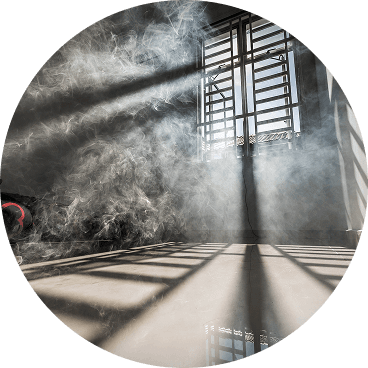
What's In The Smoke
30xSmaller than a human hair
Fine enough to reach deep into the lungs. A MERV 13 is built to capture it.
How Far It Travels


It Doesn't Stay Local
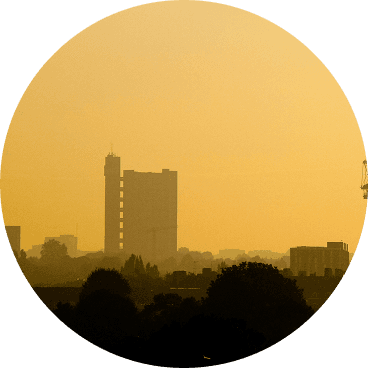
Smoke rides the wind far downwind — you can get smoky air with no fire nearby.
What To Do During A Smoke Event
Simple steps to reduce indoor exposure.
- Stay In, Close UpShut windows and doors to keep smoke out.
- Set Fan To "On"Keeps air cycling through your filter, not just when heating or cooling.
- Recirculate AirSwitch off fresh-air intake so you're not pulling smoke in.
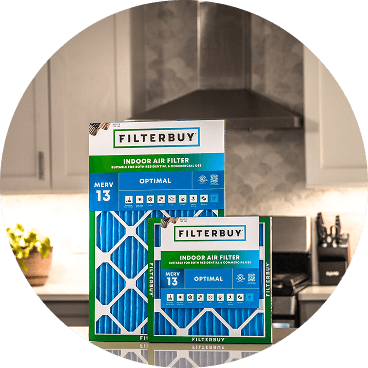
- Run A MERV 13Built to capture the fine PM2.5 in smoke.
- Add A PurifierExtra filtration for the room you use most.
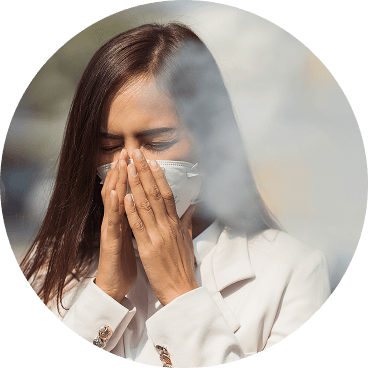
- Wear an N95 if OutsideFits snug to block fine particles — a cloth mask won't.


The Best Air Filter For Wildfire Smoke
During smoke events, the EPA recommends upgrading to a MERV 13 filter — or the highest-rated filter your system can handle — to help reduce the fine particles smoke brings indoors. MERV 13 is the level most home HVAC systems can run while still capturing PM2.5, the fine particulate that makes up the bulk of wildfire smoke.
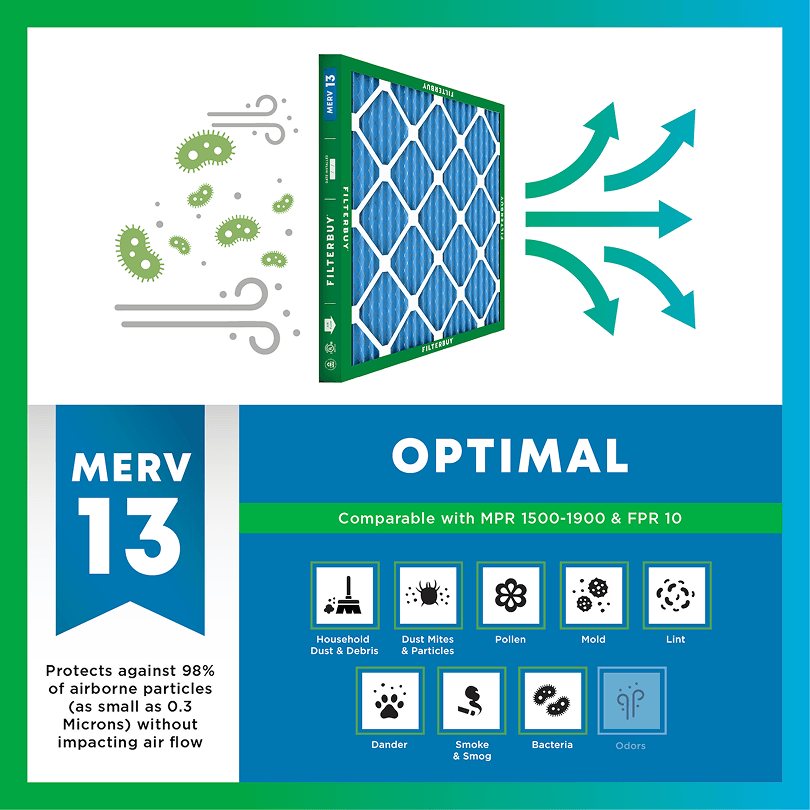
- Captures PM2.5 particles
- Blocks ash, soot, and smoke odor
- Keeps your indoor air safe—even when the outdoor air is dangerous
- Meets the EPA's recommended rating for filtering fine wildfire smoke particles.
Wildfire Smoke FAQs
Facts About Wildfires
Over 70,000 wildfires burn in the U.S. every year.
Wildfire smoke can travel 1,000+ miles, affecting states that aren't even near the blaze.
Exposure to wildfire smoke can worsen asthma, trigger heart issues, and lead to ER visits.
Indoor air can hold more fine particles during wildfire events unless it's properly filtered.
The EPA advises using MERV 13 filters or portable HEPA air cleaners during wildfire smoke events.
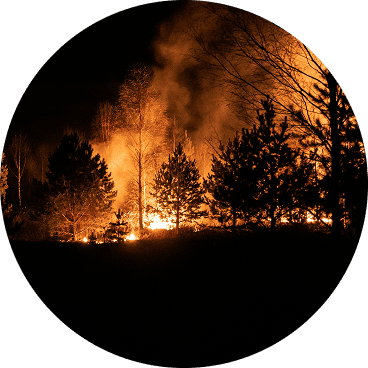
Don't Wait Until The Smoke's Inside.
Use the live wildfire smoke tracker and upgrade your air filters today to protect your lungs and your home.
Shop Filters For Smoke Protection
Live New Brunswick Forest Wildfire & Smoke Map Today: Provincial Air Quality Tracking & Indoor Protection Solutions
TL;DR
New Brunswick's official live wildfire sources are the Government of New Brunswick (GNB) wildfire dashboard and Fire Watch page. For smoke, pair Environment and Climate Change Canada's FireWork smoke forecast with your local Air Quality Health Index (AQHI). When smoke arrives, follow official advice first, then put a MERV 13 filter in your HVAC and set the fan to On.
The Filterbuy take: The map shows what's outside. Your filter reduces how much of it stays inside.
Current status (checked September 28, 2026)
The GNB Fire Watch page lists no wildfire notices or alerts. For today's fire count, open the New Brunswick wildfire dashboard.
To report a wildfire, call 911 (how to report).
Key Takeaways
Official live fire updates come from the GNB wildfire dashboard and Fire Watch page.
Canada rates smoke with the AQHI, a 1-to-10+ health-risk scale, where 7 or higher means high risk.
Health Canada's cleaner-air guidance names MERV 13 or higher for smoke, and MERV 13 is the Filterbuy smoke tier.
Live New Brunswick Wildfire & Smoke Map
The Filterbuy live wildfire map puts fire and smoke data in one view. Fire points come from Natural Resources Canada's CWFIS interactive fire map, while the smoke shading comes from NOAA's satellite Hazard Mapping System. A fire point shows where a fire was reported, not how far it has spread. Our guide explains how to read a wildfire smoke map.
For health risk, check the AQHI forecast for New Brunswick for Saint John, Fredericton, Moncton, Saint Andrews, Miramichi, Edmundston, Campbellton and Bathurst (e.g., Fredericton AQHI), or our live Canada wildfire and smoke map nationally.
Where Can I Find Official Live Fire and Smoke Maps for New Brunswick?
For fires, use the GNB wildfire dashboard. For smoke, use ECCC's FireWork forecast and the AQHI. The table matches each source to its best use.
All sources are also available in French. For evacuations, follow officials and Alert Ready.
What Do New Brunswick Wildfire Status Terms Mean?
This table puts the official GNB fire status definitions into plain language.
Source: Government of New Brunswick fire status definitions.
How Do I Read Smoke Levels in New Brunswick? (AQHI Explained)
Canada's Air Quality Health Index rates health risk from 1 to 10+. U.S.-built apps show the AQI, a different scale.
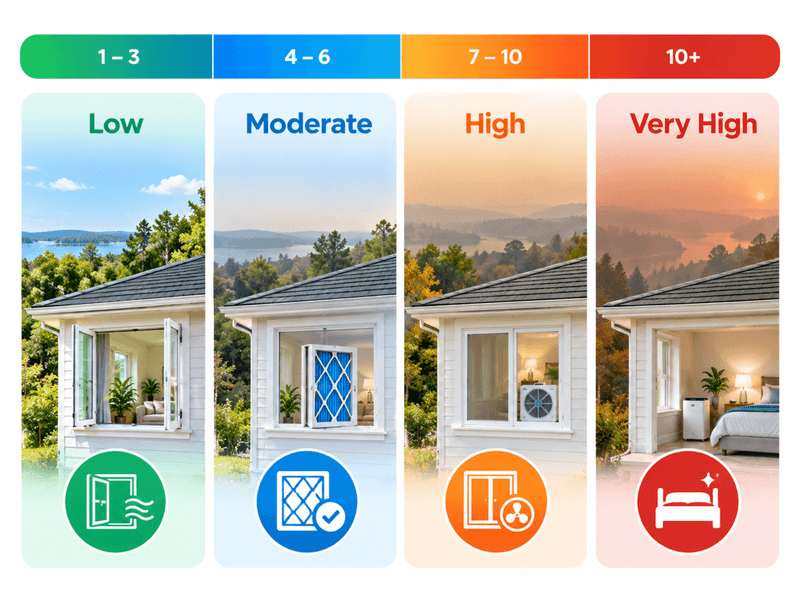
Scale: ECCC and Health Canada. Home actions: Filterbuy. During smoke, the AQHI is calculated hourly from PM2.5 (fine particles).
When to act: Filterbuy's action line is an AQHI of 7 during smoke. At that point, we recommend a MERV 13 filter in your HVAC, the fan set to On, a portable HEPA air cleaner in each occupied room, and a closed-up house. ECCC sets the scale; the action line is ours.
Why Is Wildfire Risk Higher in New Brunswick Now?
In 2025, 444 wildfires burned about 3,400 hectares in New Brunswick, according to GNB. After 10 dry months, the province launched the 2026 season early and brought in four new Fire Boss aircraft, then released a multi-year wildfire management plan in August.
Health Canada notes that wildfire season typically runs from early April to October (Health Canada). Filterbuy watches the fall overlap, when furnaces run more and filters load faster.
How Do I Protect My Home From Wildfire Smoke in New Brunswick?
Start with official guidance: ECCC air quality statements and local officials, including any direction to stay in or leave. These steps support that advice and follow Health Canada on protecting your indoor air.
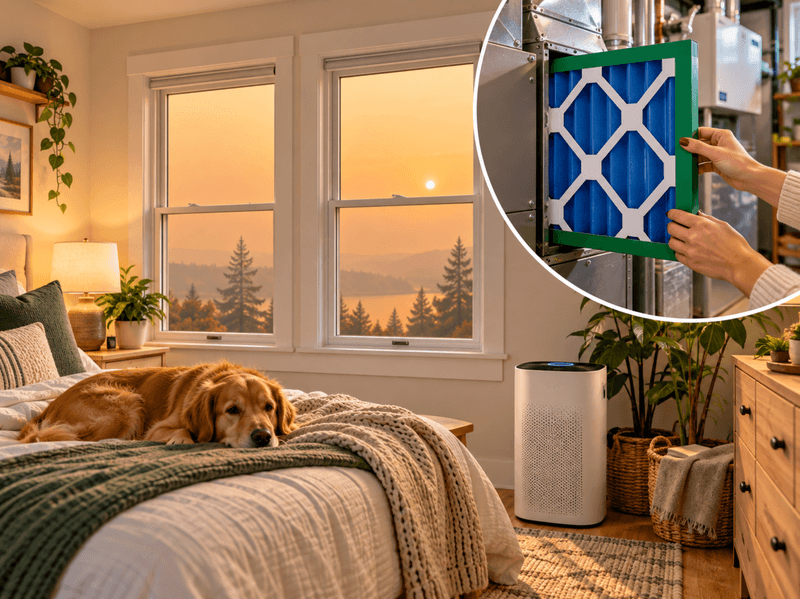
Put a MERV 13 filter in your HVAC. It's the whole-home layer. EPA recommends a MERV 13 or higher filter during smoke and notes that most furnaces can run one without equipment problems when it's replaced often (EPA). Match the size printed on your current filter.
Set the thermostat fan to On. On "Auto," air is only filtered while the system heats or cools. On keeps it filtering all the time.
Run a portable HEPA air cleaner in each occupied room, bedrooms first. That's Filterbuy's recommendation; Health Canada describes one clean-air room. In wildfire studies, portable cleaners cut indoor PM2.5, the fine particles in smoke, by an average of 57% (NCCEH evidence review). Skip ionizers and ozone generators; Health Canada and EPA advise against cleaners that produce ozone.
Close the house up. Shut windows, doors and dampers, limit exhaust fans, and skip candles, frying, the wood stove and smoking.
Recirculate indoor air. Health Canada's cleaner air spaces guidance advises recirculating while air is poor. For an HRV or ERV, follow the maker's smoke settings.
Check your filter during any smoke event. Replace it when it looks dark brown or black, which can be well before its normal interval (EPA). Keep spares on hand. Afterward, see how to clean the air in your house after wildfire smoke.
No central HVAC? In apartments or homes with baseboard or wall heat, portable HEPA air cleaners are your main defence. Put one in each room you use, starting with the bedroom.
A DIY box-fan cleaner with a MERV 13 filter is a reasonable stopgap, not a replacement for a certified unit. Use a certified 2012-or-newer fan and never leave it unattended.
We've worked through plenty of smoke seasons with Canadian households, and one habit sets apart the homes that breathe easy: they close the windows, keep the furnace fan running, and put a fresh MERV 13 filter in before the smoke arrives.
The Filterbuy.ca Team
The Filterbuy New Brunswick Smoke-Season Playbook
A Daily Smoke-Day Routine
Atlantic Daylight Time. AQHI times follow ECCC New Brunswick bulletins.
Size Your Clean-Air Room in 30 Seconds
Multiply floor area by two-thirds: a 300 sq ft bedroom wants a smoke CADR of about 200, and high ceilings need more. The rule comes from Health Canada's advice on choosing a portable air cleaner.
Before the Season Starts (Early April)
Note the filter size on your current filter and get a MERV 13 in before smoke arrives.
Keep spare filters, and buy air cleaners early.
Which Filterbuy Air Filter Is Best for Wildfire Smoke Season?
MERV 13, in your size. It's the Filterbuy tier for smoke; we recommend a tier, not a single "wildfire filter."
EPA notes most furnaces can run MERV 13 without equipment problems when it is replaced often.
Filterbuy cuts 600+ sizes, priced in CAD with free shipping in Canada, plus custom air filters. Pleated filters capture particles, not the gases behind smoke smell; for odours, see the Odor Eliminator line. HEPA belongs in portable cleaners, not furnaces (MERV 13 vs. HEPA guide).
→ Find your MERV 13 filter size
Who Is Most at Risk From Wildfire Smoke?
Children, older adults, pregnant people and anyone with lung or heart disease face higher risk, according to Health Canada. If that's you, ask your doctor about a smoke plan. For breathing trouble or chest pain, call 911.
Supporting Statistics: What U.S. Research Shows About Wildfire Smoke
17% more asthma emergency visits. Across 19 days of Canadian smoke in 2023, U.S. asthma emergency visits ran 17% above expected. Source: CDC, Morbidity and Mortality Weekly Report (2023).
61.5 million people exposed to particle spikes. That many Americans live in counties graded F for short-term particle pollution. Source: American Lung Association, State of the Air 2026.
About 3.6 times more filtered air. In EPA tests, a box fan with one MERV 13 filter delivered a CADR of 111; a four-filter design delivered 401. Source: U.S. EPA, Research on DIY Air Cleaners.
Frequently Asked Questions
What MERV Rating Do I Need for Wildfire Smoke?
MERV 13. EPA recommends MERV 13 or higher during smoke. Filterbuy recommends it too, with a portable HEPA air cleaner in each occupied room.
Is There a Forest Fire in New Brunswick Right Now?
The GNB wildfire dashboard lists every active forest fire in New Brunswick with its size and status, and conditions change within hours.
Why Is It Smoky in New Brunswick When There Are No Fires Nearby?
Health Canada notes that smoke can travel thousands of kilometres, so haze often comes from fires in other provinces. Read more on how far wildfire smoke can travel.
Can I Have a Campfire in New Brunswick Today?
Check the burning conditions map or call 1-866-458-8080. Campfires follow the daily setting: No burn, Restricted (8 p.m. to 8 a.m.), or Burn permitted.
Glossary
GNB: The Government of New Brunswick.
ECCC: Environment and Climate Change Canada.
FireWork: ECCC's 72-hour wildfire smoke forecast.
AQHI (Air Quality Health Index): Canada's 1-to-10+ health-risk scale for local air pollution.
PM2.5: Fine particles 2.5 micrometres or smaller, the main health concern in smoke.
MERV (Minimum Efficiency Reporting Value): A 1-to-16 rating of how well an HVAC filter captures particles.
HEPA: A portable air cleaner filter standard that captures 99.97% of 0.3-micrometre particles.
CADR (Clean Air Delivery Rate): How much filtered air a portable air cleaner delivers.
Sources
All sources accessed September 28, 2026.
About the author: Michelle Wan is Brand Manager and Air Quality Writer at Filterbuy. She works directly with Filterbuy's manufacturing teams, so her advice reflects how filters are built and used in real homes (B.A., UC Santa Cruz).
About the reviewer: David Clark, a Licensed HVAC Technician with Filterbuy HVAC Solutions, reviews Filterbuy's HVAC guidance for technical accuracy.