
Air Quality in Quebec
Air quality index (AQI⁺) and PM2.5 air pollution in Quebec •
Live Air Quality Ratings in Quebec
Live city rankings are temporarily unavailable.
The Right Air Filter For High AQI Days
When outdoor air quality drops, the EPA recommends upgrading to a MERV 13 filter — or the highest-rated filter your HVAC system can handle — to help capture more of the fine particulate (PM2.5) that comes with poor air quality. MERV 13 is the highest rating most residential systems can run without restricting airflow.
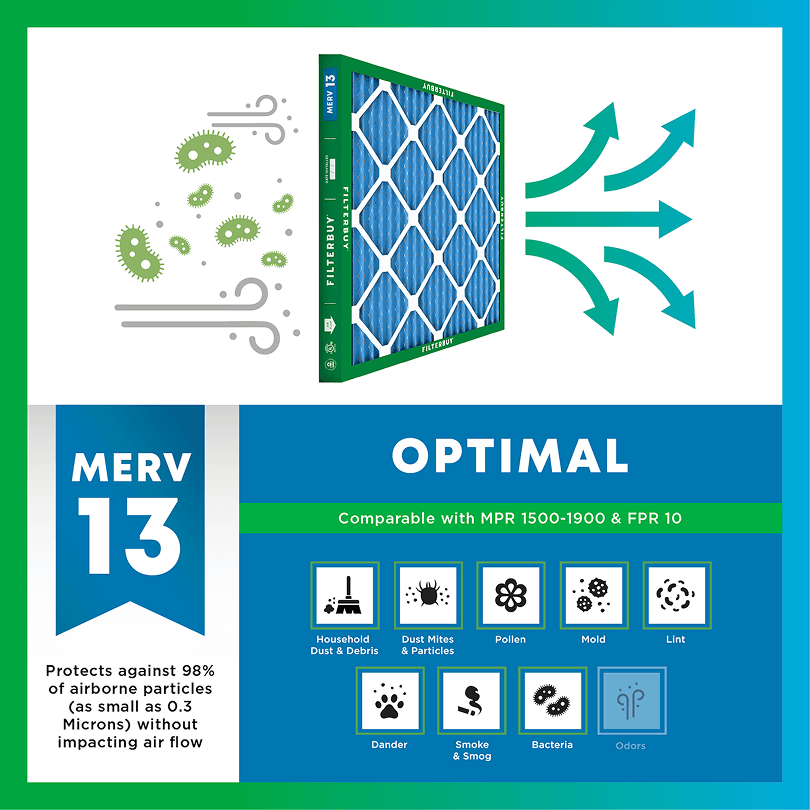

- Captures PM2.5 and other fine particulates
- Filters ash, soot, and smoke particles
- Rated to capture particles as small as 0.3 microns
- Matches the filter rating the EPA suggests during high-AQI and smoke events

AQI FAQs
What is AQI?
AQI stands for Air Quality Index, the EPA's scale for reporting daily air quality. It runs from 0 to 500. The higher the number, the greater the level of air pollution. Values at or below 100 are generally considered satisfactory; values above 100 mean air quality is unhealthy, first for sensitive groups, then for everyone as numbers climb.
What does AQI measure?
The AQI tracks five major pollutants regulated by the Clean Air Act: ground-level ozone, particle pollution (PM2.5 and PM10), carbon monoxide, sulfur dioxide, and nitrogen dioxide. The reported AQI value reflects whichever pollutant is highest at that time — most often ozone or fine particles (PM2.5).
How is AQI calculated?
Monitoring stations measure pollutant concentrations, and the EPA converts each into a standardized 0–500 score using set breakpoints. Each pollutant gets its own sub-index, and the highest sub-index becomes the reported AQI. That's why a single number can represent different pollutants on different days.
What is a good AQI?
An AQI of 0–50 is rated "Good" — air quality poses little or no risk. 51–100 is "Moderate," acceptable for most people though unusually sensitive individuals may want to limit prolonged outdoor exertion. Anything at or below 100 is generally considered satisfactory air quality.
What does an AQI of 100 (or 150) mean?
100 is the dividing line: at or below it, air quality is satisfactory for the general public. From 101–150, air is "Unhealthy for Sensitive Groups" — people with respiratory conditions, older adults, and children. From 151–200, it's "Unhealthy" and everyone may begin to feel effects.
Why is the AQI bad today?
Short-term AQI spikes usually come from wildfire smoke, temperature inversions that trap pollutants near the ground, high-ozone weather (hot, sunny, stagnant days), or heavy traffic and industrial activity. Check a real-time source like the map on this page to see which pollutant is driving today's reading in your area.
What AQI is bad for running or exercise?
Many runners follow the EPA category lines: below 50, no adjustment needed; 51–100, unusually sensitive people may shorten intense workouts; above 100, sensitive groups are advised to reduce prolonged or heavy outdoor exertion; above 150, that advice extends to everyone. Exercise increases how much air you breathe in, which is why thresholds matter more during workouts.
What AQI is safe to open windows?
A common rule of thumb is to keep windows open when the AQI is under 100 and close them when it climbs above, especially during wildfire smoke events when fine particles are elevated. When windows are closed, running your HVAC system with a fresh filter helps capture particles circulating indoors.
Should I wear a mask based on AQI?
Public health agencies generally suggest considering a well-fitted N95-style respirator outdoors when the AQI exceeds 150, particularly during smoke events. Cloth and surgical masks don't filter fine particles effectively. Follow guidance from your local health department, which may adjust recommendations during severe episodes.
Check Today’s Live Real-Time Air Quality Index AQI Map in Quebec Now
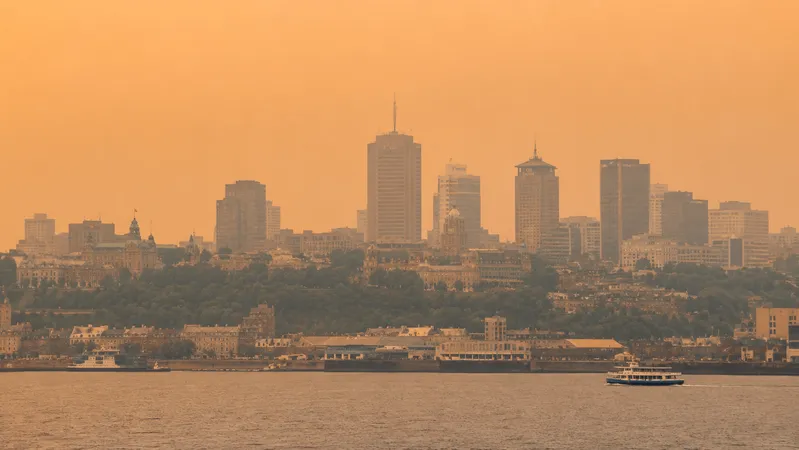
Quebec’s air can change by the hour, especially in wildfire season. The live map below shows where it stands right now. Find your city, check today’s reading and colour, and make a few simple changes at home when the air turns smoky or hazy. The readings refresh throughout the day, so look again when the weather shifts.
TL;DR Quick Answers
Live air quality index (AQI) map now today in Quebec
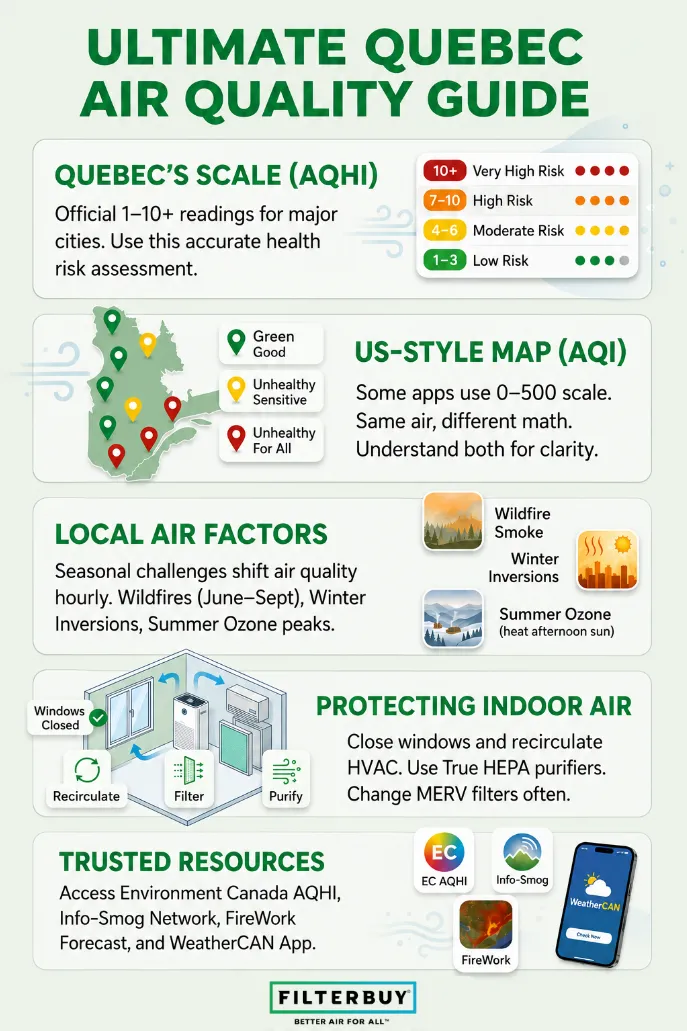
Quick answer: Environment Canada reports Quebec’s live air quality on the Air Quality Health Index (AQHI), a 1 to 10+ scale that it updates throughout the day. That’s the number to trust here, not the US 0 to 500 AQI some apps show. Check today’s reading on the live map. If it sits at 7 or higher, treat the air as poor. Close your windows, set your HVAC to recirculate, and keep hard activity indoors.
What you’re reading: Quebec uses the AQHI (1 to 10+). Some apps show a US-style AQI (0 to 500). Same air, different scale.
Quick AQHI guide: 1–3 low, 4–6 moderate, 7–10 high, 10+ very high.
Watch the pollutant: In wildfire smoke, watch PM2.5. Those fine particles affect your health the most.
Recheck often: Readings shift through the day. Look again when the wind changes or smoke moves in.
Protect indoor air: On poor-air days, a MERV 13 furnace filter helps clear smoke particles from the air inside your home.
Our take: The map shows the air outside. The air that matters most is inside your home, where you spend most of the day, and where the right filter does the most good.
Key Takeaways
Check the live map for your part of Quebec, and look again after the wind shifts or smoke moves in.
On smoky or high-PM2.5 days, keep your windows closed and set your HVAC to recirculate.
Match the right MERV filter to your system, and add a HEPA purifier for a cleaner room.
Plan outdoor time for the cleanest part of the day, and wear a well-fitting N95 when smoke is heavy.
What Quebec’s Air Quality Number Means
Quebec runs on the Air Quality Health Index (AQHI), a 1 to 10+ scale from Environment and Climate Change Canada and Health Canada. The lower the number, the cleaner the air. Colours on the map match each level, so you can read your area at a glance.
Some apps and maps show a US-style air quality index on a 0 to 500 scale instead. Both measure the same air. They just count it differently, so we’ve put both legends below.
Checking the reading helps you make a few everyday calls:
Plan daily activity, from exercise to school sports to yard work.
Look out for sensitive groups, including children, older adults, and people with asthma or heart and lung conditions.
Know when to act at home: close windows, switch the HVAC to recirculate, and run a clean filter.
Plan travel by checking conditions along your route and picking cleaner times to be outside.
AQHI Scale (Quebec and Canada)
| AQHI | Health Risk | What It Means for You |
|---|---|---|
| 1–3 | Low | Ideal air quality for outdoor activity. |
| 4–6 | Moderate | No need to change plans unless you have symptoms. Sensitive groups can take it a little easier. |
| 7–10 | High | Sensitive groups should reduce or reschedule hard outdoor activity. Everyone else should take it easier. |
| 10+ | Very High | Everyone should reduce or reschedule hard activity outdoors. |
AQI Scale (Shown on Some Maps)
| AQI | Category |
|---|---|
| 0–50 | Good |
| 51–100 | Moderate |
| 101–150 | Unhealthy for Sensitive Groups |
| 151–200 | Unhealthy |
| 201–300 | Very Unhealthy |
| 301+ | Hazardous |
How to Use the Live Quebec Map
Type your city or postal code into the map, and you’ll see your current reading and the main pollutant nearby.
Tap nearby spots to compare conditions across your region. Readings can vary from one neighbourhood to the next.
Check again throughout the day if the wind shifts, smoke drifts in, or a temperature inversion settles over your area.
Quebec-Specific Factors to Watch
Wildfire smoke can travel hundreds of kilometres, so Quebec’s air can turn hazy even when the nearest fire is provinces away. A few local conditions shape what you see on the map:
Wildfire smoke (roughly June through September). When smoke drifts in, city air can sit in unhealthy ranges for days. During heavy smoke, the AQHI can read lower than the real risk, so watch PM2.5 directly.
Winter inversions. On calm, cold days, a layer of warm air traps pollution and woodsmoke near the ground, especially in valleys and built-up areas.
Summer ozone. Heat and strong sun raise ground-level ozone in cities like Montréal and Quebec City, often peaking in the afternoon.
A long heating season. Quebec furnaces often run six to eight months a year, so your filter works harder and needs changing more often than in milder places.
Indoor Protection on Poor-Air Days
On a smoky day, closing your windows and switching your HVAC to recirculate does more for your indoor air than anything else you can do quickly. A few more steps help:
Close windows and doors, and set your central air or HVAC to recirculate so it isn’t pulling in outside air.
Use a snug, correctly sized filter and change it on schedule. A clean filter works harder than a clogged one.
Run a True HEPA purifier in one bedroom or main room, and keep that door mostly closed to hold a cleaner pocket of air.
Go easy on indoor sources. Keep frying short, skip candles and incense, and limit long runs of the kitchen or bathroom fan.
Choose the Right MERV Filter for Your Home
For wildfire smoke, reach for a MERV 13. It captures the finest particles, as long as your system keeps normal airflow. MERV stands for Minimum Efficiency Reporting Value, a rating for how well a filter traps particles. A higher number catches finer particles, so match the rating to what your system can handle.
| MERV Rating | Label | Best For |
|---|---|---|
| MERV 8 | Standard | Every day, dust, lint, and pollen with the lowest airflow resistance. |
| MERV 11 | Superior | Homes with pets or seasonal allergies. Captures dust mites, mould spores, and pet dander. |
| MERV 13 | Optimal | Finer particles, including wildfire smoke. The recommended choice during smoke season, provided airflow remains normal. |
| Odour Eliminator | Odour Eliminator | Carbon-infused filtration for smoke, cooking, and pet odours. Especially useful during closed-up Quebec winters. |
Filterbuy makes pleated HVAC filters in MERV 8, 11, and 13, plus an Odour Eliminator option, in over 600 standard and custom sizes for a tight fit. We craft every filter in our own facilities and ship it with free delivery to Canada, with no minimum order. Set up Subscribe & Save so a fresh filter is on hand before the next smoke advisory, and edit, skip, or cancel anytime.
Outdoor Planning and Travel
Check the live map before a school run, a game, or a few hours of yard work, and adjust if the air looks poor. A few tips for smoky days:
In heavy smoke or high PM2.5, wear a well-fitting N95. Cloth and loose surgical masks don’t filter fine particles.
Keep car windows up and set the cabin air to recirculate.
Heading between regions? Check the map along your route and pick rest stops where the air is cleaner.
"After years of watching smoke seasons play out in real Quebec homes, we'll tell you the part the map can't: the reading is a weather report, but your filter is the roof. Put a MERV 13 in before the smoke season starts, and checking the AQHI becomes a quick glance instead of a worry." – Filterbuy Team
7 Trusted Resources to Help You Breathe Easier in Quebec
When the map shows trouble, here’s where we look next. These are the tools we keep bookmarked, most of them straight from Environment Canada and the Government of Quebec.
1. Start With the Official Reading for Your Area
Environment Canada’s live AQHI gives you the official 1 to 10+ reading and forecast for Montréal, Quebec City, Gatineau, Saguenay, and more. It’s the first place we’d look to see whether today’s air is a low, moderate, high, or very high health risk.
Source: weather.gc.ca/airquality/pages/provincial_summary/qc_e.html
2. See the Monitor Closest to Home
Quebec’s own network maps the air quality index station by station, so you can check the reading nearest your neighbourhood. It’s a useful cross-check when you want more local detail than the national summary gives.
Source: iqa.environnement.gouv.qc.ca/contenu/index_en.asp
3. Look Ahead Before You Plan Your Day
Environment Canada’s FireWork system shows how wildfire smoke should move across Quebec over the next 72 hours. If you’re weighing outdoor work or weekend plans, give it a look a day or two ahead.
Source: weather.gc.ca/firework/index_e.html
4. Know How to Look After the People Who Matter Most
This Government of Canada guide walks through who feels wildfire smoke first, what to watch for, and the steps that help. It’s a trustworthy companion to the indoor tips on this page.
Source: canada.ca/en/services/health/healthy-living/environment/air-quality/wildfire-smoke.html
5. Understand What Your Number Really Means
Canada’s national AQHI page explains, in plain terms, how the 1 to 10+ scale works and what each level means for your day. A few minutes here make every other reading on this list easier to read.
Source: canada.ca/en/environment-climate-change/services/air-quality-health-index.html
6. Let the Updates Come to You
The free WeatherCAN app sends AQHI updates for your area and your own comfort level, so you don’t have to remember to check. That’s a relief for families and for anyone more sensitive to smoke.
Source: canada.ca/en/environment-climate-change/services/weather-general-tools-resources/weathercan.html
7. Turn What You’ve Learned Into Cleaner Air at Home
When the air outside isn’t at its best, the right filter keeps the air inside clean. Our plain-language guide helps you match a MERV 8, 11, or 13 filter to your system, with no jargon and no guesswork.
Source: filterbuy.com/resources/air-filter-basics/all-about-merv-ratings/
What the Research Confirms
Most people check the outdoor map and stop there. The bigger story is inside your home, and U.S. EPA research backs that up.
We spend about 90% of our time indoors.
The EPA reports we spend roughly 90% of our time indoors, where some pollutants run two to five times higher than outside. (EPA, Indoor Air Quality). So the outdoor reading is only half the picture. The air inside is the part you can actually control.
PM2.5 is the smoke you can’t see.
The EPA’s AirNow program names fine particles as the biggest health threat in smoke. They reach deep into the lungs and put strain on the heart and lungs. (EPA AirNow, Fires and Your Health). It’s why we point people to the PM2.5 number, not the haze out the window.
MERV 13 is the smoke-season standard.
The EPA recommends a MERV 13 or higher filter during smoky stretches, and notes most HVAC systems can run one when you change it often. (EPA, Preparing for Smoke and Heat). In the homes we serve, it’s also the highest rating most Canadian furnaces handle without straining airflow.
Final Thought
The live map is the easy half. The harder half, the one that decides how your family breathes, is what you’ve set up at home before the smoke arrives.
After years of watching smoke seasons play out in real homes, here’s where we land:
The map is a weather report. Your filter is the roof. One tells you what’s happening. The other does something about it.
Timing beats checking. A MERV 13 in your furnace in May does more for a smoky July than refreshing the number in July.
Quebec makes the case. The furnace runs six to eight months, smoke shows up most summers, and the windows stay shut on both ends of the year. Filters here work harder.
Your Next Steps
Keep your air clean today, and be ready for the next time smoke rolls in.
Check today’s reading. Find your city above. A 7 or higher means take it easier outdoors.
If the air is poor, act indoors:
Close windows and doors.
Set HVAC or A/C to recirculate.
Run a HEPA purifier in one room with the door closed.
Fit the right filter. MERV 8 for everyday dust, 11 for pets and allergies, 13 for smoke. → Find Your Size
Set up auto-delivery. A fresh filter before the next advisory. Free shipping to Canada, cancel anytime. → Subscribe & Save
Stay ready. Bookmark your city’s AQHI and turn on WeatherCAN alerts.
AQHI at a glance: 1–3 low, 4–6 moderate, 7–10 high, 10+ very high. At 7 or higher, sensitive groups ease up outdoors.
Frequently Asked Questions
Keep Your Indoor Air Clean This Smoke Season
Clean indoor air starts with the right filter, ready when you need it. Find your filter size or set up Subscribe & Save so you’re never caught without a fresh one. Want the national picture too? Check our Canada air quality map.
Why homeowners across Canada choose Filterbuy
Rated 4.9 out of 5, with more than 85,000 five-star reviews from customers across North America.
Free shipping to Canada on every order, no minimum. Prices shown in CAD at checkout.
Over 600 sizes, including custom. Every size, guaranteed.
We craft every filter in our own facilities and ship it straight to your door.