Shop by
The Air Quality Index (AQI) measures how polluted the air is and how it may affect your health.
0–50 (Good): Air quality is satisfactory.
51–100 (Moderate): Acceptable, but some pollutants may pose minor concerns.
101–150 (Unhealthy for Sensitive Groups)
151–200 (Unhealthy)
201–300 (Very Unhealthy)
301+ (Hazardous)
Still okay for most, but if you have asthma or allergies, take it easy and avoid long outdoor workouts.
Shop MERV 11 filters→
By Michelle Wan | Reviewed by David Clark, Licensed HVAC Technician | Published: 18 August 2026 | Updated: 18 August 2026
Kelowna's official air quality reading is published by British Columbia under the community name Central Okanagan, not Kelowna, and it uses AQHI-Plus, a smoke-adjusted version of the national Air Quality Health Index. Check the live map above before outdoor activity, especially July through September. When the reading climbs, close windows, recirculate indoor air, and run a MERV 13 filter.
Kelowna sits on the floor of the Okanagan Valley, and the terrain that makes the view worth the drive also traps whatever ends up in the air. Filterbuy Canada works in air filtration, so we spend our days on the half of this problem a household can control. Not the smoke outside. The air on your side of the window.
Kelowna's AQHI is published under the community name Central Okanagan, and a single station at KLO Road has generated it since 1994.
B.C. reports AQHI-Plus, a smoke-adjusted formula adopted in 2021, not the standard national AQHI.
Air quality warnings arrive at two scales: the community of Kelowna for local sources, and the Central Okanagan region for wildfire smoke.
Fine particulate matter, known as PM2.5, drives Kelowna's worst days, whether it arrives from a wildfire or settles under an inversion.
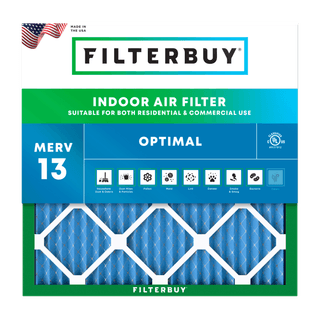
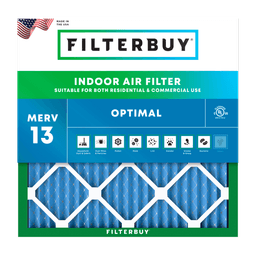
A MERV 13 filter, the Optimal tier at Filterbuy Canada, paired with recirculated indoor air, is the most practical way to cut indoor particles.
Kelowna's air quality shifts hour to hour, so it pays to check a live source rather than this morning's impression. British Columbia publishes the current reading as the Central Okanagan Air Quality Health Index, and Environment and Climate Change Canada carries the same value in its British Columbia summary. A reading of 1 to 3 is low risk and anything from 7 up is high, so that is the line to watch. During wildfire season the number can climb from low to high in a single afternoon, which is why this page carries a live map instead of a fixed figure.
Kelowna has no listing of its own on the provincial Air Quality Health Index. British Columbia publishes the reading for the Central Okanagan instead, a monitoring community that also takes in West Kelowna, Lake Country, and Peachland.
The same regional logic governs warnings, and this is where residents get caught out, because warnings are issued at two different scales depending on what caused the problem.
Source: B.C. Air Quality Subscription Service .
The consequence is easy to miss. If you subscribe to provincial notifications and tick only Kelowna, the wildfire smoke bulletins issued for the Central Okanagan will never reach you. Select both.
Since 1994 the Central Okanagan has been served by a single provincial monitoring station: Kelowna KLO Road, on Regional District property in the south of the city. That one instrument generates the AQHI for all four municipalities, and its 24-hour PM2.5 average also determines whether open burning is permitted across the region, per the Regional District of Central Okanagan. One monitor, two jobs.
Environment and Climate Change Canada has since added ten low-cost PM2.5 sensors around the region, in Rutland, Glenmore, Lower Mission, East and North Kelowna, West Kelowna, Peachland, Joe Rich, and the North Westside, specifically to cover ground the older network misses.
So the regional AQHI remains the right number for planning your day. If you want to know about your own street, though, the sensor map sits a good deal closer than KLO Road.
Canada measures air quality with the Air Quality Health Index, while the United States uses the Air Quality Index. Many phone apps show the American style AQI for Kelowna, so the number you see depends on which system your app follows. Our Canada air quality index map covers both.
British Columbia adds a third wrinkle. During smoky periods the standard AQHI was found to under-report health risk, so the province introduced an adjustment called AQHI-Plus. It ran as a pilot from May 2018 and went province-wide in March 2021, backed by two peer-reviewed health studies. Every reading in the province now follows the AQHI-Plus formula, year-round. In a valley where fine particulate drives the worst days, that distinction matters, because the adjustment exists to stop smoke being averaged away.
Source: Environment and Climate Change Canada and Health Canada define the AQHI. B.C. publishes the AQHI-Plus adjustment.
A note from author Michelle Wan: Building this page, the first thing I did was search the provincial site for Kelowna. There is no Kelowna. Three numbers also circulate here, and none of it is signposted for residents, which is why I led with it rather than burying it below the map.
The AQHI sorts conditions into four risk bands. At-risk people, including children, seniors, pregnant people, and anyone with a heart or lung condition, act one band earlier.
Source: Environment and Climate Change Canada AQHI health messages, via BC Air Quality. Follow your doctor's usual advice.
If you organise sport or school activities, the City of Kelowna notes that some regions cancel outdoor events once the AQHI reaches 9.
Wildfire smoke is the main reason Kelowna's air quality spikes. The McDougall Creek wildfire was reported on 15 August 2023 north of West Kelowna, jumped Okanagan Lake two nights later, and put 35,000 people under evacuation order. Our live wildfire and smoke map for Canada tracks where smoke is heading.
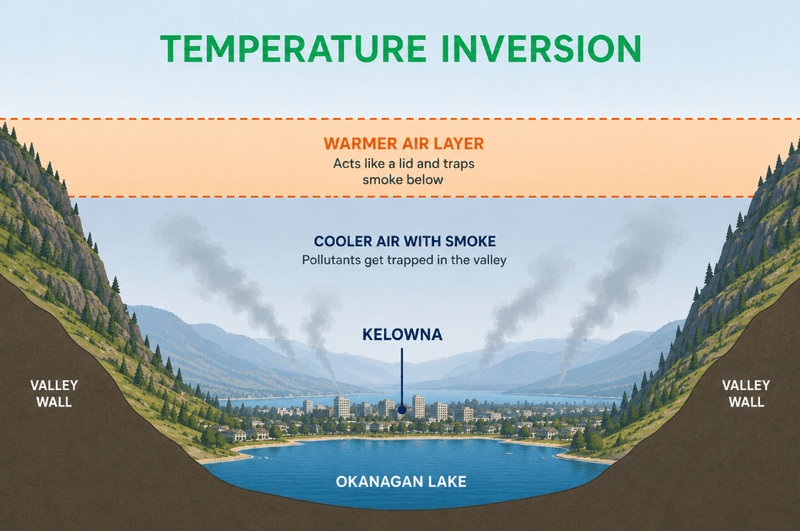
Smoke does not need a wildfire, and this is the point we think gets missed about Kelowna. In February 2022, ECCC issued an air quality advisory for the city after a single structure fire on Highway 97 combined with an inversion, trapping smoke near ground level. One building, in midwinter, was enough. Here the source matters less than whether the lid is on. A calm January morning can score worse than a breezy day in August.
Kelowna's air is good for most of the year. The risk concentrates into one summer window, with a second, quieter one on cold winter mornings.
Spring, March to May: generally good, though pollen bothers allergy sufferers even while the index stays low.
Summer, July to September: the highest risk window, when smoke can push the reading from low to high within a day.
Autumn, October to November: wildfire risk eases, though open burning season adds smoke of its own.
Winter, December to February: usually clean, but a cold, still day caps the valley and holds wood smoke near the ground.
The most effective response to outdoor smoke is to clean and recirculate indoor air. Close windows and doors, set your HVAC to recirculate rather than draw in outside air, and run a high efficiency filter. The City of Kelowna advises residents with central heating or cooling to run a filter rated MERV 13 up to HEPA during smoke events, plus a portable HEPA cleaner in the room you use most.
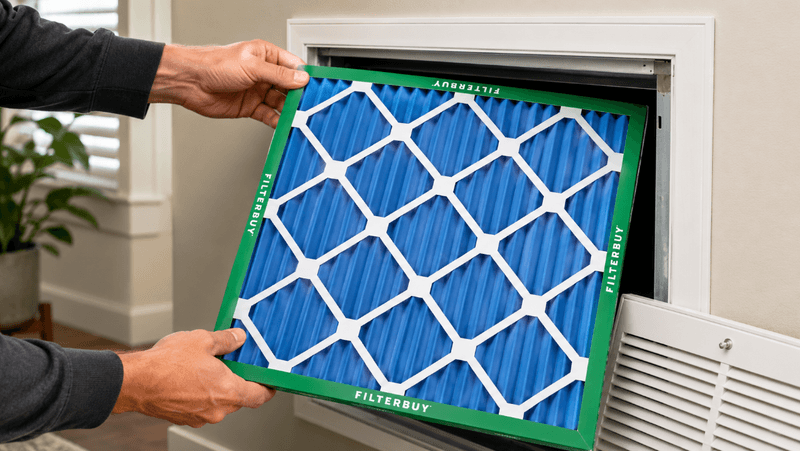
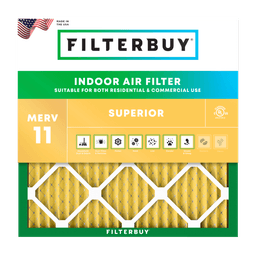
Filterbuy Canada carries MERV 13 Optimal filters in over 600 sizes, with free shipping across Canada. Worth knowing in the Okanagan: smoke loads a filter far faster than ordinary house dust, so check yours monthly through a smoky stretch and replace it once it looks grey rather than waiting on the calendar. A Subscribe and Save schedule handles that, and you can edit, skip, or cancel anytime. If the smell lingers, the carbon-infused Odour Eliminator deals with what a pleated filter cannot. Outside smoke season, MERV 11 Superior carries the everyday load, and our guide to MERV ratings sets the two side by side. Whichever you fit, confirm your furnace is rated for the added resistance.
"In a valley like the Okanagan, the mistake I see most is homeowners upgrading their filter the day the smoke arrives. By then the system is already pulling smoke through the house. Fit the higher-rated filter in June and keep a spare."
Attributed to David Clark, Licensed HVAC Technician
Most air quality pages stop at the outdoor number. Filterbuy Canada comes at this from the filter side, and the Okanagan reads differently from the coast. Vancouver's smoke arrives on the wind and leaves on it. Kelowna's settles under a lid and sits.
So the more useful question is not what the reading says this hour, but how many days it has stayed that way. A filter that has been pulling smoke since Tuesday is no longer the filter you installed. That is our argument for treating filter changes here as event-driven rather than calendar-driven, and for fitting the higher-rated filter in June instead of reacting in August.
50% lower indoor PM2.5 with a high-efficiency HVAC filter and the fan running continuously.
24% lower with a typical low-efficiency filter on the same fan.
55% of outdoor PM2.5 still reached indoors with a MERV 13 filter alone.
22% once a portable air cleaner ran alongside it.
Source: Antonopoulos et al. 2024, U.S. National Institutes of Health, measured in one home through a 2020 smoke event.
17% more asthma-related emergency department visits than expected in the United States.
19 smoke days in the 2023 Canadian season, the same one as McDougall Creek.
British Columbia issues wildfire smoke warnings by weather forecast region rather than by city, and the Central Okanagan region takes in Kelowna. Warnings for local sources use the community of Kelowna instead.
Live PM2.5 for the Central Okanagan appears on the BC Air Quality station map, and because the province reports AQHI-Plus, it shapes the index directly.
Yes. A MERV 13 filter sold as Optimal at Filterbuy Canada, captures a large share of fine smoke particles as your HVAC recirculates air. Pair it with a portable HEPA cleaner on the worst days.
You cannot clear the smoke over the Okanagan, but the air inside your house is yours to manage. Filterbuy Canada carries over 600 sizes, including custom sizes, with free shipping to Canada and prices in CAD. Find your size before the next smoky week arrives.
Air Quality Health Index (AQHI): Canada's official 1 to 10+ scale for the health risk from air pollution.
AQHI-Plus: British Columbia's smoke-adjusted version of the AQHI, adopted province-wide in 2021.
Air Quality Index (AQI): The United States 0 to 500 scale, based on pollutant concentration.
Central Okanagan: The monitoring community and forecast region under which Kelowna's AQHI is reported.
PM2.5: Fine particulate matter 2.5 microns or smaller, the main health concern in wildfire smoke.
Temperature inversion: Warmer air above cooler air, capping a valley and trapping pollutants.
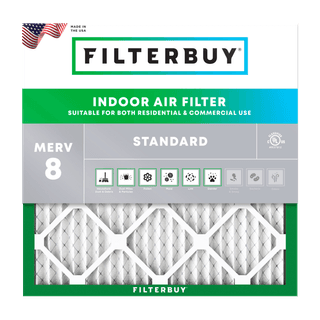
MERV: Minimum Efficiency Reporting Value, rating how well a filter captures particles. See our MERV ratings guide.
HEPA: A High Efficiency Particulate Air filter, used in portable cleaners rather than furnaces.