
Winter Storm Warning Map: How to Read Today's Alerts and Protect Your Home's Air
October 14, 2026
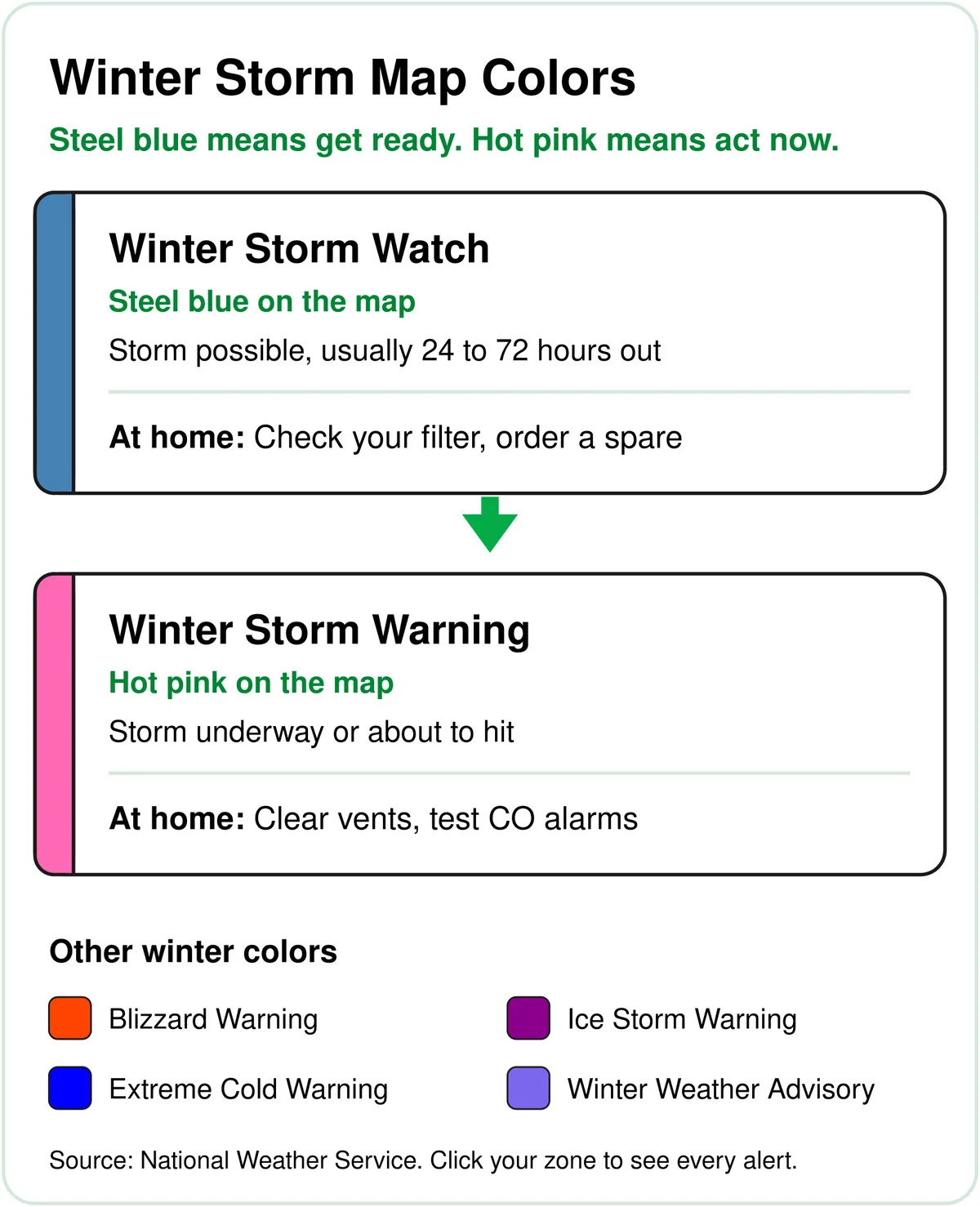
Hot pink on the National Weather Service hazard map means a Winter Storm Warning: a winter storm is underway or about to hit. Steel blue marks a Winter Storm Watch, which means conditions favor a storm, usually 24 to 72 hours out. The official live map at weather.gov refreshes about every 5 minutes. Each zone shows only one color, so click yours to read every alert.
Watch (steel blue): Check your air filter. If it looks gray or is due soon, order a spare now.
Warning (hot pink): Clear snow from outdoor furnace vents and test your carbon monoxide and smoke alarms.
Power out: Run generators outdoors, at least 20 feet from doors and windows.
A home sealed up against a storm keeps recirculating its own air, dust included. Filterbuy stocks more than 600 filter sizes with fast and free 2-day delivery to most US states. Order when the watch goes up, not after the snow starts.
Not sure which filter fits your system? Answer a few quick questions and we'll match you to one before the storm hits.
TL;DR
The official winter storm warning map is the National Weather Service (NWS) hazard map at weather.gov. Hot pink means a Winter Storm Warning: dangerous snow, sleet, or ice is on the way or already falling. At Filterbuy, a U.S. air filter manufacturer, we read that pink from the furnace closet. Clear your vents and test your carbon monoxide alarms, then put in a fresh air filter before the roads close.
Key Takeaways
The NWS hazard map at weather.gov is the official live winter storm warning map.
Hot pink is a Winter Storm Warning, but the map shows one alert per zone, so click in to see them all.
A watch means a storm is possible, while a warning means dangerous winter weather is imminent or already here.
Run generators outdoors, at least 20 feet from the house, to prevent carbon monoxide poisoning.
Filterbuy's rule of thumb: if your air filter is due within a few weeks, change it before the storm arrives.
Where Can I Find a Live Winter Storm Warning Map Today?
The most reliable live winter storm warning map is the National Weather Service hazard map on weather.gov. According to the NWS map help page, it refreshes about every 5 minutes with every alert in effect.
How to check the winter storm warning map near you:
Open the national hazard map at weather.gov.
Click your state or county to zoom in on your local NWS office.
Click the colored area, or enter your ZIP code, to read the full alert.
Keep a weather app or NOAA Weather Radio on, since winter storm warnings usually don't trigger phone alerts.
Filterbuy's guide to what a winter storm warning means explains the alert text, and the NWS Winter Storm Severity Index rates a storm's likely disruption up to three days out.
What Do the Colors on the Winter Storm Warning Map Mean?
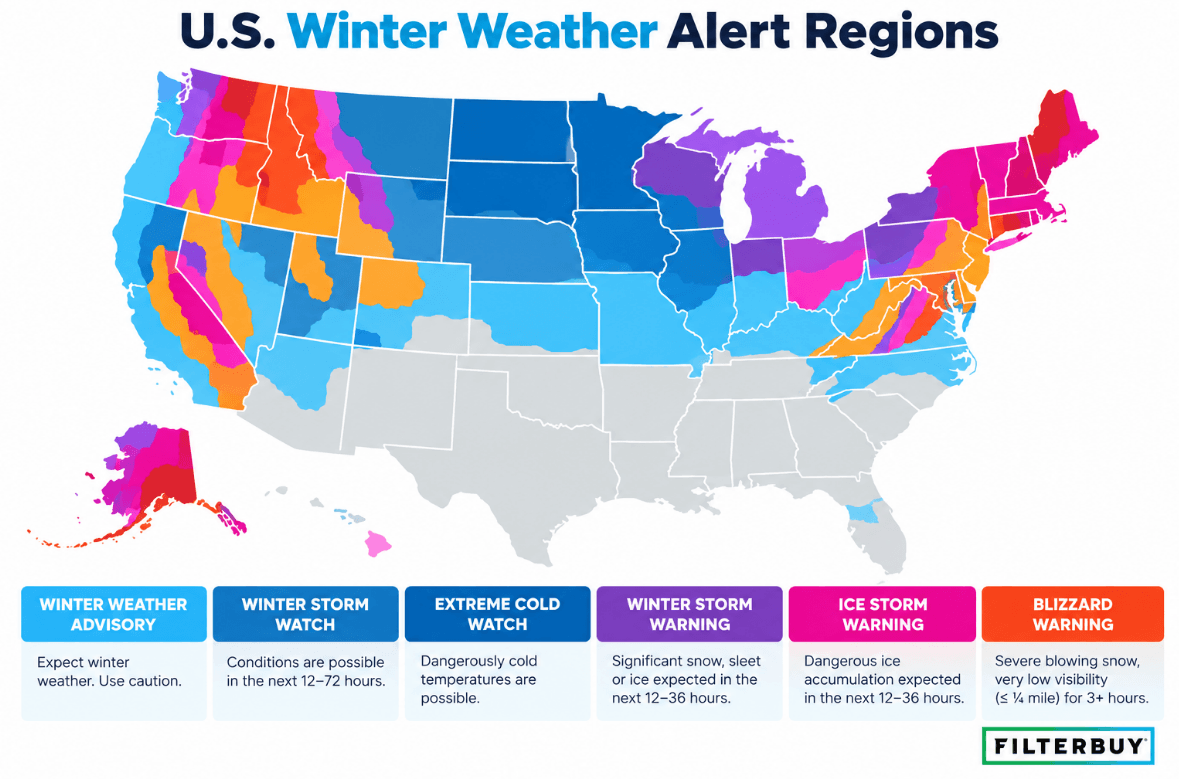
On the NWS winter storm warning map, hot pink means a Winter Storm Warning, the signal to act now. Dark magenta marks an Ice Storm Warning, which tends to bring the longest outages, while a Winter Weather Advisory is a step lower. Filterbuy's rule of thumb, built into the table below: blizzards are vent problems, and ice storms are power problems.
Winter Storm Warning Map Color Key and Home Risk
Source: National Weather Service map color table; home risk column is Filterbuy guidance. Blizzard criteria: NWS St. Louis.
Why your county can look purple before a big storm: The map shows one color per zone, picked from a fixed priority list. A Winter Weather Advisory outranks a Winter Storm Watch, so today's light snow can hide a watch for a bigger storm tomorrow. A pink county may also be under an Extreme Cold Warning, whose blue looks like watch steel blue. Click your zone and read every alert.
What's the Difference Between a Winter Storm Watch and a Warning?
A Winter Storm Watch means conditions are lining up for a dangerous storm; a Winter Storm Warning means it's imminent or underway. NWS Binghamton describes a watch as carrying roughly 50 to 80% certainty that warning thresholds will be met, usually 24 to 72 hours out. Filterbuy's winter storm watch vs. warning guide covers the full NWS alert ladder.
Warning criteria are set locally, which is why the winter storm warning map by state can look uneven.
How Winter Storm Warning Criteria Vary by Region
Sources: NWS St. Louis winter products; NWS Atlanta winter product definitions. Criteria are set by each local NWS office.
Your Area Just Turned Pink: What Should You Do at Home?
When a Winter Storm Warning covers your county, start with the checklist below. Filterbuy built it from more than a decade of making filters in the U.S., and licensed HVAC technician David Clark reviewed it.
Most storm checklists stop at batteries and bottled water. I read a winter warning from the furnace closet, because the filter is the one part you can fix in two minutes before the roads close."
— Michelle Wan, Brand Manager and Air Quality Writer, Filterbuy
Swap in a fresh air filter. If it looks gray or is due soon, change it now and keep a spare. We cut every Filterbuy filter to order and ship within 24 hours, but no carrier can reach an iced-over street, so order when the watch goes up. See how often to change your furnace filter in winter, then find your filter size.
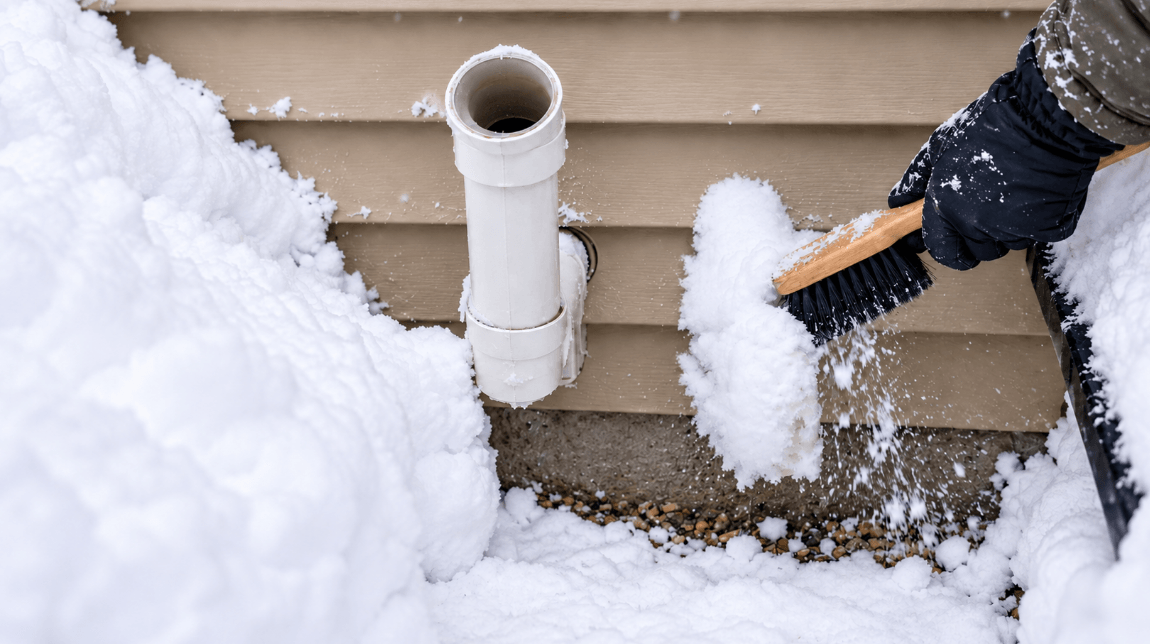
Clear outdoor vents. The U.S. Consumer Product Safety Commission advises clearing snow from furnace vents so carbon monoxide doesn't build up inside. If ice has capped a pipe, here is how to clear a frozen furnace vent pipe safely.
Test every CO and smoke alarm. Fresh batteries keep them working through an outage.
Set the thermostat and leave it. A steady setting and open interior doors spread warm air evenly.
Protect your pipes. Open sink cabinets on exterior walls.
Stage outage supplies. Use flashlights instead of candles, and charge phones early.
"After a heavy snow, most no-heat calls I see on high-efficiency furnaces trace back to a drift or an ice cap over the exhaust pipe. Clearing it by hand at the wall usually gets the heat back on."
— David Clark, Licensed HVAC Technician, Filterbuy HVAC Solutions
How Does a Winter Storm Affect Your Indoor Air?
A sealed-up home recirculates dust and fireplace smoke for days, and your air filter catches them on every cycle.
Our manufacturing floor in Talladega, Alabama, has taught Filterbuy two lessons. First, we've pulled filters from customers' homes in February that were completely black after just 30 days. Second, a 4-inch filter rides out a long storm better because each pleat is deeper; our 1-inch filters carry 14 pleats per foot, while our 4-inch filters carry 8. Learn more about winter indoor air quality.
Which Filterbuy Air Filter Is Right for Storm Season?
Not sure which rating fits? Start with the Filterbuy MERV rating chart, then shop MERV 8 air filters, MERV 11 air filters, or MERV 13 air filters.
"During any winter warning, stick with the MERV rating your system is built for, usually MERV 8 to 11, and save a first-time jump to MERV 13 for a mild week when you can watch how it runs."
— David Clark, Licensed HVAC Technician, Filterbuy HVAC Solutions
How Do You Stay Safe From Carbon Monoxide During a Winter Storm?
Carbon monoxide (CO) is the biggest indoor air danger in a winter storm. This odorless, colorless gas kills more than 500 Americans each year, according to the CDC, and the risk climbs during power outages. As an air filter manufacturer, Filterbuy will be straight with you: no air filter removes carbon monoxide, so only a working CO alarm can warn you.
Follow these rules from the CDC and CPSC:
Run generators outdoors, at least 20 feet from doors, windows, and vents. The CPSC warns that an open garage door does not provide enough ventilation.
Never heat your home with a gas oven, stove, or charcoal grill.
Keep space heaters 3 feet from anything that can burn (see Filterbuy's space heater safety guide).
If a CO alarm sounds or anyone feels headache, dizziness, or nausea, get everyone outside to fresh air and call 911.
Supporting Statistics
1. Over 1,300 people are killed and more than 116,800 are injured each year in crashes on snowy, slushy, or icy pavement.
Why it matters: Once a warning is issued, stay home.
Source: Federal Highway Administration, Road Weather Management Program
2. U.S. electricity customers averaged 11 hours without power in 2024, nearly double the average of the decade before. Major weather events caused 80% of those hours.
Why it matters: Plan backup heat before the lights go out.
Source: U.S. Energy Information Administration, Today in Energy
3. Americans spend about 90% of their time indoors, where some pollutants run 2 to 5 times higher than typical outdoor levels.
Why it matters: A home sealed up for a storm leans harder on its air filter.
Source: U.S. Environmental Protection Agency, Report on the Environment
Winter Storm Warning Map FAQ
Should I Change My Air Filter Before a Winter Storm?
Yes, if it's due within a few weeks. Your furnace may run almost nonstop once the storm hits.
Can I Run My Furnace During a Power Outage?
Usually not, because gas furnaces need electricity for the blower and controls. A generator can run one only through an electrician-installed transfer switch. Filterbuy's guide to heating your home in a winter power outage explains your options.
How Long Does a Winter Storm Warning Last?
As long as the storm is expected to. Each alert lists start and end times, and your NWS office can extend or cancel it.
Can a Winter Storm Watch Be Canceled or Upgraded?
Yes. The NWS can cancel or downgrade a watch if the storm weakens, or upgrade it to a warning as confidence grows.
What Is the Difference Between a Blizzard Warning and a Winter Storm Warning?
A blizzard warning is about wind and visibility (35+ mph winds, visibility of ¼ mile or less for 3+ hours). A winter storm warning is about how much snow, sleet, or ice falls. See blizzard warning vs. winter storm warning.
Stay Ahead of the Next Storm
Filterbuy has made air filters in its own U.S. plants since 2013 and stocks 600+ sizes. Before the next storm, set up Filterbuy auto-delivery so a fresh filter is always on the shelf.
Glossary
National Weather Service (NWS): The National Oceanic and Atmospheric Administration (NOAA) agency that issues U.S. weather alerts.
Winter Storm Warning: An NWS alert that dangerous winter weather is imminent or occurring.
Winter Storm Watch: An NWS alert that a significant winter storm is possible.
Winter Weather Advisory: An NWS alert for winter weather below warning criteria.
Ice Storm Warning: An NWS alert for damaging ice, often ¼ inch or more.
Blizzard Warning: An NWS alert for wind-driven, near-whiteout snow.
Extreme Cold Warning: The NWS alert for dangerous cold; it replaced the Wind Chill Warning in October 2024.
Winter Storm Severity Index (WSSI): A Weather Prediction Center tool rating a storm's likely disruption.
Carbon monoxide (CO): An odorless, colorless, poisonous gas made by burning fuel.
MERV (Minimum Efficiency Reporting Value): A 1–16 rating of how well an air filter captures particles; Filterbuy makes MERV 8, 11, and 13.
HVAC: Heating, ventilation, and air conditioning.