
Winter Storm Tracker: Live Map of Winter Weather Alerts
October 14, 2026
Search your ZIP code, city, or county on the tracker to see every active National Weather Service winter alert for your area. Each alert card shows the alert type and when it expires. The alert level also tells you what to do at home, starting with your furnace filter. Take the quick quiz below to find the right filter before the next alert.
Not sure which filter fits your system? Answer a few quick questions and we'll match you to the right one.
TL;DR
Stay informed about winter storm warnings, winter weather advisories, blizzard warnings, ice storm warnings, and cold weather alerts across the U.S. with the Filterbuy Winter Storm Tracker and official National Weather Service (NWS) updates. Check the latest winter weather alerts in your area, understand what each warning means, and use Filterbuy's Alert-to-Action Ladder to turn weather alerts into simple steps to protect your home.
Key Takeaways
Stay updated on winter weather alerts. The Filterbuy Winter Storm Tracker helps homeowners understand winter storm warnings, watches, advisories, and cold weather risks using official National Weather Service (NWS) information.
A watch means prepare; a warning means act. The NWS issues a watch when a significant event is possible and a warning when it is happening or about to happen (NWS).
Warning thresholds are local. Two inches of snow can bring a winter storm warning to metro Atlanta, while Cleveland's office waits for roughly 6 inches in 12 hours.
No alert doesn't mean no risk. Filterbuy treats any forecast low near 20°F or below as a pipe-protection night, alert or not.
Every alert is a home checkpoint. Filterbuy's rule: check your filter at an advisory, swap it at a watch, and keep vents clear during a warning.
Is There a Winter Storm Warning Near Me?
To see today's alerts, enter your ZIP code or city in the winter storm warning map above, or tap "Use my location," and the map lists every active NWS alert for your county. If nothing shows up, no alert has been issued yet. For what a warning means, see Filterbuy's winter storm warning guide.
It takes about 30 seconds:
Search your ZIP code, city, or county.
Read the alert card to see the alert type and when it expires.
Open the full NWS statement linked from the card.
And don't wait for your phone to buzz. Winter storm, blizzard, and ice storm warnings don't push to phones; only "Significant" snow squall warnings do.
How to Read the Winter Storm Tracker Map
The tracker is a national weather alerts map filtered down to winter. Tap any shape for details.
Colors show the alert type. Each alert uses its standard NWS hazard color.
Shapes follow forecast zones. Alerts track county and zone lines, not radar.
Timestamps tell you how fresh it is. Check the "Last refreshed" stamp.
The tracker reports alerts, not snowfall forecasts. For storm severity, check the NWS Winter Storm Severity Index (WSSI).
Winter Weather Alerts Explained: Watch vs. Warning vs. Advisory
A watch means a storm or dangerous cold is possible, a warning means it is here or close, and an advisory means a lesser hazard is on the way (NWS). Each alert below is paired with what we'd do at home.
Source: National Weather Service watch, warning, and advisory definitions. Home actions are Filterbuy recommendations.
Filterbuy also has guides to winter storm watch vs. warning, the winter weather advisory, the ice storm warning, and blizzard warning vs. winter storm warning.
What Triggers a Winter Storm Warning or Cold Weather Alert?
No national snowfall total or temperature sets off a winter storm warning. Each of the 122 NWS forecast offices writes local criteria, so one storm can bring a warning in one state and only an advisory in the next.
Source: National Weather Service local office criteria. Thresholds vary by office and can change; check your local NWS office for current criteria.
Cold alerts vary just as much. Our guides to the extreme cold warning and the cold weather advisory explain what sets them off, and our freeze warning vs. frost advisory guide covers fall and spring cold.
What the Map Won't Tell You
Here are the gaps Filterbuy plans around.
No alert doesn't mean no risk. Our rule of thumb is to treat any forecast low near 20°F or below as a pipe-protection night, alert or not. Open sink cabinets on exterior walls and let those faucets drip.
The same alert can hit harder in a mild climate. A cold weather advisory can start below 20°F in southeast Louisiana but not until a -20°F wind chill near Milwaukee. Where cold alerts are rare, that may be your pipes' coldest night of the year.
Stacked alerts are the real red flag. A storm alert and a cold alert in your county together can mean a power outage in a dangerous cold. In December 2022, a winter storm and arctic front left more than a million customers from Texas to Maine without power (NOAA NCEI). If you see both, plan backup heat before the snow starts.
What's New in NWS Winter Alerts
On October 1, 2024, the NWS renamed its wind chill alerts, so the Wind Chill Warning, Watch, and Advisory are now the Extreme Cold Warning, Extreme Cold Watch, and Cold Weather Advisory (KPTV/Gray News). Next, the NWS plans to swap "Advisory" headlines for plain-language ones that lead with the hazard, such as "SNOW" (NWS), though no date had been set when this page was updated. For the full story, see Did the NWS get rid of wind chill warnings.
Filterbuy's Alert-to-Action Ladder: What to Do at Home
Filterbuy's ladder matches each alert to the steps our team would take at home.
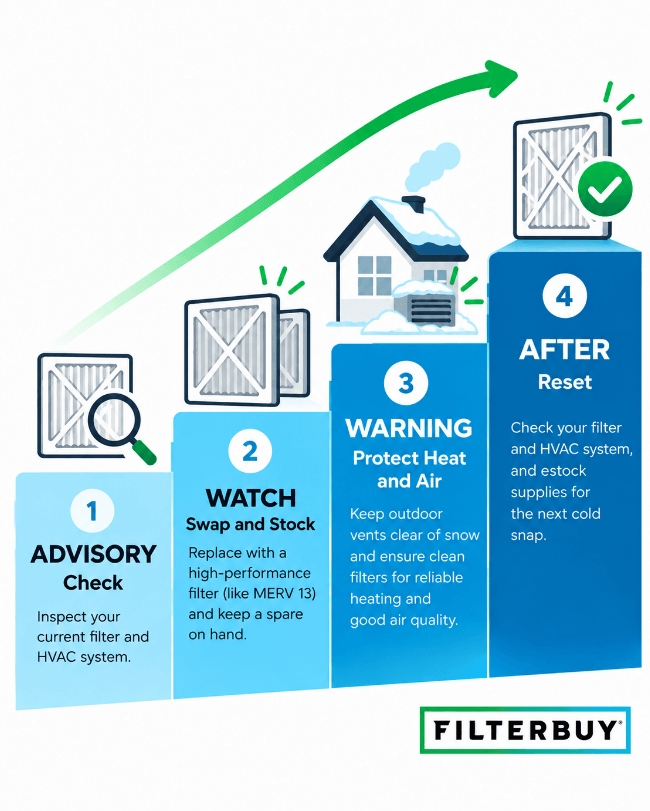
Advisory: check. Hold your furnace filter up to a light. If light barely passes through, or you can't remember your last change, it's overdue. Then test your carbon monoxide (CO) and smoke alarms.
Watch: swap and stock. A watch gives you one last calm window. Put in a fresh filter and keep a spare. Filterbuy cuts every filter to order and ships within 24 hours, but no carrier can reach an iced-over street. See how often to change your air filter. Find your outdoor vent pipes now, before snow buries them.
Warning: protect heat and air. Stay home if you can, and keep snow off furnace and dryer vents, since a blocked exhaust vent can push CO inside. Here's how to clear a frozen furnace vent pipe. Run any generator outdoors, at least 20 feet from doors and windows, as the CDC advises. See heating your home in a winter power outage.
After the storm: reset. Check the filter again. Days of nonstop heating can load it in about 30 days instead of the usual 60 to 90.
"Most no-heat calls during a winter storm trace back to two things a homeowner can check in five minutes: a snow-blocked vent pipe and a clogged filter. Clear the vents and swap the filter before the snow starts."
— David Clark, Licensed HVAC Technician, Filterbuy HVAC Solutions
Since Filterbuy makes filters, we'll be clear about their limits: no air filter removes carbon monoxide. "Carbon monoxide is a gas, so filtration is the wrong tool entirely," says Filterbuy founder and CEO David Heacock. Only a working CO alarm can warn you; here's why no air filter removes carbon monoxide. The CDC reports that non-fire CO poisoning kills more than 400 Americans a year. Read up on winter carbon monoxide safety.

See why indoor air quality gets worse in winter.
Why a Filter Company Built a Winter Storm Tracker
Most weather maps stop at the alert. The Filterbuy tracker picks up with the question that comes next: what does my house need?
Filterbuy, an American air filter manufacturer, has made furnace filters for more than a decade, and every winter looks the same. A filter that seemed fine in October is clogged by December; the Filterbuy team has pulled February filters from customers' systems that were black after 30 days of heavy run time. In a storm, that clogged filter or a buried vent pipe can become an emergency.
"An alert tells you what the sky is about to do. We wanted every alert on this map to also tell you what your house needs, in a task you can finish in five minutes."
— Michelle Wan, Brand Manager and Air Quality Writer, Filterbuy
Supporting Statistics
Billion-dollar winter storms killed 1,463 people from 1980 to 2024. NOAA counts 24 such storms costing $104.2 billion, and the December 2022 storm put more than 200 million people under winter alerts. Source: NOAA NCEI
Cold kills more people than winter storms. From 2015 to 2024, NWS records show an average of 38 cold-related and 28 winter-weather deaths a year. Source: National Weather Service
Cold caused 63% of U.S. weather deaths in 2006–2010. CDC death-certificate data show about 2,000 weather-related deaths a year in that period. Source: CDC National Center for Health Statistics
Filterbuy's take: Give cold alerts the same attention you'd give a snow alert.
Winter Storm Tracker FAQ
How often does the Winter Storm Tracker update?
The tracker refreshes automatically from the NWS alerts feed throughout the day. Check the "Last refreshed" stamp before you travel.
What should I do if a cold weather advisory is near me?
A cold weather advisory means the cold is dangerous but below warning level. Dress in layers, cover exposed skin, and check your furnace filter.
Can I see weather alerts near me for things other than winter storms?
Yes. For every hazard, use the official NWS map at weather.gov. For outdoor air quality, check the Filterbuy live AQI map.
Does my furnace filter matter during a winter storm?
It does. A furnace may run almost nonstop in a storm, straining the blower if the filter is clogged. For most homes, a Filterbuy MERV 8 filter handles everyday dust, while MERV 11 suits pets or allergies. Here's which MERV rating you should use.
Get Your Home Storm-Ready
Whenever cold or snow is in the forecast, check the tracker and act on the watch, not the warning. Filterbuy cuts more than 600 filter sizes to order in Talladega, Alabama and ships them free. Find your furnace filter size, or set up Filterbuy auto-delivery and get a reminder three days before each shipment.
Glossary
National Weather Service (NWS): The U.S. federal agency, part of NOAA, that issues official weather alerts.
Winter Storm Watch: An NWS alert that heavy snow, sleet, or ice is possible.
Winter Storm Warning: An NWS alert that warning-level snow, sleet, or ice is expected or occurring.
Winter Weather Advisory: An NWS alert for hazardous wintry weather below warning criteria.
Blizzard Warning: An NWS alert for strong wind and blowing snow that cut visibility.
Ice Storm Warning: An NWS alert for damaging ice buildup from freezing rain.
Extreme Cold Warning: An NWS alert for life-threatening cold; it replaced the Wind Chill Warning in 2024.
Cold Weather Advisory: An NWS alert for dangerous cold below warning level; it replaced the Wind Chill Advisory.
Winter Storm Severity Index (WSSI): An NWS tool that forecasts winter storm severity.
Carbon monoxide (CO): A colorless, odorless, deadly gas from burning fuel.
MERV (Minimum Efficiency Reporting Value): A 1–16 rating of how well an air filter captures particles; Filterbuy makes MERV 8, 11, and 13 filters.
Sources
National Weather Service, Hazard Simplification: WWA system and proposal
National Weather Service, Hazard Simplification FAQ sheet
NWS Weather Prediction Center, Winter Storm Severity Index
Gray News via KPTV, NWS retires wind chill alerts
Centers for Disease Control and Prevention, Carbon Monoxide Poisoning Basics
National Weather Service, Wireless Emergency Alert messages and local office winter warning criteria
NOAA NCEI, Billion-Dollar Weather and Climate Disasters, U.S. summary
National Weather Service, 80-year U.S. weather fatality statistics
CDC National Center for Health Statistics, Deaths attributed to heat, cold, and other weather events, 2006–2010