
Replacing a Furnace in Winter: What to Do When It Dies Mid-Season
October 12, 2026
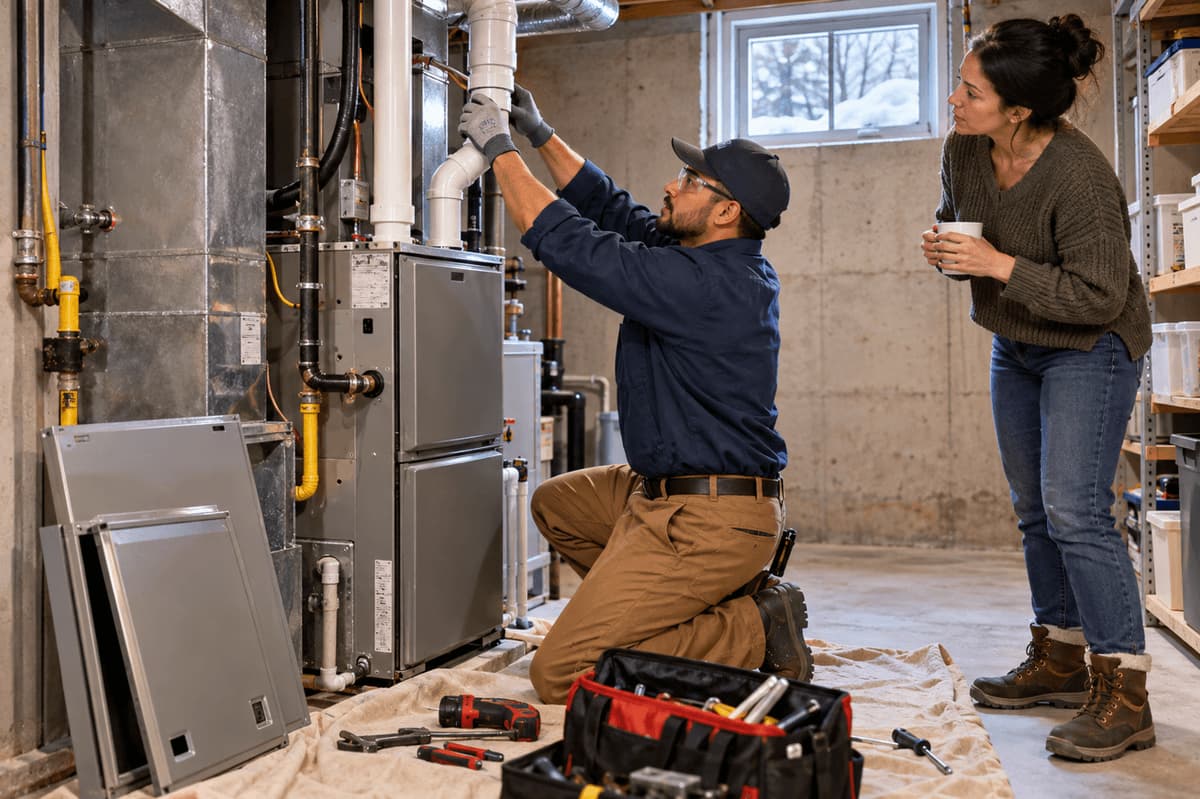
Replacing a furnace in winter usually takes one to three days from breakdown to working heat. As a filter manufacturer for more than a decade, Filterbuy also watches a detail that is easy to miss after a hurried install: the filter slot on the new unit.
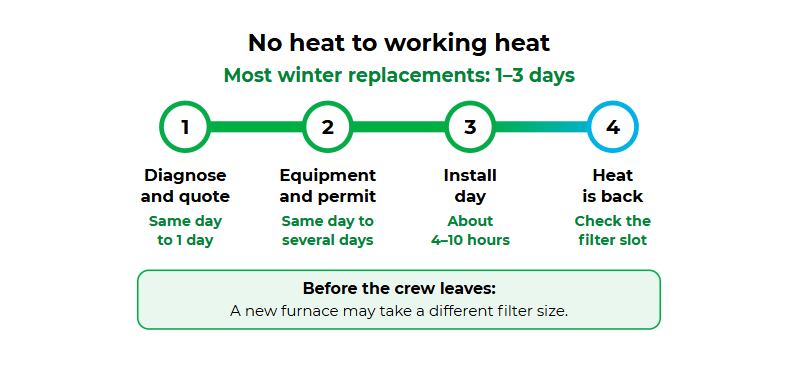
Most winter furnace replacements reach working heat in one to three days. The install itself usually takes about 4 to 10 hours.
While you wait, heat one room with electric space heaters, and never use a gas oven for warmth. Once the new furnace is in, check its filter size, since it may not match your old one.
Take the quick quiz below to match your new system to the right filter.
Answer 3 quick questions and we'll match your new furnace to the right filter.
Already know your new filter size? Shop filters at Filterbuy
TL;DR
Most winter furnace replacements take one to three days. Until then, heat one room safely with electric space heaters and keep your pipes from freezing, but never use a gas oven for warmth. Compare two written quotes, then confirm the new furnace's filter size.
Key Takeaways
Space heaters need at least 3 feet of clearance from anything that can burn.
Never heat a home with a gas oven, and keep generators outside, more than 20 feet from windows, doors, and vents.
The federal Energy Efficient Home Improvement Credit (Section 25C) ended for furnaces placed in service after December 31, 2025.
A new furnace may need a different filter size, and sizes are nominal: a Filterbuy 20x25x1 filter measures 19.50 x 24.50 x 0.75 inches.
How Fast Can You Replace a Furnace in Winter?
Most winter replacements reach working heat in one to three days. Diagnosis and quoting often happen on the first visit, and when the wait runs longer, the cause is usually equipment stock or a permit.
| Stage | Typical Timing | What Happens |
|---|---|---|
| Diagnosis Visit | Same day to next day | A technician confirms the failure and whether to repair. |
| Quote and Sizing | Same visit to 1 day | The contractor sizes and prices options. |
| Equipment and Permit | Same day to several days | The contractor confirms stock and pulls any permit. |
| Installation | About 4–10 hours | The crew swaps in the new furnace and tests it. |
| Final Inspection | Varies by jurisdiction | Some areas require an inspector's sign-off. |
What to Do in the First Hour After Your Furnace Stops
Before you book a replacement, rule out the simple causes. A tripped breaker or a dead thermostat battery can shut a furnace down, and so can a badly clogged air filter. Renters should call the landlord or property manager first and follow up in writing.
Check for a gas smell first. If you smell gas, get everyone out without flipping switches and call your gas utility or 911 from outside.
Check the thermostat. Set it to Heat above room temperature and swap in fresh batteries.
Check the breaker and furnace switch. Most furnaces have a nearby service switch that looks like a light switch.
Check the air filter. A filter packed with dust chokes airflow, and that can trip a safety switch that shuts the furnace off. Filterbuy's guide to clogged furnace filter symptoms explains the warning signs, and our guide on how to change your furnace filter walks you through the swap.
Have four details ready when you call. Give the dispatcher the model and serial numbers from the furnace label, the fuel type, any flashing error code, and your filter size.
How to Stay Safely Warm While You Wait for a New Furnace
While you wait, heat one smaller part of the house with electric space heaters. The U.S. Fire Administration heating safety guidance says to keep anything that can burn at least 3 feet away and to plug heaters directly into a wall outlet. Turn them off whenever you leave the room or go to bed.
The CDC carbon monoxide guidance warns never to heat your house with a gas oven or burn charcoal indoors, and to install battery-operated or battery-backup CO detectors near every sleeping area. If the power goes out too, any generator belongs outside and more than 20 feet from windows, doors, and vents.
To hold heat, close doors to unused rooms and draw the curtains at night, as the National Weather Service cold weather guidance recommends.
How to Protect Your Pipes When the Heat Is Out
Let cold water drip from faucets and open kitchen and bathroom cabinet doors so warmer air reaches the plumbing, as the American Red Cross frozen pipe guidance recommends. In our view, this belongs in the first hour of an outage, before pipes along exterior walls start to freeze.
If a faucet slows to a trickle, a pipe may already be freezing. Leave that faucet open and warm the pipe with a hair dryer or heating pad, never an open flame. Know where your main water shutoff is in case a pipe bursts.
Should You Repair or Replace a Furnace in Winter?
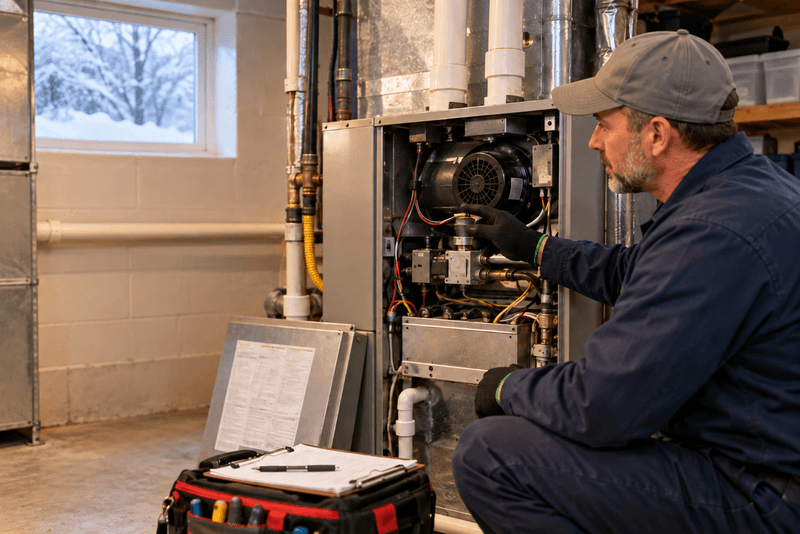
Repair usually makes sense for a younger furnace with one failed part, such as an igniter or flame sensor. Age matters too: Filterbuy's gas furnace lifespan guide puts most gas furnaces at about 15 to 20 years with regular maintenance. Replacement is the better call when an aging furnace keeps needing repairs or suffers a major failure such as a cracked heat exchanger.
A cracked heat exchanger can let combustion gases into the airflow, which is why many technicians shut the furnace down on the spot. If a contractor recommends replacement for this reason, ask for photos or a camera inspection of the crack.
How to Avoid Overpaying for an Emergency Furnace Replacement
Get two written quotes, even in winter, because rushed decisions tend to cost more. A complete quote names the exact model, its annual fuel utilization efficiency (AFUE) rating, the permit, and the labor warranty.
Ask how the furnace was sized. ACCA Manual J is the national standard for calculating residential heating and cooling loads.
Compare efficiency on equal terms. Under the ENERGY STAR furnace criteria, certified gas furnaces reach at least 97% AFUE in the U.S. North and 95% in the U.S. South.
Ignore expired tax credits. The IRS instructions for Form 5695 confirm the credit ended for property placed in service after December 31, 2025.
Ask about rebates and assistance. Many utilities run their own furnace rebate programs, and the federal LIHEAP energy assistance program can help eligible households with heating costs and, in some cases, furnace repair or replacement.
Ask about extra fees. Confirm whether the quote includes after-hours charges.
Watch the payment terms. A deposit is common, but the FTC home improvement scam guidance says not to pay the full amount up front.
What to Expect on Installation Day in Cold Weather
Expect no central heat for most of the workday, then a faint burning smell during the first few heating cycles as factory coatings burn off. If the smell lingers, or if you smell gas, shut the system off and call the installer. Before the crew packs up, walk through this short list.
See the filter slot. Note which way the airflow arrow points.
Label the cabinet. Write the nominal filter size on the furnace in marker.
Check the vent and drain. A condensing furnace vents through plastic pipe and drains water, so ask how both are protected from freezing.
Test your CO detectors. Do it once the furnace is running.
How to Protect Your New Furnace After Installation
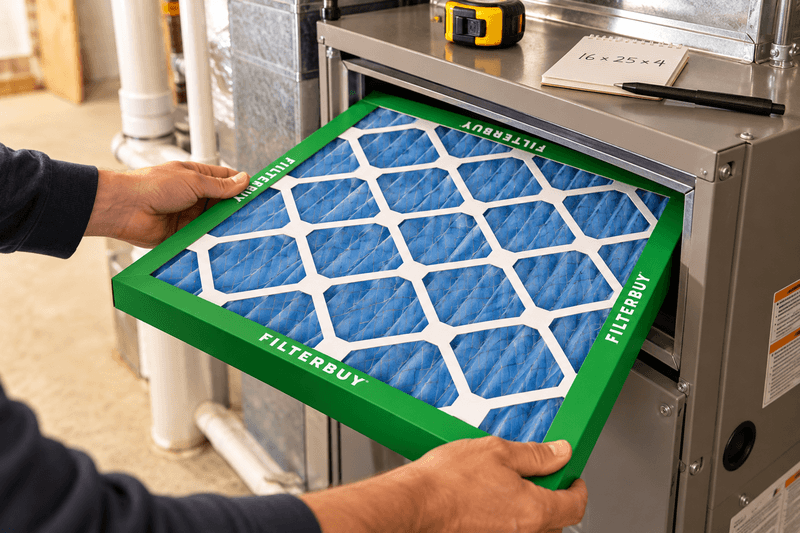
Start by confirming the new furnace's filter size, since a replacement may take a different size or depth than the old one. The size printed on any filter is a rounded nominal size. As a manufacturer, Filterbuy cuts filters slightly under that nominal size so they slide into the slot, which is why our own 20x25x1 filter measures 19.50 x 24.50 x 0.75 inches. Order by the nominal size listed on the new furnace's slot or manual, and measure only to confirm it.
Check the first filter after a few weeks, since installation dust can load it quickly. If the furnace stops heating right after a filter change, Filterbuy's troubleshooting guide traces it to a minimum efficiency reporting value (MERV) rating too restrictive for the system, a poorly fitted filter, or a tripped safety switch. We walk through each fix for why a furnace stops heating after a filter change.
Our guide to finding the right furnace filter size shows where to look. Standard 1-inch pleated filters typically last 60 to 90 days, while 4-inch filters from a new media cabinet typically last 3 to 6 months. See how long a furnace filter lasts for the full breakdown.
To choose a rating, start with the EPA explanation of MERV ratings, then check which ratings your furnace manual allows. We make MERV 8, MERV 11, and MERV 13 pleated filters in hundreds of standard sizes, and if your new furnace takes an unusual size, our custom air filters are cut to your exact measurements. Filterbuy provides fast and free 2-day delivery to most US states.
"On a no-heat call in January, the first thing I pull is the air filter, because a clogged filter can shut a furnace down. When a furnace truly needs replacing, I tell homeowners to ask for photos of the failed part and a written load calculation before they sign."
David Clark, Licensed HVAC Technician
Supporting Statistics
1. Natural gas heats 47% of U.S. homes. For nearly half of households, a no-heat call should start by ruling out a gas leak.
2. Water damage and freezing claims averaged $15,400 per claim from 2019 to 2023. Dripping faucets cost little next to a single claim.
Source: Insurance Information Institute, Facts and Statistics: Homeowners and Renters Insurance
3. About 100 people die in the U.S. each year from CO poisoning from portable generators. Winter storms often cut power and heat at once, so place any generator with care.
Source: U.S. Consumer Product Safety Commission, Winter Storm Carbon Monoxide and Fire Safety Tips
Frequently Asked Questions
Can a Furnace Be Replaced in Freezing Weather?
Yes. Contractors replace furnaces year-round, even in extreme cold, and the install itself usually takes one workday.
How Long Can a House Go Without Heat in Winter?
There is no single safe number of hours, since it depends on outdoor temperature and insulation. If you cannot keep young children or older adults warm, stay with family or at a local warming center until the heat is back.
Is It Cheaper to Replace a Furnace in Winter or Spring?
Winter replacements can cost more when they involve an after-hours call or rushed quotes. If a safe repair keeps your furnace running, scheduling the replacement for spring gives you room to shop.
Do I Need a Permit to Replace a Furnace?
Many cities and counties require a mechanical permit, and the contractor usually pulls it. Ask whether it is in the quote.
What Size Filter Does a New Furnace Need?
Use the nominal size printed on the new furnace's filter slot or in its manual, then check Filterbuy's air filter sizes chart to compare nominal and actual dimensions.
Ready for a Furnace That Dies Mid-Season?
After a mid-season furnace replacement, find the new unit's exact filter size at Filterbuy and start an air filter subscription so replacement filters arrive on a set schedule.
Glossary
AFUE (Annual Fuel Utilization Efficiency): The percentage of fuel a furnace turns into usable heat.
Condensing Furnace: A high-efficiency gas furnace that captures extra heat from exhaust and drains the resulting water.
Heat Exchanger: The furnace part that moves heat from burning fuel into household air.
Manual J: The Air Conditioning Contractors of America (ACCA) standard used to calculate how much heating and cooling a specific home needs.
MERV (Minimum Efficiency Reporting Value): A rating from 1 to 16 that describes how well an HVAC air filter captures airborne particles.
Section 25C: A federal home efficiency tax credit that ended for property placed in service after 2025.