
Heating Degree Days: What They Are and What They Mean for Your Furnace
October 14, 2026
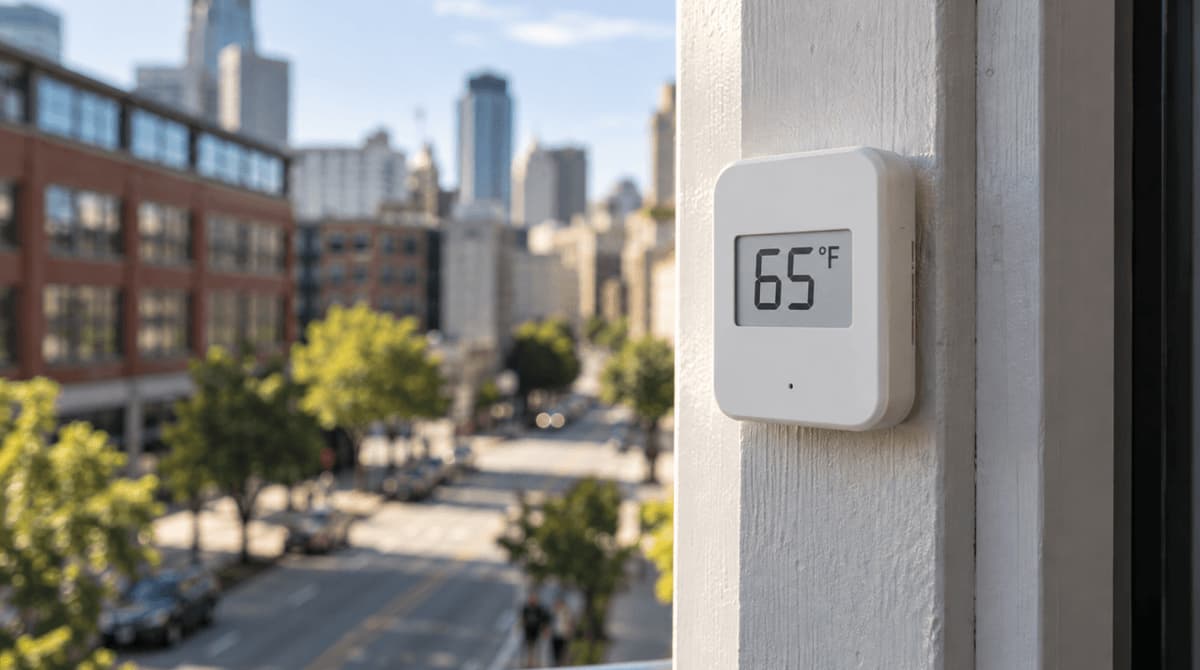
Heating degree days (HDDs) measure how far a day's average outdoor temperature falls below 65°F. The more HDDs pile up, the longer your furnace runs and the faster your air filter fills with dust.
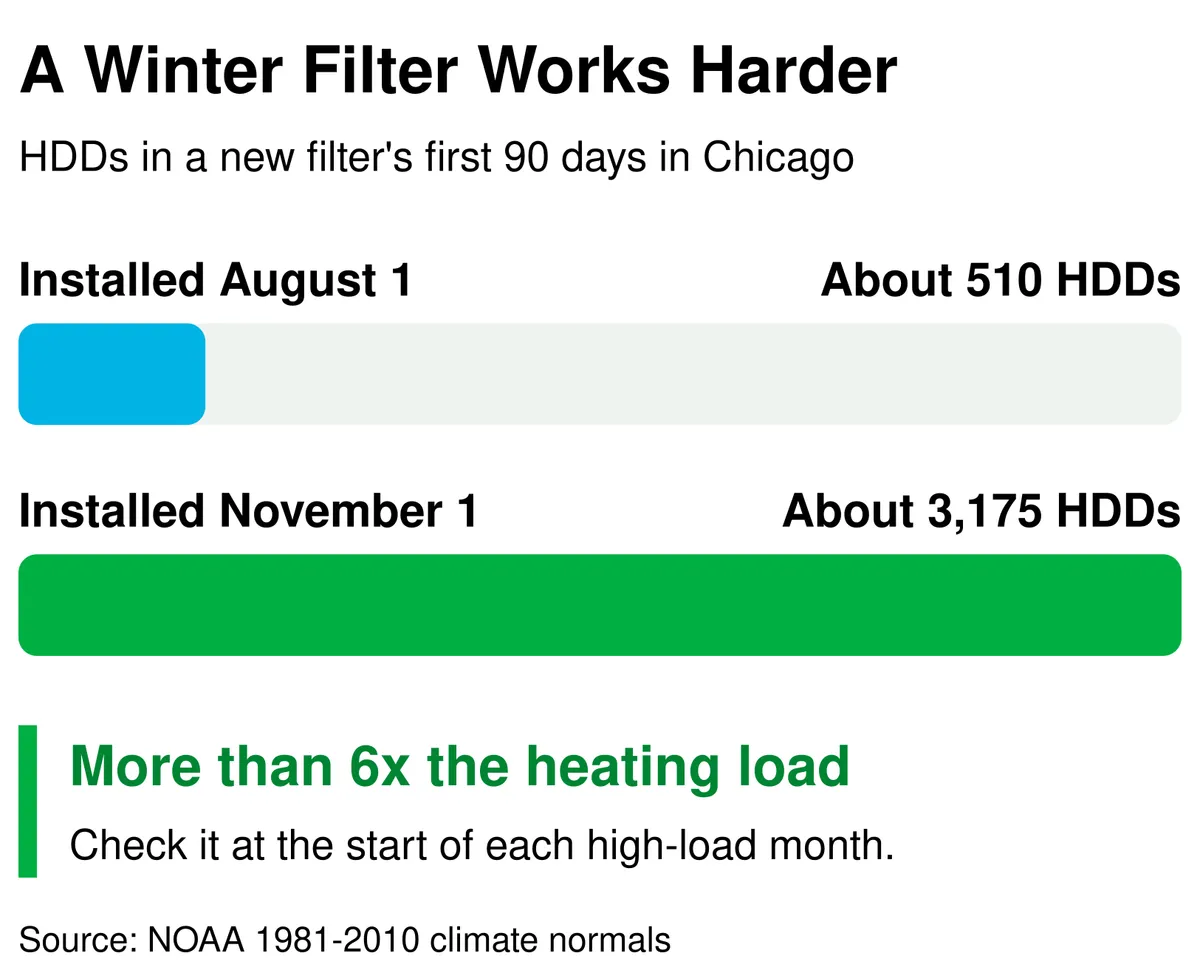
A day that averages 40°F adds 25 HDDs. In Chicago, a filter installed November 1 faces more than six times the heating load of one installed August 1. Take the quick quiz below to find the right filter for your home this winter.
Fast and free 2-day delivery to most US states, with auto-delivery every 30, 60, or 90 days.
Answer a few quick questions and we'll match you to the right filter for winter.
TL;DR
Heating degree days (HDDs) measure how cold a day was compared with 65°F, the point below which most homes need heat. A day that averages 40°F adds 25 HDDs. Filterbuy watches them because the more HDDs pile up, the longer your furnace runs and the faster your filter fills with dust.
Key Takeaways
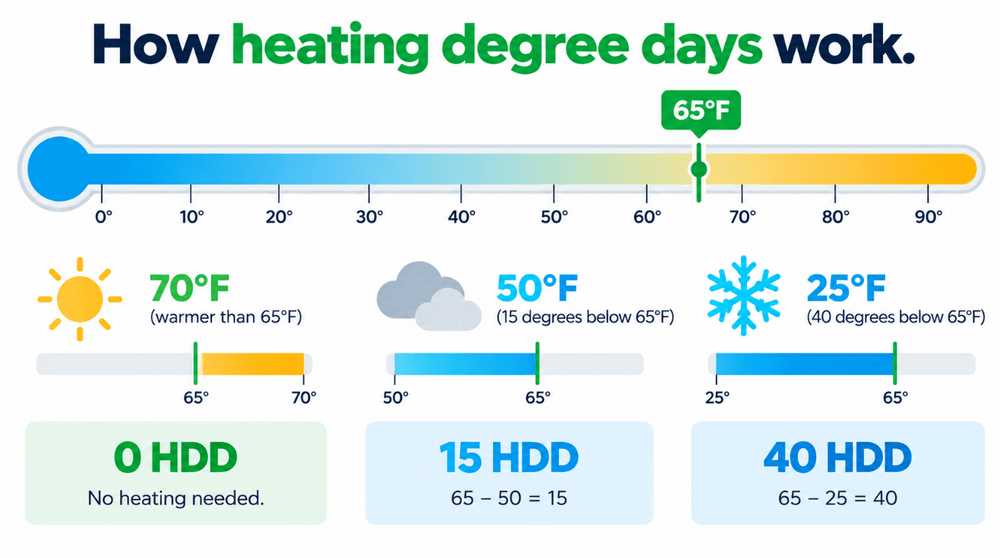
One heating degree day equals one degree that a day's average temperature falls below 65°F. A 30°F day counts as 35 HDDs; a 70°F day counts as zero.
HDDs add up over a month or a whole season, from about 128 a year in Miami to about 7,580 in Minneapolis (NOAA's 1981–2010 climate normals).
In many cold cities, January logs about three times the HDDs of October, so a furnace fan on AUTO pulls about three times as much air through the filter.
HDDs tell you when to look at your filter, not whether to change it. ENERGY STAR recommends a monthly filter check either way.
What Are Heating Degree Days?
A heating degree day measures how much heating a day demands: the number of degrees its average outdoor temperature falls below 65°F. The U.S. Energy Information Administration (EIA), the federal agency that tracks U.S. energy data, describes HDDs as a measure of how much heat a building needs to stay warm.
Why 65°F Is the Starting Point
Around 65°F outside, sunlight and everyday household activity keep most homes comfortable with the heat off. Below that, your furnace or heat pump covers the gap, one degree at a time. The Minnesota DNR notes that some uses call for a 50°F base, but 65°F is the U.S. standard for homes.
How Do You Calculate Heating Degree Days?
To calculate heating degree days, average the day's high and low temperatures and subtract that average from 65°F. A positive answer is the day's HDD count, and any day averaging 65°F or warmer counts as zero. Add the daily numbers for a monthly or seasonal total.
HDD = max(0, 65°F − (Thigh + Tlow) ÷ 2)
Worked example: a January day in Chicago with a high of 32°F and a low of 18°F averages 25°F, so it adds 65 − 25 = 40 heating degree days.
A mixed fall week adds up like this:
HDDs = 65°F minus the daily mean temperature, where the daily mean is (high + low) ÷ 2. Days averaging 65°F or warmer count as zero.
How Do Heating Degree Days Affect Furnace Runtime and Heating Bills?
Heating degree days track furnace runtime because a house loses heat in proportion to the gap between the indoor and outdoor temperature. When that gap doubles, heat loss roughly doubles too, and the furnace runs about twice as long to keep up.
The Fuel Industry Already Runs on Degree Days
Heating oil companies have used this for decades, dividing the HDDs between deliveries by the gallons a home burned to get its "K-factor." Shipley Energy, a heating oil supplier, gives an example: if 1,000 HDDs pass and the tank takes 200 gallons, the home burns about a gallon every five degree days.
Use HDDs to Read Your Own Heating Bill
The same idea works on your own bill. Many utilities print degree days on it; Nicor Gas lists this period's and last year's. Subtract a typical summer month's gas use first, since water heating and cooking don't follow the weather, then divide what's left (therms, or kWh for a heat pump) by the period's HDDs. The result is your usage per degree day. If it drops after you seal drafts, you're saving energy, even in a colder winter.
What Do Heating Degree Days Mean for Your Air Filter?
Heating degree days give you an early warning about filter loading. With your fan on AUTO, the blower runs only while the furnace heats, so every extra HDD pulls more air, and the dust and pet dander it carries, through your filter. A month with three times the HDDs can load a filter roughly three times faster, which is why how often to change your air filter depends on how hard your system runs, not just the calendar.
The Peak-Month Multiplier: How Much Harder January Works
We measured that swing by comparing normal January and October HDDs by city, using NOAA's 1981–2010 climate normals. Filterbuy calls the ratio the peak-month multiplier: roughly how much more air a filter on an AUTO-fan system handles in January than in October.
Source: NOAA 1981–2010 climate normals. Peak-month multiplier = normal January HDDs ÷ normal October HDDs.
Why a "90-Day Filter" Isn't 90 Days of Equal Work
In Chicago, a filter installed August 1 sees about 510 HDDs by October 31; one installed November 1 sees about 3,175 by January 31, more than six times the heating load. Minneapolis follows suit: about 675 versus 3,875. Summer AC loads filters too, but for heating, the best time for a fresh filter is the start of your high-load months.
Filterbuy's winter furnace filter guide confirms it from the manufacturing side: furnaces often run 10 or more hours a day in freezing weather, and a filter that lasts three months in mild fall weather can clog in about a month during a hard freeze. As our manufacturing team says: "a filter that looks fine in October can be completely choked by December."
Filterbuy's Degree-Day Filter Check
"I don't want anyone to feel like they need an HVAC license just to pick the right filter."
— Michelle Wan, Brand Manager and Air Quality Writer, Filterbuy
Our routine is short:
Find your monthly HDD normals on your utility bill or from NOAA's Climate Prediction Center.
Flag your high-load months, any month with roughly double your October HDDs.
Check your filter at the start of each high-load month. ENERGY STAR's checklist calls for a monthly filter inspection (ENERGY STAR).
Compare it against a sheet of white paper. If the media looks gray and matted next to the paper, replace it.
Write the date and your running HDD total on the new filter's frame. After two changes, you'll know roughly how many degree days a filter lasts in your home. Filterbuy calls that its degree-day budget, the filter version of an oil company's K-factor.
Adjust for your fan setting. If your fan runs ON all the time, the filter loads year-round and HDDs matter less.
Degree-day budget example: a Chicago filter installed November 1 looks gray at your January 1 check, so its budget is the normal November and December total of about 1,900 HDDs. March and April together usually log about 1,330, so a filter installed March 1 should last past April, all else equal.
Filterbuy's guide on how often to change your air filter, reviewed by licensed HVAC technician David Clark, notes that a loaded filter can choke airflow enough to trip a furnace's safety switch.

Where Can You Find Heating Degree Days for Your Area?
You can find heating degree days for your area in three places. Your gas or oil bill often lists them, NOAA's Climate Prediction Center publishes weekly and monthly tables for U.S. cities and states, and the EIA tracks population-weighted degree days by region.
Heating Degree Days vs. Cooling Degree Days
Cooling degree days (CDDs) work the same way in summer, counting degrees above 65°F. A 78°F day adds 13 CDDs, and they track AC runtime the way HDDs track your furnace. Filterbuy's live AQI map shows what's in the outdoor air your system pulls in.
Why Filterbuy Tracks Heating Degree Days
Filterbuy has made air filters in the U.S. for more than a decade, and we cut and pleat every filter to order in our own plants in Alabama, Pennsylvania, Texas, and Utah. From that side of the furnace, we see the connection every winter: the weather sets how hard your furnace works, and that sets how fast a filter loads. This guide puts that to work.
Supporting Statistics
1. Space Heating Is the Largest Energy Use in U.S. Homes, at 42% of Residential Energy Consumption
Fuel-oil homes spent $1,164 on space heating in 2020, versus $519 for natural gas.
Why it matters: HDDs drive the biggest line on most energy bills.
Source: EIA, 2020 Residential Energy Consumption Survey
2. EIA Expects About 3,150 Heating Degree Days This Winter, 3% Below the 10-Year Winter Average
EIA forecasts October 2026 at 236 HDDs, 7% above that month's 10-year average.
Why it matters: a cold October is an early cue to check your filter.
Source: EIA, Short-Term Energy Outlook, October 2026
3. Americans Spend About 90% of Their Time Indoors, Where Some Pollutants Run 2 to 5 Times Higher Than Outdoors
Why it matters: in high-HDD months, the air your furnace recirculates is the air your family breathes.
Source: EPA, Report on the Environment
Frequently Asked Questions
Are Heating Degree Days the Same as the Average Temperature?
No. Any day averaging 65°F or warmer counts as zero, so a month with a few warm days can log fewer HDDs than its average suggests.
Do Heating Degree Days Apply to Heat Pumps?
Yes. A heat pump meets the same heating load as a furnace, so its runtime rises with HDDs too, and its electricity use can climb faster on the coldest days as its efficiency drops.
Can Heating Degree Days Tell Me Exactly When to Change My Filter?
Not on their own. HDDs show when your system works hardest, a smart cue to check the filter. How fast it fills also depends on pets, renovation dust, wildfire smoke, and your filter's MERV rating.
Should I Change My Furnace Filter More Often in Winter?
Usually. Check it monthly from your first high-load month through spring. A cold month can load a filter several times faster than a mild one, so let your degree-day budget, not the calendar, decide when to swap it.
How Do I Find Heating Degree Days for My ZIP Code?
Degree days come from weather stations, not ZIP codes, so use the station closest to you in the sources above. Degree days on your gas or oil bill already reflect your service area.
Stay Ahead of the Cold
You can't control the weather, but you can keep your furnace breathing easy as degree days pile up. Start by confirming your size. David Clark, Licensed HVAC Technician with Filterbuy HVAC Solutions, puts it simply: "Homeowners bring me the old filter and ask what to buy. I ask for a photo of the empty slot instead." Once you find your exact filter size, choose from Filterbuy's 600+ sizes made in the USA, and set up Filterbuy auto-delivery every 30, 60, or 90 days so fresh filters arrive before your coldest months.
Glossary
Heating degree day (HDD): The degrees a day's average temperature falls below 65°F; a measure of heating demand.
Cooling degree day (CDD): The degrees a day's average temperature rises above 65°F; a measure of cooling demand.
Base temperature: The outdoor temperature (65°F in the U.S.) above which a typical home needs no heat.
Climate normal: NOAA's 30-year average for a weather measure.
K-factor: Heating degree days per gallon of heating oil a home burns; used to schedule deliveries.
Peak-month multiplier: Filterbuy's ratio of a city's normal January to October HDDs, estimating extra midwinter filter load.
Degree-day budget: Filterbuy's term for how many heating degree days a filter lasts in a specific home, found by logging HDDs between changes.
Filter loading: Captured particles building up in a filter, gradually restricting airflow.
Fan setting (AUTO vs. ON): AUTO runs the blower only while heating or cooling; ON runs it continuously.
MERV: Minimum Efficiency Reporting Value, a 1–16 scale rating how well an HVAC filter captures particles.