
Winter Carbon Monoxide and Smoke Safety: What Your HVAC System Can and Can't Do
October 20, 2026
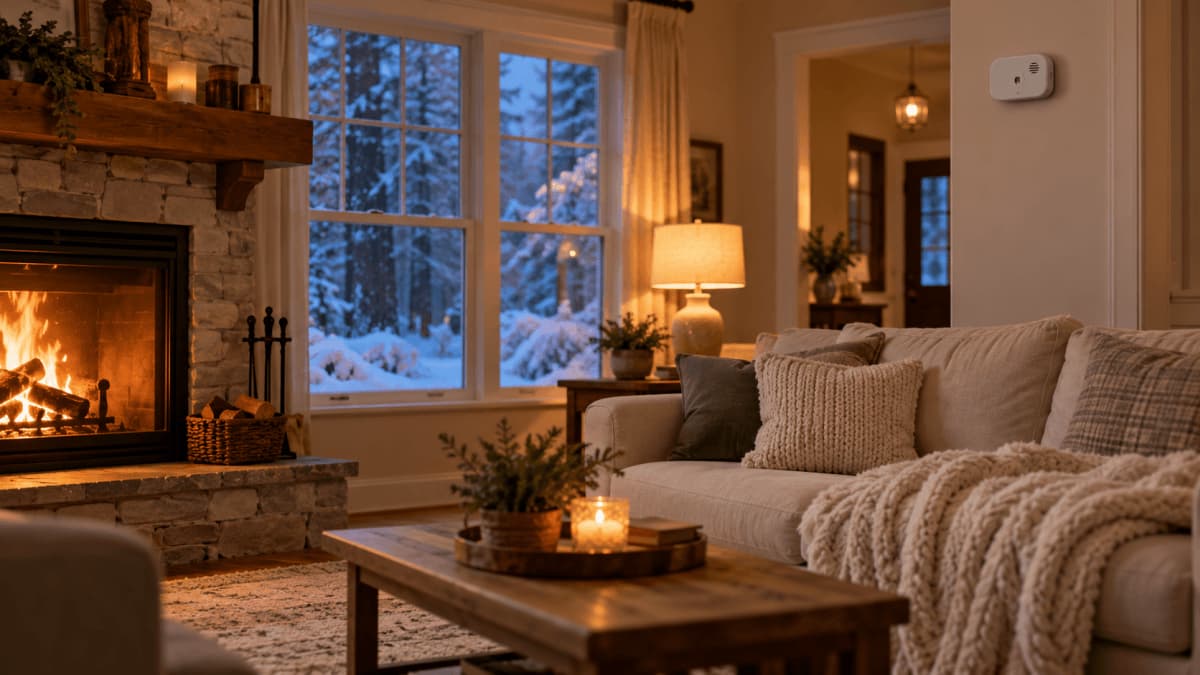
Can Your HVAC Filter Protect You From Carbon Monoxide and Smoke?
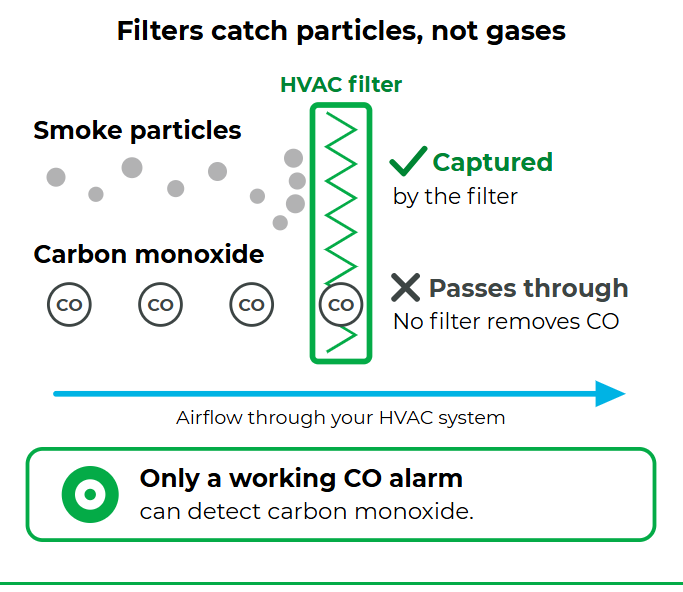
No. An HVAC filter can’t remove carbon monoxide, and only a working CO alarm can detect it. CO is a gas, and filters capture particles, not gases. Your filter can capture smoke particles, and a MERV 13 filter captures finer ones if your system is built for it. The filter match quiz below helps you find the right fit for your system.
Answer a few quick questions and we’ll match you to the right filter for your home.
Already know your filter size? Shop air filters at Filterbuy
Carbon monoxide (CO) is an invisible, odorless gas that standard HVAC filters cannot capture; filtration targets particles, not gases. Only working CO alarms detect carbon monoxide. HVAC filters, including higher-MERV options, can reduce airborne smoke particles, but they don't address combustion gases, equipment malfunctions, or ventilation problems. These are two separate safety issues that require two separate solutions.
Winter brings closed windows, running furnaces, and (in some regions) wildfire smoke that lingers into colder months. It's easy to assume that because an HVAC system moves air through the whole house, it also protects that air from every airborne hazard. That assumption can be dangerous. Carbon monoxide safety and smoke-particle control rely on entirely different tools, and confusing the two can leave a real gap in protection.
Can HVAC Filters Remove Carbon Monoxide Or Smoke?
No. HVAC filters, regardless of MERV rating, cannot remove carbon monoxide. Carbon monoxide is a gas, and standard mechanical filtration, including Filterbuy filters, is designed to capture particles like dust, pollen, and smoke, not gas molecules. The only reliable way to detect carbon monoxide in a home is a certified CO alarm.
HVAC filters can reduce airborne smoke particles, particularly fine particulate matter (PM2.5), when paired with a compatible system and an appropriately rated filter. Higher-MERV filters, such as MERV 13, are more effective at capturing smoke particles than lower-rated filters, but they still don't address the gases found in smoke or the source of combustion problems.
Why Carbon Monoxide Risk Rises In Winter
Carbon monoxide poisoning cases spike during colder months, and the reasons are mostly behavioral and seasonal. Furnaces and fireplaces run more often. Power outages during winter storms lead people to use generators, sometimes without following safety guidance. Vehicles get started in attached garages to warm up before a drive. Homes are sealed tightly against the cold, which reduces natural air exchange and allows any CO that is produced to accumulate indoors rather than dissipate.
According to the CDC, unintentional carbon monoxide poisoning causes more than 400 deaths, about 100,000 emergency department visits, and roughly 14,000 hospitalizations in the United States every year. Many of these incidents cluster in winter, when fuel-burning appliances and vehicles are used more heavily in enclosed spaces.
What Causes Carbon Monoxide In A Home?
Carbon monoxide forms when fuel (natural gas, propane, oil, wood, or gasoline) burns incompletely. Common sources inside and around homes include:
Fireplaces and wood stoves with blocked or damaged flues
Portable and standby generators, especially when used indoors or in attached structures
Gas stoves, ovens, and water heaters
Vehicles and small engines running in garages
Any combustion equipment operating without adequate exhaust venting
Any of these can introduce carbon monoxide into a home's air, and the risk multiplies when ventilation is poor or equipment hasn't been inspected recently.
Can Carbon Monoxide Travel Through HVAC Ducts?
Yes. If carbon monoxide enters the air inside a home (for example, from a malfunctioning furnace or an idling car in an attached garage), the HVAC system's air handler can circulate that air throughout connected ductwork and rooms. This is one reason CO can spread quickly to parts of a house far from its original source. It's also why relying on airflow patterns to predict or contain CO is not a safe strategy; the correct response is detection and evacuation, not air circulation management.
Can An HVAC Filter Remove Carbon Monoxide?
No. This bears repeating because it's the single most important fact in this guide: standard HVAC filters, regardless of MERV rating, cannot remove carbon monoxide. CO is a gas made of very small molecules that pass through the fibers of mechanical air filters unaffected. Filtration, the process of trapping particles as air moves through a filter media, has no effect on gas molecules at this scale.
Only a certified carbon monoxide alarm can detect CO in a home. There is no filter, air purifier, or HVAC accessory that substitutes for a working alarm.
Can HVAC Filters Remove Smoke?
Partially. HVAC filters can capture a meaningful portion of the particulate matter found in smoke, especially fine particles known as PM2.5 (particles 2.5 micrometers or smaller, small enough to penetrate deep into the lungs). Higher-MERV filters, such as MERV 13, are rated to capture a higher percentage of these fine particles than lower-rated filters like MERV 8.
That said, filters address only the particle component of smoke. Smoke also contains gases, including carbon monoxide (depending on the combustion source), and no mechanical filter removes those gases. Filtration reduces particulate exposure; it does not neutralize smoke's gaseous byproducts or address the source producing the smoke.
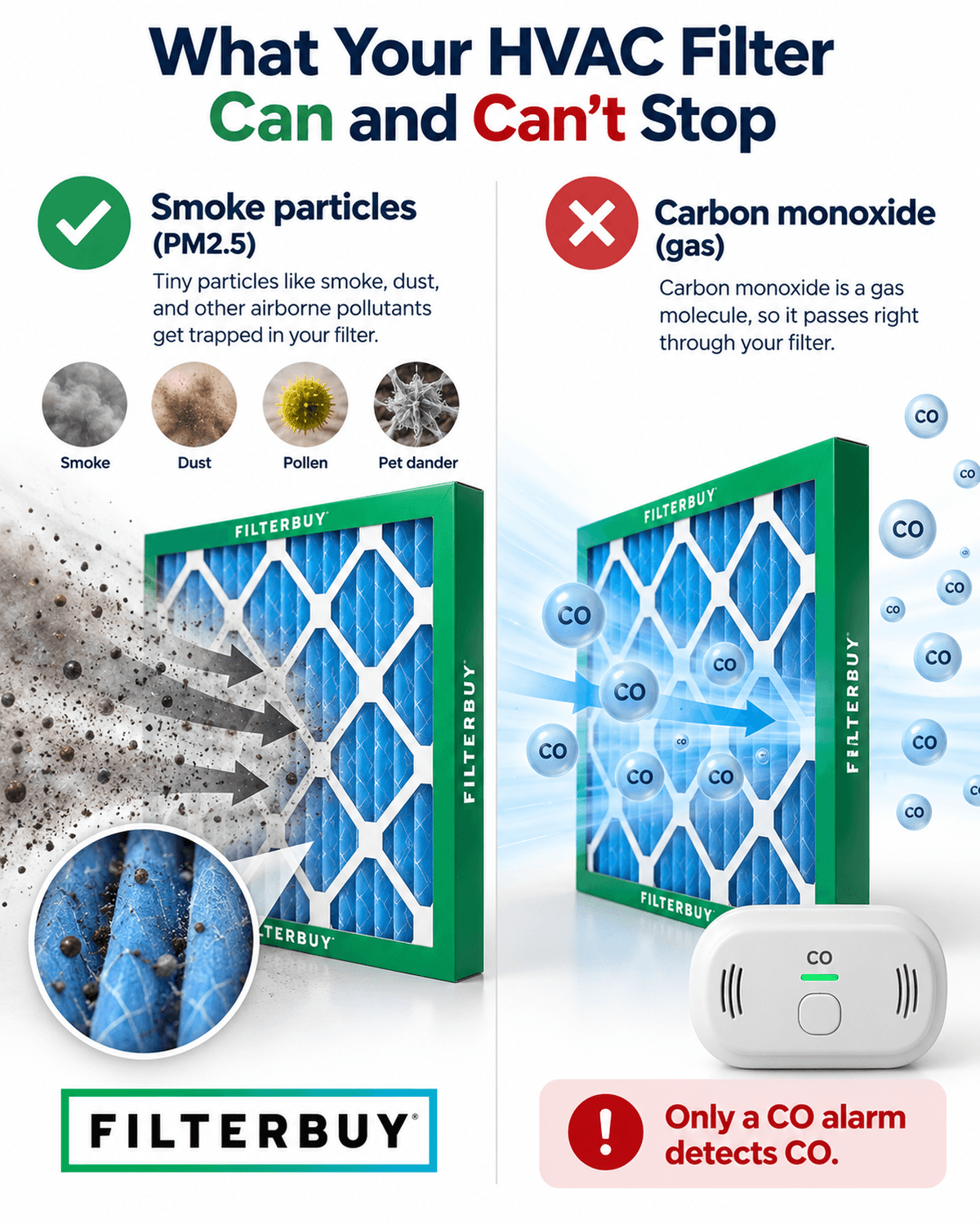
Carbon Monoxide Vs. Smoke: What Your HVAC Filter Can Actually Do
| Hazard | Composition | Can a standard HVAC filter help? | What actually protects you |
|---|---|---|---|
| Carbon monoxide | Colorless, odorless gas | No | Certified CO alarms, source maintenance, proper venting |
| Wildfire or fireplace smoke (particles) | Fine particulate matter (PM2.5) | Partially Especially with MERV 13 | Source control, ventilation strategy, higher-MERV filtration, portable HEPA units |
| Smoke gases | Various combustion gases | No | Source control, ventilation, professional inspection |
This table is the core distinction to remember: filtration addresses particles, not gases, and carbon monoxide is entirely a gas-phase hazard.
MERV Ratings For Smoke
MERV (Minimum Efficiency Reporting Value) measures how effectively a filter captures particles of different sizes. For smoke particle reduction, the rating matters:
| MERV Rating | Particle Capture Performance | Suitability for Smoke |
|---|---|---|
| MERV 8 | Captures larger particles like dust and lint | Limited effect on fine smoke particles |
| MERV 11 | Captures smaller particles, including some fine dust | Moderate improvement for smoke particles |
| MERV 13 | Captures fine particles, including much PM2.5 | Best standard option for reducing smoke particles |
Before upgrading to a higher MERV rating, confirm compatibility with your specific HVAC system. Some systems aren't designed to handle the airflow resistance of denser filter media, and installing an incompatible filter can strain the equipment. Check manufacturer specifications or consult an HVAC technician if you're unsure.
CO Alarms: Where To Install Them And How To Maintain Them
Because filters can't detect or remove carbon monoxide, alarms are the primary safety tool. Best practices include:
Install a CO alarm on every level of the home, including the basement.
Place alarms outside each sleeping area so they're audible while occupants are asleep.
Choose alarms with battery backup so they continue working during a power outage, a time when CO risk from generators is elevated.
Interconnected alarms, where one sounding triggers all units in the home, are preferred because they ensure the alert is heard throughout the house.
Test alarms monthly to confirm they're functioning.
Follow manufacturer and Consumer Product Safety Commission (CPSC) guidance on alarm lifespan and replace units at their recommended end-of-life date, since CO sensors degrade over time.
What To Do If A CO Alarm Sounds
If a carbon monoxide alarm goes off, leave the home immediately. Get everyone, including pets, outside into fresh air. Call 911 from outside the home, not from inside. Do not stay inside to investigate the source, locate the alarm, or open windows before leaving; carbon monoxide can cause confusion and impaired judgment quickly, and every moment spent inside increases exposure risk. Let emergency responders determine when it's safe to re-enter.
What Are The Symptoms Of Carbon Monoxide Exposure?
The CDC identifies the most common symptoms of carbon monoxide poisoning as headache, dizziness, weakness, nausea, vomiting, chest pain, and confusion. These symptoms are often described as flu-like, but a key distinguishing factor is the absence of fever. If multiple household members experience these symptoms simultaneously, especially during cold weather with furnace or fireplace use, carbon monoxide exposure should be considered and the home evacuated.
How To Reduce Furnace-Related CO Risk Before Winter
Preparing fuel-burning equipment before winter reduces the likelihood of a CO-producing malfunction:
Schedule a professional inspection of the furnace, including the heat exchanger and burners, before the heating season begins.
Have a technician check flue pipes and venting for blockages, corrosion, or disconnections.
Clear snow, debris, and nesting materials from exterior exhaust vents regularly throughout winter.
Never use a gas oven or range as a heating source. These appliances aren't designed for sustained space heating and can produce dangerous CO levels.
Never idle a vehicle inside an attached garage, even with the garage door open, since CO can still migrate into the home.
Generator Safety
Generators are a significant source of winter CO poisoning, particularly during power outages. Operate generators outdoors only, positioned at least 20 feet away from windows, doors, and vents. Never run a generator inside a home, attached garage, basement, crawlspace, shed, or on a porch, even temporarily or with doors and windows open. Exhaust from generators can accumulate quickly in these enclosed or semi-enclosed spaces and reach lethal concentrations within minutes.
How HVAC Maintenance Fits Into Winter Safety
Routine HVAC maintenance supports a healthy, efficient system, but it should be understood for what it is: airflow and particle management, not carbon monoxide prevention. Good maintenance practices include:
Installing a filter that properly fits the system's filter slot
Choosing a MERV rating compatible with the equipment's specifications
Inspecting filter condition regularly and replacing it according to manufacturer guidance, since replacement intervals vary by filter type, household conditions, and usage
Keeping supply and return registers unblocked by furniture or rugs
Calling a technician if airflow seems abnormally weak or the system is cycling unusually
HVAC maintenance is not a substitute for a combustion-safety inspection of furnaces, fireplaces, or gas appliances, and it does not replace carbon monoxide detection. These are separate systems addressing separate risks.
How To Reduce Smoke Indoors
Reducing indoor smoke exposure depends on identifying the source:
Fireplace smoke: Ensure proper flue operation and have chimneys inspected and cleaned regularly to prevent smoke from entering living spaces.
Cooking smoke: Use a range hood vented to the outdoors whenever cooking produces smoke or strong odors.
Candle or incense smoke: Use in well-ventilated areas and extinguish promptly if smoke becomes noticeable.
Wildfire smoke: Keep windows and doors closed during smoke events, run the HVAC system with a higher-MERV filter if the system supports it, and consider a portable HEPA air cleaner for rooms where people spend the most time.
Ventilation strategy (knowing when to bring in outdoor air and when to seal the home against it) matters as much as filtration. During wildfire smoke events, keeping outdoor air out is usually preferable; during routine cooking, ventilating smoke outdoors is the better approach.
When Smoke Means Something Is Wrong
Not all smoke calls for the same response. Certain signs indicate a problem that filtration or ventilation won't solve:
Smoke from a fireplace entering the room instead of going up the chimney
Smoke originating from the furnace or other HVAC equipment
Smoke or haze near electrical outlets, panels, or wiring
A burning wiring smell anywhere in the home
Smoke that continues even after the suspected source has been turned off or extinguished
In any of these situations, stop using the equipment immediately and contact a qualified professional or emergency services. These are indicators of equipment failure or fire risk, not routine air-quality issues.
What Your Air Filter Cannot Protect You From
To be direct about the limits of HVAC filtration, an air filter cannot protect against:
Carbon monoxide
Natural gas or propane leaks
Combustion equipment failure
Chimney or flue problems
Electrical fires
The gaseous components of smoke
Pollution at its source, rather than after it has already entered the air
Recognizing these limits is part of using HVAC filtration appropriately, as one layer of indoor air quality management, not a comprehensive safety system.
Choosing A Filterbuy Filter For Smoke Particles
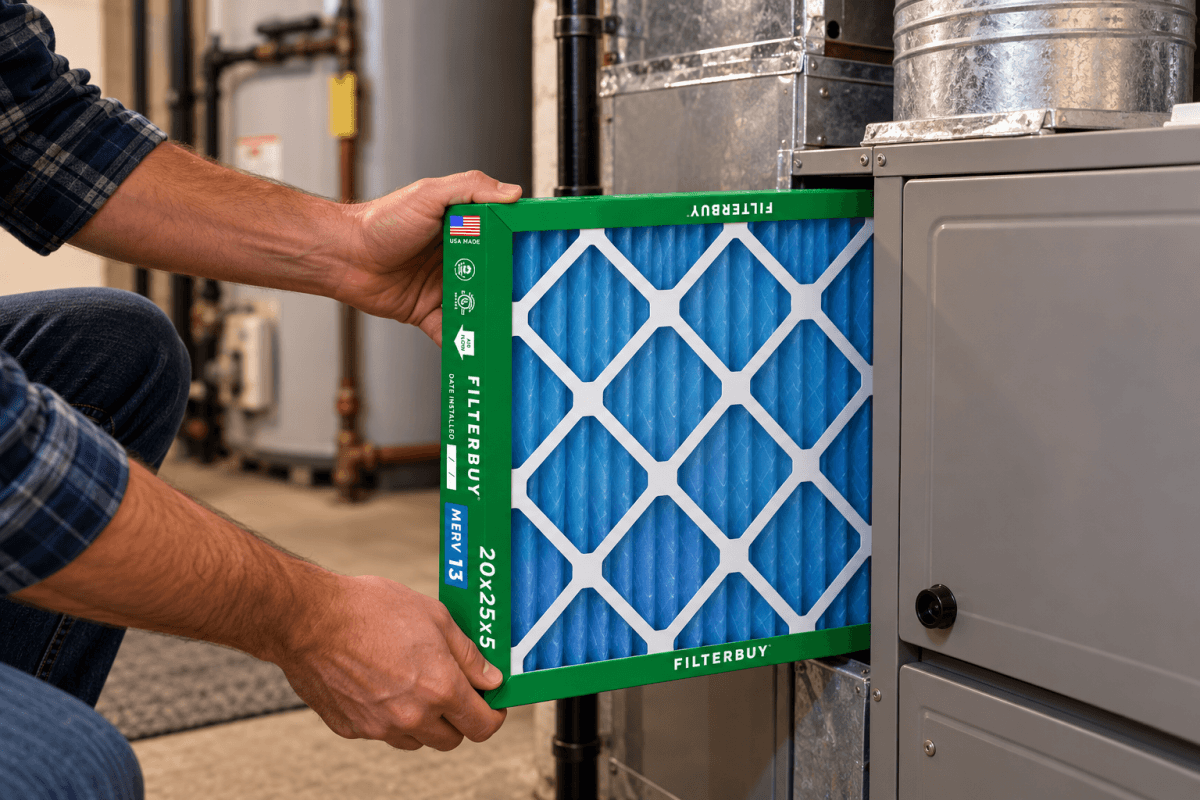
Filterbuy filters are designed for particle filtration, capturing dust, pollen, pet dander, and smoke particulate as air passes through the HVAC system. For households managing smoke particle exposure, a MERV 13 Filterbuy filter offers stronger particulate capture than lower-rated options, provided it's compatible with the HVAC system's specifications.
Filterbuy offers filters in a wide range of sizes to fit most residential systems, with options delivered on a schedule that matches the household's needs. It's worth emphasizing that this filtration addresses airborne particles only. It is not a carbon monoxide safety measure, a substitute for CO alarms, or a tool for preventing combustion-related hazards. For CO protection, a certified alarm and routine combustion-equipment inspection remain essential regardless of which air filter is installed.
Keeping Both Risks In View This Winter
Carbon monoxide safety and smoke-particle control call for different tools and different habits. CO safety depends on prevention at the source, proper venting, routine equipment inspection, and (most critically) working, interconnected CO alarms with battery backup. Smoke-particle control depends on identifying the source, applying the right ventilation strategy, and using compatible, appropriately rated HVAC filtration.
Treating these as one combined problem risks under-protecting against the hazard that matters most: carbon monoxide, which no filter can detect or remove. Before winter sets in, test every CO alarm in the home, schedule a professional furnace inspection, and evaluate whether your HVAC system could benefit from a higher-MERV filter for smoke particle reduction. Each step addresses a distinct risk, and together they build a more complete picture of winter indoor air safety.
Frequently Asked Questions
Can An HVAC Filter Remove Carbon Monoxide?
No. Carbon monoxide is a gas, and standard HVAC filters are designed to capture particles, not gases. Only a certified CO alarm can detect carbon monoxide in a home.
Can Carbon Monoxide Travel Through Air Vents?
Yes. If carbon monoxide enters a home's air supply, the HVAC system's ductwork can circulate it to other rooms, which is why whole-home detection via alarms, not airflow management, is the correct safety response.
Can A Furnace Cause Carbon Monoxide?
Yes. A malfunctioning or poorly vented furnace is one of the most common sources of indoor carbon monoxide, particularly when the heat exchanger is cracked or the flue is blocked or disconnected.
What Are The First Symptoms Of CO Poisoning?
According to the CDC, early symptoms include headache, dizziness, weakness, nausea, vomiting, chest pain, and confusion. These resemble flu symptoms but typically occur without fever.
Where Should I Install CO Detectors?
Install a CO alarm on every level of the home, including the basement, and place one outside each sleeping area so it can be heard while occupants are asleep.
What Should I Do If My CO Alarm Sounds?
Leave the home immediately with all occupants and pets, and call 911 from outside. Do not stay inside to investigate the source or open windows first.
Can An HVAC Filter Remove Smoke?
HVAC filters can reduce airborne smoke particles, especially fine particulate matter, when the filter's MERV rating is compatible with the system. They don't remove the gaseous components of smoke.
What MERV Rating Is Best For Smoke?
MERV 13 generally offers the strongest particle capture for smoke among standard residential filter ratings, provided the HVAC system is compatible with that filter's airflow resistance.
Is MERV 13 Safe For My HVAC System?
It depends on the system. Some HVAC equipment isn't built to handle the airflow resistance of a MERV 13 filter. Check your system's specifications or consult an HVAC technician before upgrading.
How Often Should I Change My HVAC Filter In Winter?
Replacement frequency depends on the filter type, household conditions, and system usage. Follow the manufacturer's guidance for your specific filter rather than a fixed universal schedule.
Can A Dirty Filter Cause Carbon Monoxide?
A dirty filter does not create carbon monoxide. CO is produced by incomplete combustion in fuel-burning equipment, not by filter condition. A clogged filter can affect airflow and system performance, but it is not a CO source.
Can An Air Purifier Remove Carbon Monoxide?
No. Standard air purifiers, like HVAC filters, are designed to capture particles. They are not effective at removing carbon monoxide or other gases. CO detection requires a certified carbon monoxide alarm.
See More
Understand how winter conditions, carbon monoxide, wildfire smoke, and HVAC airflow affect your home's indoor air safety. Learn why proper ventilation, effective filtration, and carbon monoxide detection each play an important role in protecting your household.
Explore the relationship between HVAC airflow, smoke particles, and carbon monoxide safety. These visual insights help explain what your home's air filtration system can accomplish, where its limitations begin, and why additional safety measures are essential.
Take a closer look at home air safety and the importance of understanding airborne pollutants. Discover how different protective measures work together to support cleaner indoor air and a safer home environment.