
Best Time to Buy a Furnace or Heat Pump: Seasonal Pricing & Rebates
October 20, 2026

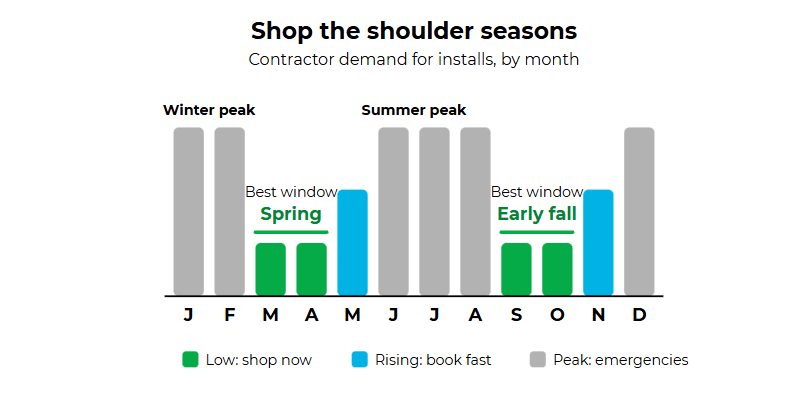
The best time to buy a furnace or heat pump is spring (March and April) or early fall (September through mid-October). Contractors have open calendars in these shoulder seasons, so you can compare quotes without pressure. Midwinter and midsummer cost the most, because emergency no-heat and no-cool calls fill installer schedules.
Timing matters more this year because the federal Section 25C tax credit ended for systems placed in service after December 31, 2025. As an air filter manufacturer, Filterbuy looks at timing from the filter slot outward: the filter you pull each fall shows how hard your system has been working.
The best time to buy a furnace or heat pump is spring (March and April) or early fall (September through mid-October). Contractor demand is lowest then, so you can compare quotes without pressure. With the federal 25C tax credit ended for 2026 installs, check state and utility rebates before you sign.
New system or old, take the quick quiz below to match it with the right air filter.
Answer 3 quick questions and we’ll match you to the right filter for your furnace or heat pump.
Already know your filter size? Shop Filterbuy Air Filters
TL;DR
Buy a furnace or heat pump in spring or early fall, when contractor demand is lowest. If your system fails in winter, a safe repair that lasts until spring usually costs less than an emergency replacement. With the 25C credit gone, confirm state and utility rebates before you sign.
Key Takeaways
Spring and early fall are the best times to buy because contractor demand is lowest.
A safe winter repair that carries an aging furnace to spring usually beats a rushed emergency replacement.
The federal Section 25C tax credit does not apply to any furnace or heat pump placed in service after December 31, 2025.
The federal HEAR rebate covers up to $8,000 of a heat pump for income-qualified households in participating states.
When Is the Best Time of Year to Buy a Furnace or Heat Pump?
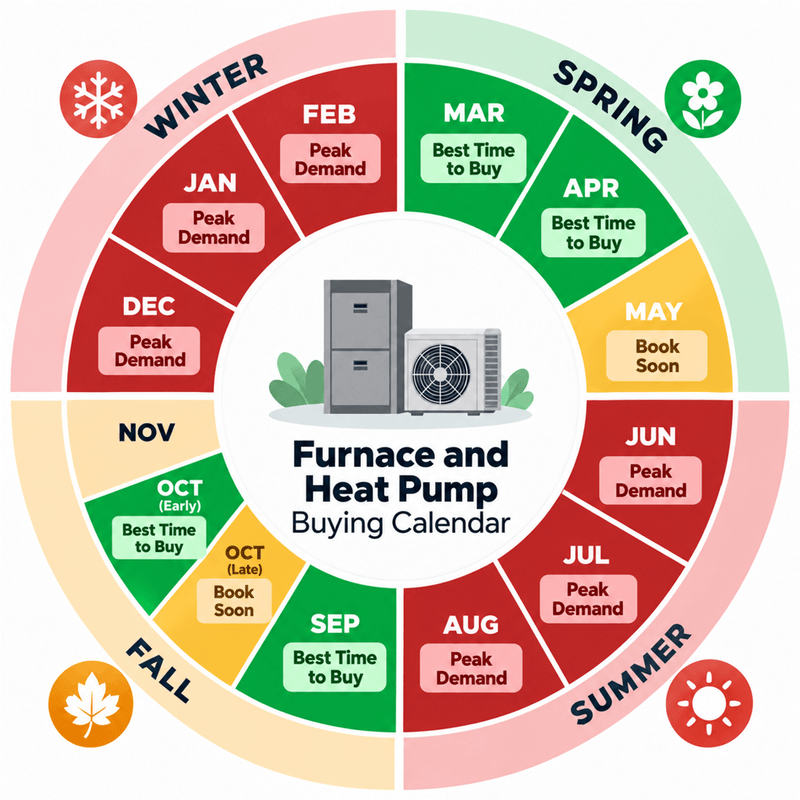
Spring and early fall are the best times of year to buy a new furnace or heat pump. Filterbuy's rule of thumb: shop in the shoulder seasons, and buy at the peaks only when you have to. For heat pumps, spring has a slight edge because you can test both modes before either peak.
Furnace and Heat Pump Buying Calendar
| Season | Demand and What It Means |
|---|---|
| Early spring (March, April) | Low demand. Best window for a planned replacement. |
| Late spring (May) | Rising demand. Good for a heat pump before summer. |
| Summer (June to August) | Peak demand. AC emergencies take priority. |
| Early fall (September to mid-October) | Low demand. Best window to replace a furnace. |
| Late fall (late October, November) | Rising demand. Book quickly. |
| Winter (December to February) | Peak demand. Mostly emergency installs. |
Why Are HVAC Prices Lower in Spring and Fall?
HVAC prices are lower in spring and fall because contractor demand drops, which gives you room to negotiate. The Filterbuy take: the price you pay reflects the time you gave yourself as much as the equipment you chose.
Is Winter a Bad Time to Buy a Furnace or Heat Pump?
Winter is usually the most expensive season to buy a furnace or heat pump, because most winter purchases are emergencies and few homeowners can wait for three bids while the house cools.
Should You Repair or Replace a Furnace in Winter?
Repair a furnace in winter when it is mid-life and a technician confirms the fix is modest and safe, since that buys you time to shop in spring. A common rule of thumb: multiply the unit's age by the repair quote, and if the result tops $5,000, replacement usually wins.
Never run a furnace flagged for a cracked heat exchanger, since it can leak carbon monoxide into the home. Keep CO alarms on every level, as the Consumer Product Safety Commission advises. If your furnace has already quit, the Filterbuy guide on what to do when a furnace dies mid-season walks you through the next steps.
Can a Heat Pump Keep Your Home Warm in Winter?
Yes. Cold-climate heat pumps can keep a home warm through long subfreezing stretches, and the U.S. Department of Energy describes air-source heat pumps as a legitimate space heating alternative in colder regions. The nonprofit Northeast Energy Efficiency Partnerships names models built for cold regions in NEEP's cold-climate heat pump list. New to heat pumps? Start with how a heat pump works.
For one cold room or an addition, a ductless mini-split heat pump can fill the gap. Filterbuy ductless mini-split systems come with a 7-year compressor and 3-year parts warranty and require professional installation. See our guide to mini-split tax credits and rebates.
What Changed for Furnace and Heat Pump Buyers in 2026?
Four policy changes affect 2026 buyers: the end of the 25C credit, the lifted R-410A installation deadline, state-run HEAR rebates, and a 2028 gas furnace efficiency standard.
2026 Policy Changes for Furnace and Heat Pump Buyers
| Policy | 2026 Status and What It Means |
|---|---|
| Section 25C tax credit | Ended. No federal credit for 2026 installs. |
| R-410A installation deadline | Lifted in May 2026. Older R-410A units may still be offered, except in New York. |
| HEAR heat pump rebate | State by state. Up to $8,000 for qualifying households where launched. |
| 95% AFUE gas furnace standard | Set for December 18, 2028. New non-weatherized gas furnaces will need condensing technology. |
The IRS confirms the Energy Efficient Home Improvement Credit covered improvements made through December 31, 2025, worth up to $2,000 a year for a heat pump and $600 for a furnace. The Appliance Standards Awareness Project notes that the 2028 gas furnace standard requires 95% AFUE, which effectively means condensing furnaces only.
On refrigerants, the Air Conditioning Contractors of America (ACCA) reports that the EPA's May 2026 rule lifted the R-410A installation deadline for equipment made before 2025, everywhere except New York. ACCA also expects refrigerant prices to climb.
Questions to Ask Before You Sign a 2026 Quote
A good 2026 quote should answer these questions:
Which refrigerant does this system use, and what will it cost to service later?
Is the system sized with a Manual J load calculation, or copied from the old unit's label?
Will a condensing furnace need new venting in my home?
What filter size and thickness does the new system take?
Which Rebates Still Lower the Cost of a New Furnace or Heat Pump?
The Home Electrification and Appliance Rebate (HEAR) is the largest federal incentive left for heat pumps. According to ENERGY STAR, HEAR heat pump rebates reach up to $8,000, covering up to 100% of the cost for households below 80% of area median income and up to 50% for households between 80% and 150%. Each state administers the program, so availability varies.
Gas furnaces do not qualify for HEAR, but some gas and electric utilities pay rebates on high-efficiency furnaces and heat pumps. Search the Database of State Incentives for Renewables & Efficiency by ZIP code for local programs, and see the Filterbuy heat pump tax credit and rebate guide for 2026 for state-by-state detail.
How to Time Your Furnace or Heat Pump Purchase
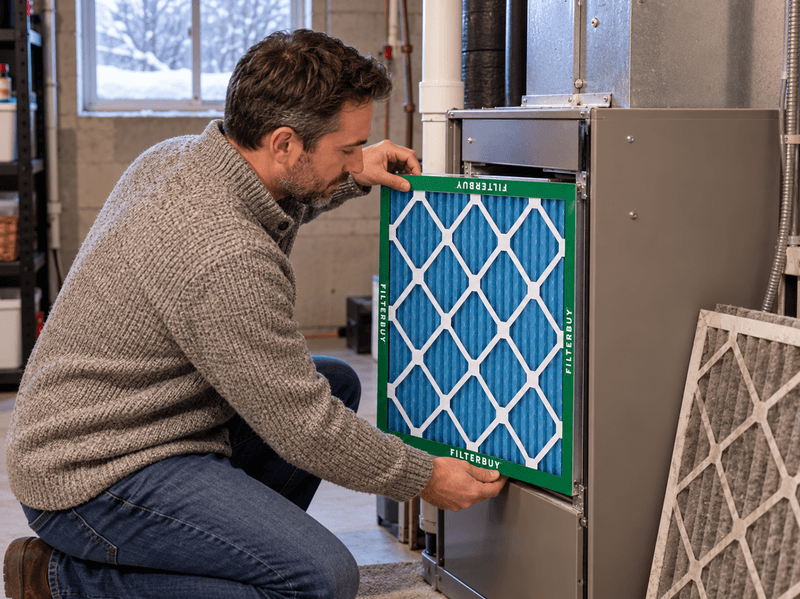
Spot trouble in the fall, then shop in spring.
The Filterbuy Fall Filter-Slot Check
When you pull the old filter before heating season, look for these signs:
The filter looks heavily loaded well before its scheduled change date.
Dust settles on vents and furniture faster than it used to.
The system runs longer, or cycles on and off more often, than last winter.
Some rooms heat unevenly, or the system makes new noises.
If you notice two or more, mention them at your fall tune-up and start collecting quotes before spring.
A Sample Timeline If Your Furnace Is Flagged This Fall
Filterbuy's six-month plan for an aging furnace that is still safe to run:
October: Run the filter-slot check, book a tune-up, and work through our winter HVAC prep checklist or our tips to get your heat pump ready for winter.
November to February: Run on the approved repair and check the filter every 30 days, as explained in how often to change your furnace filter in winter.
January: Request rebate pre-approval before state funds run short.
March: Collect at least three written, itemized quotes.
April: Install during a mild week, then confirm the new system's filter size. Filterbuy air filters in hundreds of sizes ship with fast and free 2-day delivery to most US states.
“Most furnace emergencies we hear about start as small warning signs in the fall, like a blower that short-cycles or a filter that clogs faster than it should. Homeowners who treat the fall tune-up as their buying signal get to shop in the quiet weeks instead of on the coldest night of the year.”
David Heacock, Founder and CEO, Filterbuy
Supporting Statistics
1. Heat pumps now outship gas furnaces.
The Air-Conditioning, Heating, and Refrigeration Institute counted 1,738,011 air-source heat pumps shipped from January through May 2026, versus 1,232,653 gas furnaces. Heat pump shipments rose 1.4% while gas furnace shipments fell 10.5%.
Our read: get quotes on both in the same shoulder-season round.
Source: AHRI May 2026 U.S. Heating and Cooling Equipment Shipment Data
2. Winter heating costs are shifting by fuel.
For winter 2026 to 2027, the U.S. Energy Information Administration expects natural gas heating expenditures to fall 9%, electricity bills to rise 4%, and heating oil spending to jump 21%.
Our read: compare your local gas and electric rates before choosing.
Source: EIA Mixed Outlook for Energy Expenditures This Winter
3. Heating safety is a buying factor.
More than 400 Americans die, and more than 100,000 visit an emergency room each year from unintentional carbon monoxide poisoning not linked to fires.
Our read: use the yearly heating checkup CDC recommends to decide on repair or replacement.
Frequently Asked Questions
What Month Is the Cheapest Time to Buy a Furnace?
September and early October tend to be the cheapest months to buy a furnace, followed by March and April, when contractor demand dips.
Is a Heat Pump or a Gas Furnace Cheaper to Run?
It depends on climate and local energy prices. Heat pumps often cost less to run where winters are moderate, while a gas furnace can win where winters are severe and gas is cheap.
Can I Still Get a Federal Tax Credit for a Furnace or Heat Pump in 2026?
No. Section 25C ended for systems placed in service after December 31, 2025. For a 2026 purchase, look to HEAR and local utility rebates.
Should I Wait Until Spring If My Furnace Still Works?
Yes, if a technician confirms the furnace is safe and repairs are minor. If a safety problem turns up, replace it sooner.
Plan Your Furnace or Heat Pump Purchase Today
The best time to buy a furnace or heat pump is before an emergency makes the choice for you, so book a fall tune-up now and line up quotes for spring or early fall. In the meantime, a Filterbuy air filter subscription delivers the right size on schedule.
Glossary
AFUE (Annual Fuel Utilization Efficiency): The share of a furnace's fuel that becomes usable heat.
Condensing Furnace: A gas furnace that recaptures exhaust heat, using plastic venting and a drain.
Filterbuy: An air filter manufacturer that also sells ductless mini-split systems direct to homeowners.
HEAR (Home Electrification and Appliance Rebate): A state-run federal rebate on heat pumps and other electric upgrades for income-qualified households. Also called HEEHR or HEEHRA.
Manual J: The ACCA load calculation used to size heating and cooling equipment for a specific home.
R-410A: A refrigerant being phased down in home heat pumps and air conditioners