Mini Split Not Heating? 9 Causes and Fixes (Start With the Filter)
September 29, 2026
Mini Split Not Heating? Here’s What to Check First
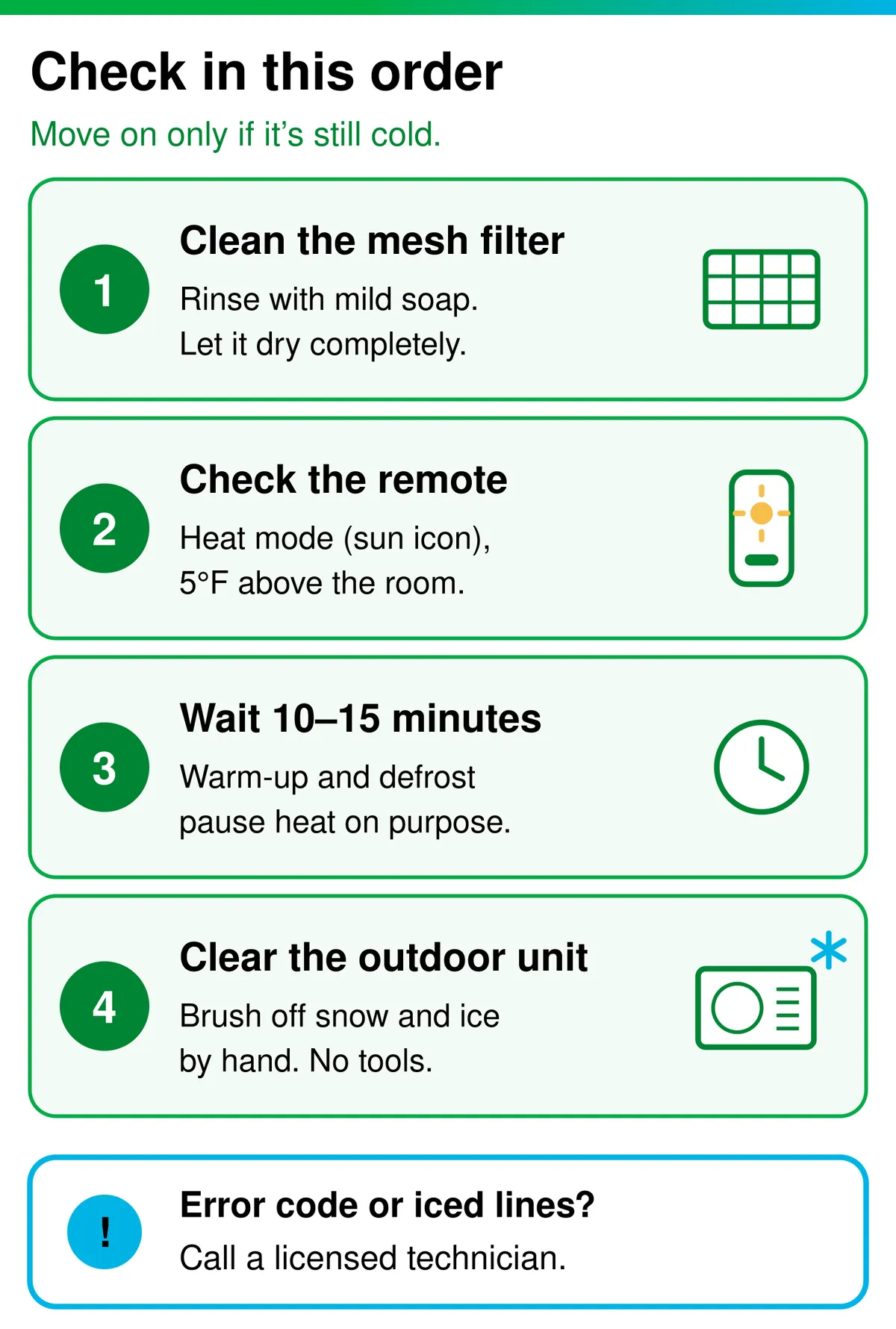
A mini split that isn’t heating usually needs its mesh filter cleaned or its remote switched to Heat. Set it to the sun icon, at least 5°F above the room, and give it 10 to 15 minutes. Warm-up and defrost pause the heat on purpose. Still lukewarm? Clear the outdoor unit, and call a licensed technician about error codes or leaks.
If your unit just can’t keep up with the room or your winters, the quick quiz below will match you to the right mini split.
Room too big, or winters too cold? Filterbuy mini splits offer heating down to 5°F, in 12,000, 18,000, and 24,000 BTU sizes, with free 2-day delivery.
Shop Mini Split SystemsProfessional installation required.
Not sure which mini split fits your space? Answer a few quick questions and we’ll match you to the right system.
TL;DR
A mini split not heating usually needs its mesh filter cleaned first. Then set the remote to Heat, at least 5°F above the room, and give it 10 to 15 minutes; warm-up and defrost pause heat on purpose. Still lukewarm? Clear the outdoor unit, and call a licensed technician about error codes or leaks.
Key Takeaways
The filter is Filterbuy's first check. A clogged mesh filter traps heat at the indoor coil and turns warm air lukewarm.
Some pauses are normal. Warm-up takes a few minutes, and defrost can stop the heat for 5–15.
Refrigerant is a job for a pro. EPA rules require Section 608 certification.
Why We Start With the Filter
Filterbuy manufactures air filters in the USA. We also sell ductless mini splits, and our HVAC Solutions team services ductless systems in Florida and Texas homes. The most common "broken heater" we see is a unit protecting itself from a clogged mesh screen.
"…the pattern that stands out is how many protection codes are really airflow codes wearing a costume. Owners are told the mesh screen behind the front panel is the filter. It is not. It is a coil guard."
— Michelle Wan, Brand Manager and Air Quality Writer, Filterbuy
Is It Really Not Heating? Try the Two-Minute Thermometer Test
Your hand is a poor judge: air below body temperature feels cool on skin even while it warms the room.
Run the unit in Heat for 15 minutes, then hold a kitchen thermometer at the vanes for a minute and compare it with the room. Clearly warmer air means it's heating but the heat isn't spreading (Causes 7 and 8). Air within a few degrees of the room means it isn't heating (start with Cause 1).
What Is Your Mini Split Doing? Match the Symptom to the Cause
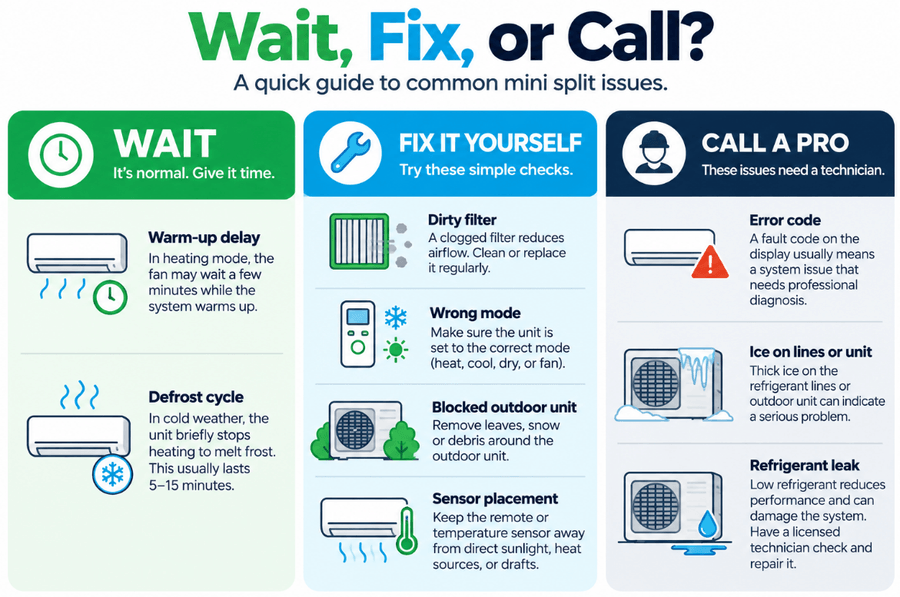
9 Reasons Your Mini Split Isn't Heating (and How to Fix Each)
1. A Dirty Filter Is Choking the Heat
A clogged mesh filter is the most common reason a mini split is heating slowly or not blowing hot air. It sits right in front of the indoor coil, so as dust builds up, less air carries heat into the room. The trapped heat raises system pressure, and the unit throttles back. Filterbuy systems have no dedicated error code for this, so a clogged filter shows up as weak heat before any fault code appears.
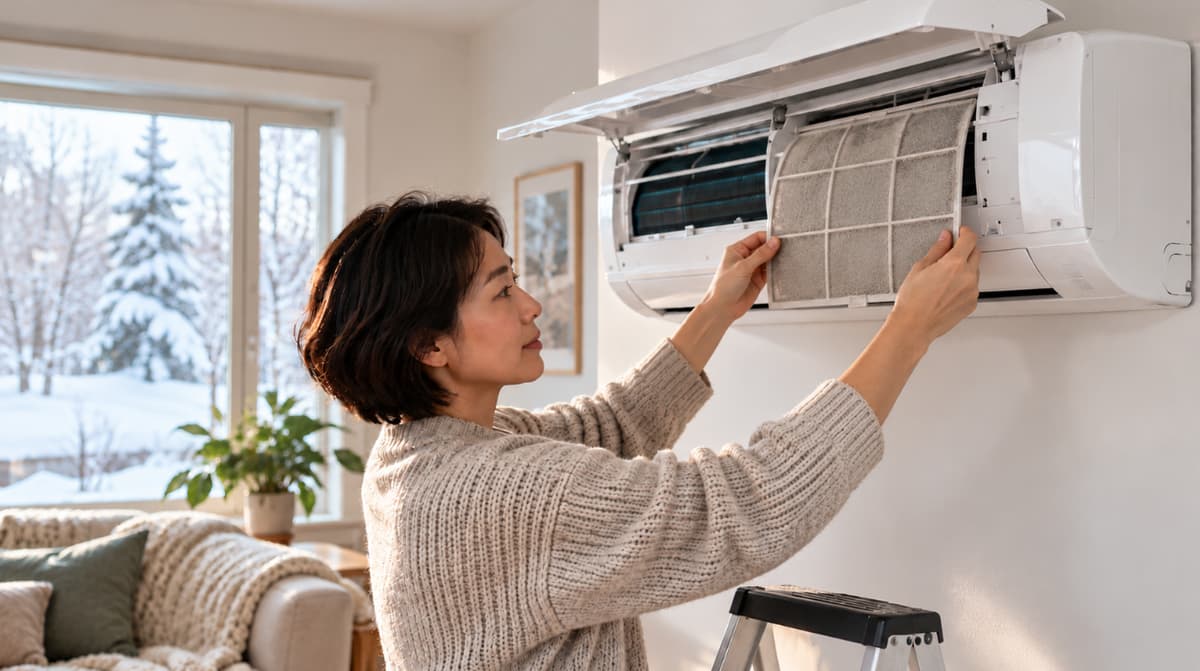
The fix: Switch off the unit at the remote and breaker, lift the front panel, and slide out the mesh filters. Rinse them in lukewarm water (no hotter than 104°F) with mild soap, and let them dry completely.
"The number-one callback we could prevent is the damp-filter mold call. A mesh that goes back in even slightly wet is how mold gets started inside the head. Give it the full drying time. A few extra minutes beats a service visit."
— David Clark, Licensed HVAC Technician
2. The Remote Is in the Wrong Mode or Setting
A mini split not working in heat mode is often just set wrong. Fan and Dry modes move air without warming it, and Auto can slip into cooling on a mild afternoon.
The fix: Look for the sun icon and set the temperature at least 5°F above the room reading. Replace weak batteries, and on a multi-zone system, put every head in the same mode. Filterbuy systems hold the compressor for about three minutes after any restart or mode change, a pause that's easy to mistake for failure.
3. The Unit Is Still Warming Up
Most mini splits keep the indoor fan off until the coil is warm, a feature called hot start or anti-cold-air protection. On Filterbuy systems the preheat takes two to five minutes.
The fix: Wait 10 minutes before troubleshooting.
4. The System Is Running a Defrost Cycle
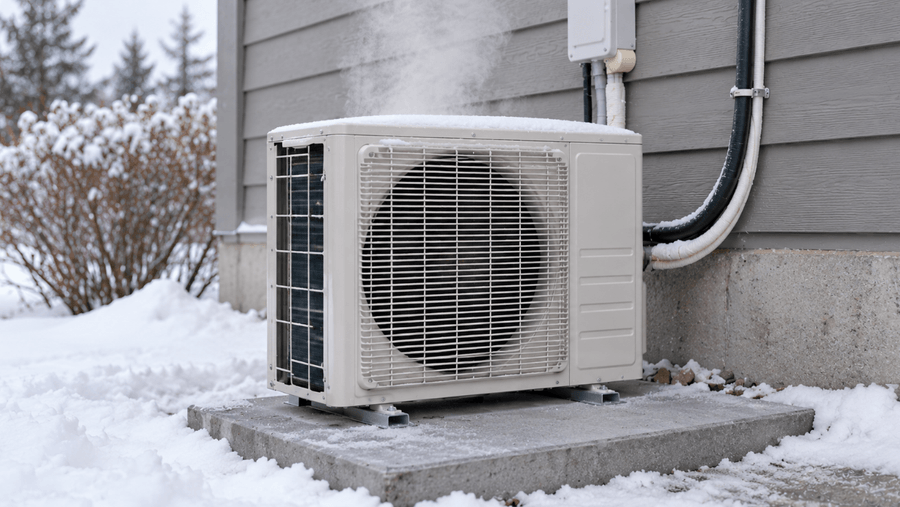
On cold, damp days, frost builds on the outdoor coil, and the mini split briefly runs in reverse to melt it. The fans pause and the outdoor unit may steam; on Filterbuy units, both restart on their own with no error code.
The fix: Wait 5–15 minutes. Steam clears fast; smoke lingers and smells burnt. If heat never returns, check Causes 5 and 9.
5. Snow, Ice, or Debris Is Blocking the Outdoor Unit
The outdoor unit pulls heat from outside air, so snow or ice packed against the coil cuts output.
The fix: Turn the system off and brush snow away by hand. Don't chip ice with tools; the fins and tubing damage easily. If snow buries it every winter, ask your installer about a stand.
6. It's Colder Outside Than Your Unit Is Built For
A mini split gathers heat from outdoor air, and the colder it gets, the less heat it can move.
The fix: Check the minimum heating temperature on your model's spec sheet. Filterbuy mini splits, for example, offer reliable heating down to 5°F. If this is your main heat and your winters run colder, choose a model rated lower.
7. The Sensor Thinks the Room Is Already Warm
Most wall-mounted mini splits read temperature at the indoor unit, high on the wall where warm air collects, so the unit can hit its setpoint and slow its fan while the floor is still cold. This is a common reason a mini split is blowing air but not warming the room.
The fix: Point the vanes down in heat mode so warm air reaches the floor. Then turn on remote sensing (I Feel or Follow Me on many brands) so it reads the temperature where you sit. Every Filterbuy mini split includes one; keep the remote out of direct sun.
A second heat source makes this worse. When a furnace or baseboard heater warms the same room, the mini split idles, and federal NREL field testing saw the indoor fan shut off in that setup. NYSERDA suggests turning the other system's thermostat down in the heat pump's zone.
8. The Unit Is Too Small for the Space
A mini split sized for one room can't keep up with an open floor plan or several rooms through doorways. It runs on high for hours yet falls short.
The fix: Close doors to rooms it wasn't sized for and seal obvious drafts. Still short? Ask a contractor for a Manual J load calculation.
9. A Refrigerant Leak or Failed Part
Low refrigerant, a stuck reversing valve, a failed sensor, or a bad control board can each stop the heat. Watch for an error code, iced refrigerant lines, hissing, or cold air after ruling out Causes 1–8.
The fix: Write down the code before you reset anything, then check Filterbuy's mini split blinking light guide. Filterbuy units have built-in refrigerant leak detection, and E4 flags a leak or system fault. Six of the thirteen codes are sensor faults, so a code that returns after one reset usually means a bad part. Shut the system off and call a licensed technician. Filterbuy mini splits require professional installation, and the warranty is void if self-installed.
When to Call an HVAC Professional
Call a licensed technician if a code returns after one reset, the breaker keeps tripping, you smell burning, or nothing above solves it.
Before calling, jot down the mode, setpoint, room and vane-air temperatures, outdoor temperature, and any code for the technician or Filterbuy's Mini Split Support Center.
How to Keep Your Mini Split Heating All Winter
Clean the mesh filters every two weeks during heating season.
Clear the outdoor unit after every snowstorm.
Book a professional tune-up before heating season. Filterbuy's mini split maintenance guide covers the rest.
The pre-filter protects the coil; your whole-home filter does the heavy lifting for air quality. Filterbuy manufactures those filters in the USA, with free auto-delivery.
Supporting Statistics: What the Research Shows
1. Heating and Cooling Take Almost Half of a Home's Energy Bill
A typical U.S. household spends about $1,900 a year on energy, and almost half goes to heating and cooling.
Source: ENERGY STAR, Air-Source Heat Pumps
2. Defrost Pauses Are Frequent and Built In
In NREL testing of a 1-ton ductless mini split in Fairbanks, Alaska, it defrosted about every 55 minutes for roughly 8 minutes.
It spent about 60% of its run time defrosting or recovering.
Source: U.S. DOE and NREL field test
3. Airflow and Refrigerant Faults Cost U.S. Homes About $2.5 Billion a Year
Low airflow and incorrect refrigerant charge add about 20.7 TWh a year in U.S. single-family homes, 9% more than fault-free systems.
Heat pumps were in 14% of modeled homes but caused about 39% of that waste; heating mode is more sensitive to both faults.
Sources: DOE OSTI, NREL study · ACEEE 2024 (PNNL, NEEA, DOE)
The study modeled central systems, but mini splits rely on the same airflow and charge.
Frequently Asked Questions
Why is my mini split blowing cold air in heat mode?
Usually it's in the wrong mode, defrosting, or low on refrigerant. Check the mode, wait 15 minutes, then call a pro.
How long does a mini split defrost cycle last?
Usually 5–15 minutes, and in cold, damp weather it can repeat about hourly. Heat then resumes automatically.
Should I use Auto mode in winter?
No. ENERGY STAR recommends Heat, because Auto can switch the system to cooling on a mild day.
Should I turn my mini split off at night or when I leave?
No. NYSERDA advises holding one steady temperature, because setbacks can raise energy bills and slow the room's warm-up.
Can I add refrigerant to my mini split myself?
No. Handling refrigerant requires EPA Section 608 certification, and low refrigerant often means a leak that has to be repaired first.
Glossary
Mini split (ductless mini split): A ductless heat pump with a wall-mounted indoor unit piped to an outdoor unit.
Mesh filter: The washable screen that keeps dust off a mini split's coil. Filterbuy calls it a coil guard.
Defrost cycle: An automatic heating pause that melts frost off the outdoor coil.
Hot start: A startup delay that keeps the indoor fan off until the coil warms.
Reversing valve: The valve that switches refrigerant flow between heating and cooling.
Manual J: The industry-standard load calculation for sizing heating and cooling.
ENERGY STAR: The EPA and DOE efficiency-certification program.
NREL: The Department of Energy's National Renewable Energy Laboratory.
NYSERDA: The New York State Energy Research and Development Authority.
EPA Section 608: The federal certification required to handle refrigerant.
Related reading: Mini split troubleshooting guide · How to clean mini split filters · Check your local air quality