Do Mini Splits Need Backup Heat? The Answer By Climate Zone
October 6, 2026

Most mini splits need backup heat only where winter nights drop below the unit's rated low-temperature limit. In climate zones 1 through 3, a properly sized mini split usually heats a home on its own. Colder zones need a plan for the nights your unit can't keep up.
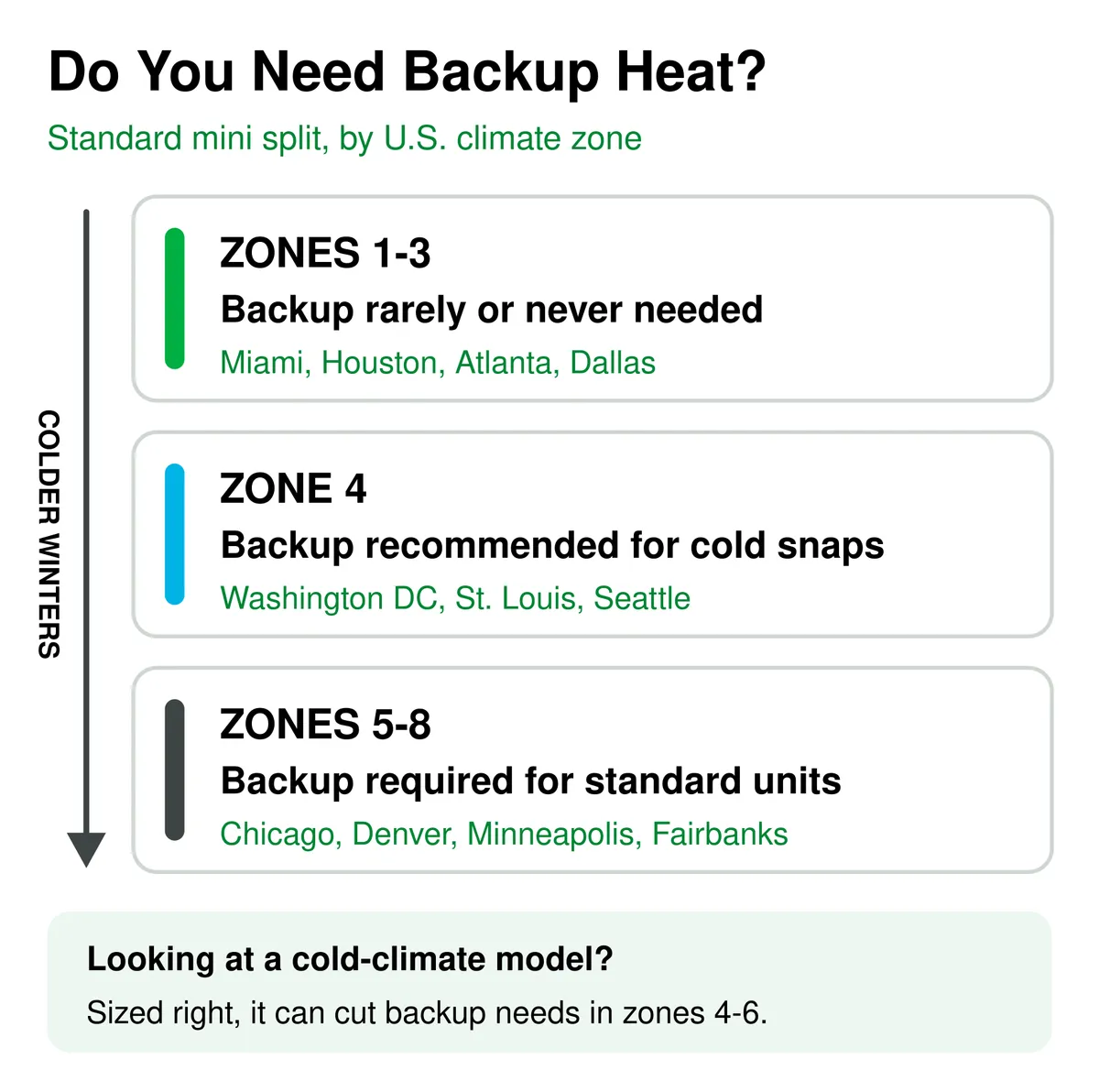
Zones 1–3: Backup is rarely or never needed.
Zone 4: Backup is recommended for cold snaps.
Zones 5–8: Backup is required for standard units unless a cold-climate model is sized for your home.
Not sure which size fits your space? The quick quiz below will match you.
Filterbuy mini splits start at $749, with a 7-year compressor and 3-year parts warranty plus fast and free 2-day delivery to most US states.
Answer a few quick questions to get your mini split match.
TL;DR
A mini split heat pump needs backup heat once outdoor temperatures fall below the point where its output can keep pace with your home's heat loss. That point depends on your climate zone and your unit's low-temperature rating, so cold and very cold climates usually need a second heat source.
Key Takeaways
A single-zone mini split heats one room or open area, so rooms beyond its reach need their own heat source.
Backup heat is rarely needed in IECC climate zones 1 through 3 and helps in zone 4 during cold snaps. In zones 5 through 8, plan on it unless a cold-climate model covers the full load.
Most wall-mounted ductless mini splits have no built-in heat strip, so emergency heat means a separate heater.
When Does A Mini Split Need Backup Heat?
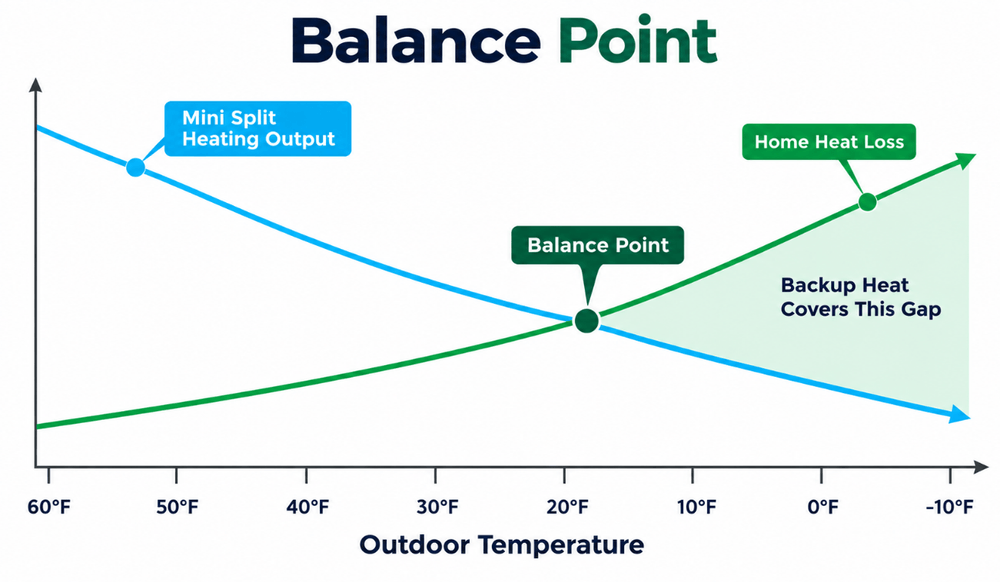
A mini split needs backup heat when your home loses heat faster than the heat pump can replace it. The outdoor temperature where heat loss and heat output meet is the balance point. Below it, backup heat fills the gap.
A ductless mini split is a heat pump that connects an outdoor compressor to a wall-mounted indoor unit through refrigerant lines rather than ductwork.
In a Minneapolis example, the same home's balance point ranged from 40°F to minus 15°F depending on sizing, according to the Building America cold climate heat pump sizing guide from Pacific Northwest National Laboratory.
Correct BTU capacity, explained in our mini split sizing guide, is your first defense against needing backup heat. Note that advertised heating capacity is typically rated at 47°F, so ask what a unit delivers at your design temperature.
Mini Split Backup Heat Needs By Climate Zone
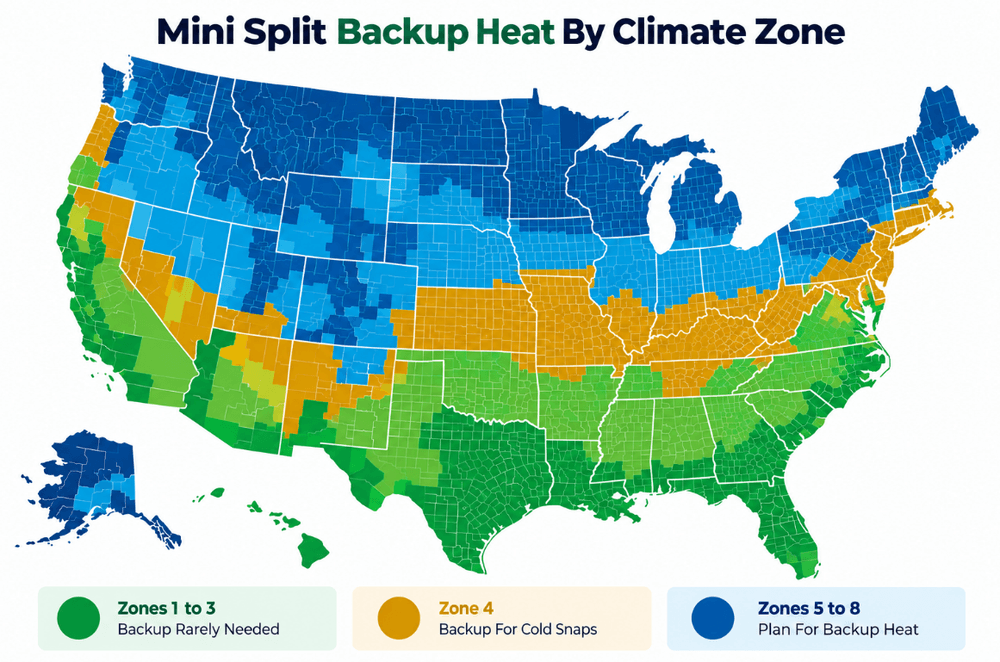
The International Energy Conservation Code (IECC) divides the United States into eight climate zones, from hot zone 1 to subarctic zone 8. We built the matrix below to show where backup heat shifts from optional to necessary.
A standard mini split here means an inverter unit rated for low-ambient heating to about 5°F. A cold-climate mini split meets ENERGY STAR cold climate criteria.
Zones 1 Through 3: A Mini Split Can Be Your Only Heat
Winter lows in hot and warm-mixed climates rarely test a modern inverter mini split, so a correctly sized unit can be the home's only heat source.
Zone 4: Plan For Cold Snaps
Zone 4 winters mostly stay within a standard mini split's range, but an arctic outbreak can push temperatures toward the single digits. An existing furnace or a single baseboard heater covers those nights.
Zones 5 Through 8: Backup Is The Default
In cold climates, design temperatures commonly sit in the single digits or below zero, where standard mini splits lose meaningful capacity. A cold-climate model sized to the full load can carry many zone 5 and 6 homes alone, but zones 7 and 8 should keep a second heat source. Our mini split cold weather performance guide covers below-freezing operation.
How Cold Can A Mini Split Heat Before Needing Backup?
Mini split spec sheets often list two cold-weather numbers: the operating range, where a unit still runs, and the heating rating, where it still delivers rated heat. Plan backup heat around the second.
Under the ENERGY STAR Version 6.2 heat pump specification, a cold climate heat pump must reach a coefficient of performance (COP) of at least 1.75 at 5°F and keep at least 70% of its 47°F heating capacity at that temperature.
Worked example: A cold-climate mini split rated at 12,000 BTU per hour at 47°F must still deliver at least 8,400 BTU per hour at 5°F (12,000 x 0.70). If a room loses 10,000 BTU per hour on a 5°F night, a unit at that minimum comes up 1,600 BTU per hour short. Size for your coldest night, not an average winter day.
Cold weather also brings defrost cycles, short pauses in heating while the outdoor coil sheds frost. The U.S. Department of Energy recommends demand-defrost control to minimize those cycles and supplementary energy use, as its guide to air-source heat pumps notes.
Where The Filterbuy Mini Split Fits
Filterbuy mini splits start at a published $749 for the 12,000 BTU model, with no quote required. They ship with fast and free 2-day delivery to most US states. Each carries a 7-year compressor and 3-year parts warranty. Professional installation is required, and the warranty is void if self-installed. At 17 SEER2, the line clears the federal efficiency minimum and is built for value. Our product pages list a heating operating range to -4°F and reliable heating down to 5°F, and we base our backup heat advice on the 5°F figure.
Every system in the line is single zone, pairing one outdoor unit with one indoor unit to heat one room or open area. Within that space, it makes a strong primary heat source in zones 1 through 3 and a good zone 4 choice with backup for cold snaps. Our units are rated to 5°F, not below zero, so if one will be your main winter heat in zones 5 through 8, pair it with backup heat or choose a cold-climate model.
What Are The Best Backup Heat Options For A Mini Split?
The best backup heat source for a mini split covers your coldest hours at the lowest total cost and risk.
Costs assume no new ductwork, and operating cost is per unit of heat delivered.
Mini Split With Baseboard Backup
Electric baseboard backup is the most common partner for a mini split in homes without ductwork. A baseboard heater turns one unit of electricity into one unit of heat, while a heat pump moves several in mild weather. That gap makes baseboards expensive as primary heat but sensible as backup. Set baseboard thermostats a few degrees below the mini split setpoint so the heat pump runs first.
A Furnace Or Boiler As Mini Split Supplemental Heat
An existing furnace or boiler left in place turns your setup into a hybrid system. The mini split handles mild weather, and the central system takes over when the mini split cannot hold the setpoint. A furnace that sits idle most of the winter still needs a clean air filter, and as an air filter manufacturer, we suggest checking it every fall. On the mini split, the pre-filter protects the indoor coil, and a clogged one cuts airflow and heating output, so clean it when the filter-cleaning reminder comes on.
Mini Split Emergency Heat: What It Means
Central heat pumps usually include electric heat strips and an emergency heat thermostat setting. Most wall-mounted ductless mini splits have neither, so emergency heat for a ductless system means a separate heater that takes over if the outdoor unit fails.
Any fuel-burning backup heater must vent outdoors. The U.S. Consumer Product Safety Commission recommends CO alarms on every level of the home and outside sleeping areas, as outlined in its carbon monoxide safety guidance.
How To Decide If Your Home Needs Backup Heat
We call this the Filterbuy Backup Heat Check. Four steps show whether you need backup heat.
Find your climate zone and your local heating design temperature.
Compare your unit's low-ambient rating with that design temperature.
Confirm sizing with a Manual J heat load calculation. Our guide to choosing a mini split system covers the other specs worth comparing.
Map uncovered rooms. In zones 4 through 8, any room without an indoor unit needs its own heat.
"The question we hear most is whether a mini split can be a home's only heat, and the honest answer starts with the spec sheet, not the sales page. We publish both our -4°F operating range and our 5°F heating rating because the first tells you when the unit stops running, and the second tells you when you need a backup plan."
— Michelle Wan, Brand Manager & Copywriter, Filterbuy
Supporting Statistics
Portable heaters: 3% of residential heating fires, 41% of fatal ones. These 2017 to 2019 figures from the U.S. Fire Administration portable heater fire report make a strong case for installed backup over portable heaters.
Ductless heat pumps over baseboard heat: seasonal COP of 3.0. A 2012 Northwest Energy Efficiency Alliance field study of 95 metered homes found that ductless heat pumps added to existing electric zonal heat cut net heating use by an average of 3,049 kWh per year.
Cold-climate prototypes still drew on backup heat. Every prototype in the U.S. Department of Energy Cold Climate Heat Pump Challenge delivered at least 100% of its rated heating capacity at 5°F. Even so, auxiliary heat supplied from almost 0% to 90% of heating at very cold temperatures, according to ACEEE field results.
Frequently Asked Questions
Can A Mini Split Be The Only Heat Source In A House?
Yes. A mini split can be the only heat source in climate zones 1 through 3, and in colder zones when a cold-climate model is sized to the full heating load.
At What Temperature Does A Mini Split Need Backup Heat?
A mini split needs backup heat below its balance point, the outdoor temperature where its output drops below the home's heat loss.
Do Mini Splits Have Emergency Heat?
Most wall-mounted ductless mini splits do not, because they have no built-in heat strips. Ductless owners install a separate heater.
Do I Need Backup Heat For A Mini Split In Zone 5?
Usually, with a standard mini split. A cold-climate heat pump sized for the full heating load may cover a zone 5 home without backup.
Find The Right Mini Split For Your Climate
Filterbuy ships single-zone ductless mini split systems in 12,000, 18,000, and 24,000 BTU sizes with fast and free 2-day delivery to most US states. Size one to the room you want to heat and book a professional installer. Then plan backup heat around your climate zone.
Glossary
Backup heat: A second heat source that covers what the heat pump cannot.
Supplemental heat: Heat added alongside a running heat pump. Also called auxiliary heat.
Emergency heat: A heat source that runs on its own when the heat pump fails.
Balance point: The outdoor temperature where heat pump output equals home heat loss.
IECC climate zone: One of eight U.S. climate regions in the International Energy Conservation Code.
Heating design temperature: The cold outdoor temperature a heating system is sized to handle.
Cold-climate heat pump: A heat pump that keeps most of its capacity in cold weather.
COP (coefficient of performance): The ratio of heat delivered to electricity used. Electric resistance heat has a COP of 1.
Single-zone mini split: One outdoor unit paired with one indoor unit that heats one room or open area.
Manual J: The Air Conditioning Contractors of America method for calculating heating and cooling loads.
SEER2: The federal cooling efficiency rating for air conditioners and heat pumps.