Best Alternatives to Window AC Units
June 26, 2026

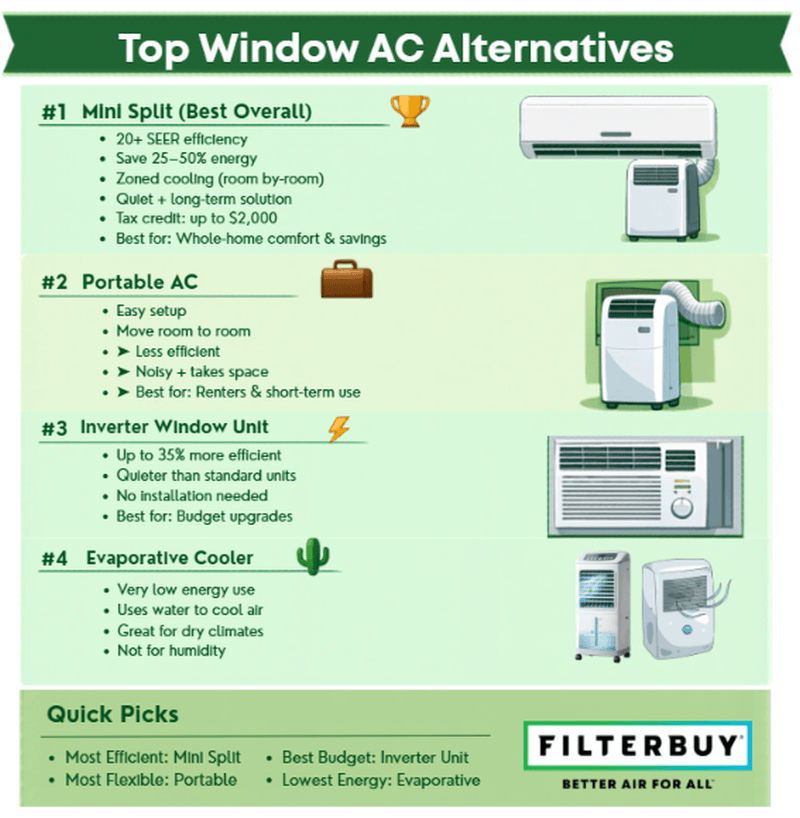
If you're done with a window unit that blocks your view, rattles all night, and drives up your summer bill, you have four real options. For most homes, a ductless mini split is the one worth buying — it's quieter, lasts roughly twice as long, cools room by room instead of all at once, and doesn't touch your window. The other three options solve narrower problems: renting, a tight budget, or a very dry climate.
The short version
- Ductless mini split — best overall. Room-by-room control, very quiet, longest service life, heats as well as cools.
- Smart inverter window unit — a real step up from a standard window AC if a mini split isn't in the budget yet.
- Portable AC — the fallback when your lease or HOA rules out anything permanent.
- Evaporative cooler — only worth considering in dry climates. Skip it anywhere humid.
Filterbuy sells single-zone mini split systems direct to homeowners — 12,000, 18,000, and 24,000 BTU, 17 SEER2, ETL listed and AHRI certified, running on R32 refrigerant, and covered by a 7-year compressor and 3-year parts warranty. Buying direct means no distributor markup between you and the equipment.
Shop Mini Split Systems Not sure what size your room needs? Answer a few questions and we'll match you.
By Michelle Wan, Brand Manager and Air Quality Writer at Filterbuy
Technically reviewed by David Clark, Licensed HVAC Technician and CEO of Filterbuy HVAC Solutions
Published April 17, 2026. Updated August 17, 2026
TL;DR
The best alternative to a window AC unit for most homes is a ductless mini split: 35% less cooling electricity, 15 to 20 years instead of 5 to 8, and heating in winter. It will not repay its premium on cooling alone; that only works when it replaces electric heat too. Renters have cheaper options, starting with a U-shaped inverter unit.
Key takeaways
A 17 SEER2 mini split uses 35% less electricity than a 10,000 BTU window AC, or roughly $52 a year for one room.
The federal 25C tax credit expired December 31, 2025 per IRS guidance. Mini splits installed in 2026 do not qualify.
A single-zone mini split costs $1,900 to $4,200 installed against $150 to $400 for a window unit, and pays back near year nine only when it also replaces electric resistance heat.
Evaporative coolers only work below 50% relative humidity, ruling out the Southeast.
Why People Are Replacing Window Units
A window AC is cheap to buy and expensive to own. The technology hasn't changed much in decades: a single-speed compressor slams on at full power, cools the room past your setpoint, shuts off, and repeats. That cycling is both where the noise comes from and where the energy goes.
Then there's everything else. It occupies a window you'd rather look out of. It has to come out every fall and go back in every spring, which is a genuinely unpleasant afternoon. Left in place through winter, the gaps around the housing leak cold air straight into the room you were trying to insulate. And most units cool one room adequately and everything past the doorway not at all.
None of that is a reason to panic-replace a working unit. It is a reason to know what you'd move to when it dies.
How the Four Options Compare
| System | Typical lifespan | Noise | Heats too? | Install | Best for |
|---|---|---|---|---|---|
| Ductless mini split | 15–20 years | Very low | Yes | Professional | Homeowners staying put |
| Inverter window unit | 7–10 years | Medium-low | Some models | DIY | Budget upgrades |
| Portable AC | 5–10 years | Medium-high | Some models | DIY | Renters with restrictions |
| Evaporative cooler | 10–15 years | Medium | No | DIY or pro | Dry climates only |
| Standard window AC | 5–8 years | High | No | DIY | Short-term stopgap |
Lifespan ranges reflect general industry expectations and vary with climate, runtime, and maintenance.
Why a Mini Split Is the One Most People Should Buy
A mini split splits the work in two. A compact outdoor condenser handles the noisy part, and a slim indoor head mounted high on the wall handles the air. The two connect through a line set that needs a hole roughly three inches across. That's the whole footprint — no ductwork, no window sacrificed, no annual removal ritual.
It runs at the speed the room needs
This is the difference that drives everything else. A window unit's compressor has two states, full blast and off. A mini split's inverter compressor modulates — it ramps up to pull a hot room down, then settles into a low, steady output to hold the temperature there. You get fewer temperature swings, no loud restart every fifteen minutes, and no repeated startup surge.
You cool only the rooms you're in
Zoning is the underrated part. A bedroom head set to 68°F at night while the rest of the house sits idle is a fundamentally different energy profile from cooling the whole floor to reach one room. If your household argues about the thermostat, this solves that too.
It heats, which a window AC doesn't
A mini split is a heat pump. It reverses in winter and moves heat indoors instead of out. That makes it a year-round system rather than a four-month appliance — which matters for garages, additions, converted attics, sunrooms, and any room your central system never quite reaches in either season.
It's quiet enough to sleep next to
The compressor lives outside. What's in the room is a fan moving air across a coil. For a bedroom or a home office where you take calls, this is often the deciding factor on its own.
It has a washable filter you actually maintain
Each indoor head has a reusable mesh filter that lifts out for rinsing. Keeping it clean keeps air moving freely across the coil, which is how the system holds its rated performance over years rather than months. It takes about two minutes.
Filterbuy single-zone mini splits
- 12,000 / 18,000 / 24,000 BTU — sized for single rooms up through large open spaces
- 17 SEER2 inverter-driven cooling and heating
- R32 refrigerant — lower global warming potential than the R410A it replaces
- ETL listed, AHRI certified
- 7-year compressor warranty, 3-year parts warranty
The honest tradeoffs
Worth saying plainly, because anyone shopping seriously will find these out anyway:
Higher upfront cost than a window unit. The equipment costs more and it needs professional installation, since it involves refrigerant lines and a dedicated electrical circuit.
The indoor head is visible. It's a slim white unit high on the wall. Most people stop noticing it within a week, but it isn't invisible the way a ceiling vent is.
It's not portable. If you're renting or moving inside two years, a mini split is the wrong purchase. Look at the inverter window unit instead.
The Other Three Options
Smart inverter window units
The best option if a mini split isn't happening this year. These use the same variable-speed compressor idea as a mini split, so they run quieter and hold temperature better than a standard window AC. Many use a U-shaped design that lets the window sash close down through the middle of the unit, which puts the compressor outside the glass and cuts the noise substantially. Still a window unit — still needs seasonal removal, still occupies the window — but a real improvement, and no installer required.
Portable air conditioners
Pick this when your lease or HOA leaves you no other choice. It rolls between rooms and vents through a hose in the window. The catch is structural: a single-hose portable pulls room air across its hot components and pushes it outside, which lowers the pressure inside and draws warm outdoor air back in through every gap in the room. It's cooling against a leak it created. Dual-hose models handle this better. They also take up floor space and put the compressor in the room with you.
Evaporative coolers
Sometimes called swamp coolers. They pull outside air through wet pads; the water evaporates, and evaporation cools the air. Very little electricity, no refrigerant. But the mechanism only works when the incoming air is dry enough to absorb moisture. In Arizona or Nevada, that's a legitimate option. In Florida, Georgia, or the Gulf Coast, you'd be adding humidity to air that's already saturated and making the room feel worse. If you don't live somewhere reliably arid, skip it.
Which One Fits Your Situation
You own your home and plan to stay: mini split. The lifespan and zoning advantages need a few years to pay off, and you'll have them.
You're cooling a garage, addition, attic, or sunroom: mini split, without much debate. These are rooms with no ductwork and a heating problem in January too.
You rent, or your HOA forbids exterior changes: inverter window unit if a window install is allowed, portable AC if it isn't.
Your budget is firm this season: inverter window unit now, mini split when the window unit fails.
You're in a dry Southwest climate and want minimum electricity use: evaporative cooler is worth pricing out.
Sizing is the part people get wrong.
An undersized unit runs constantly and never catches up. An oversized one cools too fast, shuts off before it removes humidity, and leaves the room cold and clammy. Square footage, ceiling height, sun exposure, and insulation all move the number.
Find Your Mini Split SizeBuying a Mini Split From Filterbuy
We sell single-zone systems direct to homeowners in 12K, 18K, and 24K BTU. Every system ships with the indoor head, outdoor condenser, line set, and mounting hardware, so your installer isn't sourcing parts separately.
Start with sizing, then pick the system. If you're between two sizes or cooling an unusual space — a room over a garage, a converted attic, a space with a lot of west-facing glass — talk to an installer before ordering. Getting the BTU right matters more than any other decision in this purchase.
Once it's in, maintenance is genuinely light: rinse the indoor filter monthly during heavy use, keep leaves and debris clear of the outdoor unit, and book an annual professional check.
Mini split AC federal tax credit 2026: what changed
The federal 25C tax credit for mini splits and heat pumps expired December 31, 2025. The One Big Beautiful Bill Act (Public Law 119-21) ended it seven years early. The IRS fact sheet on the OBBB energy-credit terminations confirms it. Any page promising 30% back through 2032 predates it.
Installed in 2025? Claim up to $2,000 via IRS Form 5695. Still available: HEAR rebates (up to $8,000 under 150% of Area Median Income) and the DSIRE incentive database. More in our guide to heat pump tax credits after 2025.
Verified against IRS guidance August 2026.
Frequently Asked Questions
What is the best alternative to a window air conditioner?
A ductless mini split, for most homes: 35% less cooling electricity, a 15 to 20 year life, and winter heating. Renters who cannot modify a window should look at a U-shaped inverter unit.
Is a mini split better than a window AC?
For most homeowners, yes. It's quieter because the compressor is outside, it lasts roughly twice as long, it holds temperature more steadily thanks to the inverter compressor, it heats as well as cools, and it doesn't occupy a window. A window unit wins on two things only: upfront cost and the fact that you can install it yourself.
Is there still a federal tax credit for mini splits in 2026?
No. The Section 25C credit ended for equipment placed in service after December 31, 2025. State rebates, utility rebates, and the federal HEAR and HOMES rebate programs may still apply depending on where you live. Confirm your specific situation with a qualified tax professional.
Can I install a mini split myself?
Standard systems require a professional. Charging refrigerant lines requires EPA Section 608 certification, and the outdoor unit typically needs a dedicated circuit. Attempting it yourself risks the warranty and, more practically, an undercharged system that never performs correctly.
Can I leave a mini split running all the time?
Yes, and it's usually the better way to run one. Inverter systems are built to hold a setpoint at low output. Letting a room get hot and then asking the unit to pull it back down forces it into high-output mode, which is the least efficient way to operate it.
What size mini split do I need?
Square footage is the starting point, not the answer. Ceiling height, insulation quality, window area, and sun exposure all shift the requirement. Broadly, 12,000 BTU suits a single bedroom or small living area, 18,000 BTU a larger room or small open plan, and 24,000 BTU a large open space. Use the sizing tool above, and confirm with an installer for anything unusual.
Do mini splits need filter changes?
The indoor head uses a washable mesh filter rather than a disposable one — lift it out, rinse it, let it dry, put it back. Monthly during heavy use. Keeping it clean is what keeps air moving freely across the coil.
Do mini splits add value to a home?
They're generally viewed as a desirable upgrade, particularly in homes without central air or in rooms that were previously hard to condition. Actual effect on resale depends on your local market, so treat it as a comfort investment first.
About the author
Michelle Wan is Filterbuy's Brand Manager and Air Quality Writer, writing from how equipment is built and tested at our U.S. factories. More from Michelle Wan.
Sources
IRS, EIA, DOE, ENERGY STAR, NEEP and DSIRE, linked inline. Cost ranges from our HVAC Solutions invoice review.