
Heat Pump Service Guide: Service Cost, Annual Inspection Checklist, and How to Service a Heat Pump for Lasting Performance
October 10, 2026
TL;DR
Heat pump service is a once-a-year professional tune-up plus simple homeowner upkeep, and most U.S. homeowners pay about $150 to $300 for the annual visit. Between visits, the most important job falls to you: keep the air filter clean and the outdoor unit clear, because restricted airflow drives wasted energy and early compressor wear.
Key Takeaways
• Annual heat pump service costs roughly $150 to $300 for a standard air-source system; mini-splits and geothermal systems cost more.
• A well-maintained heat pump uses 10% to 25% less energy than a badly neglected one, per the U.S. Department of Energy.
• A professional inspection checks what homeowners can't: refrigerant charge, leaks, electrical connections, and measured airflow.
• Follow Filterbuy's 1-12-4 rule: 1 professional service, 12 monthly filter checks, and 4 filter changes a year for a standard 1-inch pleated filter.
• Book service in spring or fall, before peak season.
Why Filterbuy Wrote This Guide
Filterbuy is best known for the air filters that keep heat pumps breathing. After more than a decade of manufacturing filters in the U.S. and shipping them to millions of homes, we see heat pump care from the airflow side. A technician sees a heat pump roughly one day a year. You live with yours the other 364. This guide covers both: the annual service and the airflow habits in between.
How Much Does Heat Pump Service Cost?
Heat pump service cost in the U.S. typically runs $150 to $300 for a routine annual tune-up on a single air-source system. Price rises with system type, number of indoor units, region, and any repairs found. A repair visit costs more: the average heat pump repair costs around $400, according to 2026 data from Fixr, a home-project cost guide.
Table 1. Heat pump service cost by service type
Sources: tune-up ranges from PickHVAC's U.S. heat pump service cost guide; service-call and repair figures from Fixr (2026).
Filterbuy's math: A 150–300 annual tune-up works out to about 41–82 cents a day, compared with a $400 average repair bill.
What Changes the Price of Heat Pump Service
• Region: Northeast and West Coast labor runs roughly 10% to 30% above average, per PickHVAC.
• Local service: In select markets, such as South Florida, Filterbuy HVAC Solutions provides professional heat pump maintenance.
• Maintenance plans: Annual plans typically cost 150–350 per air-source system and bundle visits with priority scheduling and repair discounts, according to PickHVAC.
Is Annual Heat Pump Service Worth the Cost?
Yes, for most homes. A single repair averages more than a tune-up, and a replacement averages roughly $8,350, per Fixr. See how long a heat pump lasts and when to replace it.
What Does a Heat Pump Inspection Include? Your Annual Checklist
A professional heat pump inspection is a one- to two-hour visit where a licensed HVAC technician tests, cleans, and measures the system's refrigerant, electrical, airflow, and drainage components. This checklist combines U.S. Department of Energy and ENERGY STAR guidance.
• Refrigerant: Measures the charge and checks for leaks. The wrong charge cuts efficiency and equipment life.
• Airflow: Measures airflow and inspects the filter, blower, indoor coil, and ducts. Restricted airflow cuts performance and can damage the compressor.
• Coils: Cleans outdoor and indoor coils. Dirty coils make the system run longer.
• Electrical: Tightens connections and measures motor voltage and current. Loose connections are unsafe and wear parts early.
• Moving parts: Lubricates motors and bearings where needed.
• Condensate drain: Clears the drain line and pan. Clogs cause leaks and humidity problems.
• Controls: Tests the thermostat, startup and shutdown cycle, defrost, and reversing valve.
• Ductwork: Finds and seals duct leaks that waste conditioned air.
“The annual visit is where I catch refrigerant and electrical problems. The filter is the homeowner's side of the job, and it matters every day the system runs.”
David Clark, Licensed HVAC Technician and reviewer of this guide
Why airflow comes first: Airflow problems alone can cut efficiency by up to 15%, per ENERGY STAR. Full task list: Filterbuy's heat pump tune-up checklist.
Your Service Visit Game Plan: Before, During, After
Filterbuy's rule: ask for numbers, not checkmarks.
Before the visit
1. Note symptoms: odd noises, short cycling, or rooms that won't reach temperature.
2. Write down your filter size, last change date, and heat pump model number.
3. Clear two feet around the outdoor unit and a path to the indoor unit.
4. Hire a licensed, insured technician with EPA 608 certification; DOE also suggests an Energy Skilled-recognized certification.
During the visit: ask for these readings (PickHVAC and the DOE both call for measured checks)
1. Superheat and subcooling, compared with the manufacturer spec.
2. Static pressure or measured airflow on ducted systems.
3. Compressor and fan motor amp draw.
4. A defrost test in heating mode.
Red flag: Refrigerant added with no leak search. Low refrigerant usually means a leak; topping off without fixing it means paying again.
After the visit: File the report with your warranty papers and compare readings next year, a habit ENERGY STAR also recommends.
How to Service a Heat Pump Yourself: 6 Safe DIY Steps
Homeowners can safely handle these six tasks in about 30 minutes, with no special tools. Filterbuy's DIY-or-pro rule: if a job means opening an electrical panel, touching refrigerant lines, or using gauges, call a licensed technician.
Safety first: Turn off power to the heat pump at the thermostat and at the outdoor disconnect or breaker before you touch the outdoor unit.
1. Check and replace the air filter. Inspect it monthly and replace it when it looks gray or clogged. We build every Filterbuy filter for 90-day performance, which matches the DOE's every-3-months guidance; see how often to change your HVAC filter for pets, allergies, or heavy use. Our advice: higher MERV isn't automatically better. Use what your manufacturer allows; an overly restrictive filter cuts airflow. Ductless mini-split filters are usually washable; NYSERDA recommends rinsing them at least monthly. See our heat pump filter guide for sizes and MERV ratings.
2. Clear the outdoor unit. Remove leaves, clippings, snow, and ice. Keep two feet clear around the condenser, or follow the manufacturer's spec.
3. Rinse the coil and straighten fins. With the power off, gently hose the coil fins, never with a pressure washer. Straighten crushed fins with an inexpensive fin comb.
4. Clean supply and return registers. Vacuum vents and keep furniture and rugs from blocking them.
5. Flush the condensate drain line. Pour a cup of distilled white vinegar into the drain line access port to discourage algae clogs, if your system has one.
6. Set the thermostat correctly. Run the fan on "auto," as the Department of Energy advises, and avoid deep setbacks in winter that can trigger costly backup heat.
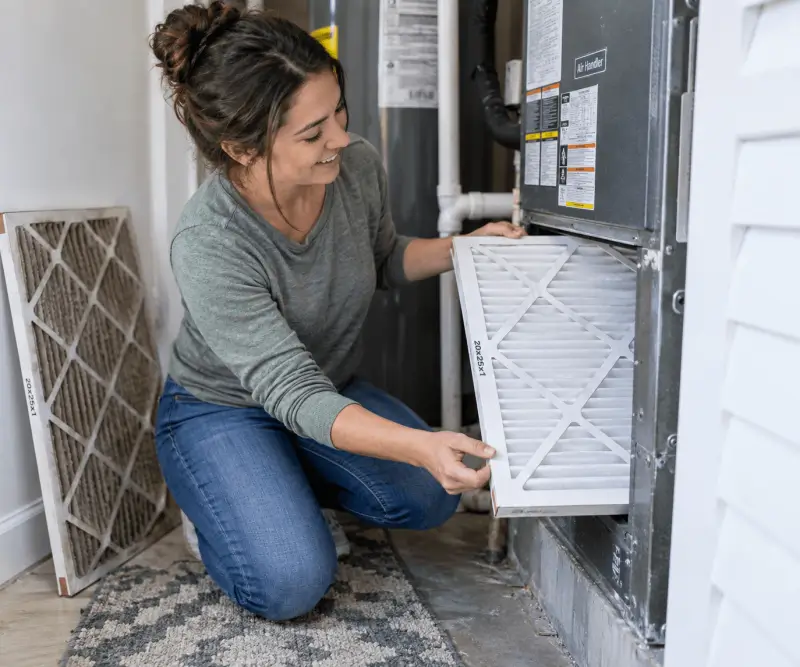
Our pro tip: Write the install date on the filter frame. Filterbuy's heat pump filter auto-delivery ships the right size on your replacement schedule and saves up to 5% on each order.
Cold-weather tips: our winter prep checklist for heat pumps.
Heat Pump Maintenance Schedule: Who Does What, and When
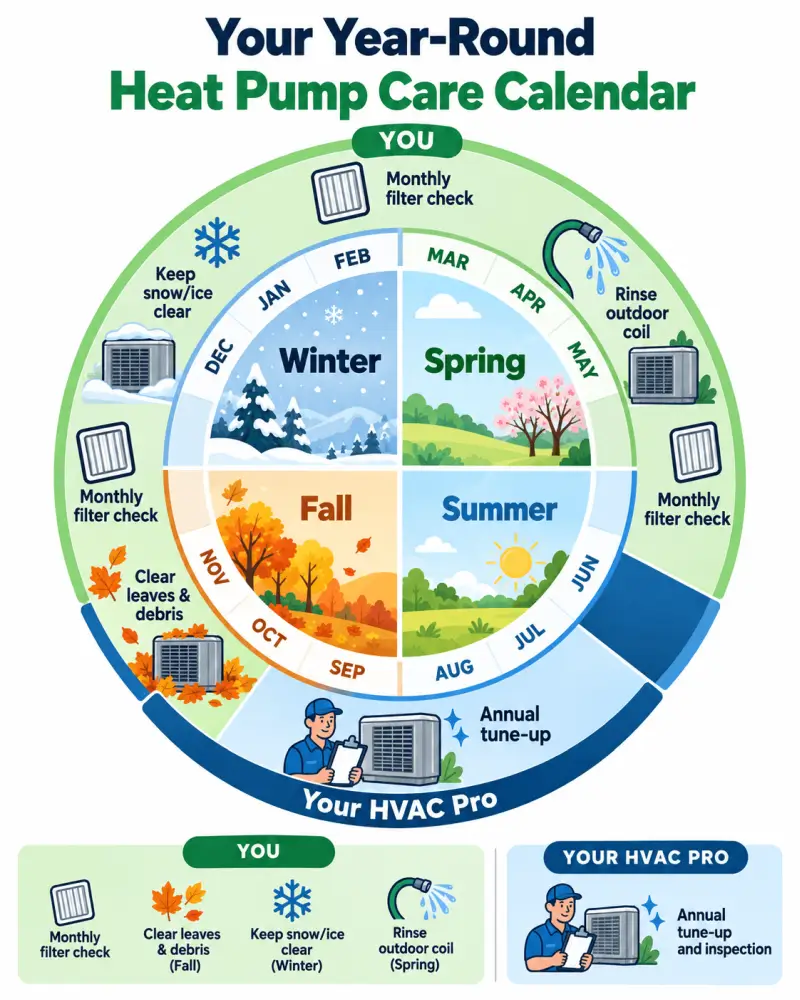
A heat pump needs one professional service a year plus monthly homeowner checks. Homeowners own airflow; licensed technicians own refrigerant, electrical, and diagnostic work. Refrigerant work requires EPA Section 608 certification, so never add refrigerant yourself.
The Filterbuy 1-12-4 rule. Our simplest way to remember heat pump care:
1. 1 professional service visit a year, ideally in spring or fall.
2. 12 filter checks, one each month.
3. 4 filter changes a year for a standard 1-inch pleated filter, more often with pets or allergies.
Table 2. Homeowner vs. professional heat pump maintenance by season
Homes with pets, allergies, or year-round heat pump use may need filter changes every 30–60 days.
For a task-by-task walkthrough, see our heat pump maintenance checklist and cost guide.
Signs a Heat Pump Needs Service Now
Call now if you notice any of these; each gets costlier with time.
• Ice that stays on the outdoor coil after a defrost cycle
• Weak airflow or rooms that won't reach the set temperature
• Short cycling (turning on and off every few minutes)
• Grinding, squealing, or rattling noises
• A sudden jump in your electric bill with no change in weather or use
• Water pooling around the indoor unit
Rule out simple causes first with Filterbuy's heat pump troubleshooting guide, or see what your system costs to run in our heat pump heating cost and efficiency guide.
Supporting Statistics: Why Heat Pump Service Pays Off
Three U.S. data points support annual service:
1. Heat pumps outsold gas furnaces by 12% in 2025.
– 3.6 million heat pumps vs. 3.2 million gas furnaces shipped.
– Heat pumps have consistently outsold furnaces since 2021.
– Source: RMI, a U.S. energy nonprofit, using AHRI shipment data
2. 52% of U.S. home energy went to heating and cooling in 2020.
– A heat pump handles both jobs.
– Source: U.S. Energy Information Administration
3. Common faults can raise energy use about 30%.
– Top faults: leaky ducts, incorrect refrigerant charge, and low airflow.
– An annual inspection checks all three.
– Source: National Institute of Standards and Technology (NIST)
Heat Pump Service FAQs
How Often Should a Heat Pump Be Serviced?
A heat pump should be professionally serviced at least once a year, per the U.S. Department of Energy. ENERGY STAR suggests timing check-ups for spring and fall, before contractors get busy.
Does Skipping Service Void a Heat Pump Warranty?
Skipping service can void a heat pump warranty, because manufacturers can require proof of annual professional maintenance, per PickHVAC. DIY repairs can also void coverage, according to Fixr. Keep every service receipt.
What Is the Difference Between a Heat Pump Inspection and a Tune-Up?
A heat pump inspection diagnoses the system's condition, while a tune-up adds cleaning and adjustments. Most annual service visits include both.
Glossary
• Heat pump: An electric system that moves heat into a home in winter and out in summer.
• Air-source heat pump: The most common type; it exchanges heat with outdoor air.
• Ductless mini-split: A heat pump with wall-mounted indoor units (heads) and no ductwork.
• Geothermal heat pump: A heat pump that exchanges heat with the ground through buried loops.
• Superheat and subcooling: Temperature readings technicians use to confirm the refrigerant charge is correct.
• Static pressure: The air resistance in ducts and filters; too high means restricted airflow.
• Refrigerant charge: The amount of refrigerant in the sealed system, set to the manufacturer's specification.
• Reversing valve: The part that switches refrigerant flow between heating and cooling.
• Defrost cycle: A routine in which a heat pump briefly reverses to melt frost off its outdoor coil in cold weather.
• Auxiliary (backup) heat: Costlier electric resistance heat that supplements a heat pump in deep cold.
• Condensate drain: The line and pan that carry moisture removed from indoor air out of the home.
• MERV: Minimum Efficiency Reporting Value, a 1-to-16 rating of how well an air filter captures particles.
• EPA Section 608 certification: The U.S. Environmental Protection Agency credential required to handle refrigerants.
• Filterbuy: A U.S. manufacturer of HVAC air filters in 600+ sizes, sold factory-direct.
• DOE: U.S. Department of Energy.
• ENERGY STAR: The U.S. EPA program that rates energy efficiency.
• AHRI: Air-Conditioning, Heating, and Refrigeration Institute, the HVAC manufacturers' trade group.
• NIST: National Institute of Standards and Technology, a federal research agency.
• EIA: U.S. Energy Information Administration, the federal energy statistics agency.
Keep Your Heat Pump Breathing Easy with Filterbuy
Annual service protects the system once a year; clean airflow protects it daily. That airflow is what Filterbuy obsesses over, because our mission is better air for all. We make American-made heat pump air filters in more than 600 standard sizes plus custom sizes, with free factory-direct shipping. Find your heat pump filter and set up auto-delivery to get a new filter every 90 days.
Sources
• U.S. Department of Energy: Operating and Maintaining Your Heat Pump
• ENERGY STAR: Maintenance Checklist
• NYSERDA: Air Source Heat Pump Maintenance Tips
• Fixr: Heat Pump Repair Cost (2026)
• PickHVAC: Heat Pump Service Cost: What Homeowners Pay and How to Save
• PickHVAC: Heat Pump Repair and Parts Replacement Cost 2026
• U.S. EPA: Section 608 Technician Certification Requirements
• NIST: Energy Efficiency of HVAC Equipment Suffers Due to Poor Installation
• U.S. EIA: Use of Energy Explained, Energy Use in Homes
• RMI: Tracking the Heat Pump and Water Heater Market in the United States
• ENERGY STAR: 10 Tips for Hiring a Heating and Cooling Contractor