
Electric Heat Pump Guide: How Heat Pump Electric Heat Works, Energy Costs, and Expert Tips for Better Home Comfort
October 6, 2026

Why we wrote this guide: At Filterbuy, an air filter manufacturer based in Talladega, Alabama, we've built HVAC filters in our own U.S. plants since 2013, and our sister company, Filterbuy HVAC Solutions, services heat pumps in Florida homes. We've learned that most "something's wrong with my heat pump" calls trace back to a clogged filter or a defrost cycle mistaken for a breakdown. Here are the answers and math we use ourselves.
TL;DR
An electric heat pump moves heat from outdoor air into your home. It typically delivers two to four units of heat for every unit of electricity, while the backup "electric heat" strips inside it deliver only one. In Filterbuy's experience, keeping those strips idle is the biggest lever on your winter bill. Steady thermostat settings and a clean filter do most of the work.
Key Takeaways
• The U.S. Department of Energy (DOE) says air-source heat pumps can cut heating electricity use by up to 75% versus electric resistance heat.
• "Heat pump electric heat" usually means the backup heat strips: resistance coils that turn electricity into heat one-to-one.
• At the U.S. Energy Information Administration's (EIA) projected 2026 rate of 18.2¢/kWh, an hour on 10 kW strips costs about $1.82. The same heat costs about $0.61 from a heat pump at a COP of 3.
• A $9.49 Filterbuy MERV 11 filter costs about as much as five hours of 10 kW strip heat.
What Is an Electric Heat Pump?
An electric heat pump is an all-in-one heating and cooling system that runs on electricity and moves heat instead of creating it. In winter, it pulls heat from outdoor air and releases it indoors; in summer, it works like a central air conditioner.
Your heat pump is really two heaters in one cabinet. One is the efficient compressor. The other is a bank of electric resistance strips for backup, and an hour on the strips can cost up to three times as much.
Comparing systems? See heat pump vs. HVAC systems.
How Does Heat Pump Electric Heat Work?
Heat pump electric heat works through a refrigerant loop that absorbs heat outdoors and releases it indoors, powered by an electric compressor. Even cold winter air holds usable heat that refrigerant can absorb.
1. Absorb. Cold refrigerant in the outdoor coil absorbs heat and turns to gas.
2. Compress. The compressor squeezes the gas, raising its temperature well above room temperature.
3. Release. The blower pulls household air through your air filter, across the hot indoor coil, and out your vents.
4. Expand and repeat. The refrigerant cools and returns outside.
5. Defrost when needed. In cold, damp weather, the system briefly reverses to melt frost off the outdoor coil, often with backup heat running.
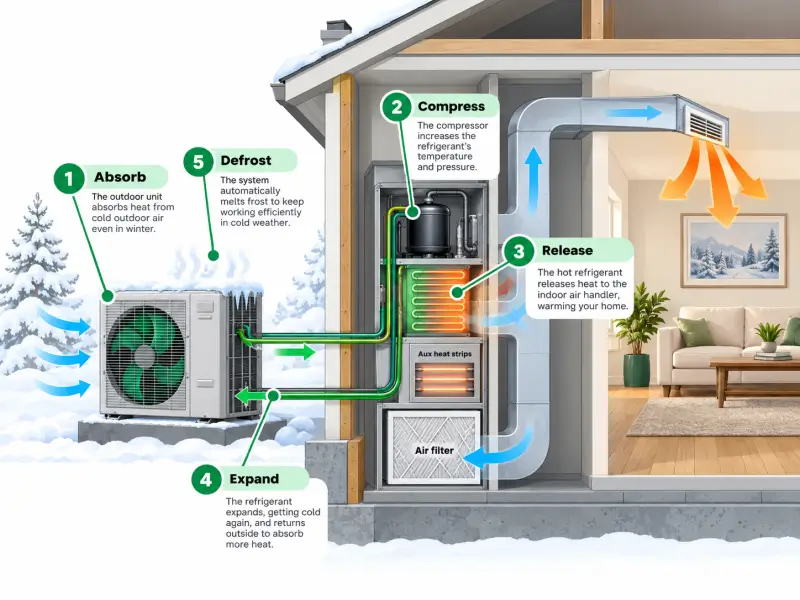
Notice step 3: every BTU your heat pump delivers passes through your air filter first. As filter makers, we at Filterbuy treat the filter as part of the heating system.
Heat Pump vs. Electric Resistance Heat: What's the Difference?
The difference is how each makes heat. A heat pump moves heat. Resistance heat, from baseboard heaters to the backup strips inside a heat pump, converts electricity to heat one-to-one.
When Does a Heat Pump Use Backup Electric Heat?
A heat pump uses backup electric heat when it can't keep up with your home's heat loss on its own. That happens below the balance point (often 30°F to 45°F for standard air-source models), during defrost, and after a large thermostat jump. As David Clark writes in his guide to what aux heat on your thermostat means, "Auxiliary heat is not a sign of failure."
Auxiliary heat and emergency heat are not the same.
• Aux heat turns on automatically and runs alongside the heat pump.
• EM heat is a manual setting that shuts the heat pump off and runs only the strips.
• Filterbuy HVAC Solutions' standing advice: if you ever need emergency heat, call for service right away.
Filterbuy's 4-Question Aux Heat Check. Seeing "Aux Heat"? Work down this list:
1. Is it near or below freezing outside? Backup help is normal.
2. Did you just raise the thermostat 2°F or more? Strips often engage when the gap tops 1.5 to 2 degrees, according to HVAC trainers at Alabama Power, the Alabama electric utility. Normal, but avoidable.
3. Is the outdoor unit steaming? That's defrost. It should end within minutes.
4. None of the above? Check your filter first, then call a technician.
Some thermostats show "Stage 1 & 2" instead of "Aux Heat" when strips join in.
Alabama Power training analyst Jim Goolsby sums it up: "The heat strip is significantly less efficient than the heat pump!"
How Much Does It Cost to Run an Electric Heat Pump?
Cost depends on your rate and on which heater runs. Most guides quote monthly averages. At Filterbuy, we priced the hour, because your thermostat picks a heater hour by hour, at the EIA's projected 2026 average of 18.2¢/kWh.
Filterbuy Heat Cost Ladder: cost to deliver about 34,000 BTU of heat (18.2¢/kWh)
How we calculated it: 34,120 BTU is the hourly output of a 10 kW heat strip. We divided 10 kWh by each COP and multiplied by 18.2 cents per kWh, the U.S. Energy Information Administration's projected 2026 average residential electricity price (Short-Term Energy Outlook, September 2026). Use your own bill's rate; runtimes vary by home and climate.
Even in deep cold, a cold-climate heat pump at a COP of 1.75 costs about 43% less per hour than heat strips.
Maintenance moves these numbers. The DOE reports energy use can differ by 10% to 25% between a well-maintained and a severely neglected heat pump. Replacing a clogged filter can lower cooling energy use by 5% to 15%.
For install pricing, see our heat pump heating cost guide. The federal 25C tax credit ended for installs after December 31, 2025; our heat pump tax credit guide covers what's left, and DSIRE's incentive database lists state and utility rebates by ZIP code.
How to Price Your Own Backup Heat in 3 Steps
You need two numbers: your strip size and your electric rate.
1. Find your true rate. Divide your bill's total charges by the kWh used. That includes fees.
2. Find your strip size. Check the heater kit label on your air handler, or ask your technician. Kits are rated in kW, usually 5, 10, or 15. Turn off power before opening any panel.
3. Multiply. Strip kW × your rate = your cost per hour on aux heat. Divide by three for a rough mild-weather heat pump cost.
Worked example: 10 kW × $0.182 = $1.82 per hour on strips, or about $0.61 per hour on the heat pump.
Put it in perspective: a 20x25x1 Filterbuy MERV 11 filter on auto-delivery costs $9.49 in a six-pack (August 2026 pricing). That equals about five hours of 10 kW strip heat. If a clogged filter adds even a few aux hours a season, a fresh one covers its cost.
Expert Tips to Lower Heat Pump Electric Heat Costs
Keep the compressor doing the work and the backup strips idle. These are the habits the Filterbuy team sees pay off:
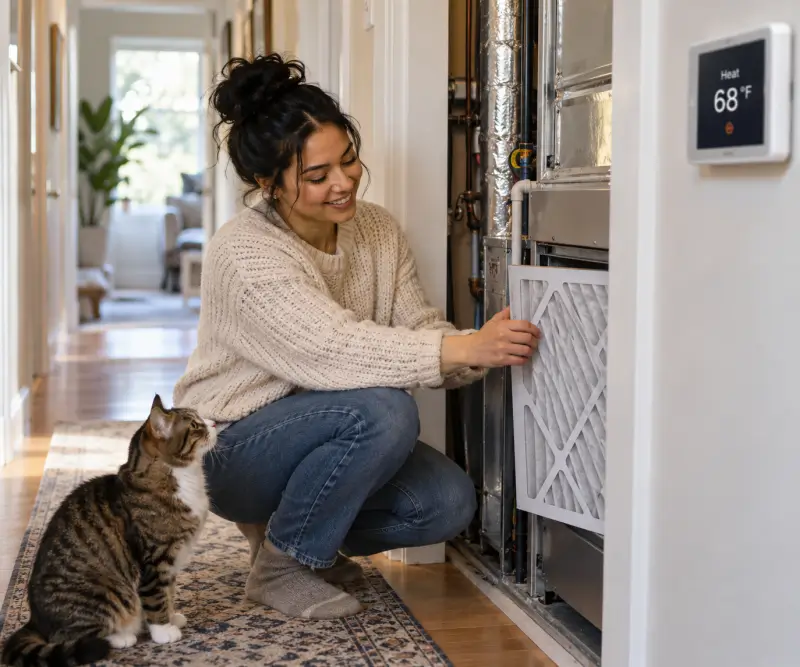
1. Change your air filter on schedule. A dirty filter restricts airflow and calls in the strips sooner. Filterbuy auto-delivery defaults to 90 days, matching ENERGY STAR guidance, and homes with pets tend to pick 60. A MERV 11 filter suits most heat pumps; see our heat pump filter guide.
2. Raise the temperature one degree at a time. The DOE advises against any setback that triggers backup heat. A thermostat with adaptive recovery warms the house gradually without the strips.
3. Log when Aux Heat appears. For a week of cold mornings, note the outdoor temperature each time "Aux Heat" shows without a thermostat change. That's roughly your balance point. Share it with your installer to set an aux heat lockout, which keeps strips off above that temperature.
4. Keep the outdoor unit clear. Clear away snow and leaves, and trim plants back at least 2 feet.
5. Book a yearly tune-up, as the DOE recommends. Our heat pump winter prep guide walks you through it.
"When I started digging into heat pump questions from our customers, I expected complicated answers. Most came back to two simple habits: change the filter on time, and stop cranking the thermostat."-Michelle Wan, Brand Manager and Air Quality Writer at Filterbuy
Pro Tip from Filterbuy: We cut, pleat, and frame every filter to order in our own U.S. plants, in 600+ sizes plus custom cuts, and ship within 24 hours. Set up air filter auto-delivery every 30, 60, or 90 days so a fresh filter arrives before your heat pump has to work harder.
Is an Electric Heat Pump Right for Your Climate?
An electric heat pump fits most U.S. climates when it's matched to local winters. In cold climates, choose an ENERGY STAR Cold Climate model (COP of at least 1.75 at 5°F), which the DOE says is designed to perform as low as 5°F, or a gas-furnace backup. Learn more about how heat pumps work in cold climates, or read is a heat pump worth it in 2026.
Supporting Statistics
Federal and national-lab research backs up what we see.
1. 42% of U.S. homes heat mainly with electricity.
◦ Finding: Electricity was the main heating fuel in 42% of homes in 2024.
◦ Source: U.S. Energy Information Administration, using Census Bureau data.
2. Resistance heat uses at least twice the energy of a heat pump.
◦ Finding: Most U.S. homes that heat with electricity still use resistance heat.
◦ Source: DOE Office of Policy.
3. 92% to 100% of homes heated with electricity, oil, or propane would save.
◦ Finding: Median savings run $300 to $650 a year for 49 million such homes with air conditioning.
◦ Study: National Renewable Energy Laboratory, 550,000 simulated homes, published in Joule.
◦ Source: American Public Power Association summary.
Frequently Asked Questions
Is a heat pump the same as electric heat? No. A heat pump moves heat, delivering two to four units per unit of electricity. "Electric heat" usually means resistance heat, such as baseboards or heat strips, which delivers one.
Why does my thermostat say "Aux Heat"? Backup heat strips are helping the heat pump. That's normal near freezing, during defrost, or after a 2°F thermostat jump. Frequent aux heat in mild weather points to a dirty filter or a setting problem.
Should I turn my heat pump down at night? Only slightly, if at all. The DOE advises against setbacks that trigger backup heat. A heat pump thermostat with adaptive recovery can handle small setbacks without the strips.
Glossary
• Electric heat pump: A system that uses electricity and refrigerant to move heat into or out of a home.
• Auxiliary (aux) heat: Backup heat, usually resistance strips, that turns on automatically.
• Emergency (EM) heat: A manual setting that shuts off the heat pump and runs only backup heat.
• Heat strips: Resistance coils in the air handler that turn electricity directly into heat.
• Balance point: The outdoor temperature where a heat pump's output equals a home's heat loss.
• COP (coefficient of performance): Heat delivered per unit of electricity; resistance heat has a COP of 1.
• ENERGY STAR Cold Climate: A label for heat pumps holding a COP of at least 1.75 at 5°F.
• MERV: Minimum Efficiency Reporting Value, a rating of how well a filter captures particles.
• BTU (British thermal unit): A unit of heat; one kWh equals about 3,412 BTU.
• 25C tax credit: A federal heat pump credit that ended for installs after 2025.
Keep Your Heat Pump Running Efficiently
You're the hero of your home's comfort. Set up Filterbuy auto-delivery so your electric heat pump never works harder than it should.
Sources
• U.S. Department of Energy: Heat Pump Systems
• U.S. Department of Energy: Operating and Maintaining Your Heat Pump
• U.S. Department of Energy: Maintaining Your Air Conditioner
• ENERGY STAR: Heat Pump Equipment Key Product Criteria
• U.S. EIA: Short-Term Energy Outlook, Electricity (September 2026)
• DOE Building America Solution Center (PNNL): Thermostat Controls
• Alabama Power: Strip heating Q&A with HVAC trainers
• DSIRE: Database of State Incentives for Renewables & Efficiency
• U.S. EIA: Electricity use is becoming more common for residential heating (October 10, 2025)
• DOE Office of Policy: Heat Pumps Keep Homes Warm and Bills Low
• American Public Power Association: Benefits of Heat Pumps Detailed in New NREL Report