
What Is the Air Quality Index (AQI)? A Homeowner's Guide
August 25, 2026

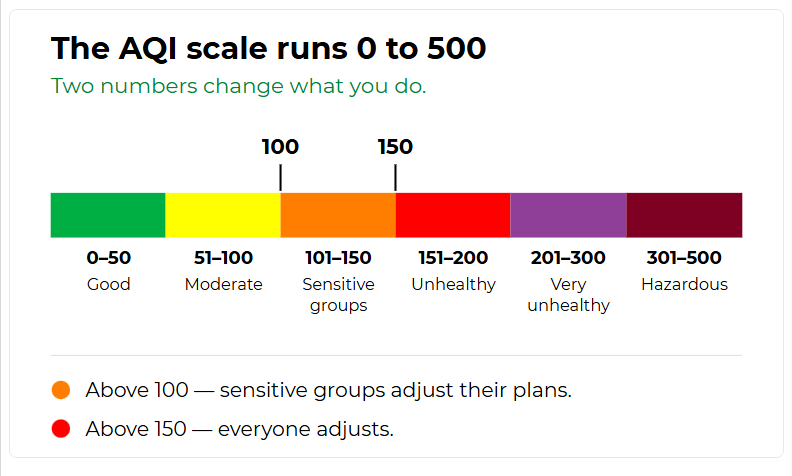
The Air Quality Index (AQI) is a 0 to 500 scale the EPA uses to report how clean or polluted outdoor air is. Lower numbers mean cleaner air. The EPA divides the scale into six color-coded categories, and two numbers on it are the ones worth remembering.
Under 100 — air quality is generally satisfactory for most people.
Above 100 — unhealthy for sensitive groups, like children and people with asthma.
Above 150 — unhealthy for everyone, regardless of medical history.
The AQI covers outdoor air only. When it climbs, what your HVAC filter captures indoors is the part you control — browse air filters at Filterbuy, or take the quick match below.
Answer a few quick questions and we’ll match you to the right filter for your system.
Already know your size? Shop air filters at Filterbuy.
The Air Quality Index (AQI) is a 0–500 scale used by the U.S. Environmental Protection Agency (EPA) to report how clean or polluted outdoor air is on any given day. Lower numbers mean cleaner air.
Most healthy adults can go about their day normally below 100, but once AQI climbs above 150, everyone should take precautions, especially indoors.
Key Takeaways
AQI 0–50 (Good): Clean air, no precautions needed.
AQI 51–100 (Moderate): Acceptable for most; minor irritation possible for sensitive individuals.
AQI 101–150 (Unhealthy for Sensitive Groups): Children, older adults, and those with asthma or heart disease should reduce outdoor exertion.
AQI 151+ (Unhealthy to Hazardous): Everyone should limit outdoor activity and prioritize indoor air quality.
AQI ≠ Indoor Air Quality: A good outdoor AQI doesn't automatically mean your indoor air is clean (and the same is true in reverse).
Your HVAC filter matters: On high-AQI days, a MERV 13 air filter from Filterbuy can significantly reduce the fine particles entering your home.
What Is the Air Quality Index (AQI)?
The Air Quality Index is a standardized reporting system developed by the U.S. Environmental Protection Agency (EPA) to communicate daily outdoor air quality to the general public. It converts complex scientific data (measurements like micrograms of particles per cubic meter of air) into a single number on a scale from 0 to 500.
Think of it like a speedometer for air pollution. The higher the number, the more polluted the air and the greater the health risk. The EPA designed the AQI to be instantly readable, so you don't need a science degree to know whether it's safe to take your dog for a walk.
The AQI is updated hourly in most regions and is available through tools like the EPA's AirNow platform, most weather apps, and smart home devices.
Why the AQI Exists: Simplifying Complex Pollution Data
Raw pollution data is not consumer-friendly. Telling someone that PM2.5 concentrations are at 35.5 micrograms per cubic meter doesn't help them decide whether to keep their windows open.
The AQI solves this by translating measurements of multiple pollutants into one universal number. The EPA uses specific formulas to ensure that an AQI of 120 carries roughly the same public health implication regardless of which pollutant is driving it. The result is a tool that's consistent, comparable, and immediately actionable. The EPA often describes it as a traffic light for the air.
What Pollutants Does the AQI Measure?
The AQI tracks five major air pollutants regulated under the Clean Air Act. At any given hour, the pollutant with the highest concentration determines the reported AQI value. For example, if ozone is at an AQI of 40 but wildfire smoke pushes particulate matter to an AQI of 155, the reported number is 155.
Here's what each pollutant represents:
PM2.5 (Fine Particulate Matter): Microscopic particles produced by combustion sources like wildfires, vehicle exhaust, and industrial emissions. Because of their tiny size, PM2.5 particles can travel deep into lung tissue and enter the bloodstream, making them one of the most health-significant pollutants on the list.
PM10 (Coarse Particulate Matter): Larger particles like dust, pollen, and mold spores. These tend to irritate the eyes, nose, and throat rather than penetrating as deeply as PM2.5.
Ground-Level Ozone (O₃): Often called smog, ground-level ozone forms when sunlight reacts with pollutants from cars and industrial sources. It's a known lung irritant and is especially problematic on hot, sunny days.
Nitrogen Dioxide (NO₂): Released primarily from burning fuel in vehicles and power plants. NO₂ is a marker of traffic-related air pollution.
Sulfur Dioxide (SO₂) and Carbon Monoxide (CO): Byproducts of industrial processes and fossil fuel combustion, respectively.
Of these, PM2.5 and ground-level ozone are the two pollutants most commonly responsible for elevated AQI readings across the U.S.
How the AQI Scale Works: 0 to 500 Explained
The AQI scale runs from 0 to 500. Every 50-point increment represents a meaningful shift in health risk. The higher the number climbs, the broader the population affected.
Here's how the EPA divides the scale into six color-coded categories:
| AQI Range | Category | Color | Health Effects |
|---|---|---|---|
| 0–50 | Good | Green | No risk; air quality is satisfactory. |
| 51–100 | Moderate | Yellow | Acceptable; minor effects for unusually sensitive individuals. |
| 101–150 | Unhealthy for Sensitive Groups | Orange | Sensitive groups may experience symptoms; the general public is unlikely to be affected. |
| 151–200 | Unhealthy | Red | Everyone may experience health effects; sensitive groups may be more seriously affected. |
| 201–300 | Very Unhealthy | Purple | Health alert; serious effects may affect the entire population. |
| 301–500 | Hazardous | Maroon | Emergency conditions; severe risk to everyone. |
What AQI Number Is Considered Good?
An AQI between 0 and 50 is classified as "Good" and is represented by the color green. At this level, air pollution poses little to no risk, and everyone, including children, older adults, and those with asthma, can go about outdoor activities without concern.
The Moderate range (51–100) is also generally safe for healthy adults. The air quality is acceptable, though a small number of people who are unusually sensitive to specific pollutants like ozone may notice minor respiratory irritation. For the vast majority of the population, anything under 100 doesn't require a change in plans.
At What AQI Level Does Air Become Harmful?
The short answer: above 100 for sensitive groups, above 150 for everyone else.
AQI 101–150 (Orange): Children, older adults, people with asthma, and those with heart or lung conditions may experience coughing, shortness of breath, or mild irritation. Healthy adults are largely unaffected.
AQI 151–200 (Red): The air is considered unhealthy for the entire population. Breathing during outdoor exertion may become noticeably harder. Limiting time outside is recommended for everyone.
AQI 201–300 (Purple): A public health alert. Serious health effects (chest tightness, wheezing, fatigue, eye and throat irritation) are possible for all groups, not just sensitive individuals.
What Happens If the AQI Reaches 500?
An AQI of 500 is rare, but it does occur. It represents the top of the standard scale. It indicates Hazardous conditions, typically seen only during extreme wildfire events or severe industrial accidents where dense smoke settles into low-lying areas.
At this level:
The entire population is at risk for serious health effects.
All outdoor physical activity should be avoided without exception.
Staying indoors with filtered air is not optional; it is a health necessity.
Sealing gaps around doors and windows, running air purifiers, and using high-efficiency HVAC filters become critical lines of defense.
How AQI Affects Different Groups
Air pollution does not carry the same risk for everyone. Certain groups are significantly more vulnerable, even at AQI levels in the Orange range (101–150).
Children: Still developing lungs, combined with a higher breathing rate per pound of body weight and more time spent being active outdoors, makes children particularly susceptible to pollution.
Older Adults: Aging adults may have undiagnosed or underlying cardiovascular or pulmonary conditions that amplify the impact of even moderate pollution levels.
People with Asthma: Elevated ozone or particulate matter can trigger asthma attacks at lower AQI thresholds than the general population.
Heart Patients: Research has linked fine particle pollution (PM2.5) to heart attacks and arrhythmias in those with existing heart disease.
Pregnant Individuals: Prolonged exposure to elevated pollution levels has been associated with adverse fetal outcomes, including low birth weight.
If any of these household members live in your home, the AQI threshold at which you take action should be lower than the general guidelines suggest.
AQI vs. Indoor Air Quality: Why They're Not the Same Thing
This is one of the most common misconceptions about the AQI: many homeowners assume a good outdoor score means the air in their home is also clean. It doesn't.
The AQI reported on your weather app measures outdoor air only, captured by sensors positioned outside of buildings. It says nothing about the air inside your home, which has its own set of pollution sources: pet dander, dust mites, mold, cooking fumes, and volatile organic compounds (VOCs) from cleaning products and synthetic materials.
It's entirely possible to have an outdoor AQI of 25 (Good, green) while your indoor air quality is poor due to a dirty HVAC filter or inadequate ventilation. The reverse is also true: on a high-AQI day, your indoor air can remain relatively safe if you keep windows closed and run a properly filtered HVAC system.
How to Check Your Local AQI
Monitoring AQI doesn't require any special equipment. Several free, reliable tools are available:
EPA AirNow (airnow.gov): The official U.S. government source for real-time air quality data, updated hourly.
Smartphone Weather Apps: Most native and third-party weather apps now include an "Air Quality" tab with current AQI readings.
Smart Home Devices: Many smart home devices can verbally report the current AQI on request.
Filterbuy's Wildfire Smoke & AQI Hub: Get targeted, real-time air quality guidance, especially during wildfire season or high-pollution events in your region.
What to Do When AQI Is High
When the AQI climbs into the Red, Purple, or Maroon zones, taking deliberate steps can meaningfully reduce your family's exposure.
Limit outdoor time. Reduce the amount of time you and your household spend outside, especially during peak pollution hours. Avoid strenuous outdoor exercise, because the harder you breathe, the deeper pollutants travel into your lungs.
Close windows and doors. Outdoor pollution infiltrates your home through open windows, doors, and natural ventilation. Closing them is the single fastest action you can take to protect indoor air.
Run your HVAC on recirculate. Switch your system to recirculation mode so it filters indoor air rather than drawing in polluted outdoor air. Make sure the filter is clean and capable of catching fine particles.
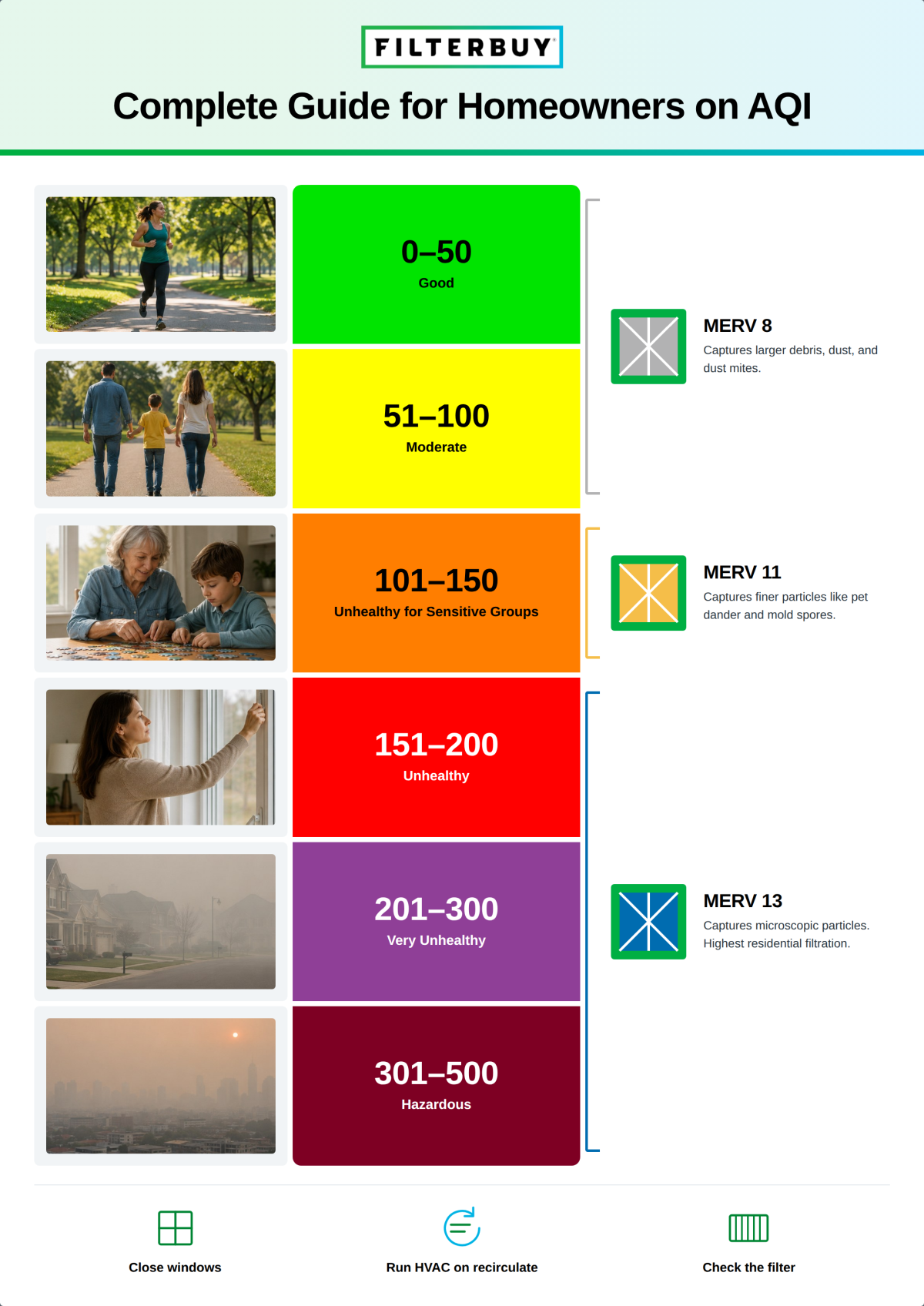
Upgrade to a MERV 13 air filter. Standard filters are not designed to capture PM2.5, the fine particles that pose the greatest health risk during wildfire smoke events and high-pollution days. Filterbuy's MERV 13 air filters are specifically engineered to trap these microscopic particles, providing a meaningful layer of protection when outdoor air quality deteriorates. Replacing your filter before a predicted pollution event (not just after) ensures your system is ready when you need it most.
Seal gaps and drafts. Fine particles can seep through cracks around doors, windows, and utility penetrations. Weather-stripping and draft excluders help limit infiltration during extreme events.
Common Misconceptions About AQI
Myth: Moderate AQI (51–100) is unsafe.
Fact: A yellow rating is considered acceptable for the vast majority of healthy adults. It's a signal to pay attention, not a reason to stay indoors.
Myth: A single spike in AQI always means a health emergency.
Fact: Health guidance is generally based on sustained exposure, typically over 24-hour averages, rather than a brief momentary fluctuation. A temporary spike doesn't automatically carry the same risk as prolonged elevated readings.
Myth: The AQI tells you how clean the air is in your home.
Fact: The AQI is strictly an outdoor metric. Your indoor air quality requires its own monitoring and management strategy, starting with a quality HVAC filter.
Myth: Only people with health conditions need to worry about high AQI.
Fact: Once the AQI exceeds 150, everyone can experience adverse effects. Sensitive groups are simply affected at lower thresholds.
Protecting Your Home When It Matters Most
The AQI is a planning tool, not a panic button. Most of the time, you're looking at Green or Yellow, and life carries on as normal. But when it shifts to Orange, Red, or worse, your home should become an active barrier against outdoor pollution. Not a passive one.
On high-AQI days, the quality of your indoor air depends on how well your HVAC system filters what comes in. A Filterbuy MERV 13 filter can capture the fine particles (PM2.5) that standard filters miss, giving your family a meaningful layer of protection during wildfire smoke events, heavy smog, or any prolonged period of poor air quality. Checking and replacing your filter before pollution season is one of the most practical steps a homeowner can take.
Stay informed, stay filtered, and your home can remain a clean-air sanctuary regardless of what's happening outside.
Frequently Asked Questions About the Air Quality Index
What is the simplest definition of the Air Quality Index?
The Air Quality Index (AQI) is a standardized scale from 0 to 500 used by the U.S. EPA to report how clean or polluted outdoor air is on any given day. A lower AQI means cleaner, safer air. A higher number indicates greater pollution and health risk. The AQI measures short-term exposure risk, typically over hours or days, based on five major pollutants.
What AQI number is considered good?
An AQI between 0 and 50 is classified as "Good" and poses little to no health risk for any population group. The Moderate range (51–100) is also generally acceptable for healthy adults, though unusually sensitive individuals may notice minor symptoms. Most people can conduct normal outdoor activities without precaution below 100.
At what AQI level does air become harmful?
Air becomes harmful for sensitive groups (children, older adults, and those with asthma or heart disease) once the AQI exceeds 100. For the general population, significant health effects typically begin above 150. Above 200, the air is considered "Very Unhealthy" and poses serious risks to everyone, regardless of health status.
What pollutants are used to calculate the AQI?
The AQI is calculated using five pollutants: ground-level ozone, particulate matter (PM2.5 and PM10), carbon monoxide, sulfur dioxide, and nitrogen dioxide. These are regulated under the Clean Air Act. The pollutant with the highest concentration at a given time determines the reported AQI value.
What happens if the AQI reaches 500?
An AQI of 500 represents Hazardous conditions, the maximum on the standard scale. At this level, the entire population faces serious health risks. All outdoor activity should be avoided, and staying indoors with filtered air is essential. These readings are rare and typically occur during severe wildfire events or industrial accidents.
Does a good outdoor AQI mean my indoor air is also clean?
No. The AQI measures outdoor air only and does not account for indoor pollution sources like dust, pet dander, mold, or cooking fumes. Your indoor air quality requires its own management strategy, including regular HVAC filter changes and proper ventilation practices.
How does a MERV 13 filter help during high-AQI days?
A Filterbuy MERV 13 air filter is designed to capture fine particles (PM2.5), the microscopic pollutants most responsible for health effects during wildfire smoke and high-pollution events.
Standard filters used in most homes are rated MERV 8 or below and cannot effectively capture particles at this size. Upgrading to a MERV 13 filter helps prevent outdoor pollution from recirculating through your home's air supply.
How often should I check the AQI?
Checking AQI before outdoor activities is a good habit, particularly during wildfire season or periods of high pollution. Daily monitoring isn't necessary under normal conditions, but using Filterbuy's Wildfire Smoke & AQI Hub to track air quality ensures you're notified when levels reach thresholds that require action.