
Winter Outlook 2026-2027: What NOAA’s El Niño Forecast Means for Your Home’s Air
November 4, 2026

This winter’s forecast points two ways: much of the North leans warmer than average, while the South and East Coast lean wetter. Neither pattern gives your furnace a break, because a sealed-up home recirculates the same indoor air all season.
Rainy regions should keep an eye on humidity. Drier regions should watch for airborne dust. Not sure which filter fits your home? Take the quick match quiz below.
Find Your Filter Match for Winter
Answer a few quick questions and we’ll match you to the right MERV rating for your home.
TL;DR
NOAA's 2026-2027 U.S. Winter Outlook leans warmer than average across much of the northern U.S. and wetter than average across the South and East Coast, largely because of a very strong El Niño. Even a milder, wetter winter keeps the windows shut and the heat running, so the two things to manage at home are moisture and a clean HVAC air filter.
Key Takeaways
NOAA released the 2026-2027 U.S. Winter Outlook on October 15, 2026; it covers December through February.
A very strong El Niño is tilting the odds toward a stormier South.
In wet regions, watch humidity and mold. In dry regions, watch for dust and parched air.
Filterbuy's take: a mild forecast is no reason to skip filter changes; ENERGY STAR advises checking the filter monthly.
At Filterbuy, we've made pleated air filters in our own U.S. plants since 2013, and each fall we read the winter outlook with one question: how will this weather change the air inside your home?
What Does NOAA's 2026-2027 Winter Outlook Predict?
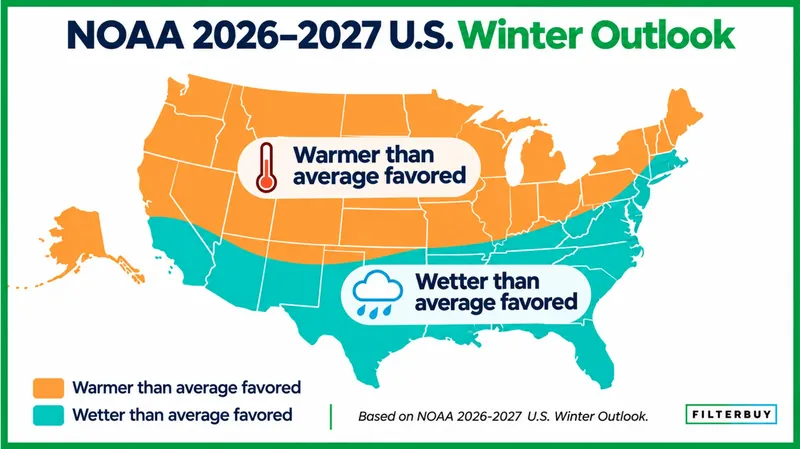
NOAA's 2026-2027 winter outlook favors a warmer-than-average season for much of the northern United States and a wetter-than-average one for the southern tier and East Coast. The National Oceanic and Atmospheric Administration (NOAA) issued the outlook on October 15, 2026, covering meteorological winter, December through February.
The strongest odds of above-average warmth stretch across the Pacific Northwest, northern Rockies, Midwest, Mississippi Valley, much of the East and Alaska, while parts of the Southeast, including Florida, lean toward near-normal temperatures. See the official December–February winter outlook map from NOAA's Climate Prediction Center.
For precipitation, the Southwest, South and East Coast are favored to run wetter than average. Parts of the northern Rockies and Great Lakes, along with Hawaii and much of Alaska, lean drier.
Why Is El Niño Shaping This Winter Outlook?
El Niño, a periodic warming of the central and eastern tropical Pacific Ocean, is the main reason this US winter outlook leans warm in the North and wet in the South.
According to Ken Graham, director of NOAA's National Weather Service, a very strong El Niño will likely shift the jet stream south and east over the contiguous U.S., which tilts the odds toward stormier weather across the South. In its October 8 El Niño update, NOAA's Climate Prediction Center put the chance at 83% that this El Niño will grow stronger during October–December than any on record since 1950.
Still, an outlook shifts the odds; it doesn't guarantee the weather. Plan for the likely pattern, and keep the winter storm warning map handy for cold snaps.
What Does a Warmer, Wetter Winter Mean for Indoor Air?
A milder winter doesn't mean cleaner indoor air. Homes stay sealed either way, and the heat keeps recirculating the same dusty air for weeks.
Our perspective: As an American air filter manufacturer, Filterbuy pays the closest attention to mild forecasts. A hard freeze reminds people to check the furnace; mild, rainy weeks rarely do, so filter changes and humidity checks quietly slip.
Wet weather brings a second concern: moisture. Rainy days and damp coats add it to your home, and closed windows keep it there. The U.S. Environmental Protection Agency (EPA) recommends keeping indoor humidity below 60%, ideally between 30% and 50%, to help prevent mold, and it flags window condensation as a sign of high humidity.
Drier regions have the opposite problem, since air below 30% humidity lets dust stay airborne. A hygrometer shows which camp your home is in; Filterbuy's winter indoor air quality guide covers both.
What Should You Do in Your Region This Winter?
Filterbuy built this table to pair each NOAA forecast zone with the indoor air issue to watch first. Find your region and start with the last column.
Source: NOAA 2026-2027 U.S. Winter Outlook, issued October 15, 2026.
How Do You Prepare Your HVAC System for This Winter?
Whatever your region's forecast, these five steps get a home ready before peak heating season.
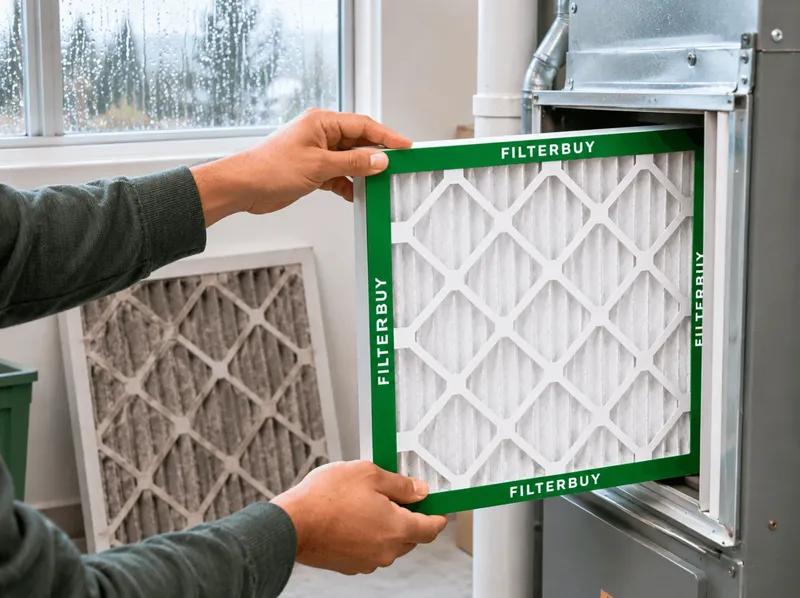
Replace your air filter now. Start the heating season with a clean pleated filter; Filterbuy makes more than 600 sizes. ENERGY STAR recommends checking the filter monthly and changing it as needed, at least every three months. For a winter-specific schedule, see how often to change your furnace filter in winter.
Choose the right MERV rating. Filterbuy makes MERV 8, 11 and 13 filters. According to the EPA, higher MERV ratings trap smaller particles: MERV 13 captures at least 50% of the finest particles tested (0.3 to 1 micron), compared with at least 20% for MERV 11. The EPA suggests at least MERV 13, or as high as your system can handle; see which MERV rating to use.
Measure indoor humidity. Set a hygrometer in your main living space and aim for 30% to 50%.
Test carbon monoxide alarms. Fuel-burning appliances work harder in winter, so the CDC recommends battery-operated or battery back-up CO detectors near every sleeping area. Learn the carbon monoxide warning signs, too.
Book a furnace tune-up. A licensed HVAC technician can inspect the burners and heat exchanger. ENERGY STAR advises scheduling the heating check in the fall, before contractors get busy.
"During any winter warning, stick with the MERV rating your system is built for, usually MERV 8 to 11, and save a first-time jump to MERV 13 for a mild week when you can watch how it runs."
David Clark, Licensed HVAC Technician, Filterbuy HVAC Solutions
Pro tip from the Filterbuy team: Order replacement filters as soon as a Winter Storm Watch goes up rather than waiting for the warning. Better yet, set up Filterbuy Auto-Delivery so the right size shows up on schedule.
When Should You Act? A Winter Outlook Prep Calendar
NOAA's forecast will keep shifting as El Niño evolves, so Filterbuy matched each upcoming release to a home task.
Sources: NOAA, its Climate Prediction Center and the U.S. EPA.
Supporting Statistics: What the Research Shows
Most of our time is spent indoors.
Americans spend about 90% of their time indoors.
Some pollutants run 2 to 5 times higher indoors than outdoors.
Filterbuy's take: the EPA notes that energy-efficient homes lacking ventilation can trap pollutants.
Heating costs are expected to split by fuel this winter.
Electricity (more than 40% of homes): up about 4%
Heating oil: up 21%
Natural gas: down 9%
Propane: down 3%
Filterbuy's take: whatever your fuel, ENERGY STAR warns that a dirty filter can raise energy costs and damage equipment.
Source: U.S. Energy Information Administration, October 7, 2026
Carbon monoxide is a serious winter risk.
More than 400 deaths a year from unintentional, non-fire CO poisoning
More than 100,000 emergency department visits
More than 14,000 hospitalizations
Filterbuy's take: CO is odorless and colorless, so pair each filter change with a CO alarm test.
A Word from Our Author
"I read a winter outlook differently than most people. Instead of asking whether I'll need a heavier coat, I ask how long the windows will stay shut. Even a mild, wet forecast means a closed-up house and a furnace that cycles all season, so my own winter prep starts with a fresh filter and a quick humidity check, before the first storm shows up on the map."
Michelle Wan, Brand Manager & Copywriter, Filterbuy
Winter Outlook FAQ
Will the 2026-2027 Winter Be Warmer Than Normal?
In much of the country, yes. NOAA favors above-average temperatures across the northern U.S. and much of the East, while parts of the Southeast lean near normal.
When Is NOAA's Next Winter Outlook Update?
NOAA updates seasonal outlooks monthly; the next update is November 19, 2026.
Will This El Niño Winter Bring More Snow?
NOAA favors more precipitation across the South and East Coast, but the outlook doesn't forecast seasonal snowfall, since snow is rarely predictable more than a week ahead.
Does a Warmer Winter Mean I Can Change My Filter Less Often?
No. Your heating system still recirculates the same indoor air, and ENERGY STAR advises checking the filter monthly.
What Does El Niño Mean for U.S. Winter Weather?
According to NOAA, a very strong El Niño tends to shift the jet stream south and east, tilting the odds toward a stormier South and a warmer North. Those impacts are more likely, not guaranteed.