
Why Is My House So Dusty In Winter? Causes And Filter Fixes That Work
October 23, 2026

Your house gets dustier in winter because it stays sealed, your furnace runs longer, and dry air makes dust cling. Leaky return ducts can also pull in dust from the attic or crawlspace. Your furnace filter catches it, so check it monthly and make sure it fits without gaps. Take the quick quiz below to find your winter filter match.
Why winter dust builds up
Four conditions add dust. Your filter catches it.
Sealed house
Dust can’t get out
More furnace time
Filters fill faster
Dry air
Static makes dust cling
Leaky return ducts
Pull in attic dust
Your furnace filter catches it
When it’s clean and fits without gaps
Check monthly
Swap when gray
Fit it snug
No gaps around it
Try MERV 11
If manual allows
Find your winter filter match
Answer a few quick questions and we’ll match you to the right filter for your home.
Already know your filter size?
Shop air filters at FilterbuyFast, free 2-day delivery to most US states.
TL;DR
Winter dust comes from a sealed house, longer furnace run times, dry air, and air leaks. Check your filter monthly and make sure it fits without gaps. Keep indoor humidity between 30% and 50%. If dust keeps returning, upgrade to a MERV 11 or MERV 13 filter your HVAC manual approves and have your ducts leak-tested.
Key Takeaways
Furnace blowers run longer in cold weather, so filters fill faster in heating season.
Below about 30% humidity, static makes dust cling, and the American Lung Association advises staying under 50% for dust mites.
ENERGY STAR reports that a typical house loses about 20 to 30 percent of duct airflow to leaks.
A snug fit matters as much as a filter's MERV rating, because any gap lets dusty air slip around it.
What Makes A House Dustier In Winter?
Six winter conditions drive most of the extra dust: closed windows, longer furnace run times, dry air, leaky return ducts, the stack effect, and seasonal sources such as fireplaces and humidifiers. Many homes have several at once.
Closed Windows Keep Dust Inside
A sealed winter house keeps the dust it produces. The U.S. Environmental Protection Agency (EPA) explains that inadequate ventilation can increase indoor pollutant levels because too little outdoor air comes in to dilute indoor sources. Filterbuy's breakdown of what household dust is made of covers where that dust starts.
Your Furnace Runs Longer And Moves More Air
A furnace that runs longer loads its filter faster. Cold weather keeps a forced-air furnace or heat pump cycling, and since an air filter traps dust as air passes through it, every extra hour adds to the load. That is why Filterbuy tells customers to judge a winter filter by its color, not the date on the frame.
Dry Winter Air Makes Dust Cling
Dry indoor air makes fine dust cling to surfaces. Below about 30% relative humidity, static builds on TVs and plastic blinds and pulls in dust. The American Lung Association advises keeping your home below 50 percent humidity because dust mites need moist air. In deep cold, fog or frost on the inside of your windows means the air is too humid, so ease back toward 30%.
Leaky Return Ducts Pull In Attic And Crawlspace Dust
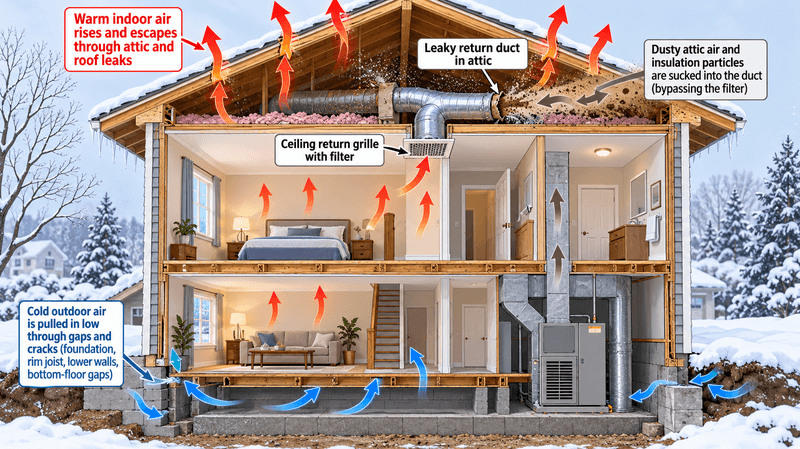
Leaky return ducts pull unfiltered dust from attics, crawlspaces, and garages into your heating system, because return ducts run under suction. ENERGY STAR, the federal efficiency program, reports that about 20 to 30 percent of the air that moves through the duct system in a typical house is lost to leaks and poorly connected ducts.
Most winter dust guides skip filter location, but it decides whether that dust gets caught. If your filter sits in a wall or ceiling return grille, air leaking into the duct behind it bypasses the filter and blows into your rooms. An uncovered filter slot on the furnace cabinet does the same on a smaller scale. If you change your filter at a wall or ceiling vent, you have a return grille filter.
The Stack Effect Draws Dust Through Gaps
The stack effect draws cold, dusty air into your house through low gaps. Warm indoor air rises and escapes near the attic, which pulls outdoor air in through rim joists and other openings below. The U.S. Department of Energy notes the stack effect is most pronounced in winter, when indoor and outdoor temperatures differ most. Crawlspace dust pulled in this way often shows up as dark lines along carpet edges.
Fireplaces, Humidifiers, And Holiday Boxes Add Their Own Dust
Wood stoves, humidifiers, and stored decorations add dust of their own. Wood stoves shed fine ash whenever the door opens, and the U.S. Fire Administration advises keeping wood stove doors closed except when loading the fire.
Ultrasonic humidifiers can spray tap water minerals that settle as a gritty white film, so the U.S. Consumer Product Safety Commission (CPSC) recommends filling humidifiers with water that has had its minerals removed, such as distilled water, and holding humidity between 30% and 50%. Open holiday boxes from the attic in the garage, since they carry a year of settled dust.
Find Your Winter Dust Cause: A Quick Diagnostic
Where dust shows up points to its source. Match what you see below, starting with the filter rows, which are the cheapest fixes.
Winter Dust Diagnostic Table
| WHAT YOU NOTICE | CAUSE, CHECK, AND FIX |
|---|---|
| Dust returns everywhere within days of cleaning |
Cause: Loaded filter and longer furnace run time Check: No light through it means it is loaded Fix: Replace it, then check monthly |
| Gray streaks around supply registers |
Cause: Filter bypass or leaky return ducts Check: Look for gaps around the filter and an open filter slot Fix: Order the exact size and cover the slot |
| Dust clinging to TVs and plastic blinds |
Cause: Dry air and static Check: A hygrometer reads under 30% Fix: Raise humidity to 30% to 50% |
| Dark lines along carpet edges |
Cause: Stack effect pulling air through gaps Check: A tissue strip flutters near baseboards on windy days Fix: Seal gaps with caulk or weatherstripping |
Which Air Filter Helps Most With Winter Dust?
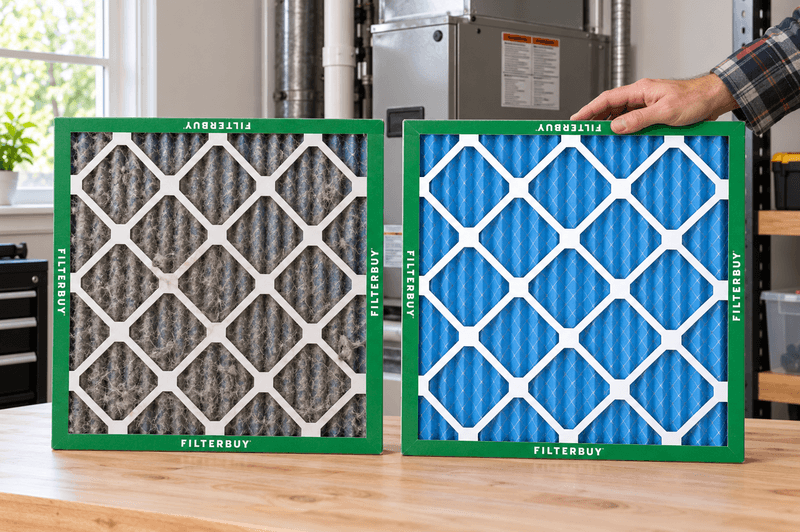
For most dusty homes, a pleated MERV 11 filter is the practical winter upgrade. A higher MERV (Minimum Efficiency Reporting Value) rating captures more fine dust, but only when your HVAC system supports that rating. Filterbuy's guides cover high-efficiency furnace filters in winter and choosing the right MERV rating in more depth.
MERV 8: MERV 8 air filters capture everyday dust, lint, and pollen, which suits homes with light dust and no pets. Confirm your HVAC manual supports MERV 8.
MERV 11: MERV 11 air filters also catch finer particles such as pet dander, so they fit homes with pets or a fireplace. Check that your HVAC manual lists MERV 11.
MERV 13: MERV 13 air filters capture the finest particles of the three, including wood smoke particles. Use one only if your HVAC manual approves MERV 13.
Fit matters as much as rating, and one detail from our factory floor shows why. We make every filter about 1/4 to 1/2 inch smaller than the nominal size printed on its frame so it slides in without binding, which means a filter one size off leaves a gap dusty air uses all winter. Our guide on how to measure your air filter shows how to find the exact size, and as a family-owned manufacturer, Filterbuy makes all three ratings in hundreds of standard sizes and custom air filter sizes.
How Often Should You Change Your Air Filter In Winter?
Check your HVAC filter monthly during heating season and replace it when it looks gray or loaded, whatever the date on the frame says. Filterbuy's guidance on how often to change your air filter starts at 60 to 90 days for a 1-inch or 2-inch pleated filter in a standard home and 30 to 45 days for homes with pets or heavy use.
Across a five-month heating season, roughly November through March, those intervals translate into the counts below. Counts round up and include the filter you install before the first cold snap.
Filters Needed For A Five-Month Winter
| Your Home | Replace Every | Filters For Winter |
|---|---|---|
| Standard home, 1- or 2-inch filter | 60–90 days | 2–3 |
| Pets or heavy use, 1- or 2-inch filter | 30–45 days | 4–5 |
| Standard home, 4-inch filter | 3–6 months | 1–2 |
What Else Reduces Dust In A House During Winter?
A few extra steps catch dust the HVAC filter misses. Set the thermostat fan to ON for a few hours a day to pull more room air through the filter, then back to AUTO to save electricity. For a bedroom that stays dusty, a portable True HEPA air purifier adds a second filter where you sleep. If dust outlasts a filter upgrade, have an HVAC technician seal your return ducts.
More seasonal steps are in Filterbuy's winter indoor air quality tips.
How We Built This Guide
Michelle Wan wrote this guide from Filterbuy's own sizing and replacement guidance, and licensed HVAC technician David Clark reviewed the HVAC details. The two tables and the return-grille bypass explanation are our own.
“We cut every filter slightly under its listed size so it slides in easily, which is why the right size matters. Check yours on the first of each month until spring, and if you can’t see light through the pleats, swap it.”
David Heacock, Founder and CEO, Filterbuy
Supporting Statistics
1. Americans spend about 87% of their time inside buildings, according to a survey of 9,386 people. With windows shut in winter, the HVAC filter becomes the main way airborne dust leaves.
Source: The National Human Activity Pattern Survey (NHAPS), Lawrence Berkeley National Laboratory
2. Heating and air conditioning use 52% of a typical household's annual energy. Every heating hour is also a blower hour pushing room air through your filter.
Source: Use of Energy in Homes, U.S. Energy Information Administration
3. 95 million U.S. households own at least one pet, including 53% with a dog and 39% with a cat. Pets stay inside more in the cold, adding dander to the dust your filter has to catch.
Source: U.S. Pet Industry Reaches $158 Billion in 2025, American Pet Products Association
Frequently Asked Questions About Winter Dust
Why Does My House Get Dusty Right After I Turn The Heat On?
The first heating cycles push out dust that settled in the ducts and on the heat exchanger over summer, partly burning it off. The spike usually fades within days, and a filter installed before the first cold snap catches more of it.
Does A Humidifier Help Reduce Dust In Winter?
Yes, if indoor humidity is below 30%, since moister air reduces the static that makes dust cling. Use distilled water in ultrasonic models to avoid adding mineral dust.
What MERV Rating Is Best For A Dusty House In Winter?
MERV 11 suits most dusty homes, especially those with pets or a fireplace, while MERV 13 captures the finest particles. Either one works only if your HVAC manual supports it and the filter fits without gaps.
Should I Get My Air Ducts Cleaned If My House Is Dusty In Winter?
Duct cleaning removes the dust already inside your ducts, but it will not stop leaks from pulling in more. Start with a correctly sized filter and a leak inspection.
Find The Right Filter For Your Winter Dust
The fastest fix for winter dust is the right filter. Check your filter's size and the highest MERV rating your HVAC manual supports, then shop Filterbuy air filters by size with fast and free 2-day delivery to most US states.
Glossary Of Winter Dust Terms
MERV (Minimum Efficiency Reporting Value): ASHRAE's 1 to 16 scale for how well an HVAC filter captures airborne particles.
Return Duct: The duct that carries room air back to the furnace under suction.
Filter Bypass: Air that flows around a filter through gaps instead of through it.
Nominal Size: The rounded filter dimensions printed on the frame and used for ordering.
HVAC: Heating, ventilation, and air conditioning, the system that moves heated or cooled air through a home.
Stack Effect: Warm indoor air rising and escaping high in a house, which pulls outdoor air in through lower gaps.