
Furnace Fan On or Auto in Winter? Comfort, Cost & Filtration Trade-Offs
October 21, 2026
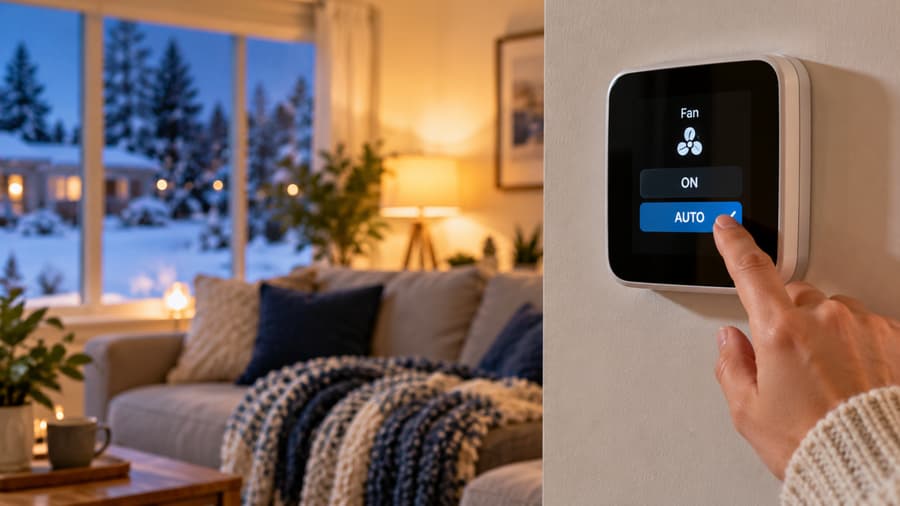
For most homes, AUTO is the better winter setting. It runs the blower only while the furnace heats, so it costs less and avoids cool drafts between cycles. Switch to ON or Circulate if some rooms stay cold or you want more air passing through your filter. Just plan on checking your filter monthly once you do.
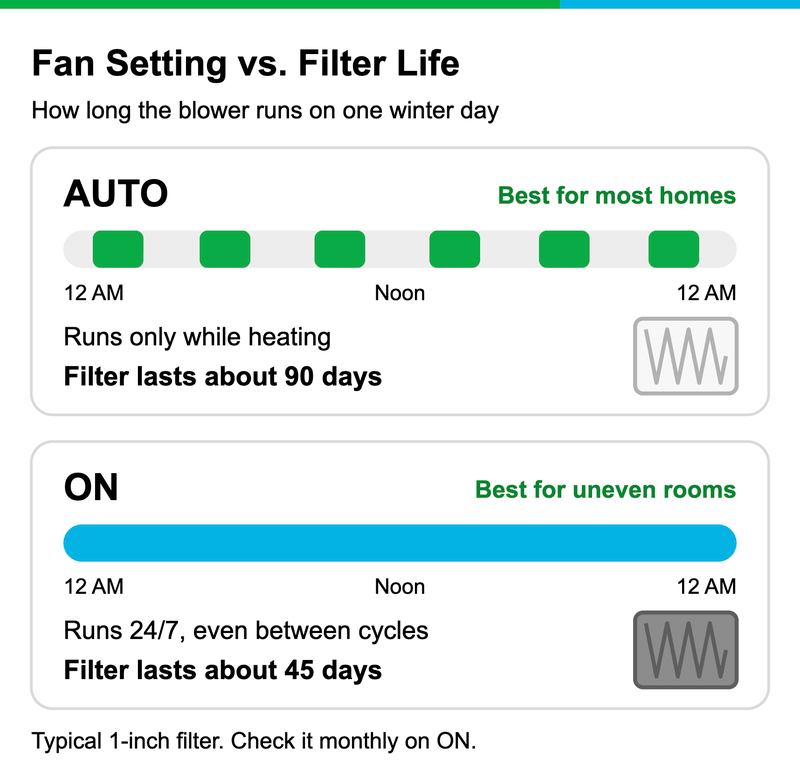
AUTO: Blower runs only during heat cycles. Lower cost, longer filter life.
ON: Blower runs 24/7. More even temperatures, but your filter loads faster.
Circulate: Blower runs part of every hour. A middle option.
For most homes on fan ON, a MERV 8 filter balances capture and airflow. It catches larger debris, dust, and dust mites.
Find Your Filter Match
Answer a few quick questions and we'll match you to the right filter.
TL;DR
For most homes, AUTO is the better winter setting for your furnace fan. It costs less to run and avoids the cool drafts that come between heating cycles. Switch to ON or Circulate if some rooms stay cold or you want more filtration for allergies, especially with an efficient ECM blower, and check your filter monthly once you do.
Key Takeaways
AUTO runs the blower only while the furnace heats; ON runs it 24/7, even when the burner is off.
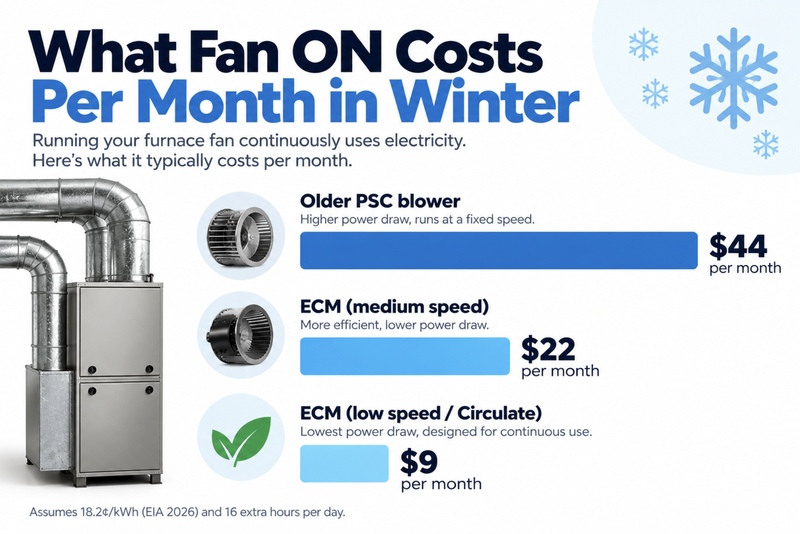
Running the fan continuously costs roughly $9 to $44 a month in winter at the 2026 U.S. average electricity price, depending mostly on the blower motor.
Fan ON evens out temperatures and filters more air, which helps homes with allergies or dust.
Fan ON also loads your filter faster. Check it monthly and expect about two extra filters per return each heating season.
Fan ON can feel drafty in winter because the air between heating cycles is cooler than your skin.
Should My Furnace Fan Be On or Auto?
For most of the winter, keep your furnace fan on AUTO. The blower then runs only when it's delivering warm air. ON makes sense when comfort or air quality matters more than the extra electricity, such as uneven rooms or a household with allergies or pets. Many newer thermostats also offer Circulate, a middle option that runs the blower for part of every hour.
At Filterbuy, we make every filter we sell in our own U.S. plants, so we look at this question from the filter's side. Our customers tell us fan ON is one of the most underused fixes for winter air quality. What they don't always expect: the day you switch to ON, your filter schedule changes too.
Furnace Fan ON vs AUTO in Winter: Side-by-Side
How Much Does It Cost to Run a Furnace Fan Continuously?
Running a furnace fan around the clock in winter costs about $9 to $44 a month for a typical home. According to PickHVAC's guide to furnace electricity use, an older PSC blower draws roughly 300 to 600 watts when it runs 24/7, while an ECM blower usually draws 150 to 300 watts and less at low speed.
To estimate your own cost, multiply blower watts by extra hours per day and by 30, divide by 1,000, then multiply by your price per kWh. The table below uses 18.2 cents per kWh for 2026, the U.S. Energy Information Administration's October 2026 forecast for the average residential price, and assumes ON adds about 16 blower hours on a cold day.
Estimates at 18.2 cents per kWh (EIA 2026 forecast) and 16 extra blower hours per day. Season = 5 months. Extra use: about 240, 120 and 48 kWh per month.
Your motor type depends largely on when your furnace was installed. Department of Energy standards that took effect on July 3, 2019 require ECM or similar motors in most new furnaces, and Energy Trust of Oregon reports the DOE expected the change to cut furnace motor energy use by as much as 46 percent.
The cost most guides leave out is filters. A 1-inch filter that lasts 90 days on AUTO often needs replacing closer to every 45 days on ON, which works out to about two extra filters per return over a five-month heating season. At Filterbuy filter auto-delivery prices for a common 20x25x1 size ($7.91 for MERV 8 or $9.49 for MERV 11, per filter in a six-pack), that's roughly $16 to $19 a season. It's small next to the electricity, but it decides whether fan ON actually cleans your air.
Circulate costs about a third as much. At a typical 20 minutes an hour, it adds roughly $3 a month with an ECM blower or $15 with a PSC blower, with a third of the extra filter wear.
Does Fan ON Make My Home More Comfortable in Winter?
Fan ON evens out temperatures, but it can also make a room feel cooler. Constant airflow moves warm air from ceilings and upper floors into colder rooms. Between heating cycles, though, the vents blow room-temperature air, which feels chilly on skin.
Where your ducts run matters too. ENERGY STAR estimates that 20 to 30 percent of the air moving through a typical duct system is lost to leaks and poor connections, and ducts in an unheated attic or crawlspace lose even more heat under all-day airflow.
Does Running the Furnace Fan Help With Air Quality and Allergies?
Yes. On ON, air passes through your filter every hour the blower runs instead of only during heating cycles, which is why allergy-prone households often prefer it.
That extra filtering comes with a cost. ON can push up to three times as much air through your filter as AUTO, so the filter loads faster. Filterbuy has pulled used filters from customers' systems in February that were completely black after just 30 days. Fan ON also can't rescue a clogged or flat fiberglass filter; it just moves dirty air faster.
A filter that looks fine in October can be completely choked by December, and that's when we see the most avoidable furnace failures.
The Filterbuy Team.
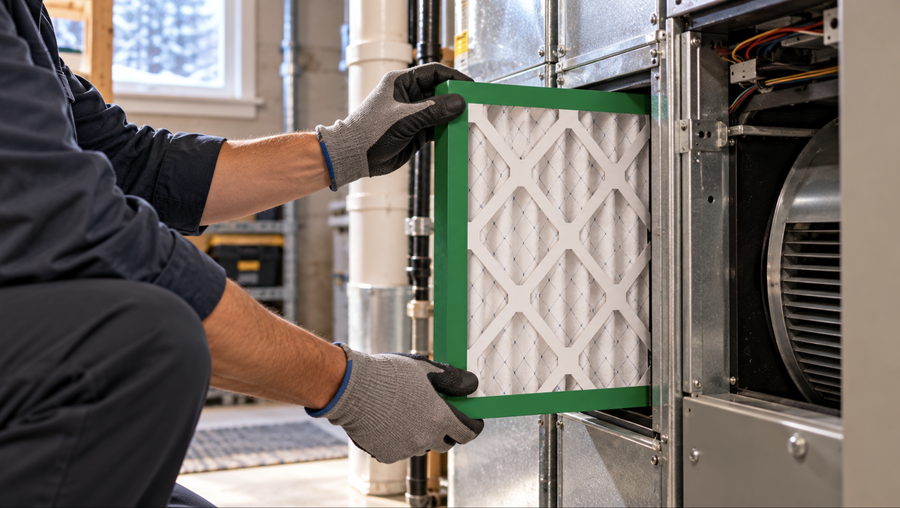
To find your own schedule, try Filterbuy's two-check test. On the day you switch to ON, write the date on the filter frame. After 30 days, hold the filter against a sheet of white paper. If it looks gray and matted, replace it and plan on a 30-day cycle; if it still looks light, check again at 45 days. That matches ENERGY STAR's advice to check your filter every month in winter, and Filterbuy's winter furnace filter guide lists schedules by filter depth.
Filterbuy's 1-inch filters carry 14 pleats per foot and its 4-inch filters only 8, because each 4-inch pleat is much deeper and holds more dust. If your furnace takes a 4-inch filter, fan ON is far easier to live with. For most homes on fan ON, a MERV 8 to MERV 11 filter balances capture and airflow; see MERV ratings explained.
Which Setting Is Right for Your Home This Winter?
AUTO suits most homes; ON or Circulate suits homes with cold rooms or allergy concerns. Find the first row below that describes yours.
If two rows conflict, try Circulate.
Not Sure? Run a One-Week Test at Home
A week and a cheap digital thermometer will show whether fan ON buys real comfort.
Days 1–3 on AUTO: Each morning and evening, note the reading in your coldest room next to the thermostat's.
Days 4–7 on ON or Circulate: Take the same readings at the same times.
Compare the gap. If your coldest room ran 3°F or more below the thermostat on AUTO and the gap closed on ON, keep it. If little changed, go back to AUTO and keep the savings.
If you keep ON, reset the filter clock that same day and check the filter at 30 days.
How Do I Know If My Furnace Has an ECM or PSC Blower?
Because the motor drives most of the cost, it's worth a quick check.
Check the age. A furnace made after mid-2019 very likely has an ECM or similar high-efficiency blower.
Read the rating plate. Look for the words "variable speed," "ECM" or "X13."
Look at the motor. With the power off at the furnace switch, look for a control module mounted on the motor (ECM) or a separate capacitor nearby (PSC).
Supporting Statistics: What the Research Shows
52% of a typical U.S. home's yearly energy goes to space heating and air conditioning, according to the U.S. Energy Information Administration's 2020 Residential Energy Consumption Survey. That makes blower hours a real line on your bill.
Americans spend about 90% of their time indoors, where some pollutants run 2 to 5 times higher than outdoors, reports the U.S. EPA's Report on the Environment. In a closed-up winter home, fan ON sends that air through your filter more often.
Over 90% of U.S. homes had three or more detectable allergens, and 73% had at least one at elevated levels, in a National Institutes of Health study of nearly 7,000 homes. Allergy and pet households gain the most from extra filtration.
Frequently Asked Questions
Does the Same Advice Apply to Heat Pumps or Summer?
Yes for heat pumps, which use the same blower and filter. In summer, AUTO has an extra edge: a fan running between cooling cycles can blow moisture from the wet AC coil back into your home.
Is It Bad to Leave the Furnace Fan On All the Time?
For most systems, no. ECM motors are designed for long, low-speed run times. The trade-off is a higher electric bill and a filter that loads faster.
How Often Should I Change My Filter If the Fan Is On ON?
Check it monthly; the two-check test above finds your exact interval. Filterbuy's filter auto-delivery can ship the right size on that schedule so you never miss a change.
Glossary
Furnace blower (furnace fan): The fan that moves air through the filter and ducts.
AUTO fan setting: Runs the blower only while the system heats or cools.
ON fan setting: Runs the blower nonstop.
Circulate mode: Runs the blower for part of each hour.
ECM (electronically commutated motor): An efficient, variable-speed blower motor used in most new U.S. residential furnaces since July 3, 2019.
PSC (permanent split capacitor) motor: An older single-speed blower motor that uses more electricity than an ECM.
kWh (kilowatt-hour): The billing unit for electricity: 1,000 watts for one hour.
MERV (Minimum Efficiency Reporting Value): A 1–16 scale that rates how well a filter captures particles.
The Bottom Line: Pick Your Setting, Then Match Your Filter Schedule
AUTO keeps electricity costs and drafts low for most homes. If you choose ON or Circulate for comfort or filtration, change your filter schedule the same day.
For more, read Filterbuy's guide to winter indoor air quality or learn how often to change your HVAC filter.
Running your fan more this winter? Find your filter size at Filterbuy among 600+ sizes, made in the USA and shipped fast and free, or set up filter auto-delivery so the next one arrives right on schedule.
Sources
U.S. Energy Information Administration, Short-Term Energy Outlook: Electricity, Coal, and Renewables (October 6, 2026 release; 2026 residential price forecast).
ENERGY STAR (U.S. EPA), Heat & Cool Efficiently (monthly filter checks).
ENERGY STAR (U.S. EPA), Duct Sealing (20–30 percent duct air loss).
Energy Trust of Oregon, Stay up to date on the latest standards for residential furnace motors (DOE July 3, 2019 furnace fan standard).
U.S. Energy Information Administration, Use of Energy Explained: Energy Use in Homes (2020 RECS; 52% heating and cooling share).
U.S. EPA, Report on the Environment: Indoor Air Quality (90% of time indoors; 2–5x pollutant levels).
National Institutes of Health, Allergens widespread in largest study of U.S. homes (Nov 30, 2017; nearly 7,000 homes).
PickHVAC, Rene Langer, How Much Electricity a Gas Furnace Uses Per Month (PSC and ECM blower wattage ranges).