
Vog Explained: Volcanic Smog and Hawaii's Air Quality
September 22, 2026

What Is Vog?
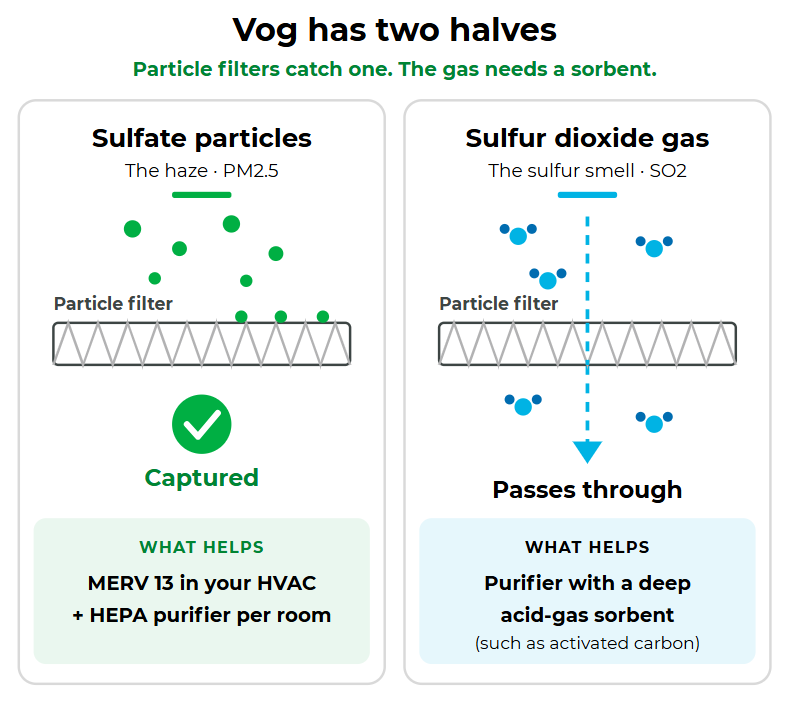
Vog is volcanic smog: sulfur dioxide (SO2) gas from Kīlauea plus the sulfate particles it forms downwind. A particle filter captures the sulfate particles, but SO2 gas passes right through.
When your local AQI tops 100, switch to a MERV 13 filter in your HVAC system and run a HEPA air purifier in each room. Near the vents, add a purifier with a deep acid-gas sorbent.
Not sure what fits your system? The quick match quiz below will point you to the right filter.
Made in the USA since 2013 · 600+ sizes
Find your filter match
Answer a few quick questions and we'll match you to the right filter for your home.
By Michelle Wan, Brand Manager & Air Quality Writer | Reviewed by David Clark, Licensed HVAC Technician
Published: September 22, 2026 | Updated: September 22, 2026
TL;DR
Vog is volcanic smog: sulfur dioxide gas from Kīlauea plus the sulfate particles it becomes downwind. When the AQI goes above 100, Filterbuy recommends a MERV 13 filter in your HVAC system plus a HEPA air purifier in each room. Homes near the vents also need an acid-gas sorbent.
Key Takeaways
Vog is sulfur dioxide (SO2) gas plus the sulfate aerosol it forms.
Kīlauea has erupted in episodes since December 2024, at times releasing about 50,000 tonnes of SO2 a day.
Particle filters "half-help": they catch PM2.5, the fine particles in vog, but not SO2 gas.
Above AQI 100, switch to MERV 13 if you have HVAC and run a HEPA air purifier in each room.
What Is Vog?
Vog is volcanic smog, a hazy mix of sulfur dioxide gas and acidic sulfate particles. Kīlauea's SO2 reacts with oxygen, moisture, and sunlight, and over minutes to days it turns into sulfuric acid droplets and sulfate particles small enough to count as PM2.5 (USGS Hawaiian Volcano Observatory).
At Filterbuy, we've made air filters in the USA since 2013, and vog is the one pollutant we're asked about that no single filter solves.
Where Does Hawaii's Vog Come From Right Now?
As of September 2026, Hawaii's vog comes from Kīlauea's summit eruption, which began December 23, 2024, in Halemaʻumaʻu crater. Lava fountains for hours, then the vents go quiet for days or weeks, and USGS counted 54 episodes through August 2026 (USGS daily Kīlauea update).
SO2 output varies sharply by phase:
Source: USGS Hawaiian Volcano Observatory daily updates and hazard notices, 2025–2026. Emission rates vary by episode.
Last verified September 21, 2026: alert level Watch, eruption paused. Check the USGS daily Kīlauea update for updates.
How Does Vog Move Around the Islands?
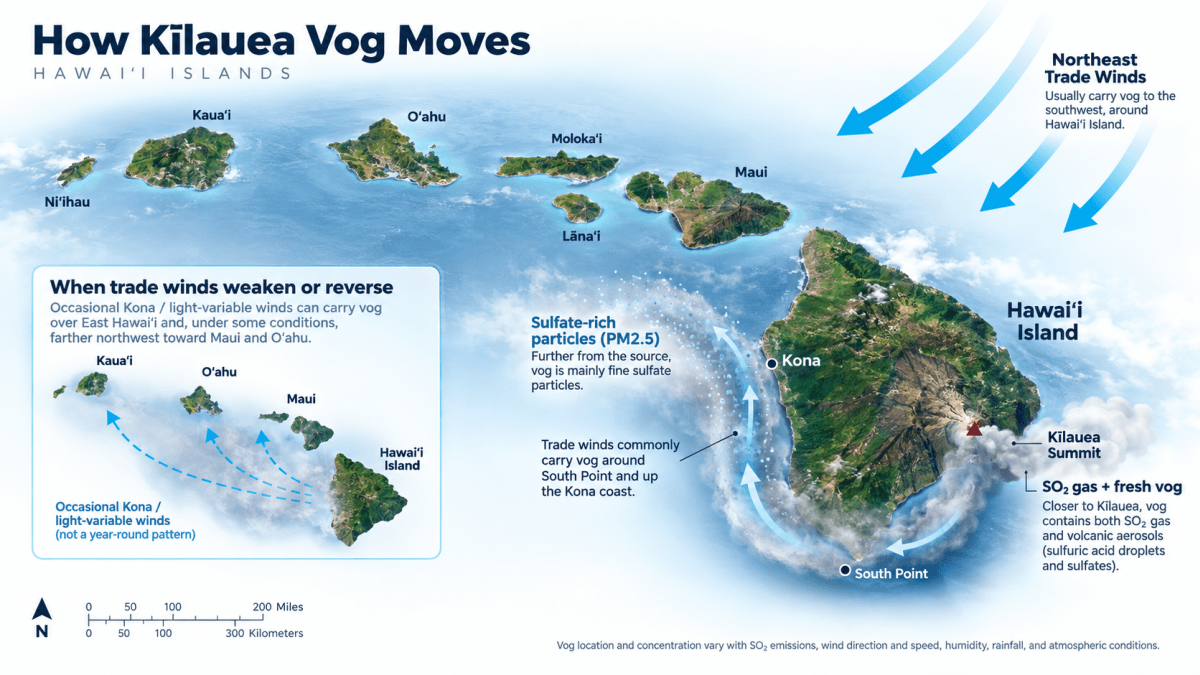
Wind decides who gets vog more than distance does. From May through September, trade winds blow 80–95% of the time, carrying vog around Hawaiʻi Island's southern tip to the Kona coast, where sea breezes trap it (USGS Hawaiian Volcano Observatory).
When the trades weaken, mostly in winter, vog can settle over Hilo and drift to Maui, Oʻahu, and Kauaʻi.
Vog vs. Wildfire Smoke: Why It Behaves Differently
Both vog and wildfire smoke raise PM2.5, but vog is an acidic sulfur pollutant, while smoke comes mostly from burned organic material.
Sources: USGS Hawaiian Volcano Observatory; Hawaii Interagency Vog Information Dashboard.
That's where vog departs from Filterbuy's wildfire smoke and AQI guide. Near the volcano, the gas matters as much as the particles.
What Are the Health Effects of Volcanic Smog?
Short-term vog exposure most often causes eye, nose, and throat irritation, coughing, headaches, and chest tightness, and it can set off asthma attacks. SO2 quickly narrows asthmatic airways, especially during exercise. Fine sulfate particles reach deep into the lungs and are linked to more ER visits for people with heart or lung disease (USGS Hawaiian Volcano Observatory).
People with asthma, COPD, or heart disease, along with children, older adults, and pregnant people, are most likely to feel it.
In Hilo, each 10 ppb rise in SO2 was tied to 6.8% more asthma and COPD ER visits three days later, though season mattered more (Environmental Research study via PubMed).
Vog's acid rain can leach lead and copper into rooftop rainwater catchment systems; the Department of Health subsidizes testing.
Educational content, not medical advice. If you have a lung condition, ask your doctor about a vog plan.
How to Check Hawaii Vog Air Quality and the Vog Forecast
The best vog tools report SO2 and PM2.5 separately, since a standard AQI can miss short gas spikes. These are worth bookmarking:
Hawaii Interagency Vog Information Dashboard gathers conditions and forecasts.
Hawaii Department of Health air quality data shows statewide SO2 and PM2.5 readings.
University of Hawaiʻi VMAP vog forecast maps where vog will drift.
AirNow Hawaii air quality guidance links PM2.5 monitors.
Filterbuy's live Hawaii AQI map shows conditions by island and town, including Honolulu's live AQI.
I track these readings the way a lot of people check the surf report. The thing I want every Hawaii family to know is that a clear morning in Hilo and a hazy afternoon in Kona can land on the same day. Watch your own town, and treat vog as two problems that each need their own fix.
Which Half of Vog Is in Your Air? A 3-Step Check
Look past the AQI to SO2. If the nearest Hawaii Department of Health air quality data station shows high SO2, the gas is reaching you.
Trust your nose. SO2 smells like fireworks or a struck match (Interagency Vog Dashboard's vog explainer). If you smell it indoors, a particle filter won't be enough.
Notice haze that has no smell. Haze without a sulfur odor usually means sulfate particles, which a MERV 13 filter and HEPA air purifiers can reduce.
Why Particle Filters Only Half-Help With Vog
A good particle filter captures vog's sulfate aerosol, but gas molecules like sulfur dioxide pass right through it. Removing SO2 takes a sorbent such as activated carbon or a media treated for acid gases (Interagency Vog Dashboard air purifier guidance).
That's why Filterbuy's rule of thumb is to match the filter to your half of vog. MERV 13 goes in the HVAC system and HEPA goes in portable air purifiers, never the furnace (see Filterbuy's MERV 13 vs. HEPA guide).
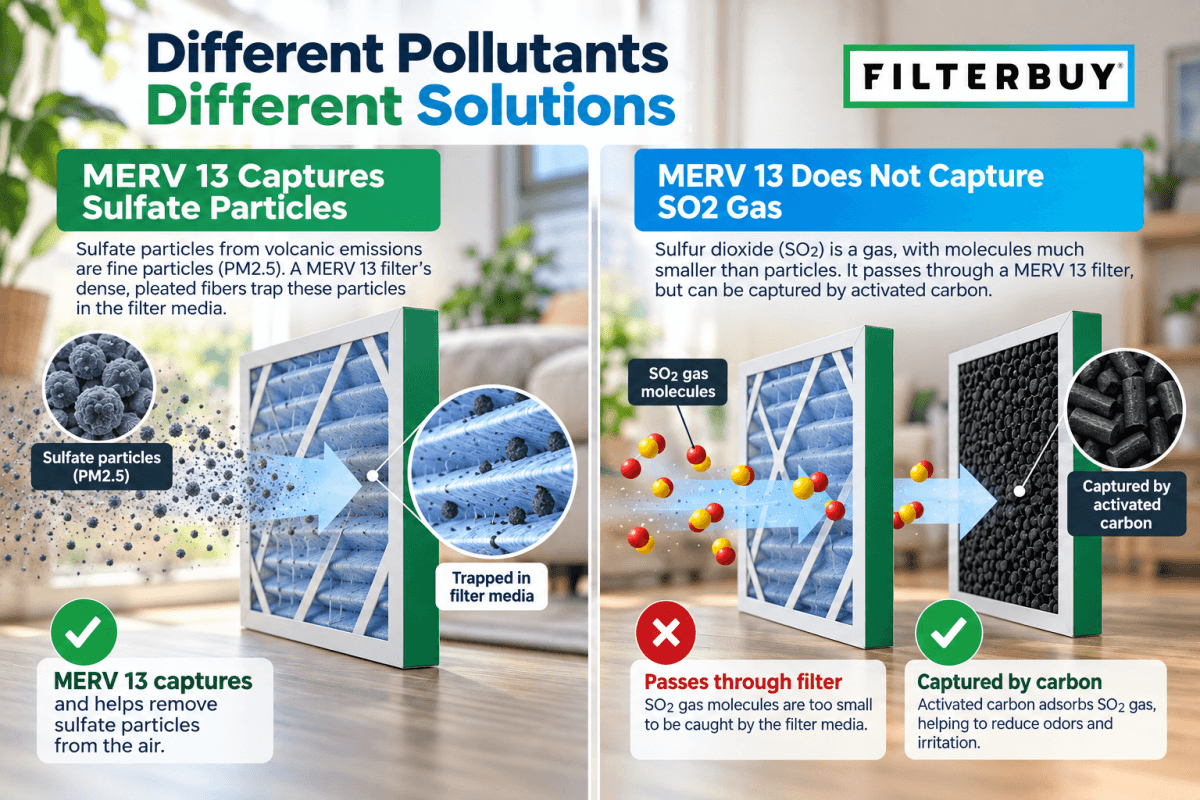
Source: Hawaii Interagency Vog Information Dashboard (IVHHN) air purifier guidance. A HEPA air purifier in each room is Filterbuy's recommendation. No particle filter removes SO2 gas.
Why MERV 13 is the right tier. MERV 13 is the tier Filterbuy recommends for vog's fine particles, rated under ASHRAE Standard 52.2. For fine particles, the EPA air cleaner guide recommends a filter rated MERV 13 or higher and notes that most furnaces and HVAC systems can use one without equipment problems when it's replaced often. Just confirm your size (see our MERV rating chart).
What about carbon filters? Filterbuy makes one, the Odor Eliminator, designed for household odors. We don't rate it for sulfur dioxide, and we'd rather say so than oversell it. Carbon only removes gases well in large amounts, so near the vents, a HEPA air purifier with a deep carbon bed is the better choice.
Choosing a HEPA air purifier. The EPA air cleaner guide points to three checks:
Size it by smoke CADR. Choose a smoke CADR of at least two-thirds of the room's square footage, so a 300-square-foot bedroom needs about 200.
Judge the carbon by weight. Gas filters have no standard rating, so a heavier carbon bed is the safer bet.
Skip ozone makers. The EPA advises against purifiers that produce ozone, which can include some ionizers.
Your Vog-Day Home Checklist
Start with official guidance. Check AirNow Hawaii air quality guidance and the Hawaii Department of Health air quality data, and follow Hawaiʻi County Civil Defense if it tells you to stay in or leave an area.
Filterbuy's action line is an AQI above 100. Once your local reading tops 100, or SO2 rises near the vents, take these four steps in order:
If you have an HVAC system, switch to a MERV 13 filter. The EPA recommends MERV 13 or higher for fine particles, and it's your whole-home layer.
Set the thermostat fan to On. Auto only filters while the system heats or cools.
Run a HEPA air purifier in each room, starting with bedrooms. Without central HVAC, these purifiers are your main defense.
Close up the house. Shut windows and doors, and skip candles, incense, frying, smoking, and vacuuming without a sealed unit.
Check your filter during vog episodes and replace it when it looks dark brown or black, which can be well before its normal change interval. Keep spares on hand. Watch kūpuna and keiki for overheating. The Department of Health doesn't recommend masks for the public at typical vog levels.
Supporting Statistics
1. 1,957 Hawaiʻi Island Schoolchildren Studied
Researchers, including USGS scientists, followed 4th and 5th graders at 25 schools.
Acidic vog was linked to more coughing, not new asthma diagnoses.
Takeaway: Vog irritates young airways even far from the vents.
Source: USGS summary of the Environment International study (2016)
2. 9.1% of Hawaii Adults Have Asthma
Adults statewide: 9.1%.
Native Hawaiian adults: 15.6% (2022 data).
Takeaway: About one in eleven Hawaii adults is in vog's most sensitive group.
Source: Hawaii State Department of Health Asthma Control Program
3. HVAC Systems Run Less Than 25% of the Time
A filter only cleans air while the system runs.
Takeaway: On heavy vog days, switch the fan to "on."
Source: EPA air cleaner guide
Frequently Asked Questions
Can A Filterbuy Filter Remove Vog?
It helps with the particle half. A Filterbuy MERV 13 filter reduces vog's sulfate PM2.5 in the air your system moves, but SO2 gas needs a purifier with a deep carbon bed.
Is It Safe To Visit Hawaii During Vog?
Generally, yes. USGS advises pregnant travelers and those with heart or lung conditions to check with a doctor first.
Should I Close My Car Vents In Vog?
Near Hawaiʻi Volcanoes National Park's dense plume, yes. The USGS Hawaiian Volcano Observatory advises closing windows and vents and turning off the fan and AC.
Be Ready Before the Next Vog Day
We've noticed island households change filters less often than mainland customers, so filters are often overdue when trades stall. Keep a fresh MERV 13 filter in place. Filterbuy makes 600+ sizes in the USA, and auto-delivery keeps a spare on the shelf.
Glossary
Vog: Volcanic smog, made of SO2 gas and sulfate particles.
Sulfur dioxide (SO2): A colorless volcanic gas that can trigger asthma symptoms.
Sulfate aerosol: Sulfuric acid and sulfate particles formed from SO2.
PM2.5: Particles 2.5 microns or smaller that reach deep into the lungs.
Kīlauea: Hawaiʻi Island's active volcano, the source of vog.
VMAP: The University of Hawaiʻi vog forecast model.
MERV: Minimum Efficiency Reporting Value, a 1–16 filter rating.
CADR: Clean air delivery rate, how fast a purifier removes particles.
HEPA: A filter standard for portable air purifiers, not HVAC systems, capturing at least 99.97% of 0.3-micron particles.
AQI: Air Quality Index, a 0–500 pollution scale.
ASHRAE: The engineering society behind the MERV test standard.
Activated carbon: A porous sorbent that traps gases, including SO2, and odors.