
How the Urban Heat Island Effect Worsens City Air Quality
August 14, 2026
By Michelle Wan | Reviewed by David Clark, Licensed HVAC Technician | Published: August 14, 2026
Urban heat islands worsen air quality mainly by speeding up ground-level ozone formation, because the reaction that creates ozone runs faster in hot, sunny air. Hotter blocks also push cooling demand higher, and the calm, stagnant weather that intensifies a heat island is the same weather that keeps pollution from dispersing.
The EPA puts U.S. cities at roughly 1–7°F hotter than outlying areas by day and 2–5°F hotter at night. A 2025 analysis of 776 U.S. monitoring stations found 90.5% show a significant positive link between temperature and ozone.
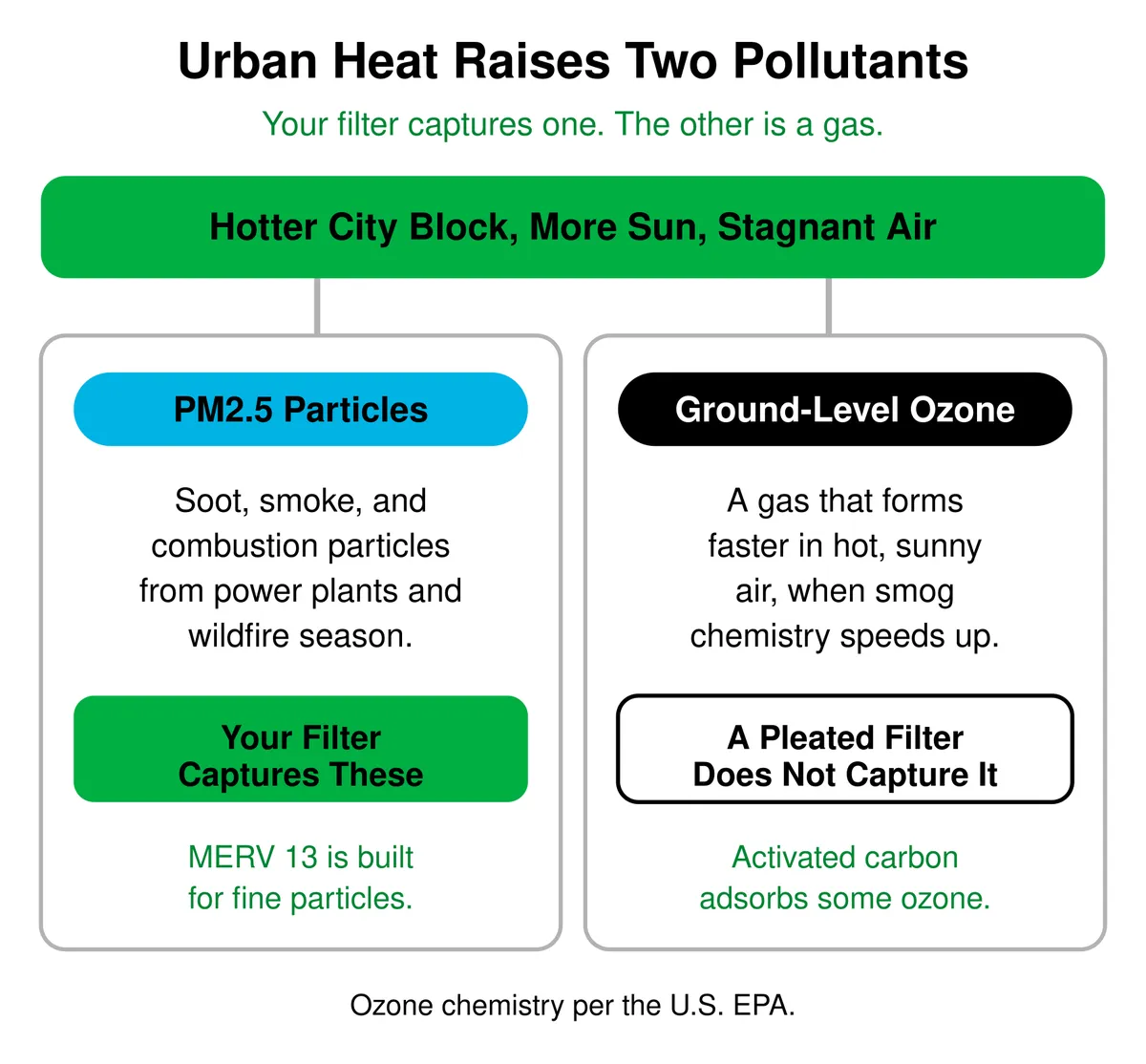
Here is what a residential HVAC filter can and cannot capture on a heat island day:
PM2.5 and combustion particles: captured by a pleated filter, and MERV 13 is built for microscopic particles
Pollen, dust, and dust mites: MERV 8 handles larger debris, and MERV 11 captures finer particles like pet dander and mold spores
Ground-level ozone: a gas, so a standard pleated filter has no mechanism to capture it
VOCs and odors: activated carbon media adsorbs gases and odors
Answer a few quick questions and we will match you to the right filter for your home.
Already know your size? Shop pleated filters in 600+ standard and custom sizes, shipped factory-direct.
TL;DR
The urban heat island effect is the tendency of cities to run hotter than surrounding rural land, because dark pavement, dense buildings, and missing tree canopy absorb and re-radiate solar heat. That extra heat worsens air quality directly: ground-level ozone forms faster in hot, sunny conditions, and cooling demand rises, pushing power plants to emit more. The hottest blocks in a city are usually its smoggiest, and they tend to be the low-income neighborhoods with the fewest trees.
Key Takeaways
U.S. cities run about 1–7°F hotter than outlying areas by day and 2–5°F hotter at night, and conventional roofing can reach 66°F above the surrounding air temperature, per the U.S. Environmental Protection Agency.
90.5% of U.S. ozone monitoring stations show a significant positive ozone–temperature correlation, the relationship scientists call the "climate penalty."
In the Los Angeles basin, the area most affected by urban heat overlaps more than 80% with the area most affected by ozone, per the California EPA.
Low-income city blocks average 15.2% less tree cover and run 2.7°F hotter than high-income blocks, according to a Nature Conservancy survey of the 100 largest U.S. urbanized areas.
Standard pleated HVAC filters capture fine particles but do not remove ozone. Ozone is a gas; only activated carbon or chemical media adsorbs it.
What Is The Urban Heat Island Effect?
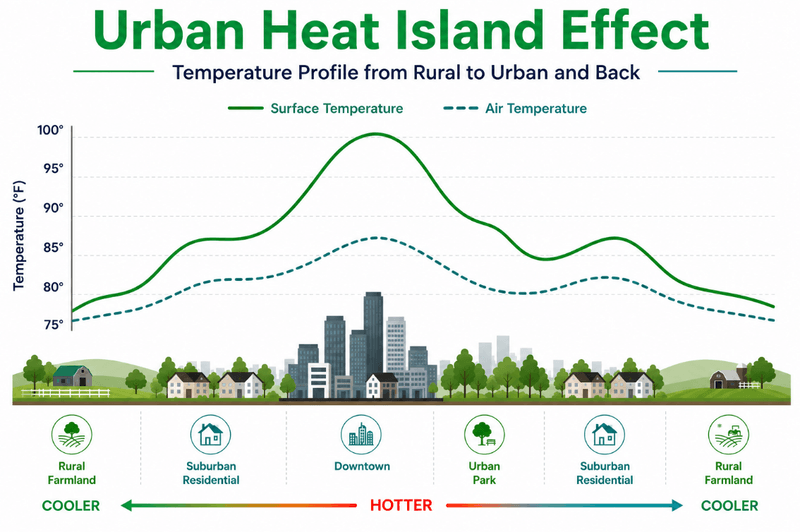
The urban heat island effect is a measurable temperature difference between a developed area and the less-developed land around it. Asphalt, brick, and dark roofing absorb solar radiation all day and release it slowly at night, while the trees and soil that would normally cool the ground have been paved over. Waste heat from vehicles, buildings, and air conditioners adds to the load.
Reviewing the research, the EPA puts the gap in U.S. cities at roughly 1 to 7°F during the day and 2 to 5°F at night. Surfaces run far hotter than the air above them, with conventional roofing reaching as much as 66°F above surrounding air temperature. Humid regions and larger, denser cities show the widest gaps of all.
Nighttime is where heat islands do their quietest damage. Rural land sheds heat after dark; a city block does not. That prolonged warmth keeps the pollution chemistry running and keeps residents from recovering, which is why stagnant heat sits alongside wildfire smoke as one of the main reasons air quality turns bad on a given day.
How Does The Urban Heat Island Effect Worsen Air Quality?
Urban heat degrades air quality through three linked mechanisms. It speeds up the reaction that produces ground-level ozone. It drives up electricity demand for cooling, and with it, power plant emissions. And the calm, stagnant conditions that make heat islands most intense are the same ones that keep pollution from dispersing.
The EPA states the chemistry plainly: ground-level ozone forms when nitrogen oxides meet volatile organic compounds in sunlight and hot weather. Hold every other variable steady, and more ozone forms as the air gets sunnier and hotter. The agency also notes that calm, clear weather produces more severe heat islands, while strong winds and cloud cover suppress them. So the worst heat island days and the worst stagnation days tend to be the same days.
The energy loop is measurable too. The EPA puts the increase in electricity demand for air conditioning at 1–9% for each 2°F rise in temperature, with the high end in countries like the U.S. where most buildings are air-conditioned. That demand is met largely by fossil-fuel generation, which emits more of the nitrogen oxides that feed ozone formation in the first place.
Why Ozone Is The Pollutant Most Affected By Urban Heat
Ozone responds to temperature more directly than any other common pollutant, because heat feeds the reaction itself rather than simply moving the result around. Researchers quantify that relationship as the climate penalty factor: the extra ozone produced per degree of warming.
A 2025 analysis in npj Clean Air examined 776 U.S. monitoring stations from 2015 to 2022 and found 90.5% showed a statistically significant positive correlation between temperature and ozone, with the climate penalty factor reaching 2.1 µg/m³ per °C in the most sensitive regions, chiefly California and the northeastern urban corridor. The same paper cites California fieldwork in which ozone rose 2–8 ppb for every 1°C increase within the 22–39°C range.
The geographic overlap is the part homeowners feel. The California EPA reports that in the Los Angeles basin, the area most impacted by urban heat islands overlaps more than 80 percent with the area most affected by ozone pollution. The hottest blocks and the smoggiest blocks are largely the same blocks.
I live in the San Francisco Bay Area, where the built environment adds roughly 9°F to the average resident. The thing that reframed this topic for me was realizing heat and smog are not two problems that happen to land on the same afternoon. They are one problem. The block that holds the heat is the block that cooks the ozone. That is why the filter question and the shade question sit closer together than they look.
— Michelle Wan, Brand Manager and Air Quality Writer, Filterbuy
This matters more each year. The American Lung Association’s “State of the Air” 2026 report found 129.1 million people exposed to ozone levels that put their health at risk, the highest number in six years. The Association attributes part of the backslide to higher temperatures, dry sunny skies, and more frequent air stagnation events.
What That Extra Ozone Does To People
Ozone is a powerful oxidant that irritates the airways, and the EPA describes the resulting inflammation as comparable to a sunburn on the skin. Depending on exposure, it can cause coughing and a sore throat, make it painful to breathe deeply, trigger wheezing and shortness of breath as airway muscles constrict, and aggravate asthma. Long-term exposure is linked to asthma development, not just asthma attacks.
The people most at risk, per EPA guidance on ozone health effects, are people with asthma, children, older adults, and anyone active outdoors, especially outdoor workers. Children carry the greatest risk because their lungs are still developing, they are more likely to be outside when ozone peaks, and they are more likely than adults to have asthma in the first place. That combination is worth sitting with, because the peak ozone hours on a hot day are also the hours kids are most likely to be outside playing.
Does The Heat Island Effect Increase PM2.5 Too?
Yes, though less directly. Heat does not create fine particulate matter (PM2.5) the way it creates ozone. It raises PM2.5 through side doors instead: more power generation, stagnation that lets particles pile up, and an overlap with wildfire season. The effect is real but smaller and less consistent than the ozone response, which is why ozone dominates the summer air quality picture in most cities.
For homeowners, the practical distinction matters: PM2.5 is a particle your HVAC filter can capture. Ozone is a gas it cannot.
Which Neighborhoods Get Hit Hardest?
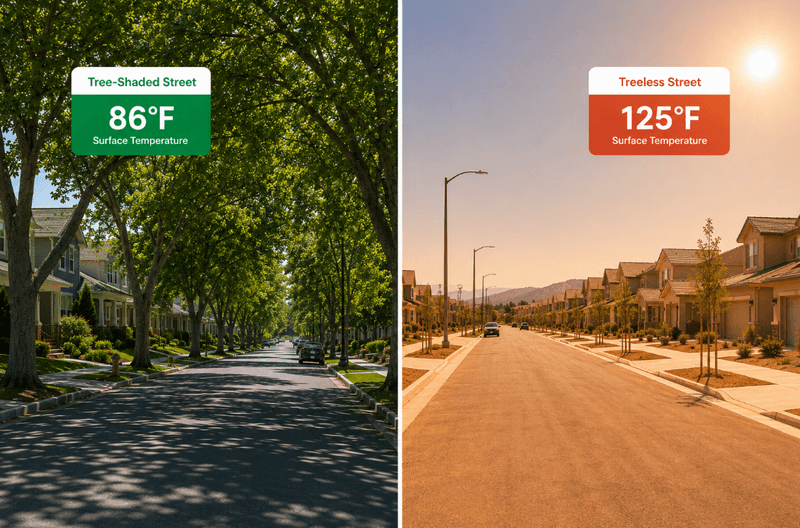
Heat islands are not evenly distributed within a city, and neither is the pollution that follows them. The strongest predictor of a hot block is missing tree canopy, and tree canopy tracks income and, historically, housing policy. In our experience, this is the part that gets flattened most often into “cities are hotter,” when the variation that actually matters happens between neighborhoods a few miles apart.
A Nature Conservancy study in PLOS ONE surveyed the 100 largest U.S. urbanized areas and found that in 92% of them, low-income blocks have less tree cover than high-income blocks, averaging 15.2% less canopy and running 1.5°C hotter. In the Northeast, the gap widens to 30% less cover and 4.0°C hotter.
The historical layer is documented as well. Grades of Heat, a Columbia University project published alongside Climate Central’s heat report, found that historically redlined Grade D areas experience hotter summers than Grade A areas in 150 of 179 major U.S. cities, averaging 6.5°F hotter across those cities.
There is one honest complication here that almost nothing written about urban canopy mentions. Trees emit biogenic volatile organic compounds, and VOCs are one of the two ingredients ozone needs. Those emissions roughly double during high-temperature periods, according to the npj Clean Air analysis cited above. The net effect of canopy is still clearly positive. Shade and direct pollutant uptake outweigh the VOC load, which is why the Park Service reports a net reduction in urban ozone formation. But it is the reason species selection matters to city foresters, and the reason “plant anything” is weaker advice than “plant the right thing for your region.”
Urban Heat Island Intensity In Major U.S. Cities
Climate Central’s Urban Heat Hot Spots in 65 Cities calculated a per-capita urban heat island (UHI) index for each city: the extra heat the average resident feels because of the built environment.
You can pull up current conditions for three of those cities on our live map: New York City, Chicago, and Phoenix.
Source: Climate Central, Urban Heat Hot Spots in 65 Cities. Across those cities, nearly 34 million people – 68% of the 50 million analyzed – live in block groups with a UHI index of 8°F or higher.
How To Tell Whether Your Own Block Is A Heat Island
Climate Central ranks three factors by how much they drive the UHI index: albedo (how much sunlight a surface reflects), percentage of green space, and population density. Those are modeling inputs rather than anything a homeowner can measure directly, so Filterbuy translates them into three things you can check from your own driveway in about five minutes.
Look up at your roof, then down at your street. Dark shingles and fresh asphalt absorb; light, aged, or reflective surfaces give heat back. Albedo carries the most weight in the index, and it is also the factor most under your control.
Count the shade at 3 p.m., not at noon. Green space ranks second, but only canopy that actually falls across pavement and walls during peak heat is doing the work. A tree that shades your roof at midday and nothing at all by mid-afternoon is scoring worse than it looks.
Look one block out, not just at your lot. Surface parking, low-rise commercial roofing, and wide unshaded roads are the combination that turns a block into a hot spot regardless of what you have planted.
For the actual modeled number where you live, Climate Central publishes a census block group heat map covering 37,094 block groups across the 65 cities studied.
What The Heat Island Effect Means For The Air Inside Your Home
Your indoor air on a heat island day is a blend of two things: what your HVAC system recirculates, and what leaks in through the building envelope. The table below is the honest breakdown of what residential filtration can and cannot do about each.
Filterbuy is a U.S. air filter manufacturer, building pleated HVAC filters in more than 600 standard and custom sizes and shipping them factory-direct. That table is blunt for a reason. The question we field most on hot, hazy days is whether a better filter will fix the smog, and after more than a decade of manufacturing and better than two million households served, our answer has not changed: not by itself. A pleated filter is built for particles, and ozone is a gas. Selling past that distinction would be the easy thing to do and the wrong thing to do.
In practice, that means MERV 13 filters on high-PM2.5 days, MERV 11 filters as the everyday choice for allergy and pet households, and MERV 8 filters where an older system needs the lowest airflow resistance. Confirm your system can handle the jump before moving up a tier.
That ozone row is where most air quality advice gets sloppy. Ozone is a reactive gas, and a pleated particle filter simply has no mechanism for removing it. Activated carbon does, and the numbers are decent: a Lawrence Berkeley National Laboratory pilot study in a Sacramento office building found MERV 8 filters containing 300 grams of activated carbon per 0.09 m² of face area removed 60% to 70% of ozone at 67 and 81 days after installation, while reference filters without carbon showed negligible removal. Residential carbon filters carry far less carbon than that commercial configuration, so treat the Filterbuy Odor Eliminator activated carbon filters as real help with odors and VOCs, not as an ozone scrubber.
There is also a maintenance consequence specific to heat islands. Because cooling demand climbs 1–9% for every 2°F, a stretch of 95°F days means your air conditioner cycles far more often and pushes far more air across the filter. Loading tracks runtime, not the calendar, so a filter that would comfortably last through April can look spent weeks early in August. Check it by eye during a heat wave rather than waiting for the reminder, and consider Auto Delivery so a clean one is already on the shelf.
On a run of 95-degree days, I pull filters that look like they have been in for six months. The homeowner tells me it has been eight weeks, and they are right. The filter is not counting weeks. It is counting the air that has moved through it, and in a heat wave your system moves a great deal more of it.
— David Clark, Licensed HVAC Technician and CEO of Filterbuy HVAC Solutions, Technical Reviewer for This Page
The Filterbuy Heat Island Day Plan
These five steps are ordered by what the Filterbuy customer service team hears people get wrong, rather than by what is easiest to write. Step one accounts for most of it: people check the AQI in the afternoon, after ozone has already peaked, then decide the map must be broken.
Check your local AQI in the morning, before the heat builds. Ozone peaks in mid-to-late afternoon, so morning is your window for ventilation and exercise.
On high-ozone days, keep windows closed and run on recirculate. You trade fresh air for lower ozone infiltration. That is a reasonable trade on an Orange or Red day, and non-negotiable if readings reach the Hazardous AQI range.
Check the filter before a heat wave, not after. A loaded filter restricts airflow exactly when your system is working hardest.
Run the fan, not just cooling. Circulating air between cooling cycles increases how many times your indoor air passes the filter.
Add shade where you can. Tree canopy is the most effective heat island intervention at the household scale.
Supporting statistics
Three figures from independent sources, each backing a different part of the argument above.
1. Most exposure happens indoors
The stat: Americans spend about 90% of their time indoors. Indoor levels of some pollutants run 2 to 5 times higher than outdoors.
Source: EPA’s Report on the Environment, updated May 2026.
2. Ozone is most of what urban trees remove
The stat: A majority of the pollution removed by National Capital Area urban forests is ozone. Three parks alone account for more than $2.7 million a year in removal value.
Source: Air Pollution Removal by Urban Forests, U.S. National Park Service i-Tree analysis of 11 parks.
3. The burden is not shared evenly
The stat: 78.4 million people of color live in counties with a failing air quality grade. 21.0 million live in counties failing all three measures. Nearly 18 million people in poverty live in counties failing at least one.
Source: Populations at Risk, American Lung Association “State of the Air” 2026.
Figures are stated as published, with no rounding or reframing. All three were confirmed against the source pages on August 12, 2026.
Frequently Asked Questions
Does the urban heat island effect cause air pollution?
Not on its own. It speeds up ozone formation from precursor emissions already present, and raises the power generation needed for cooling. The EPA lists increased air pollution as a primary documented impact of heat islands.
How much hotter are cities than surrounding areas?
The EPA reports daytime urban temperatures about 1–7°F higher than outlying areas, and nighttime about 2–5°F higher. Neighborhood gaps run larger: Climate Central’s per-capita UHI index spans 7.4°F in Phoenix to 9.7°F in New York City.
Why is ozone worse on hot days?
Ozone forms through a photochemical reaction between nitrogen oxides and volatile organic compounds that runs faster in heat and sunlight. In the most temperature-sensitive U.S. regions, published estimates put the climate penalty at roughly 2.1 µg/m³ of ozone per °C.
Do air filters remove ozone from indoor air?
Standard pleated HVAC filters do not, because ozone is a gas rather than a particle. Activated-carbon filters adsorb some ozone, though residential versions hold far less carbon than the commercial systems tested in laboratory studies.
What reduces the urban heat island effect?
Tree planting, cool roofs, reflective or permeable pavement, and green infrastructure. Tree canopy delivers the most combined benefit: shade, evaporative cooling, and pollutant uptake at once.
Ready to check your own air?
See what ozone and PM2.5 look like where you live, then match the filter to what you find. Every Filterbuy filter is made in the USA, stocked in 600+ sizes, and shipped factory-direct.
Check the Live Canada Air Quality Index MapGlossary
Filterbuy: A U.S. air filter manufacturer headquartered in Talladega, Alabama, producing pleated HVAC filters in MERV 8, 11, and 13 plus activated carbon Odor Eliminator filters, in 600+ standard and custom sizes, sold factory-direct.
Urban heat island (UHI) effect: The temperature difference between a developed urban area and the less-developed land around it, driven by heat-absorbing surfaces, lost vegetation, and waste heat.
UHI index: Climate Central’s per-location estimate of how much extra heat the built environment adds versus surrounding undeveloped land.
Ground-level ozone (O₃): A reactive gas and the main component of smog, formed when nitrogen oxides and volatile organic compounds react in sunlight and heat. Not the protective stratospheric ozone layer.
Climate penalty factor: The extra ground-level ozone produced per degree of warming; typically 1–3 ppb per °C in U.S. regions.
PM2.5: Fine particulate matter 2.5 micrometers or smaller, small enough to reach deep lung tissue.
NOx and VOCs: Nitrogen oxides and volatile organic compounds, the two precursor pollutants that react to form ozone.
MERV: Minimum Efficiency Reporting Value, the ASHRAE 52.2 scale rating a filter’s particle capture efficiency from 1 to 16.
Activated carbon: Porous carbon media used in air filters to adsorb gases and odors, including VOCs and some ozone.
Redlining: The 1930s Home Owners’ Loan Corporation practice of grading neighborhoods for mortgage risk along racial lines; its Grade D areas remain hotter and less tree-covered today.