
Toronto, ON Live Wildfire Smoke Map
Get Alerts For Wildfires In Your Area
The moment a wildfire starts near you, you'll get an instant alert and simple tips to reduce your smoke exposure.
What's In The Smoke
30xSmaller than a human hair
Fine enough to reach deep into the lungs. A MERV 13 is built to capture it.
How Far It Travels


It Doesn't Stay Local
Smoke rides the wind far downwind — you can get smoky air with no fire nearby.
What To Do During A Smoke Event
Simple steps to reduce indoor exposure.
- Stay In, Close UpShut windows and doors to keep smoke out.
- Set Fan To "On"Keeps air cycling through your filter, not just when heating or cooling.
- Recirculate AirSwitch off fresh-air intake so you're not pulling smoke in.
- Run A MERV 13Built to capture the fine PM2.5 in smoke.
- Add A PurifierExtra filtration for the room you use most.
- Wear an N95 if OutsideFits snug to block fine particles — a cloth mask won't.


The Best Air Filter For Wildfire Smoke
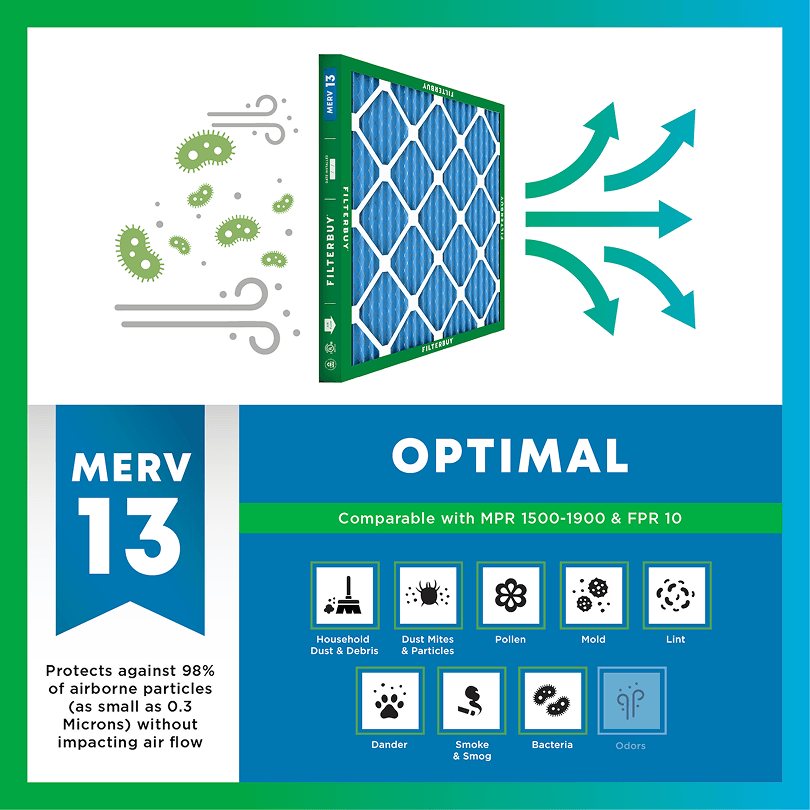
During smoke events, the EPA recommends upgrading to a MERV 13 filter — or the highest-rated filter your system can handle — to help reduce the fine particles smoke brings indoors. MERV 13 is the level most home HVAC systems can run while still capturing PM2.5, the fine particulate that makes up the bulk of wildfire smoke.
- Captures PM2.5 particles
- Blocks ash, soot, and smoke odor
- Keeps your indoor air safe—even when the outdoor air is dangerous
- Meets the EPA's recommended rating for filtering fine wildfire smoke particles.

Wildfire Smoke FAQs
Facts About Wildfires
Over 70,000 wildfires burn in the U.S. every year.
Wildfire smoke can travel 1,000+ miles, affecting states that aren't even near the blaze.
Exposure to wildfire smoke can worsen asthma, trigger heart issues, and lead to ER visits.
Indoor air can hold more fine particles during wildfire events unless it's properly filtered.
The EPA advises using MERV 13 filters or portable HEPA air cleaners during wildfire smoke events.
Don't Wait Until The Smoke's Inside.
Use the live wildfire smoke tracker and upgrade your air filters today to protect your lungs and your home.
Shop Filters For Smoke Protection
Live Toronto, ON Forest Wildfire & Smoke Map Today: Local Air Quality Tracking & Indoor Protection Solutions
TL;DR
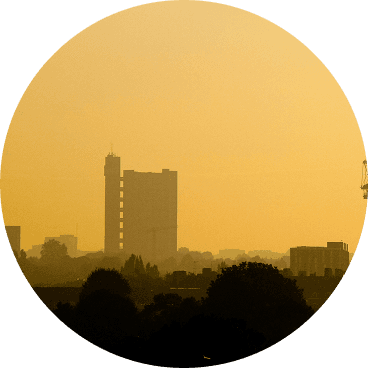
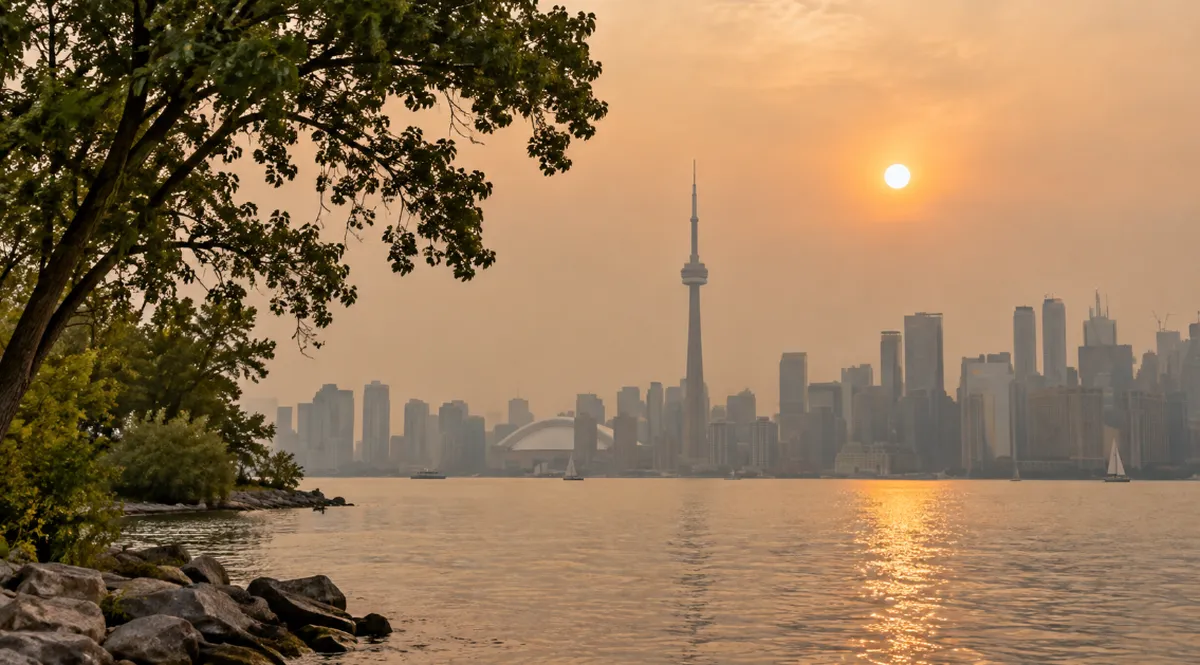
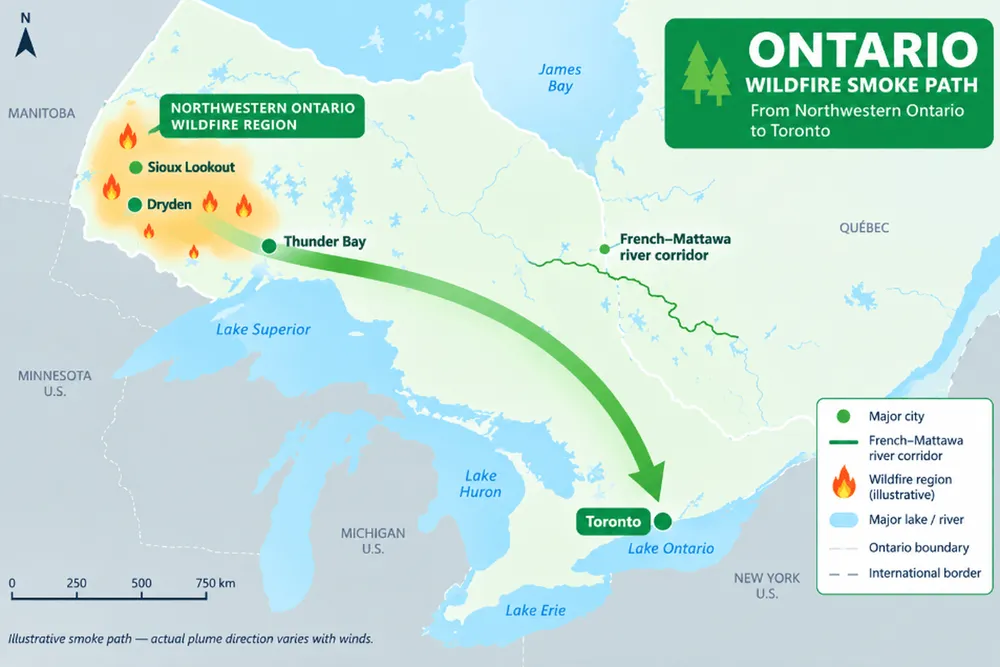
No forest fires burn within Toronto itself. The haze that settles over the city has travelled from wildfires in northwestern Ontario and Quebec, often more than 1,300 km away, so the sky can turn amber on a clear day with no fire in sight. The maps below show where those fires are and where the smoke is headed. Check the Air Quality Health Index for what you are breathing now, and close the house up when the number climbs.
Key takeaways
Toronto sits outside Ontario's fire region. Smoke over the city is transported, not local fire.
The Air Quality Health Index runs 1 to 10+. Ontario and Environment Canada issue a yellow warning at 7 and an orange warning at 10+.
Different maps answer different questions: where fires burn, where smoke will drift, and what Toronto is breathing now.
MERV 13 is the tier for smoke. Health Canada recommends that rating in a central system, and Toronto Public Health fits the same rating in its own Cleaner Air Spaces.
Smoke loads a filter far faster than dust. Check it during a smoke event and replace it once it looks dark brown or black, which can be well before the usual interval.
The Maps That Answer a Toronto Smoke Question
No single map answers the question on its own. A fire map shows you flames hundreds of kilometres away, a forecast shows where the plume is heading, and only the AQHI tells you what is actually on your street. Read them in that order and the whole picture takes about a minute to assemble.
Each source refreshes on its own schedule. Check the timestamp shown on the map before acting on it.
Why You Will Not Find a Forest Fire Burning in Toronto
Toronto has no active wildland fires, and it sits outside Ontario's fire region altogether, the northern zone whose legislated fire season runs from 1 April to 31 October. Most smoke pages skip that second part. The dividing line is the French and Mattawa rivers. North of them, wildland fires are reported to 310-FIRE and managed by Aviation, Forest Fire and Emergency Services. South of them, including every part of Toronto, they fall to municipal fire services and a 911 call. So a search for a forest fire in Toronto is nearly always a smoke question. The city's haze is imported, carried down from the boreal forest.
That changes what you should be watching. There is no evacuation route to plan and no perimeter to track. What counts is how much fine particulate reaches ground level, and how well your home keeps it out. Smoke can also ride high and colour the sky without doing much to the air you breathe, so a dramatic sunset and a low AQHI often turn up on the same afternoon.
What Toronto’s July 2026 Smoke Event Demonstrated
In mid-July 2026, six weeks before that calm September reading, fires in northwestern Ontario pushed Toronto's AQHI to 10+, the very high risk band, and the city briefly ranked among the worst in the world for air quality. It stayed under an orange warning for three days while City staff closed outdoor pools.
What stood out was the speed. Conditions moved from very unhealthy to good over a single morning, then slid back by evening. A check at breakfast tells you little about the afternoon.
Reading the AQHI and Knowing When to Act
Canada uses the Air Quality Health Index, not the American AQI. It runs 1 to 10+, grouped into low, moderate, high and very high risk. Ontario and Environment Canada issue a yellow warning when the AQHI is forecast to reach 7, and an orange warning at 10+, as Toronto Public Health explains in its Wildfire Smoke Response Strategy. The ladder below pairs each band with the indoor action Filterbuy's HVAC technicians recommend.
The Air Quality Health Index is published hourly by Environment and Climate Change Canada. Wildfire smoke can be harmful even at low concentrations.
There is a limit to how much weight one reading carries. Environment Canada states its real-time AQHI data is not quality-controlled, so treat an hourly figure as an indication rather than a measurement. If it disagrees with what you can see and smell, check the smoke forecast.
How to Keep Smoke Out of a Toronto Home
Health Canada's guidance for cleaner air spaces during wildfire smoke events recommends a filter rated MERV 13 or higher in a central system during smoke events, and recirculating indoor air for as long as outdoor conditions stay poor. Acting at an AQHI of 7, and running a portable cleaner in each occupied room rather than only one, is our own recommendation and goes further than the official guidance does. Four steps, in this order:
Put a MERV 13 in the HVAC. The central system moves far more air than any portable unit, so this is the whole-home layer.
Set the thermostat fan to On. On Auto it only filters while the system is heating or cooling; on On it filters continuously.
Add a portable HEPA air cleaner in each occupied room, bedrooms first. It treats that room harder than the central system can, and the two layers do different jobs.
Close the house up. Windows and doors shut, the system set to recirculate, and no new indoor smoke while you are sealed in: no candles, no frying, no vacuuming unless the vacuum is sealed.
"The mistake I see most often on a service call is not the wrong MERV rating. It is a filter that does not seal. Air takes the easiest path it can find, and one sitting loose in an oversized slot lets smoke stream around the media instead of through it. Check that yours sits square before you upgrade. That fix often does more than a rating jump."
David Clark, Licensed HVAC Technician
None of this is a fringe position. Toronto Public Health's Cleaner Air Spaces Network, launched in 2024, fits MERV 13 filtration in civic centres across Scarborough, North York, East York and York, along with Metro Hall and City Hall. The city landed on the same rating the federal guidance points to.
Check the fit the way you would check a size. Most furnaces and HVAC systems accommodate a MERV 13 without equipment problems, provided the filter is replaced often, which is the EPA's own finding. If you want the detail, read our guide to how MERV ratings work. Filterbuy's MERV 13 Optimal filters capture 98% of airborne particles while holding airflow. Because we manufacture rather than resell, we stock over 600 sizes, and if yours is not among them we will make it to measure.
Choosing a Filter for Toronto Smoke Season
Smoke maps to one tier on the ladder, and it is not the middle one. If you do not know your size, pull the filter you have, measure it, then start at shop by filter size.
During a smoke event, check the filter and replace it when it looks dirty, dark brown or black, which can be well before the interval on the box. Keep spares on hand.
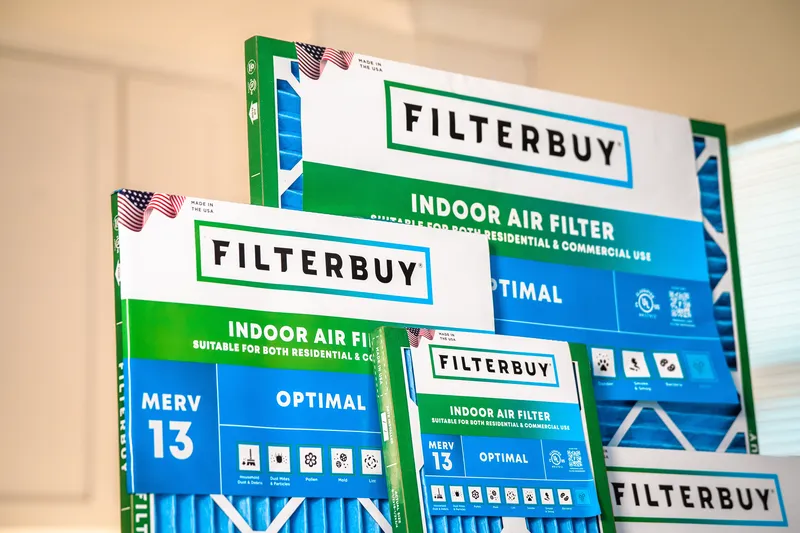
The interval printed on the box assumes household dust, not smoke, and smoke loads a filter far faster. Skip the schedule and use the look test instead: during a smoke event, check the filter and replace it once it looks dirty, dark brown or black. That can come well before the normal interval, so keep spares on hand. Our step-by-step replacement guide covers the swap. A pleated filter captures particles; odour is gas-phase, so it will not take the smell out. That is what Filterbuy's Odour Eliminator line, which uses carbon-infused media, is for. A filter subscription will put replacements on a fire-season schedule you can edit, skip or cancel at any time.
If Your Home Has No Furnace Filter
Furnace filter advice assumes a forced-air system with a filter slot, and plenty of Toronto homes have nothing of the kind. Older apartments run on hydronic baseboards. Many condos use fan coil units with a filter that is small, sealed, or serviced only by building staff. Mini-splits clean the room they serve and nothing beyond it. If that is your place, the furnace advice does not apply, and no filter you can buy will change that, ours included.
Here is what does work, in rough order of effect.
Put a portable HEPA cleaner in each occupied room, bedrooms first. Here it is the main defence rather than a supplement, because there is no whole-home layer to add it to. Size it by smoke CADR, which should be at least two-thirds of the room floor area in square feet: a 300 sq ft (28 m2) bedroom wants a smoke CADR of about 200.
Keep windows and the balcony door shut, and run a fan or air conditioner on recirculate so you can stay cool without pulling outdoor air in.
If your fan coil has an accessible filter, ask the building manager what rating it takes. Many are built around a MERV 8 and cannot take more, so check before you buy anything higher.
Cut indoor sources while sealed in: no candles, no frying, and no vacuuming unless the vacuum has a HEPA filter. Skip ionizers and ozone generators; the EPA advises against any air cleaner that produces ozone.
And when none of that is available, the city has somewhere for you to go. Toronto Public Health runs six Cleaner Air Spaces, free and open to anyone during regular hours, each fitted with the same MERV 13 filtration recommended for homes.
Hours as published by Toronto Public Health. Confirm before travelling, and check for holiday closures.
Supporting Statistics
About 80% of wildfire particle exposure happens indoors. People are inside roughly 90% of the time, and indoor particle levels reach about half the outdoor increase, so most of the exposure is accumulated in the places filtration can reach.
Source: Lawrence Berkeley National Laboratory.
The two layers measured together in one home. Researchers monitoring a Portland home through the September 2020 fires recorded an indoor-to-outdoor PM2.5 ratio of 0.55 with a MERV 13 running in the central system. Adding a portable HEPA cleaner brought the measured ratio to 0.22. Those are one study's readings in one house, not a rating for the filter.
Source: Antonopoulos et al., via the US National Library of Medicine.
Depth and cleanliness decide how much air gets filtered. In EPA chamber tests against simulated wildfire smoke, a 4-inch MERV 13 delivered 123% more clean air than a 1-inch, and cleaners were almost completely ineffective once filters were dirty.
Source: US Environmental Protection Agency.
Frequently Asked Questions
Glossary
AQHI (Air Quality Health Index). Canada's national air quality scale, 1 to 10+, published by Environment and Climate Change Canada. It converts pollutant levels into a health-risk rating.
PM2.5. Fine particulate matter 2.5 micrometres or smaller, the main health concern in wildfire smoke.
Recirculation mode. An HVAC setting that circulates indoor air through the filter instead of drawing in outdoor air, recommended by Health Canada while outdoor air is poor.
Sources
Air Quality Health Index, Toronto. Environment and Climate Change Canada. https://weather.gc.ca/airquality/pages/onaq-001_e.html
BlueSky Canada smoke forecast. UBC Weather Forecast Research Team (FireSmoke.ca). https://firesmoke.ca/forecasts/current/
CWFIS interactive map. Natural Resources Canada. https://cwfis.cfs.nrcan.gc.ca/interactive-map
Forest Fire Information Map. Ontario Ministry of Natural Resources. https://www.lioapplications.lrc.gov.on.ca/ForestFireInformationMap/index.html?viewer=FFIM.FFIM
Forest fires: updates and fire season. Ontario Ministry of Natural Resources. https://www.ontario.ca/page/forest-fires
Guidance for Cleaner Air Spaces during Wildfire Smoke Events. Health Canada. https://www.canada.ca/en/health-canada/services/publications/healthy-living/guidance-cleaner-air-spaces-during-wildfire-smoke-events.html
Wildfire smoke: protecting your physical and mental health. Health Canada. https://www.canada.ca/en/services/health/healthy-living/environment/air-quality/wildfire-smoke/protecting-your-physical-mental-health.html
Wildfire Smoke and the Cleaner Air Spaces Network. Toronto Public Health. https://www.toronto.ca/community-people/health-wellness-care/health-programs-advice/air-quality/wildfire-air-quality-strategy/
FireWork smoke forecast, Ontario. Environment and Climate Change Canada. https://weather.gc.ca/firework/firework_anim_e.html?region=ontario
Air Quality Health Index readings. Air Quality Ontario. https://www.airqualityontario.com/aqhi/
Wildfires and indoor air quality research. Lawrence Berkeley National Laboratory. https://iaqscience.lbl.gov/wildfires
Interventions to reduce PM2.5 during a wildfire event. US National Library of Medicine (PMC). https://pmc.ncbi.nlm.nih.gov/articles/PMC10863606/
Research on air cleaners to reduce wildfire smoke indoors. US Environmental Protection Agency. https://www.epa.gov/air-research/research-diy-air-cleaners-reduce-wildfire-smoke-indoors