Shop by
August 29, 2026
By Michelle Wan | Reviewed by David Clark, Licensed HVAC Technician
Published: August 30, 2026
Shut the system off, replace the filter, then clean the evaporator coil and the blower wheel — in that order. If your system ran while smoke was in the air, ash is sitting on all three, and it gets re-released every time the system cycles. How far you have to go depends on what you saw outside, not on how close the fire came.
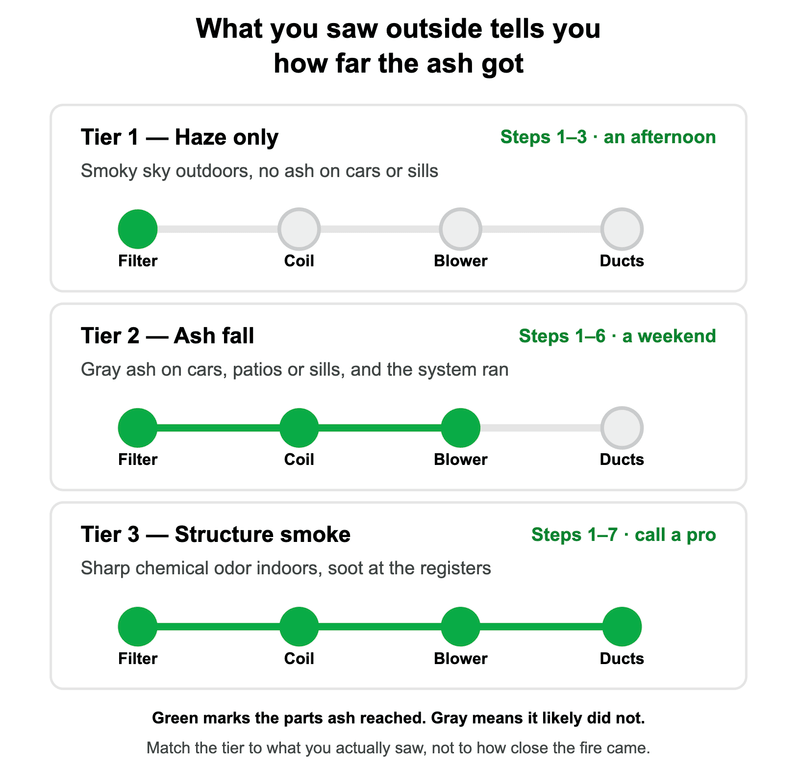
Haze only, no ash outside — Steps 1–3. Filter and registers. An afternoon.
Ash on cars, patios or sills — Steps 1–6. Add the coil, blower and condenser. A weekend or a service call.
Sharp odor indoors or soot at registers — Steps 1–7. The ducts come into it, and a professional assessment is worth booking.
The filter you put back in is the part you control every month. Match yours to your system with the quick quiz below.
Answer a few quick questions and we will match you to the right filter for your system.
Already know your size? Shop Filterbuy filters, factory-direct — 600+ sizes, made in the U.S.A.
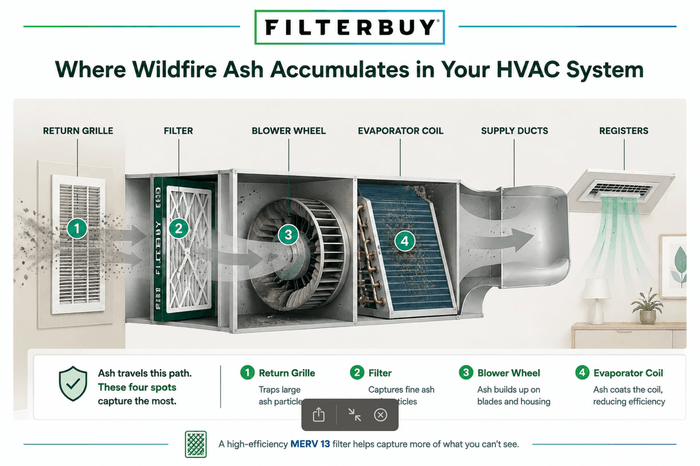
If your HVAC system ran while wildfire smoke was in the air, it pulled ash into the filter, the evaporator coil, and the blower wheel, and it will re-release that residue every time it cycles. The fix is a seven-step cleanup: shut the system down, read and replace the filter, clear the registers, clean the coil, check the blower, rinse the condenser, then decide about the ducts. Steps 1 to 3 take an afternoon. Steps 4 to 6 take a weekend or a service call.
Wildfire ash is not ordinary dust. Ash from burned structures can carry metals and other toxic residues, so the CDC advises against dry sweeping, leaf blowers, and shop vacuums, all of which push fine particles straight back into the air.
The evaporator coil is the most overlooked component. It is wet with condensate whenever the AC runs, so ash sticks to it instead of passing through. That is why a system can smell smoky months after the fire is out, and why Filterbuy HVAC Solutions technicians clean the coil before quoting anything larger.
A shop vacuum makes things worse. Shop and household vacuums do not capture fine particles, they blow them out the exhaust, so reach for a HEPA-filter vacuum instead.
The EPA recommends MERV 13 or higher during smoky periods, noting that a high-efficiency filter with the fan running continuously may cut indoor PM2.5 by roughly 50%.
Duct cleaning is not automatic. The EPA advises cleaning ducts when they show substantial visible deposits, not by default after every smoke event.
Most wildfire HVAC advice comes from one of two parties: a filter seller whose answer stops at "buy a MERV 13," or a restoration contractor whose answer to everything is a full duct cleaning. Filterbuy sits in an odd spot between the two. As a U.S. air filter manufacturer headquartered in Talladega, Alabama, we have built pleated filters here since 2013, and we now make more than 600 sizes across four American factories. That means we know what smoke does to filter media for an unglamorous reason: we get the loaded ones back.
We also see the other end of it. Our field-service arm, Filterbuy HVAC Solutions, sends technicians into homes to clean coils, pull blower wheels, and inspect ductwork, and its own service page lists fire damage among the situations that call for it.
Sitting on both sides changes the advice below in two ways. The first is that we will tell you when not to buy a service, starting with the duct cleaning in Step 7 that most homes simply do not need. The second is that a handful of these instructions come from how the filters are actually built rather than from a general HVAC textbook, and the clearest example is why you must never try to rinse an ash-loaded filter, which Step 2 covers.
Wildfire smoke damages an HVAC system two ways: fine particulate loading and residue deposition. PM2.5, meaning particles 2.5 microns and smaller, slips past most standard filters and settles on internal surfaces. Coarser ash gets pulled through return vents onto the wet evaporator coil and blower wheel, where it hardens into a film that restricts airflow and releases odor for months.
That distinction is what tells you where to spend your weekend. Distant haze is a filter problem. Ash on the patio furniture means the coil and blower are involved too, while an acrid indoor smell after a nearby structure burned points to the whole air path.
Before you touch anything, put on gloves, long sleeves, eye protection, and a close-fitting respirator rated N95 or P100. That last detail matters more than it sounds, because the California Department of Public Health warns that bandanas, surgical masks, and cloth masks do not block fine particles effectively. The ash itself is the reason for the rest of the gear: ash from burned buildings can contain asbestos, arsenic, and lead, according to Los Angeles County Public Health. One more rule worth stating plainly, from the CDC: children should not do any cleanup work at all. Its safety guidelines for after a wildfire cover the rest.
Not every home needs all seven steps. Match what you actually observed to the tier below, then work only the steps listed.
Tier 3 also warrants a professional assessment. Match the tier to what you actually observed, not to how close the fire came.
Cleaning destroys the evidence of the damage you are cleaning, so give it five minutes first. Photograph the loaded filter in place and again after removal, any ash on sills and registers, the inside of the air handler cabinet, and a wide shot of each affected room. Note the date.
Smoke damage is commonly covered even when a home never burned, and a claim is far easier to make with a photograph of a blackened filter than with a description of one you have already thrown out. Keep the receipts for filters, coil cleaner, and any service call as well.
Turn the thermostat off and cut power at the disconnect or breaker. Every minute the blower runs, it drives settled ash deeper into the ducts and back through the house. Shutting down first is what makes everything after it work, because if you clean a coil with the fan running you simply re-coat it.
Leave the system off through Step 5. If you need relief in the meantime, run a portable HEPA air cleaner in one room with the windows closed.
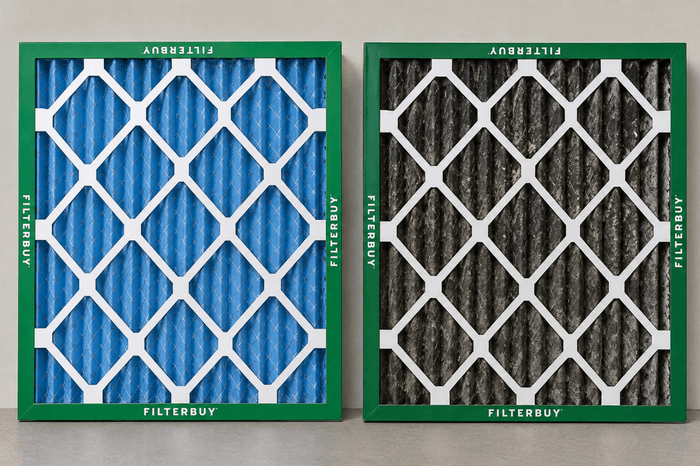
Your used filter is the best diagnostic tool you own, which is a shame, because most homeowners bin the evidence without looking at it. Pull it out, hold it up to a light, and read it against the table below before it goes in the bag.
Read the filter before you bag it. Once it is in the trash, the fastest diagnostic you had is gone.
Bag the old filter before carrying it through the house. Install a fresh MERV 13, the rating the EPA recommends during smoky periods, if your system can take it. Filterbuy builds MERV 13 in more than 600 sizes, including custom, so a nonstandard slot is not a reason to settle for a lower rating. For the full rundown, see our guide to the best MERV filter for wildfire smoke. Whether an older blower can handle the added resistance is covered a few paragraphs down.
One thing homeowners try after a fire that we have to talk them out of: do not rinse or vacuum the loaded filter to reuse it. This one is manufacturing knowledge rather than general advice. We apply an electrostatic charge to the pleated media during production, and water strips that charge straight off, so a washed filter comes out looking clean while having quietly lost much of what made it work. Pleated filters are disposable by design. Bag it and fit a new one.
Seat the new filter square in its slot. The EPA specifically warns to make sure air cannot bypass the filter through gaps around the filter holder. A loose frame lets smoke route straight past the media. Expect to replace filters far more often than usual for a while; the EPA advises checking frequently and swapping when the media looks dark. Our guide to how often to change your HVAC filter covers the normal schedule to return to afterward.
Our team fields this question more than any other, and the honest answer is that one week of running the filter tells you more than any spec sheet. Fit the MERV 13, then watch for four warning signs. Any one of them is your cue to step back to MERV 11.
A new whistle, or a louder rush of air, at the return grille.
Weaker airflow at the supply vent furthest from the air handler.
Cooling cycles stretching longer with no change in the weather.
During cooling season, frost forming on the copper line where it enters the air handler.
Then check again at day 45, not just on day one. Resistance peaks when a filter is loaded, so that is when a marginal system finally shows itself, and after a fire your filter reaches that point far sooner than the calendar suggests. The air filter pressure drop chart has the resistance figures if you want them.
The question we get most is whether MERV 13 will hurt the system. In a modern home, almost never. What actually hurts systems is the filter nobody remembered to change. I would rather you run MERV 11 on a real schedule than MERV 13 for eight months.
Michelle Wan, Brand Manager and Air Quality Writer, Filterbuy
That trade-off matters twice as much after a fire. A MERV 13 loaded solid with ash and left in place is worse than a MERV 11 you actually swap, because a blocked filter starves the blower you are trying to protect.
Work the return vents first, then the supplies, because returns are where ash entered the system. Remove each register cover, then vacuum the grille and the first few inches of duct behind it with a HEPA-filter vacuum. Wipe each cover with a damp cloth and let it dry fully before you reinstall it, since damp metal holds fresh dust.
Two rules matter more than technique. Do not use a shop vacuum. The CDC’s National Institute for Occupational Safety and Health warns that shop and household vacuums fail to filter small particles and blow them out the exhaust. Do not use compressed air or a leaf blower on a vent, for the same reason.
The evaporator coil is the finned aluminum coil inside your indoor air handler, and wildfire ash punishes it most. It is wet with condensate whenever the system cools, so ash sticks instead of passing through. A fouled coil restricts airflow, raises energy use, and holds smoke odor indefinitely.
How to do it:
Confirm power is off. Open the air handler access panel.
Vacuum loose debris off the coil face with a HEPA vacuum and soft brush, brushing with the fins, never across them.
Apply a no-rinse foaming evaporator coil cleaner made for HVAC use. No household cleaners, degreasers, or bleach.
Let it drain to the condensate pan. Flush the drain line and confirm it runs clear.
Reinstall the panel.
Ash turns alkaline once moisture reaches it, so leaving it on a wet aluminum coil risks corrosion, not just odor. Do this early in the season, not at the end of it.
How to know you actually got it clean: point a flashlight into one side of the coil. Light should shine through to the other side. That test comes straight from the EPA consumer checklist for duct and system cleaning, and it is the fastest way to tell a clean coil from one that only looks clean at the face.
Call a technician instead if the coil sits behind a sealed panel, you see standing ash in the cabinet, or reaching it would mean disconnecting refrigerant lines.
The blower wheel is the squirrel-cage fan that moves air through your home, and it collects ash in the cupped vanes where you cannot see it. Shine a flashlight into the blower compartment and look at the vanes: clean ones have crisp edges. Rounded, furred, or packed vanes mean the wheel is loaded.
The EPA’s own post-cleaning checklist sets the standard here: blower blades should be clean and free of oil and debris, and the blower compartment free of visible dust. A loaded wheel loses a meaningful share of its airflow, which shows up as weak vents, longer run times, and higher bills.
Light dust responds to careful HEPA vacuuming in place, but caked residue does not, and clearing that properly means pulling the wheel, washing it, and rebalancing it. Filterbuy HVAC Solutions covers coil, blower, and duct work under HVAC restoration, and lists fire damage as one of the situations that calls for it.
The blower you just inspected is shared by your furnace and your air conditioner, but the combustion side of a gas furnace is not something to tackle yourself. Ash and soot drawn in through the return can settle on the burners, the flame sensor, and the heat exchanger surfaces, and a fouled burner assembly becomes a combustion problem rather than an airflow one.
The EPA is unambiguous here: if you have a fuel-burning furnace, stove, or fireplace, have it inspected for proper functioning and serviced before each heating season to protect against carbon monoxide poisoning. After a smoke event that recommendation carries more weight rather than less, so book the inspection before the first cold night instead of after it.
Two things you should do yourself in the meantime: test every carbon monoxide alarm in the house and replace any that is past its expiry date, and resist the urge to run the heat "just to see if the smell burns off." It does not burn off. It circulates.
The condenser coil is the finned coil wrapping your outdoor unit, and ash mats into it from the outside in. Cut power at the disconnect, clear debris from around the unit, then rinse from the inside out with a garden hose at normal pressure, pushing ash back the way it came.
Never reach for a pressure washer. Condenser fins are thin aluminum that bends easily, and once bent they permanently reduce heat transfer, though a fin comb will straighten fins that are already flattened. The EPA checklist puts it plainly: coil fins should be straight and evenly spaced, not bent over and smashed together.
This is where homeowners get oversold. The EPA guidance on whether to have your air ducts cleaned is direct: clean ducts when they are visibly contaminated with substantial deposits of dust or debris, substantial mold, or vermin. If a visual inspection turns up none of that, cleaning is probably unnecessary. Routine duct cleaning is not something the EPA recommends at all.
Our own guide to how often you should get air duct cleaning reaches the same conclusion from the service side, which is worth saying out loud given who is writing it.
Apply that honestly. Pull two or three register covers, shine a light in, and look.
A disclosure, since it should affect how you weigh this: we sell filters, and our sister company sells duct cleaning. We have every commercial reason to tell you to book one. We are telling most of you not to.
No visible deposits, odor gone after Steps 1–6 → skip duct cleaning. Keep filtering.
Visible soot inside the duct, or odor that persists after the coil and blower are clean → you meet the EPA’s bar. Get quotes from three providers and ask each to show you the contamination they claim exists.
Fiberglass liner or flex duct that absorbed smoke → porous material cannot be cleaned like sheet metal. The EPA, NADCA, and NAIMA all recommend replacing wet or moldy fiberglass duct material rather than cleaning it.
Three things to know before you hire anyone. No duct cleaner is EPA certified. The EPA states plainly that it neither sets duct cleaning standards nor certifies or endorses companies, so treat that claim as a red flag. Get written estimates from at least three providers and ask each to show you the contamination they say exists. And note that while the EPA discourages routine use of duct sealants, it identifies fire damage inside ducts as one of the specific cases where encapsulation may be appropriate, so a sealant recommendation after a fire is not automatically an upsell.
Being straight about the limits is more useful to you than overselling the wins, so here is what seven steps of cleaning will not touch.
Gases and odor compounds. Pleated filters capture particles. They do not capture the volatile organic compounds that carry a smoke smell, which is why a spotless coil can still leave a faint campfire note. That job needs activated carbon. Filterbuy’s Odor Eliminator filters bond a carbon layer to the same pleated media, so one filter handles both particles and odor. The alternative is a portable purifier with a carbon stage running alongside a MERV 13.
Carbon monoxide. No air filter of any rating removes CO. Only working detectors and a serviced combustion appliance protect you from it.
Porous materials. Carpet, upholstery, drywall, insulation, and fiberglass duct liner absorb smoke and re-release it. If the smell survives a clean coil, clean blower, and fresh filter, the residue is in the house, not the HVAC system.
Damage you cannot see. Cleaning is not an inspection. If the fire came close enough to melt, warp, or scorch anything, that is a technician call regardless of how the system smells.
Cost figures are the published references named above, not Filterbuy estimates. The EPA range appears in a long-standing consumer guide, so treat it as directional and get three written quotes.
Restart the system and switch the thermostat fan from "Auto" to "On", so air keeps moving through the filter instead of only during cooling cycles. Check that filter weekly for the first month and keep two spares on hand, because post-fire ash circulates far longer than most people expect.
If odor returns after a clean coil, clean blower, and fresh filter, the residue is in porous materials: duct liner, carpet, or drywall. That is a restoration question, not an HVAC one.
Three findings from U.S. federal research explain why this checklist is worth a weekend, and why the filter you reinstall at the end matters more than the one you pulled out.
CDC analyzed National Syndromic Surveillance Program data covering roughly 6,000 emergency departments and found that asthma-associated ED visits were 17% higher than expected across the 19 wildfire smoke days between April 30 and August 4, 2023. The sharpest regional effect was in New Jersey and New York, where two days in early June produced 364 excess visits. Smoke days were defined as those where PM2.5 pushed the Air Quality Index to 101 or above.
Why it matters here: the health cost of smoke is measurable at the population level, and it lands hardest on people aged 5 to 17 and 18 to 64. A system still shedding ash into the house keeps that exposure going after the outdoor air has cleared. Source: CDC, Morbidity and Mortality Weekly Report, August 2023.
EPA’s 2020 National Emissions Inventory attributed 52% of total U.S. PM2.5 emissions to wildland fires, more than every other source category combined. PM2.5 is the fraction of smoke small enough to bypass a standard filter and settle on the coil and blower surfaces this checklist addresses.
Why it matters here: wildfire smoke is no longer a regional or seasonal footnote in American air quality. It is the majority of the fine particulate load nationally, which is why post-smoke HVAC recovery belongs in ordinary home maintenance rather than in disaster response alone. Source: U.S. EPA, Wildland Fire Research: Reducing Exposures.
EPA guidance for clinicians puts numbers on the filter upgrade. Running the HVAC fan continuously with a high-efficiency filter may decrease indoor PM2.5 concentrations by about 50%. Running the same system continuously with a typical low-efficiency filter reduces particle concentrations by only about 24%, citing research by Fisk and Chan. The fan setting alone is not the lever; the filter grade is roughly half the result.
Why it matters here: this is the evidence behind Step 2. Separately, EPA researchers working with Missoula Public Health measured indoor and outdoor PM2.5 across buildings during a week of heavy western wildfire smoke and found wide variation in how well each building kept smoke out. Their conclusion named the cause directly: HVAC maintenance, including replacing dirty filters, is crucial to preventing unhealthy smoke concentrations indoors. Sources: U.S. EPA, Strategies to Reduce Exposure Indoors and Influence of Building Characteristics on Wildfire Smoke Impacts on Indoor Air Quality (2025).
Every figure above is drawn from a U.S. federal source and links to the original publication in the body copy.
After manufacturing filters in the United States since 2013 and serving more than two million households, we see the same pattern after every smoke event, and it is not the one people expect. The homes that recover fastest are rarely the ones that spent the most. They are the ones that treated the filter as a consumable for a few weeks rather than a quarterly chore, and that got to the coil before the odor had a whole season to settle in.
The expensive mistake runs the other way round. A homeowner books a duct cleaning in week one, skips the coil because nobody thought to mention it, then calls back in month three because the house still smells like a campfire. The residue was never in the ducts at all. It was sitting on a wet surface eighteen inches from the filter slot, which is why Step 4 is the one we would fight to keep if this checklist ever had to be cut to three.
We would rather you spend forty dollars on filters and a weekend of your own labor than four hundred on the wrong service. If Steps 1 through 6 do not clear the smell, that is the point at which a technician earns their fee, not before.
Almost never, if the fire did not reach the equipment. Smoke and ash exposure is a cleaning problem. Replacement belongs to systems with heat damage, melted components, or ductwork that burned.
Yes, once a fresh filter is in, ideally MERV 13, and the return vents are clear. Close the fresh-air intake or set the system to recirculate, and run the fan continuously.
Odor that outlasts a filter change is almost always coming from the evaporator coil or blower wheel. With both properly cleaned, most homes clear within days. Anything beyond that points to porous materials elsewhere in the house.
Only if you can see substantial deposits inside the ducts, or odor persists after the coil and blower are clean. The EPA does not recommend routine duct cleaning without visible contamination.
MERV 13, per EPA guidance for smoky periods. Confirm your system can handle it, since older units with original blower motors sometimes cannot, and replace it far more often than the usual 90-day cycle while ash is still circulating.
Steps 1, 2, and 3 are yours: shut the system off, replace the filter, and vacuum the registers. Steps 4 through 7 belong to your landlord, and a written request naming the specific components, evaporator coil and blower wheel, gets a faster response than a complaint about a smell. Photograph the loaded filter and send it with the request. In the meantime, a portable HEPA cleaner in the bedroom does more for you than anything else you can control.
There are no ducts, so Step 7 disappears entirely and Step 3 shrinks to wiping the intake grille. What matters more is Step 4: a ductless head has its own small evaporator coil and a blower wheel sitting inches behind a washable mesh screen. Rinse the mesh, let it dry fully, and look past it at the coil fins with a flashlight. Ash reaches those coils faster than it reaches a central system, because the stock mesh is a debris screen rather than a filter. Filterbuy makes drop-in filters for mini-split systems that add real particle capture to that screen.
Replace it. A car cabin air filter is a small pleated filter behind the glovebox on most vehicles, and it loads with smoke exactly the way a home filter does, then keeps releasing that smell into a much smaller space every time you run the fan. It is a ten-minute job on most models and one of the cheapest wins available after a smoke event.
Smoke damage is often covered even when a home did not burn, but terms vary. Photograph the loaded filter and any visible ash before cleaning, and call your carrier before scheduling work.
Everything here protects one thing: the air your family breathes. Once the system is clean, the filter keeps it that way, and after a fire it needs changing far more often than the calendar says. That is the whole argument for keeping spares on hand: the filter you already own beats the one you meant to order.
Filterbuy ships more than 600 sizes factory-direct from four U.S. factories, usually within 24 hours, and Filterbuy Auto Delivery can be set to 30, 60, or 90 days. During fire season choose the shorter interval and keep the extras. An unused filter in the closet costs nothing, while a loaded one costs you every day it stays in.
Find your exact filter size → Shop Filterbuy MERV 13 filters | Track conditions in your area → live AQI and wildfire smoke map | Need a technician → Filterbuy HVAC Solutions restoration
Blower wheel. The cylindrical, cage-style fan inside a residential air handler that moves air through the duct system. Also called a squirrel-cage fan.
Condenser coil. The finned outdoor coil that releases heat from the refrigerant to the outside air; part of the outdoor condensing unit.
Evaporator coil. The finned indoor coil where refrigerant absorbs heat from household air. It is wet with condensate during cooling, which is why airborne ash adheres to it.
HEPA (High-Efficiency Particulate Air). A filter standard capturing at least 99.97% of 0.3-micron particles. Used in portable air cleaners and specialized vacuums, not standard residential HVAC slots.
MERV (Minimum Efficiency Reporting Value). The 1–20 scale rating an air filter’s particle-capture efficiency, defined by ASHRAE Standard 52.2. Higher numbers capture smaller particles.
PM2.5. Fine particulate matter 2.5 microns or smaller. The primary health hazard in wildfire smoke, small enough to reach deep lung tissue.
Odor Eliminator. A Filterbuy pleated filter with a bonded activated-carbon layer. Carbon adsorbs the odor compounds and gases that pleated media alone passes straight through.
Filterbuy. A U.S. air filter manufacturer founded in 2013 and headquartered in Talladega, Alabama, producing more than 600 filter sizes at four American factories and selling factory-direct.
Filterbuy HVAC Solutions. Filterbuy’s field-service arm, which performs coil cleaning, blower cleaning, duct cleaning, and full HVAC restoration in customers’ homes.
U.S. Environmental Protection Agency (EPA). The federal agency that publishes U.S. indoor air quality and wildfire smoke exposure guidance.
is Brand Manager and Air Quality Writer at Filterbuy, where she covers AQI trends, wildfire smoke, and indoor air quality across the resource library. She works directly with Filterbuy’s U.S. manufacturing teams across factories in Alabama, Florida, Pennsylvania, and Utah, so her guidance comes from how filters are built, tested, and used in real homes rather than from spec sheets. She also fronts much of the brand’s educational video content. Learn more on her author page.
David Clark is President of Filterbuy HVAC Solutions, an EPA-certified technician and a graduate of the South Florida Academy of Air Conditioning. He has worked installation, dispatch, maintenance, and customer service across his HVAC career, and technically reviewed the coil, blower, and duct guidance on this page.
U.S. EPA. Strategies to Reduce Exposure Indoors (MERV 13 recommendation; ~50% PM2.5 reduction with continuous fan). Updated October 2025. https://www.epa.gov/wildfire-smoke-course/strategies-reduce-exposure-indoors
U.S. EPA. Should You Have the Air Ducts in Your Home Cleaned? https://www.epa.gov/indoor-air-quality-iaq/should-you-have-air-ducts-your-home-cleaned
CDC / NIOSH. Hazards During Wildland Fire Cleanup. https://www.cdc.gov/niosh/outdoor-workers/about/wildfire-cleanup-hazards.html
California Department of Public Health. Safe Cleanup of Ash. https://www.cdph.ca.gov/Programs/EPO/Pages/Wildfire%20Pages/Safe-Cleanup-of-Ash.aspx
Los Angeles County Public Health. Returning After a Fire. https://recovery.lacounty.gov/returning-after-a-fire-public-health/
U.S. EPA. Wildfires and Indoor Air Quality. https://www.epa.gov/emergencies-iaq/wildfires-and-indoor-air-quality-iaq
