
Mississauga, ON Live Wildfire Smoke Map
Get Alerts For Wildfires In Your Area
The moment a wildfire starts near you, you'll get an instant alert and simple tips to reduce your smoke exposure.
What's In The Smoke
30xSmaller than a human hair
Fine enough to reach deep into the lungs. A MERV 13 is built to capture it.
How Far It Travels


It Doesn't Stay Local
Smoke rides the wind far downwind — you can get smoky air with no fire nearby.
What To Do During A Smoke Event
Simple steps to reduce indoor exposure.
- Stay In, Close UpShut windows and doors to keep smoke out.
- Set Fan To "On"Keeps air cycling through your filter, not just when heating or cooling.
- Recirculate AirSwitch off fresh-air intake so you're not pulling smoke in.
- Run A MERV 13Built to capture the fine PM2.5 in smoke.
- Add A PurifierExtra filtration for the room you use most.
- Wear an N95 if OutsideFits snug to block fine particles — a cloth mask won't.


The Best Air Filter For Wildfire Smoke
During smoke events, the EPA recommends upgrading to a MERV 13 filter — or the highest-rated filter your system can handle — to help reduce the fine particles smoke brings indoors. MERV 13 is the level most home HVAC systems can run while still capturing PM2.5, the fine particulate that makes up the bulk of wildfire smoke.
- Captures PM2.5 particles
- Blocks ash, soot, and smoke odor
- Keeps your indoor air safe—even when the outdoor air is dangerous
- Meets the EPA's recommended rating for filtering fine wildfire smoke particles.

Wildfire Smoke FAQs
Facts About Wildfires
Over 70,000 wildfires burn in the U.S. every year.
Wildfire smoke can travel 1,000+ miles, affecting states that aren't even near the blaze.
Exposure to wildfire smoke can worsen asthma, trigger heart issues, and lead to ER visits.
Indoor air can hold more fine particles during wildfire events unless it's properly filtered.
The EPA advises using MERV 13 filters or portable HEPA air cleaners during wildfire smoke events.
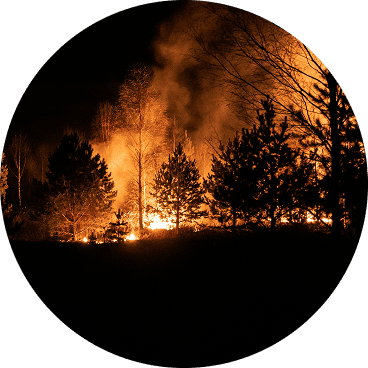
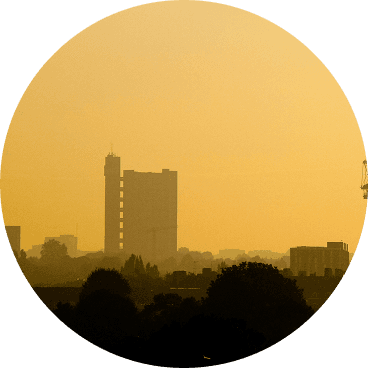
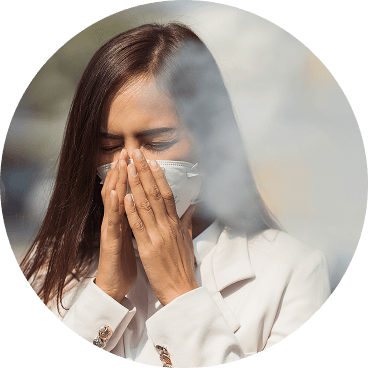
Don't Wait Until The Smoke's Inside.
Use the live wildfire smoke tracker and upgrade your air filters today to protect your lungs and your home.
Shop Filters For Smoke Protection
Live Mississauga, ON Forest Wildfire & Smoke Map Today: Local Air Quality Tracking & Indoor Protection Solutions
By Michelle Wan, Brand Manager and Air Quality Writer, Filterbuy Canada
Technical review: David Clark, Licensed HVAC Technician
Published: 23 September 2026 | Updated: 23 September 2026
TL;DR
Mississauga sits outside Ontario's designated forest fire region, so the smoke that hazes the city usually drifts in from wildfires burning hundreds or thousands of kilometres away. To track it live, start with the Canadian Wildland Fire Information System for active fires and the ECCC FireWork smoke forecast for where the plume is heading. Then confirm ground-level conditions on the Mississauga AQHI. On smoky days, close up the house, run a MERV 13 furnace filter with the thermostat fan set to On, and use a portable HEPA cleaner in the rooms you use.
Key Takeaways
Mississauga is outside Ontario's forest fire region. Grass, brush and structure fires in the city are reported to 911 and handled by Mississauga Fire and Emergency Services.
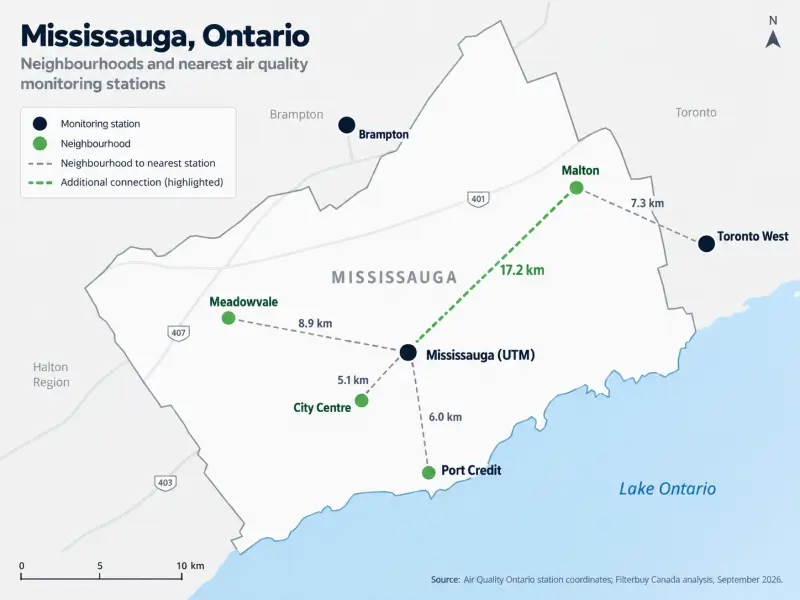
Mississauga has one provincial air monitoring station, on the University of Toronto Mississauga campus at 3359 Mississauga Road North. It measures ozone, fine particulate matter (PM2.5) and nitrogen dioxide.
Filterbuy Canada's distance analysis found Malton sits 17.2 km from that station but only 7.3 km from the Toronto West station, so north-east Mississauga residents may want to check both readings.
Peel Public Health issues an Orange Air Quality warning when Environment and Climate Change Canada (ECCC) forecasts an AQHI of 10 or higher due to wildfire smoke. It issued one on 15 July 2026 for smoke from Northwestern Ontario.
Health Canada and the U.S. EPA both point to MERV 13 or higher filtration during smoke events. The EPA adds that most furnaces accommodate MERV 13 when the filter is replaced often.
Current Live Mississauga Wildfire and Smoke Map: The Three-Check Method
No single map answers every wildfire question. A live wildfire map shows where fires are burning. A smoke forecast map shows where the plume is heading. Only an air quality reading shows what Mississauga residents are breathing right now. The Filterbuy Canada team ran all five checks below while researching this guide, and each answered a different question.
Open each source directly: CWFIS map, Ontario Forest Fire Info Map, ECCC FireWork, FireSmoke.ca, Mississauga AQHI.
Treat forecast maps as guidance, not measurements. ECCC's smoke statements for the GTA note that air quality can change over short distances and from hour to hour, which is why the ground-level AQHI reading is the final check. FireSmoke.ca also labels its forecast experimental, another reason to confirm with the AQHI.
Is There a Forest Fire in Mississauga Today?
A true forest fire inside Mississauga is unlikely because the city lies south of Ontario's forest fire region. Ontario's forest fire page places everything south of Owen Sound and Ottawa outside that region and directs fires south of the French and Mattawa rivers to 911. Locally, grass, brush and structure fires fall to Mississauga Fire and Emergency Services.
Local fire risk still shifts with the weather. On 15 July 2026, the City of Mississauga issued an open-air burn restriction that banned outdoor burning, cancelled all burn permits and prohibited fire pits, chimineas and outdoor fireplaces, while still allowing barbecues. Restrictions come and go, so check the city's open-air burning page before lighting anything outdoors.
Ontario's legislated fire season runs from 1 April to 31 October. As of the province's 20 September 2026 update, 788 wildland fires had been recorded inside the fire region in 2026, compared with 554 in 2025 and a 10-year average of 686.
Where Mississauga's Wildfire Smoke Comes From
Smoke over Mississauga is a long-distance import, tracked province-wide on the Filterbuy.ca live Ontario wildfire and smoke map, as these recent events show:
June 2023: Fires in northeastern Ontario and Quebec prompted ECCC Special Air Quality Statements across southern Ontario, including Mississauga and Brampton, on consecutive days.
June 2025: Fires in Manitoba, Saskatchewan and Alberta led to an ECCC Special Air Quality Statement naming Mississauga, Brampton, Toronto, Oshawa and Hamilton. The La Ronge, Saskatchewan, fire area pictured in coverage sits about 2,240 km away.
August 2025: Smoke from fires elsewhere in Canada brought a multi-day ECCC statement covering Mississauga, while IQAir ranked Toronto among the world's most polluted cities.
July 2026: Northwestern Ontario fires (Thunder Bay, in that region, is about 910 km away) triggered a Peel Public Health Orange Air Quality warning (AQHI forecast of 10 or higher) and a city open-air burn restriction.
Filterbuy Canada's take: Ontario's fire region begins north of Owen Sound, at least 150 km from Mississauga City Centre by our calculation. So the useful question here is rarely whether a fire is nearby. It's whether distant smoke has reached ground level today.
Which Air Monitoring Station Covers Your Mississauga Neighbourhood?
Mississauga's one provincial monitoring station sits at 3359 Mississauga Road North, on the University of Toronto Mississauga campus in the south-west. Air Quality Ontario lists it as an urban station measuring ozone, PM2.5 and nitrogen dioxide, the three AQHI pollutants. Some neighbourhoods, though, sit closer to stations in neighbouring cities.
Filterbuy Canada calculated straight-line distances from four neighbourhood centre points to the Mississauga, Brampton, Oakville and Toronto West stations, using the coordinates Air Quality Ontario publishes for each station.
Method: haversine distances from Air Quality Ontario station coordinates and published neighbourhood centre coordinates, rounded to 0.1 km.
City Centre and Port Credit residents are well served by the local station. Malton, next to Toronto Pearson International Airport, sits more than twice as far from the Mississauga station as from Toronto West, so on smoky days compare Toronto West station readings with the Mississauga AQHI. Wind and plume shape matter too, but when two nearby stations disagree, the higher reading is the safer planning number. One tip from Filterbuy Canada's research: an Air Quality Ontario "current AQHI" link opened a different station's page during our checks, so confirm the station name before trusting the number.
How to Read the AQHI During a Wildfire Smoke Event
The Air Quality Health Index (AQHI) is Canada's 1 to 10+ scale for the health risk of outdoor air. ECCC groups it into four bands: Low Risk (1 to 3), Moderate Risk (4 to 6), High Risk (7 to 10) and Very High Risk (10+). Peel Public Health issues an Orange Air Quality warning when ECCC forecasts that the AQHI will reach or has reached 10 or higher because of wildfire smoke.
Wildfire smoke can be harmful even at low concentrations. The City of Mississauga lists eye, nose and throat irritation, headaches and a mild cough as common symptoms, with wheezing, chest pain and severe coughing as more serious signs that call for medical attention. Adults 65 and older, pregnant people, infants and young children, people with heart or lung conditions and outdoor workers face higher risk and should reduce or reschedule strenuous outdoor activity.
Many phone apps display the U.S. Air Quality Index (AQI), a 0 to 500 scale built on different formulas. The two numbers aren't interchangeable, so use the AQHI for Mississauga decisions and treat a U.S. AQI figure as a secondary signal.
Supporting Statistics
17% more asthma emergency visits
The CDC tracked 19 days of Canadian wildfire smoke across the U.S. in 2023.
The smoke travelled hundreds of kilometres.
Asthma emergency visits ran 17% above expected.
Source: U.S. CDC, MMWR
Closed windows still let in most of the smoke
With doors and windows shut, indoor PM2.5 stays at 55 to 60% of outdoor levels.
Newer homes and homes with air conditioning tend to keep outdoor pollution out better than older homes.
Source: U.S. EPA
Size a portable cleaner to the room
Choose a tobacco-smoke CADR of at least two-thirds of the room's area in square feet.
Example: a 300 sq ft (about 28 square metre) bedroom needs a smoke CADR of about 200.
Source: U.S. EPA
How to Keep Wildfire Smoke Out of Your Mississauga Home
Follow ECCC and Peel Public Health alerts first. These steps draw on Peel Public Health, the City of Mississauga, Health Canada and the U.S. EPA:
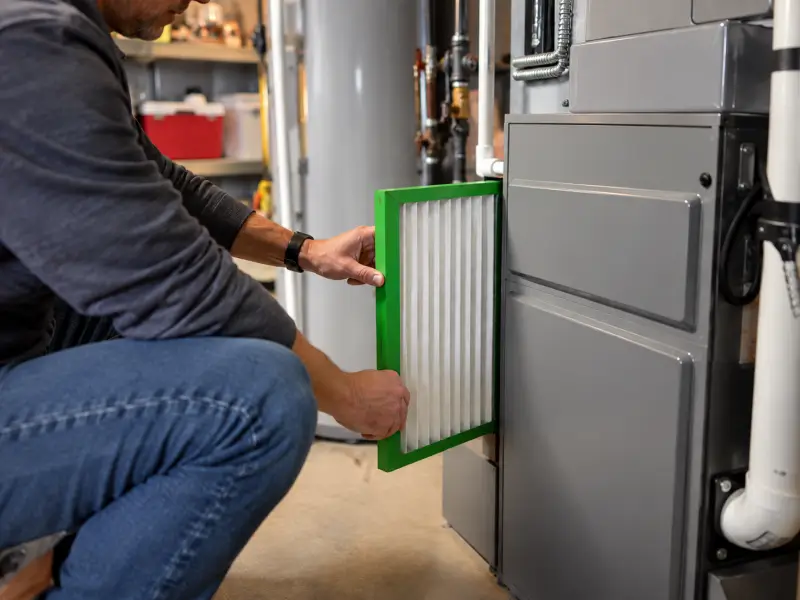
Put a MERV 13 filter in your furnace or central HVAC. The U.S. EPA recommends MERV 13 or higher during smoke events and says most systems accommodate it without equipment problems if the filter is replaced often.
Set the thermostat fan to On, not Auto, so the system filters continuously.
Run a certified portable HEPA air cleaner, sized as shown above, and skip any model that produces ozone. EPA guidance describes one clean room. Our recommendation goes further: a unit in each occupied room, bedrooms first.
Close windows and doors while indoor temperatures stay at or below 26 degrees Celsius. If a heat warning overlaps with smoke, keeping cool comes first. Set the system to recirculate, close any fresh-air intake (such as an HRV or ERV, if the manufacturer allows) and limit exhaust fans.
Don't add indoor particles: skip frying, candles, incense and vacuuming until the smoke clears.
No central system? In many apartments and condos, portable HEPA cleaners are your primary defence, not a supplement. If your building has central air, ask management which filter it uses.
Check the furnace filter during smoke events and replace it when it looks dark brown or black, which can be well before the normal interval. Keep spares on hand.
If your home gets stuffy or hot, spend time in a library, community centre or shopping mall, which often have better filtration.
Choosing a Furnace Filter for Mississauga's Smoke Season
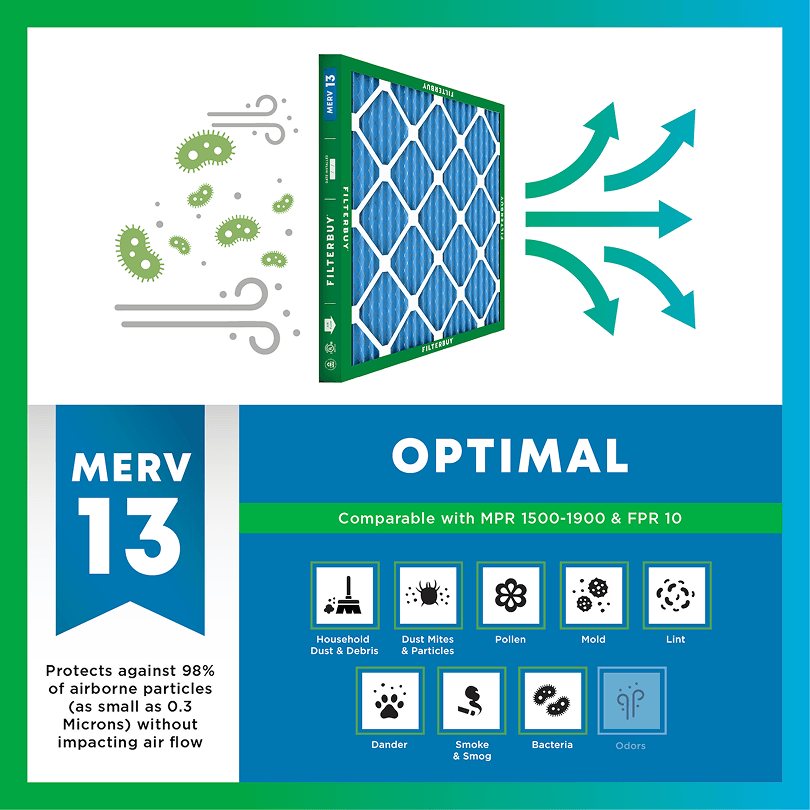
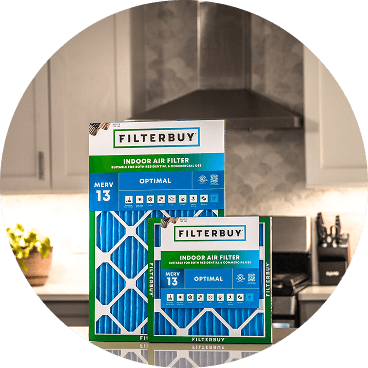
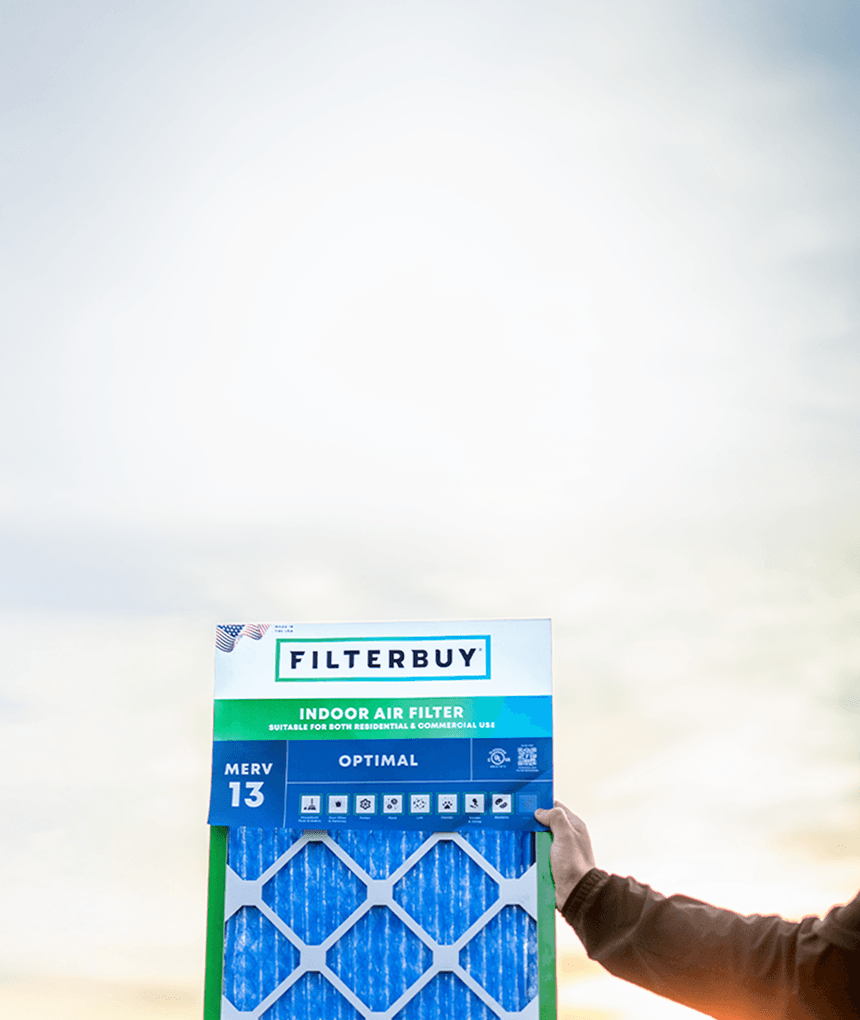
MERV 13 is the filter tier we recommend for wildfire smoke. Your furnace filter is the one smoke layer that treats every room at once, and Filterbuy Canada carries MERV 13 Optimal in over 600 standard sizes plus custom sizes.
MERV 13 Optimal captures 98% of airborne particles. It's the tier on the Filterbuy ladder that maps to smoke. Check the fit the same way you'd confirm a size: snug in the slot, with no gaps around the frame.
Pleated filters capture particles, not the gases behind smoke smell. For lingering odours, the Odour Eliminator line is the carbon option on our ladder.
Filterbuy Indoor Air Quality Team: 'We've shipped filters into more than a decade of North American smoke seasons, and the pattern holds every year. The homes that breathe easy are the ones that fit a clean MERV 13 before the haze arrives, not after.'
Michelle Wan: 'I don't want anyone to feel like they need an HVAC license just to pick the right filter. My job is to give you the straight answer, explain why it matters, and let you get back to your day.'
Our view on timing: a filter that worked through a smoky summer can be heavily loaded by late September, just as heating season begins. Swapping it now resets your system before windows stay shut for months. Every order ships free to Canada, and a subscribe and save plan you can edit, skip or cancel anytime keeps spares arriving on schedule.
Find your size and get a fresh filter in place before the next smoke event: shop MERV 13 filters at Filterbuy.ca.
Frequently Asked Questions
Glossary
AQHI (Air Quality Health Index): Canada's 1 to 10+ scale for the health risk of outdoor air, based on ozone, PM2.5 and nitrogen dioxide.
U.S. AQI (Air Quality Index): The United States' 0 to 500 air quality scale, often shown in weather apps.
CWFIS: Natural Resources Canada's Canadian Wildland Fire Information System, which maps active fires and hotspots nationwide.
FireWork: ECCC's forecast system predicting how wildfire smoke will move over the next 72 hours.
FireSmoke.ca: The BlueSky Canada portal publishing research smoke forecasts from the University of British Columbia.
Fire region: The part of Ontario where the province manages wildland fires. Mississauga lies outside it.
Restricted fire zone: A provincial ban on outdoor burning inside Ontario's fire region during high fire danger.
Special Air Quality Statement: An ECCC notice that air quality is, or is expected to be, reduced.
Orange Air Quality warning: A Peel Public Health alert issued when the AQHI is forecast to reach 10 or higher because of wildfire smoke.
PM2.5: Fine particulate matter 2.5 microns or smaller, the main pollutant of concern in wildfire smoke.
MERV: Minimum Efficiency Reporting Value, a rating of how well an HVAC filter captures particles between 0.3 and 10 microns.
HEPA: A high efficiency particulate air filter, used in portable air cleaners, capturing at least 99.97% of 0.3-micron particles.