
Prince Edward Island Live Wildfire Smoke Map
Get Alerts For Wildfires In Your Area
The moment a wildfire starts near you, you'll get an instant alert and simple tips to reduce your smoke exposure.
What's In The Smoke
30xSmaller than a human hair
Fine enough to reach deep into the lungs. A MERV 13 is built to capture it.
How Far It Travels


It Doesn't Stay Local
Smoke rides the wind far downwind — you can get smoky air with no fire nearby.
What To Do During A Smoke Event
Simple steps to reduce indoor exposure.
- Stay In, Close UpShut windows and doors to keep smoke out.
- Set Fan To "On"Keeps air cycling through your filter, not just when heating or cooling.
- Recirculate AirSwitch off fresh-air intake so you're not pulling smoke in.
- Run A MERV 13Built to capture the fine PM2.5 in smoke.
- Add A PurifierExtra filtration for the room you use most.
- Wear an N95 if OutsideFits snug to block fine particles — a cloth mask won't.


The Best Air Filter For Wildfire Smoke
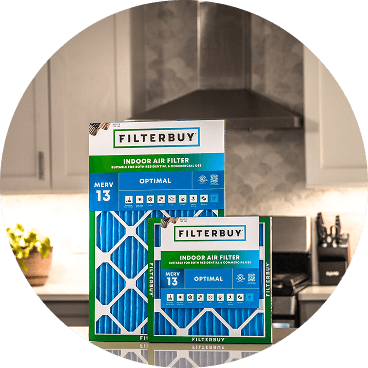
During smoke events, the EPA recommends upgrading to a MERV 13 filter — or the highest-rated filter your system can handle — to help reduce the fine particles smoke brings indoors. MERV 13 is the level most home HVAC systems can run while still capturing PM2.5, the fine particulate that makes up the bulk of wildfire smoke.
- Captures PM2.5 particles
- Blocks ash, soot, and smoke odor
- Keeps your indoor air safe—even when the outdoor air is dangerous
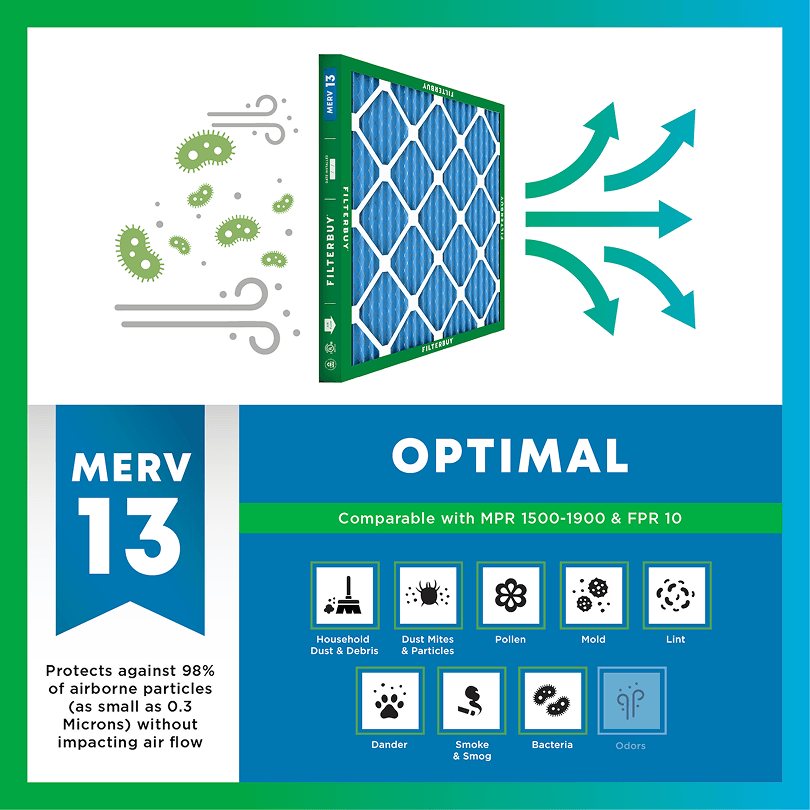
- Meets the EPA's recommended rating for filtering fine wildfire smoke particles.

Wildfire Smoke FAQs
Facts About Wildfires
Over 70,000 wildfires burn in the U.S. every year.
Wildfire smoke can travel 1,000+ miles, affecting states that aren't even near the blaze.
Exposure to wildfire smoke can worsen asthma, trigger heart issues, and lead to ER visits.
Indoor air can hold more fine particles during wildfire events unless it's properly filtered.
The EPA advises using MERV 13 filters or portable HEPA air cleaners during wildfire smoke events.
Don't Wait Until The Smoke's Inside.
Use the live wildfire smoke tracker and upgrade your air filters today to protect your lungs and your home.
Shop Filters For Smoke Protection
Live Prince Edward Island Forest Wildfire & Smoke Map Today: Provincial Air Quality Tracking & Indoor Protection Solutions
TL;DR
Prince Edward Island rarely has wildfires of its own, averaging about seven a year. Its air quality risk comes almost entirely from smoke drifting in from Nova Scotia, New Brunswick, Québec and central Canada. Use the live wildfire and smoke map below to see what is burning and where the smoke is heading today, then check the Air Quality Health Index for your community before closing up and filtering your indoor air.
Key Takeaways
The Prince Edward Island wildfire map is usually empty and its smoke map is not. The Island averages about seven wildland fires a year while still receiving mainland smoke.
Over 90% of PEI wildland fires have been human-caused, according to the province, against roughly 50% nationally.
Haze on the Island is often sea fog rather than smoke, and smoke can be present when the sky looks clear. Health Canada is blunt: air quality can be poor even when you cannot see or smell it.
The AQHI is reported for only three Island communities: Charlottetown, Summerside and St. Peters Bay.
The U.S. EPA recommends MERV 13 or higher filtration during smoky periods, if your system can handle it and the filter is replaced often.
What the Live PEI Wildfire and Smoke Map Shows Today
The live Prince Edward Island wildfire and smoke map above tracks two things: fires burning on or near the Island, and smoke moving through the air above it. On most days in fire season the first layer is blank and the second is the one that matters. A clear fire map is not evidence of clean air here, because the fires affecting PEI are usually burning in another province. If you smell smoke and see nothing on the fire layer, that is the expected pattern, not a gap in the data.
In recent seasons PEI has been the only province with no wildfires burning while Islanders were still told to limit outdoor exertion. The Island is small and heavily agricultural, so there is little continuous forest fuel, and fire has never been routine on the terrain. The provincial wildfire program reports that over 90% of recorded wildland fires here have been human-caused. But PEI sits downwind of a large fire-prone landmass, so smoke from Nova Scotia, New Brunswick, Québec, Ontario and the Prairies reaches the Gulf of St. Lawrence regularly. Fiona also felled millions of trees in 2022, leaving a fuel load on the ground.
Filterbuy maintains this map for every province and territory. We are an air filtration manufacturer, not a fire agency, so the data comes from the federal sources above. What we add is what happens after you read the number.
How to Read the Air Quality Health Index in PEI
The Air Quality Health Index (AQHI) is Environment and Climate Change Canada's 1-to-10+ scale for the health risk of current air pollution. During a mainland fire event in August 2025 it sat at level three on PEI, inside the low-risk band, even as smoke was clearly visible across the Island.
Readings are published for Charlottetown, Summerside (Wellington) and St. Peters Bay. Behind them the province runs air quality monitoring at Wellington, Charlottetown and Southampton, with live data on the PEI Air Monitoring Data Hub.
Three communities across 5,660 square kilometres leaves gaps, so near Tignish, North Cape or East Point the nearest reading may not match what is outside your door. That tempts Islanders to trust their own eyes and nose instead, and it is the correction Filterbuy's team makes most often for Maritime customers, because here the senses mislead in both directions.
Haze on PEI is often not smoke. The Island is ringed by cold water, so sea fog is ordinary summer weather, and a flat grey horizon in July is more likely fog than a plume off New Brunswick. Fog is damp, it sits in a defined layer, it burns off as the day warms, and it does not smell of anything.
Smoke can be present when nothing looks wrong. It often travels well above ground level, so a sky can look filthy while street-level air is fine, and the reverse happens just as often. Health Canada is explicit: air quality can be poor even when you cannot see or smell smoke, because the particles that carry the risk are invisible. Use your senses as a prompt to check, never as the check itself.
What to Do at Each AQHI Level
Environment and Climate Change Canada attaches specific health messages to each band, paraphrased below with the indoor step we would add for an Island home.
1 to 3 (Low). Normal outdoor activity is fine, and this is the window to change your filter before the next smoke event.
4 to 6 (Moderate). Most people need not change plans unless symptoms appear. At-risk people should ease off strenuous activity. Indoors, close up and switch the furnace fan to On.
7 to 10 (High). At-risk people should reschedule strenuous outdoor activity, and children and older adults should take it easy. Indoors, keep the fan running and check the filter.
Above 10 (Very high). At-risk people should avoid strenuous outdoor activity. Everyone else should reduce it. Windows shut, ventilation recirculating, fan running.
At-risk means people 65 and over, pregnant people, young children, anyone with a chronic heart or lung condition, and outdoor workers.
Burning rules are separate from air quality. The province updates its burning restrictions and Fire Weather Index at about 2 p.m. through the 15 March to 15 November fire season. To report a fire, call 9-1-1.
Protecting Your Indoor Air When Smoke Reaches the Island
Health Canada's guidance for cleaner air spaces advises sealing windows and doors, installing a high-quality filter, and switching ventilation to recirculation. For central systems it recommends MERV 13 or higher, noting the equipment must handle the added pressure drop. This is the sequence our HVAC team walks Canadian customers through, and steps 2 and 3 are the ones people skip:
Close windows and exterior doors, including overnight, while smoke is forecast.
Set your furnace fan to On rather than Auto. On Auto the blower only runs when the system calls for heat, which in August is close to never. A good filter the air never reaches does nothing.
Switch any HRV or air exchanger to recirculation. This is the step Canadian homes get caught by and American guidance rarely mentions. Left alone, an air exchanger faithfully pulls in the outdoor air you are trying to keep out.
Install a clean, high-efficiency filter before the smoke arrives. Our replacement guide covers airflow direction and sealing the slot.
Inspect the filter weekly during heavy smoke. It loads far faster than dust, and PEI furnaces already run six to eight months a year.
Which Filter to Choose for Smoke
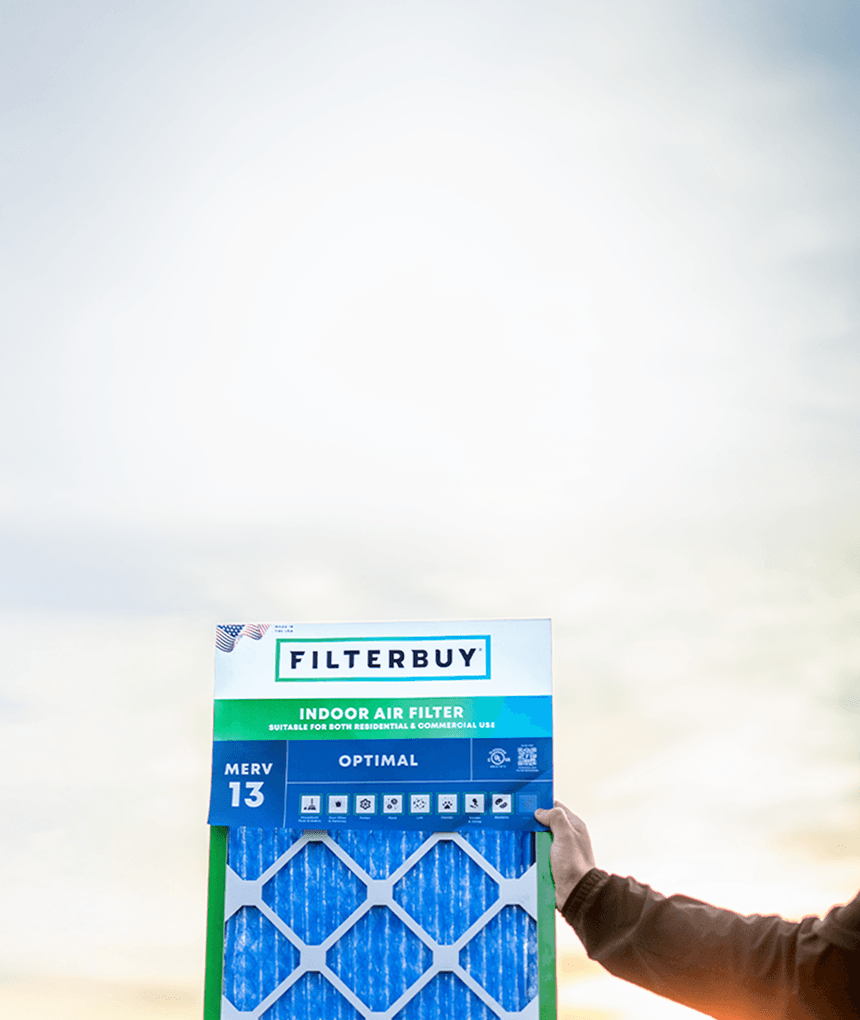
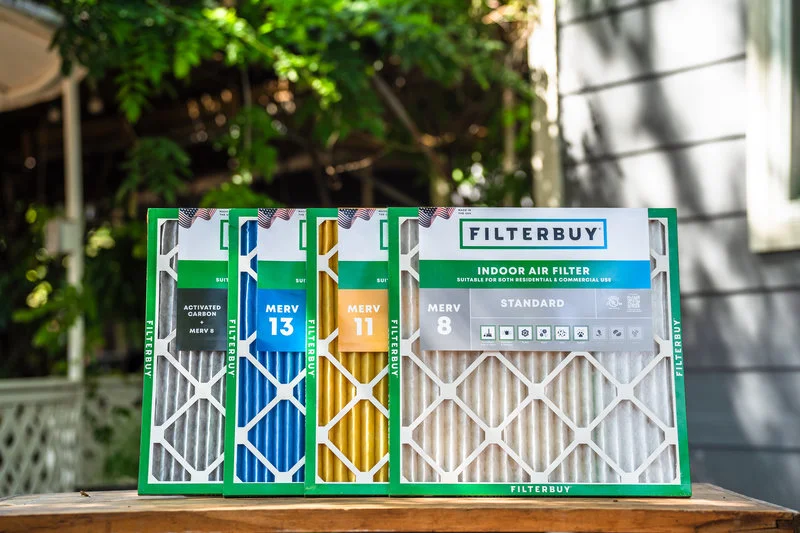
MERV 13 Optimal is the right choice during an active smoke event. It captures 98% of airborne particles as small as 0.3 microns and matches the threshold both Health Canada and the U.S. EPA point to. Our guide to the best MERV filter for wildfire smoke explains the seasonal swap.
MERV 11 Superior captures 95% and is a sensible fallback if your system cannot accommodate MERV 13. See how MERV ratings work for the full scale.
Odour Eliminator filters are carbon-infused and handle the gas-phase side: the campfire smell particle filtration alone leaves behind.
Filterbuy makes over 600 sizes, including custom dimensions, and ships free across Canada with no minimum purchase. Prices are in CAD, and subscribe and save lets you edit, skip or cancel anytime.
Because we manufacture our own filters rather than reselling someone else's, we see what comes back, and smoke-season filters look nothing like dust-season filters. Household dust greys the media evenly over months, while wildfire smoke darkens the leading edge of the pleats within days without the filter ever looking full. So skip the lamp test: a new pleated filter already blocks plenty of light and a loaded one still passes some. Hold it against white paper instead, where the colour shift shows first.
"The MERV 13 upgrade is the easy part. What I would underline for Island homeowners is replacement frequency. A loaded MERV 13 restricts airflow harder than the filter it replaced, so if you upgrade and forget about it for three months, you have made your system work harder for worse air. Buy the spare at the same time as the filter."
David Clark, Licensed HVAC Technician
Supporting Statistics
1. Closing windows helps. Filtering finishes the job.
Indoor PM2.5 still reaches 55% to 60% of outdoor levels with windows shut and no air cleaner running, ranging from 30% to 100% by home.
A high-efficiency filter with the fan on cuts indoor PM2.5 by about 50%, against about 24% for a low-efficiency filter.
Source: U.S. EPA, Strategies to Reduce Exposure Indoors
2. Canadian smoke crosses oceans. A strait is nothing.
Canadian fires burned over 6.6 million hectares by 3 August 2025, roughly three times the 25-year average.
Smoke from those fires reached Europe at least twice that season. PEI sits a few hundred kilometres from the Nova Scotia and New Brunswick fire grounds.
Source: NASA Earth Observatory, Widespread Smoke from Canadian Fires
3. The health signal shows up at moderate readings. Not just severe ones.
U.S. asthma emergency department visits ran 17% above expected on wildfire smoke days in 2023.
There were 19 such days between 30 April and 4 August, when Canadian smoke covered most of the country.
A smoke day was counted at an Air Quality Index of 101 or above, the first unhealthy band rather than an extreme one.
Higher-than-expected visits appeared in every age group from five years old and up.
Source: U.S. CDC, Asthma-Associated Emergency Department Visits During the Canadian Wildfire Smoke Episodes
Frequently Asked Questions
Glossary
AQHI (Air Quality Health Index): Environment and Climate Change Canada's 1-to-10+ scale for the health risk of current air pollution. 1 to 3 low, 4 to 6 moderate, 7 to 10 high, above 10 very high.
PM2.5: Fine particulate matter 2.5 microns or smaller, and the main health concern in wildfire smoke because particles this small reach deep into the lungs.
MERV (Minimum Efficiency Reporting Value): The North American scale rating how well a filter captures airborne particles. Higher numbers capture smaller particles.
Air exchanger (HRV/ERV): A unit that trades indoor air for outdoor air. Common in Canadian homes and a route for smoke to enter unless switched to recirculation.
Sources: Government of PEI: Wildfire · PEI Burning Restrictions · PEI Air Quality Monitoring · ECCC AQHI for PEI · ECCC AQHI Messages · Health Canada: Wildfire Smoke and Your Health · Health Canada: Cleaner Air Spaces · U.S. EPA: Reducing Exposure Indoors · NASA Earth Observatory · CWFIS · FireSmoke Canada
Reviewed by David Clark, Licensed HVAC Technician. Filter recommendations here are general guidance. Confirm your furnace can take a higher-efficiency filter before upgrading. If you have a heart or lung condition, follow your healthcare provider's advice during smoke events.