Shop by
August 29, 2026
By Michelle Wan · Technically reviewed by David Clark, Licensed HVAC Technician · Published August 30, 2026
Put a MERV 13 filter in the central HVAC and set the fan to “On” instead of “Auto.” That is the level EPA guidance points to during smoky periods, and adults 65 and older sit inside the EPA’s sensitive group, so their action threshold starts at AQI 101 rather than 151. Seal the house first, filter second, then add a portable HEPA cleaner in the bedroom for the worst days.
What each level captures:
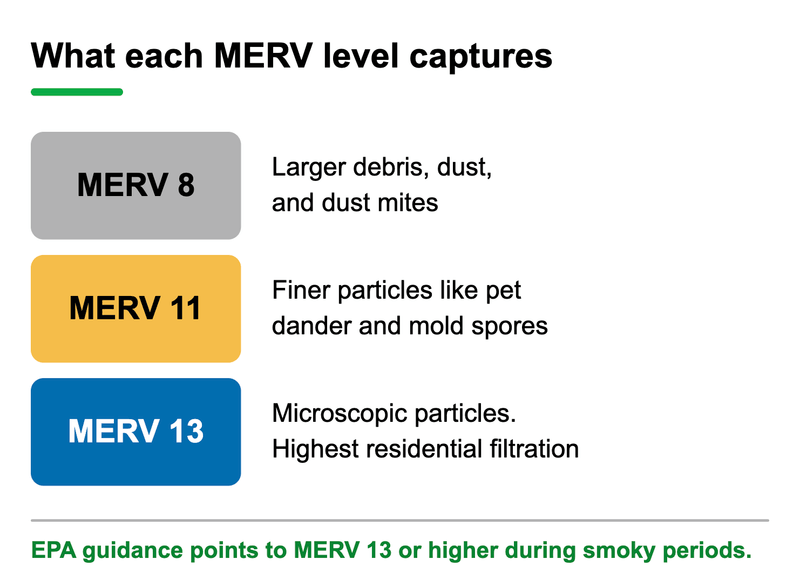
MERV 8 — larger debris, dust, and dust mites.
MERV 11 — finer particles like pet dander and mold spores. The step below MERV 13 when an older system cannot take the higher rating.
MERV 13 — microscopic particles; highest residential filtration.
Size settles this before the rating does. Return slots in older houses are often nonstandard, and a filter that does not seal is a filter smoke goes around.
Already know the rating you want? Shop MERV 13 air filters in 600+ sizes, or take the quiz below and we’ll match the filter to the system.
Answer 3 quick questions and we’ll match you to your perfect filter.
Adults 65 and older face higher risk from wildfire smoke than any other healthy-adult group, and the risk runs through the heart as much as the lungs. EPA guidance places them in its sensitive group, because chronic heart and lung disease is more common at that age. The strongest protection is a sealed house, a MERV 13 filter in the central HVAC, and the fan left running. The part most guides skip is fit: in the older homes Filterbuy services, the filter that fails is usually the one that never sealed.
The EPA classifies adults 65 and older as a sensitive group for wildfire smoke, because chronic heart and lung disease is more prevalent with age.
On dense-smoke days in California in 2015, emergency visits rose 42% for heart attack and 22% for ischemic heart disease, sharpest in adults 65 and older (Wettstein et al., JAHA, 2018).
A 2026 Yale-led study of 65.2 million Medicare beneficiaries tied cumulative smoke exposure to higher cardiovascular hospitalization in adults 65+, with heart failure risk more than 20% higher (Zhang et al., JACC, 2026).
The EPA recommends a MERV 13 or higher HVAC filter during smoky periods, with the fan set to "On" rather than "Auto."
Filters load faster during fire season, turning replacement into a recurring task many older adults cannot comfortably do alone.
Older adults are at higher risk because age raises the odds of pre-existing heart and lung disease while lowering the body’s capacity to compensate. Which is why the EPA places adults 65 and older in its sensitive group: they are likelier to already have chronic heart or lung disease, and the body’s ability to answer a challenge falls away with age. The exposure is identical to anyone else’s. The margin for absorbing it is not.
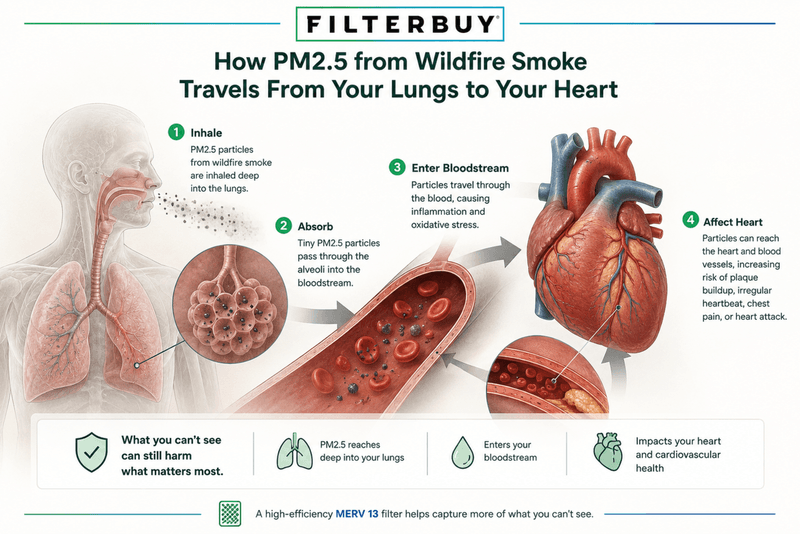
What does the damage is fine particulate matter. PM2.5, meaning particles 2.5 micrometers or smaller, settles deep in the lungs and crosses into the bloodstream, where it drives inflammation and oxidative stress. Which is why a bad smoke day can announce itself as chest pain or a fluttering heartbeat rather than a cough.
Three practical things compound the biology. Older houses predate tight-envelope construction, so smoke works its way in even with the windows shut, and medications for blood pressure or COPD cannot lapse mid-event. Reduced mobility does the rest: sealing a door, hauling a box fan, or changing a ceiling-height filter are all harder alone.
That last point is where our vantage differs from most of what you will read here. Because Filterbuy manufactures filters at four U.S. plants and also runs Filterbuy HVAC Solutions, a licensed service arm, we see both ends of the same problem: we cut the filter, and our technicians stand in front of the return it is meant to fit. Older houses are consistently where those two things fail to meet.
Research ties wildfire smoke to cardiovascular events in older adults, and the strongest recent evidence concerns long-term exposure rather than single bad days. That landmark short-term finding came from UC San Francisco, the California Department of Public Health, and the EPA, published in the Journal of the American Heart Association in 2018.
RR = relative risk. Short-term cardiovascular findings are mixed across studies; long-term findings have strengthened. Sources: Wettstein et al., Journal of the American Heart Association (2018); Zhang et al., Journal of the American College of Cardiology (2026); Vega et al., JAMA Network Open (2025).
That third row matters, and most articles leave it out. A 2025 Harvard-led Medicare cohort found the respiratory signal clearly but not a statistically significant cardiovascular one. The long-term picture has strengthened. Yale cardiologist Harlan Krumholz, a co-author of the 2026 JACC study, said wildfire smoke "should be treated as more than a temporary respiratory nuisance." It also found higher risk at modest smoke levels, so communities far from any fire line may still carry real risk.
None of which changes what a caregiver should do this week. Every measure below lowers exposure, and not one carries a real downside for someone living with a heart or lung condition.
Three national datasets between them explain why smoke lands harder on older adults. The heart disease is already common, millions of seniors live where the air fails in an ordinary year, and they spend more of their lives indoors than anyone else.
American Lung Association counts reflect only counties with air quality monitors, so they understate national exposure rather than overstate it. CDC figures are self-reported diagnoses from household interviews.
None of these three is a wildfire statistic. They describe the conditions a smoke event arrives into, which is why setup belongs before fire season. Sources: CDC/NCHS Data Brief 557, ALA State of the Air 2026, and EPA Report on the Environment.
Because adults 65 and older sit inside the EPA’s sensitive groups, their action threshold begins at AQI 101 rather than the 151 that applies to everyone else. That number is the most useful thing a caregiver can memorise, since it means an older adult should be indoors on days most people would treat as merely hazy. The ladder below sets out what happens at each level and who does it, and if you are the older adult here rather than the caregiver, take the middle column as yours.
Adults 65 and older fall inside the EPA's sensitive groups, so the action threshold begins at AQI 101 rather than 151. Check current conditions before acting.
Check the live air quality index map or AirNow first. An orange sky is not a measurement, and a merely hazy day can still read 150.
A smoke-safe home comes down to three layers that build on each other: seal the envelope so less smoke gets in, filter the whole house so what does get in is captured, then add a clean room where your parent sleeps for the worst days. Do the first two before fire season, since the third is what you fall back on once smoke has arrived.
1. Seal the envelope. Close windows, doors, and the fireplace damper. EPA clean-room guidance says that if the HVAC or window AC has a fresh-air option, turn it off or set it to recirculate. Do not run a whole-house or attic fan. See how to keep wildfire smoke out of your house.
2. Filter the whole house. During smoky periods the EPA recommends upgrading to a filter rated MERV 13 or higher. Run the fan by setting it to "On" instead of "Auto." This is the step most people skip and it does the most work. If you are weighing filter types, compare MERV 13 and HEPA for wildfire smoke.
3. Add a clean room. Choose the bedroom, close the door, and run a portable HEPA air cleaner sized for the space. Pick one that does not make ozone; CARB maintains a list of certified air cleaning devices. A DIY box-fan air cleaner is an EPA fallback rather than a first choice, for when a commercial unit is unavailable or unaffordable, and it wants a 2012-or-newer fan with a UL or ETL marking, a shroud, and thicker or multiple MERV 13 filters.
Having done all that, stop adding smoke of your own. EPA guidance rules out candles, incense, gas or wood stoves, aerosol sprays, and vacuuming without a HEPA filter, since each puts particles back into the room you just cleaned.
The six things Filterbuy HVAC Solutions technicians find most often in older homes:
Evaporative ("swamp") cooler. These pull outdoor air in by design, so EPA guidance calls for covering the outside air intakes with 4-inch-thick MERV 13 filters, or using the cooler sparingly.
Window AC fresh-air vent. Close the vent lever; seal gaps with foam strips.
Fireplace damper. Often left open year-round in older homes.
Whole-house or attic fan. Confirm it is off at the breaker.
Filter slot gaps. The one we see most, and the one homeowners never suspect. If the filter rattles, air takes the easy path around it. Upgrading the MERV rating on a filter that does not seal changes nothing.
Gas range. During heavy smoke, use the microwave or a countertop appliance.
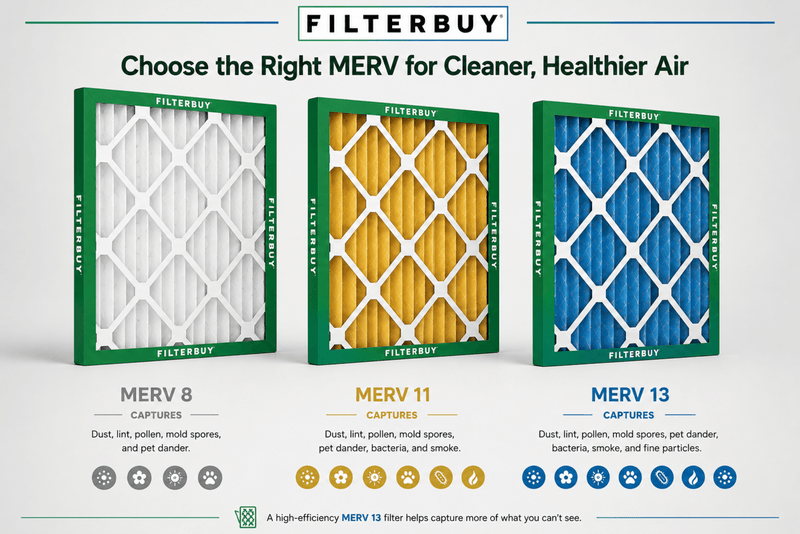
Put a MERV 13 filter in an older adult’s central HVAC if the equipment can handle it. MERV 13 is the efficiency level EPA guidance points to for smoke, and it captures a meaningful share of the PM2.5 that drives cardiovascular risk. MERV 8 and MERV 11 handle dust and pollen well, but neither reaches the high-efficiency range smoke calls for. Filterbuy builds all three, so fit decides this before the catalogue does. See the best MERV filter for wildfire smoke covers the trade-offs.
That airflow caveat is a real one. An undersized furnace or restrictive ductwork can lose airflow when a higher-MERV filter goes in, so if the system is over 15 years old, have a technician check static pressure before fire season rather than during it.
What we would add has less to do with rating than with fit. Slots in older houses are frequently nonstandard, so the nearest standard filter gets forced in and a gap is left over, which is why we built a 600-plus size range and a custom-cut line. For a caregiver, measuring that slot once and locking the size in does more good than any rating decision made from three states away.
Older homes are where filtration gets complicated. The return is often an odd size, the slot does not seal, and the system is old enough that someone should look at it before a higher-MERV filter goes in. We cut 600-plus sizes plus custom precisely because the shelf at the hardware store was never built for these houses. If you are setting up a parent’s home before fire season, size is not a detail. A filter that does not seal is a filter the smoke goes around.
Michelle Wan, Brand Manager and Air Quality Writer, Filterbuy
Measure the filter already in the slot rather than the opening. Pull it out, read the printed size off the frame, and if nothing is printed, measure the frame and note height, width, and depth in that order before photographing it. Doing this once on an ordinary visit, when nothing is on fire, removes the commonest reason a smoke-season order goes wrong.
One trap catches almost everybody. Printed filter sizes are nominal, which is to say rounded, so a filter labeled 20x25x1 actually measures about 19½ by 24½ by ¾ inches. Manufacturers undercut the stated size deliberately so the filter seats without binding, which means a slot coming up half an inch short is normal. Order by the printed nominal size, and if nothing is printed and your measurement falls between two standard sizes, that is what Filterbuy cuts custom sizes for.
Auto-delivery matters because it turns a recurring physical and mental task into something that simply arrives. Changing a filter means finding the size, driving to a store, then reaching an air handler set into a hallway ceiling, closet, or basement, which is a hard errand at 78. EPA guidance is that during periods of heavy smoke you should plan to replace the filter more often than the manufacturer recommends, and sooner if it looks heavily soiled.
For a caregiver, the value is that "did Dad change the filter?" stops being a question worth asking. Sizes are locked in, and a spare is in the closet by the time the AQI climbs. We watch the same thing every fire season, as orders across a region jump within hours of the smoke arriving, which is exactly the wrong moment to work out what size the return takes. Set up Filterbuy auto-delivery on a 30, 60, or 90-day schedule and keep a spare from May to October. See also how air quality changes by season.
A filter does nothing for the walk to the mailbox. For that, see which mask works for air pollution.
Plenty of older adults have no say over the system that filters their air, whether because they rent, live in a senior community, or occupy a house with no ductwork to begin with. Almost every guide on this subject assumes a homeowner with central HVAC, and so, until now, has this one. Here is the version for everybody else.
A central HVAC filter is the most efficient tool when one is available. When it is not, a correctly sized portable HEPA cleaner in the room where your parent sleeps does most of the same work in that room.
Filterbuy sells filters, so let us say this plainly: in the second and third rows above a filter will not fix the problem, and buying one is money wasted. What helps is a portable HEPA cleaner and a conversation with whoever runs the building.
An older adult should seek emergency care during a smoke event for chest pain or pressure, difficulty breathing, a rapid or irregular heartbeat, unusual fatigue, or any stroke sign such as slurred speech or one-sided weakness. The American Heart Association urges calling 911 rather than waiting these out and publishes the full heart attack and stroke warning signs. Do not assume a symptom is "just the smoke."
Anyone living with heart disease, COPD, or asthma should also work out a plan with their physician before fire season, covering medication supply, when to escalate, and where to go if the house cannot be kept clean.
More often than the manufacturer schedule. EPA guidance is to replace it sooner than usual during heavy smoke, and sooner again if it looks heavily soiled when you pull it. Checking monthly through fire season suits most homes.
They complement it rather than replace it. A portable HEPA cleaner treats one room, usually the bedroom, while the HVAC filter treats the whole house, so older adults benefit most from both. Where there is no central system, the portable unit becomes the whole strategy.
AQI (Air Quality Index): The EPA’s 0–500 scale for daily air quality. Values of 101–150 are "Unhealthy for Sensitive Groups," which includes adults 65 and older.
PM2.5: Fine particulate matter 2.5 micrometers or smaller, the main health-relevant pollutant in wildfire smoke. It passes from the lungs into the bloodstream.
MERV: Minimum Efficiency Reporting Value, the ASHRAE 52.2 scale (1–16) rating how well an HVAC filter captures airborne particles.
MERV 13: The efficiency level EPA guidance points to for wildfire smoke. Filterbuy manufactures MERV 13 pleated filters in the U.S. in 600+ sizes.
HEPA: High-Efficiency Particulate Air, used in portable air cleaners. The media is generally too restrictive for a standard furnace slot.
Clean room (clean-air room): A single room, usually a bedroom, sealed and filtered to stay cleanest during a smoke event. The term is EPA’s.
Static pressure: Resistance to airflow in a duct system. High readings signal a restriction that can strain the blower.
Auto-delivery: Filterbuy’s recurring filter shipment, set at 30, 60, or 90 days.
Filterbuy HVAC Solutions: Filterbuy’s licensed residential and commercial HVAC service arm. David Clark, who reviewed this article, is one of its technicians.
Michelle Wan is Brand Manager and Air Quality Writer at Filterbuy, where she translates MERV ratings, filtration, HVAC efficiency, and pressure drop into plain-English guidance for homeowners. She works directly with Filterbuy’s U.S. manufacturing teams across the company’s Alabama, Florida, Pennsylvania, and Utah plants, so her guidance reflects how filters are built and used in real homes rather than spec sheets alone. She earned her B.A. in Sociology from the University of California, Santa Cruz.
U.S. EPA. Research on DIY Air Cleaners to Reduce Wildfire Smoke Indoors.
California Air Resources Board. List of CARB-Certified Air Cleaning Devices.
American Lung Association. State of the Air 2026 — Populations at Risk. April 2026.
U.S. EPA. Report on the Environment — Indoor Air Quality. Updated May 27, 2026.
This article is for general education and does not constitute medical advice. Consult a physician about an individual’s condition.
