
Edmonton, AB Live Wildfire Smoke Map
Get Alerts For Wildfires In Your Area
The moment a wildfire starts near you, you'll get an instant alert and simple tips to reduce your smoke exposure.
What's In The Smoke
30xSmaller than a human hair
Fine enough to reach deep into the lungs. A MERV 13 is built to capture it.
How Far It Travels


It Doesn't Stay Local
Smoke rides the wind far downwind — you can get smoky air with no fire nearby.
What To Do During A Smoke Event
Simple steps to reduce indoor exposure.
- Stay In, Close UpShut windows and doors to keep smoke out.
- Set Fan To "On"Keeps air cycling through your filter, not just when heating or cooling.
- Recirculate AirSwitch off fresh-air intake so you're not pulling smoke in.
- Run A MERV 13Built to capture the fine PM2.5 in smoke.
- Add A PurifierExtra filtration for the room you use most.
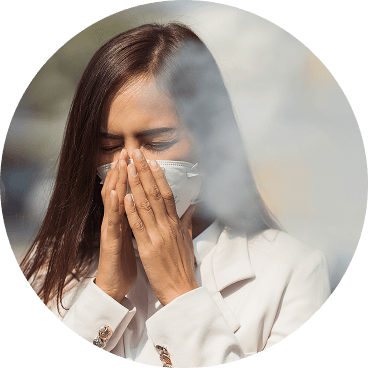
- Wear an N95 if OutsideFits snug to block fine particles — a cloth mask won't.


The Best Air Filter For Wildfire Smoke
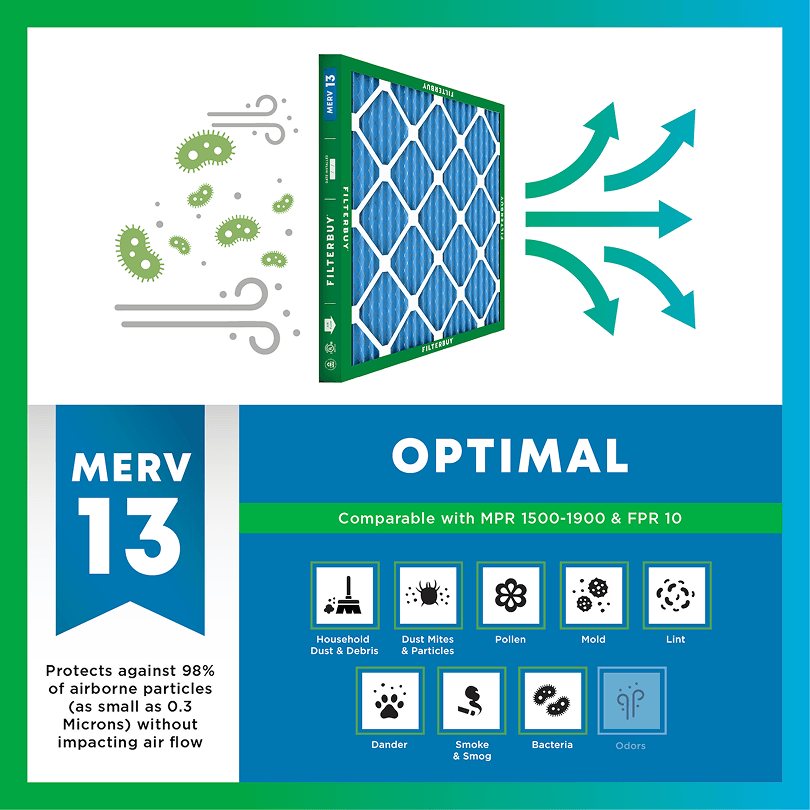
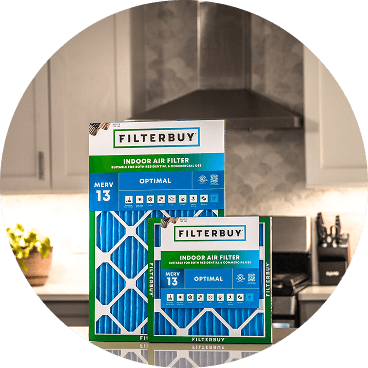
During smoke events, the EPA recommends upgrading to a MERV 13 filter — or the highest-rated filter your system can handle — to help reduce the fine particles smoke brings indoors. MERV 13 is the level most home HVAC systems can run while still capturing PM2.5, the fine particulate that makes up the bulk of wildfire smoke.
- Captures PM2.5 particles
- Blocks ash, soot, and smoke odor
- Keeps your indoor air safe—even when the outdoor air is dangerous
- Meets the EPA's recommended rating for filtering fine wildfire smoke particles.

Wildfire Smoke FAQs
Facts About Wildfires
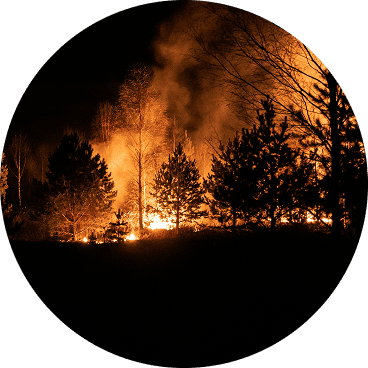
Over 70,000 wildfires burn in the U.S. every year.
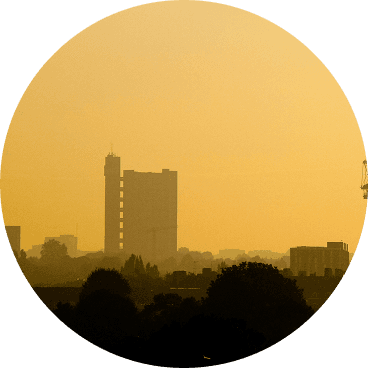
Wildfire smoke can travel 1,000+ miles, affecting states that aren't even near the blaze.
Exposure to wildfire smoke can worsen asthma, trigger heart issues, and lead to ER visits.
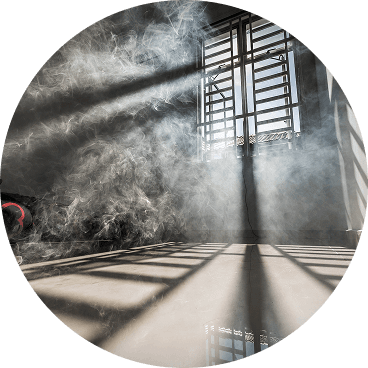
Indoor air can hold more fine particles during wildfire events unless it's properly filtered.
The EPA advises using MERV 13 filters or portable HEPA air cleaners during wildfire smoke events.
Don't Wait Until The Smoke's Inside.
Use the live wildfire smoke tracker and upgrade your air filters today to protect your lungs and your home.
Shop Filters For Smoke Protection
Live Edmonton, AB Forest Wildfire & Smoke Map Today: Local Air Quality Tracking & Indoor Protection Solutions
TL;DR
Edmonton’s smoke conditions change by the hour, and three free public tools tell you almost everything. The Alberta Wildfire Status Dashboard shows where fires are actually burning, FireSmoke.ca forecasts where the smoke plume will drift over the next 48 hours, and the Air Quality Health Index reports what the air is doing right now at Edmonton’s monitoring stations. At AQHI 7 or higher, Health Canada advises reducing outdoor exertion and improving indoor filtration. For most Edmonton homes that means a clean, correctly sized furnace filter on a continuous fan.
Key Takeaways
Edmonton can be smoky with no fire anywhere near it. Smoke routinely crosses provincial boundaries from fires in northern Alberta, BC, Saskatchewan and the Northwest Territories.
The AQHI runs from 1 to 10+, grouped into low (1–3), moderate (4–6), high (7–10) and very high (10+) health-risk categories, according to Environment and Climate Change Canada.
Health Canada recommends MERV 13 or higher to capture the fine particles in wildfire smoke (PM2.5, the ones small enough to reach deep into the lungs).
Filters load faster during smoke events. One that normally lasts 60–90 days can need replacing well before that.
Edmonton’s AQHI comes from several stations, including East, Lendrum, McCauley and Woodcroft, so readings differ across the city. Check the station nearest you.
How Do I Read Today’s Edmonton Wildfire and Smoke Map?
Read the map in three layers, because each answers a different question. The fire layer marks where wildfires are burning, the smoke layer projects where the plume drifts next, and ground-level AQHI readings tell you what Edmontonians are actually breathing. Those three rarely line up, and that mismatch is where most confusion starts.
Put simply: fires are where it burns, smoke is where the wind takes it, and the AQHI is what you are actually breathing. Each layer has a separate source: the Alberta Wildfire Status Dashboard, the FireSmoke.ca forecast, and Edmonton’s AQHI by station.
An empty fire map does not mean clean air over Edmonton. Check the smoke layer and the AQHI before calling the day clear.
What Does Edmonton’s AQHI Number Mean for My Home Today?
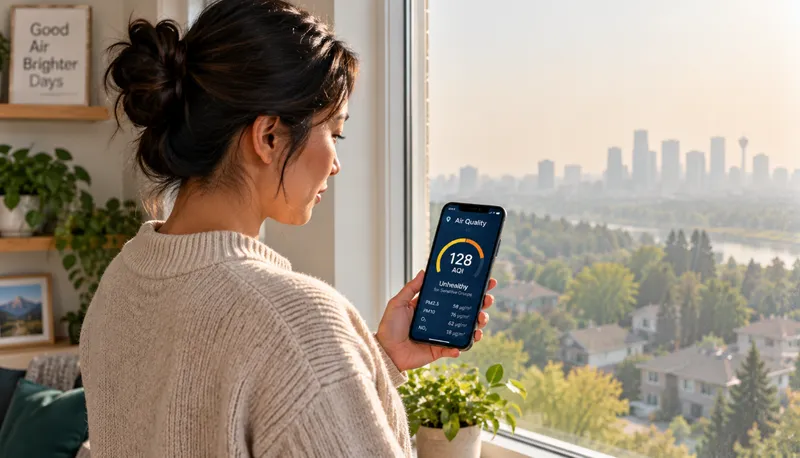
The Air Quality Health Index is a health-risk scale rather than a pollution measurement. Environment and Climate Change Canada (ECCC) calculates it from ground-level ozone, nitrogen dioxide and fine particulate matter, then reports it on a 1 to 10+ scale. Alberta enhances that calculation so it responds faster when conditions turn within the hour, and publishes separate AQHI resources and smoke guidance alongside the national index.
Filterbuy built the matrix below because the official guidance stops where the useful part starts: ECCC tells you what to do outdoors at each AQHI band, but nothing tells you what to change indoors. Pairing the two is our own work.
The Edmonton AQHI Indoor Action Matrix
The short version: at AQHI 7 or above, fit a MERV 13 filter in the HVAC, set the thermostat fan to On, run a portable HEPA air cleaner in each occupied room starting with bedrooms, and close the house up.
Outdoor guidance follows Environment and Climate Change Canada AQHI health messages. Filtration reduces what is in the air; it does not make indoor air safe or smoke-free, and it never displaces official guidance. During a smoke event, follow Alberta Health Services and Alberta Emergency Alert first.
Health Canada’s Guidance for Cleaner Air Spaces also notes that smoke overloads filters quickly, so keeping a spare on hand is planning rather than an upsell.
Why Is Edmonton Smoky When There Is No Fire Nearby?
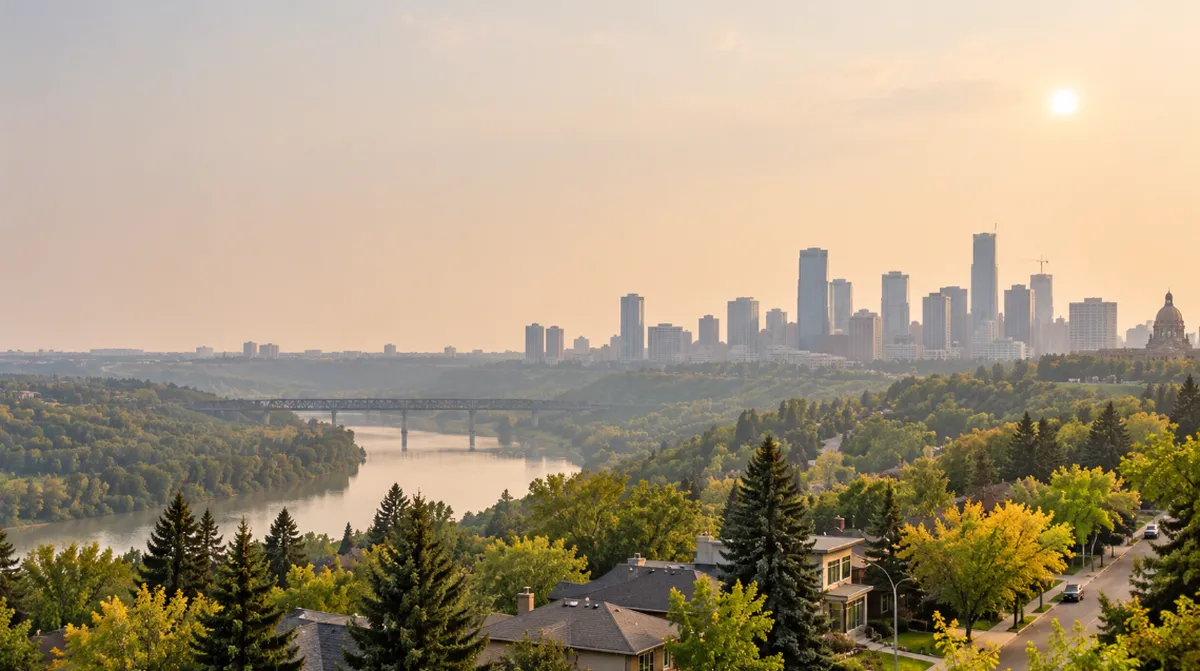
Wildfire smoke travels. Alberta’s Forest Protection Area covers 10 forest areas across the north and west, and prevailing winds carry smoke from those fires over the Capital Region, along with smoke from British Columbia, Saskatchewan and the Northwest Territories. Edmonton can sit under a dense plume while the nearest wildfire of note burns well outside the region, which is what the Alberta Capital Airshed picks up locally. For the provincial view, see Filterbuy’s Alberta-wide map.
Smoke season runs roughly June through September, precisely when the furnace is off and a filter is the last thing on anyone’s mind. That gap is worth planning around. For smoke from further afield, see the Canada-wide map.
What Is the Five-Minute Smoke-Day Routine for an Edmonton Home?
Check the AQHI for your part of the city. Readings differ from one Edmonton station to the next.
Check the FireSmoke.ca forecast. If the plume arrives tonight, act this afternoon rather than tomorrow.
Close windows, exterior doors and any fresh-air intake, then set the thermostat fan to On rather than Auto so the system filters continuously.
Run a portable HEPA cleaner in each occupied room, bedrooms first. The central system treats the whole house; a room unit treats one room harder.
Look at the filter. If it is visibly grey, replace it.
While the AQHI stays high, hold off on whatever adds particulate indoors: candles, incense, pan-frying, and vacuuming without a sealed HEPA vacuum.
Which MERV Rating Handles Wildfire Smoke in Edmonton?
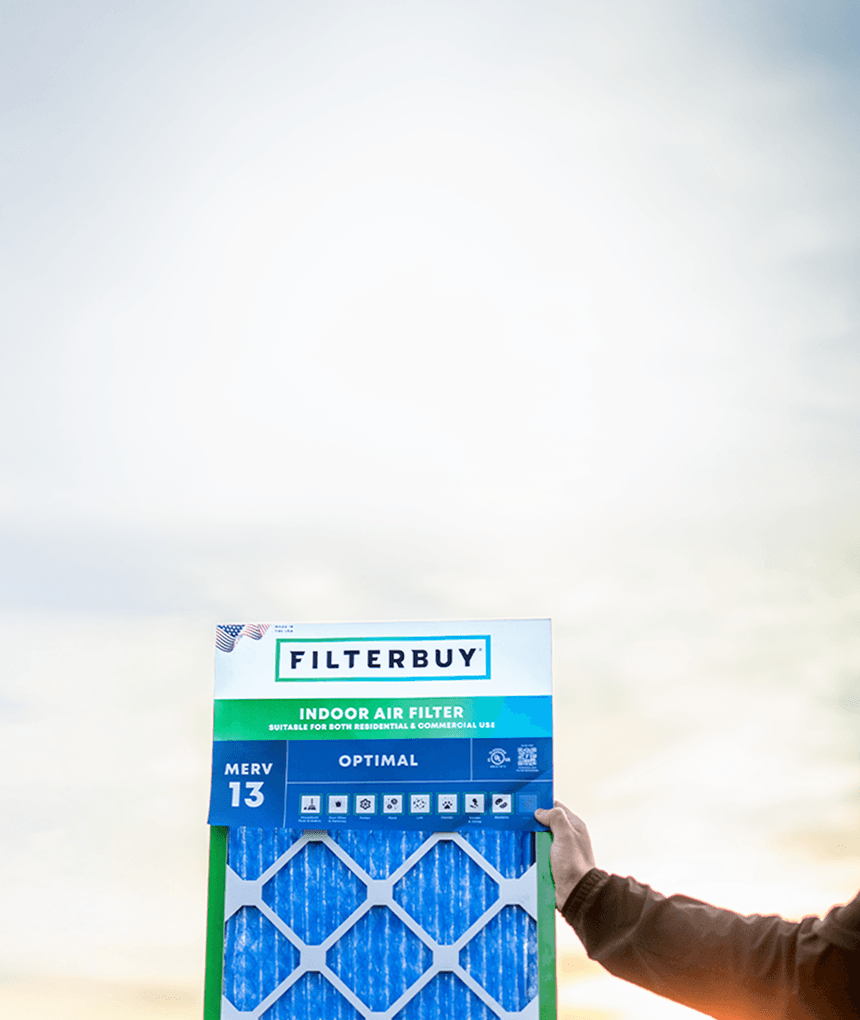
MERV 13 is the tier we recommend for wildfire smoke, and Filterbuy labels it Optimal. Health Canada recommends a filter rated MERV 13 or higher in a central system during smoke events. The US EPA notes that most furnaces and HVAC systems accommodate MERV 13 without equipment problems, provided the filter is replaced often.
Smoke maps to MERV 13 on the ladder. The US EPA notes most furnaces and HVAC systems accommodate MERV 13 without equipment problems, provided the filter is replaced often.
Sizes for each sit on the MERV 8, MERV 11, MERV 13 and Odour Eliminator pages.
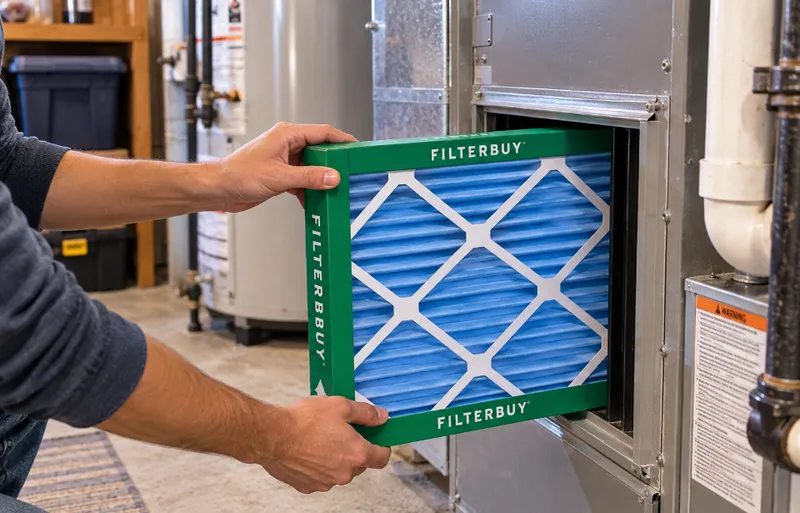
Fitting a MERV 13
Match the size printed on your current filter, the same fit check you would do for any replacement, and close the filter door so air cannot bypass the frame. Replacing it often is the condition that matters, and during smoke that means checking it rather than waiting for a date.
Where Filterbuy Lands
Health Canada and the US EPA both recommend MERV 13 or higher in a central system during smoke events. Neither sets an air-quality threshold for the switch. That part is ours: AQHI 7 is where Filterbuy tells Edmonton customers to move. Our guide to MERV ratings for wildfire smoke makes the case for getting MERV 13 in before the season rather than during it, which is the part most households miss, and running it through the weeks that matter puts the spend where the difference shows.
“The Edmonton households that get through smoke season comfortably are almost always the ones that sorted the filter out in spring, not the ones hunting for a size in August. It is the least dramatic advice we give, and the most useful.”
Filterbuy Canada Team
Does My HRV or Air Exchanger Let Smoke In?
Most Edmonton homes built in recent decades have a heat recovery ventilator. Natural Resources Canada notes modern Canadian homes rely on them because airtight construction leaves indoor air stale, and during a smoke event that same duct becomes a direct route indoors.
Rather than shutting the unit off, reduce the outdoor-air setting or switch to recirculation if yours allows it. NRCan advises leaving an HRV running except for servicing, since it also clears moisture and indoor pollutants, and an airtight house sealed for a smoky week has nowhere else to put either. Restore normal ventilation once the AQHI drops, and clean the ventilator’s filters, which NRCan puts at every one to three months.
How Do I Choose a Portable Air Cleaner?
Size it to the room. The US EPA’s clean-room guidance is a unit whose smoke CADR is at least two-thirds of the room’s floor area in square feet, so a 300 square foot bedroom wants a smoke CADR of roughly 200. Skip anything that makes ozone, including ionizers and ozone generators, which the EPA advises against.
A box-fan cleaner built with MERV 13 filters is a reasonable stopgap rather than a replacement for a certified unit. EPA research found the design effective, and it asks for a certified fan from 2012 or newer, with the unit never left running unattended.
What If You Have No Furnace Filter to Change?
Plenty of Edmonton households have no accessible filter at all: apartments, condos on baseboard heat, rented suites. For these homes a portable HEPA cleaner is the primary defence rather than a supplement. Every other smoke-day step still applies: windows and doors closed, fresh-air intakes shut, no candles or frying.
Filterbuy sells filters, so this is worth saying plainly: with no filter slot, a filter is not your answer. If you rent and the building has central ventilation, the filter belongs to the building, and whether it was changed before smoke season is a fair question for a landlord.
How Often Should I Change My Filter During Edmonton’s Smoke Season?
More often than during the rest of the year, and by inspection rather than by schedule. The usual interval assumes household dust rather than smoke.
Judge by appearance rather than by the calendar. Replace the filter once it looks dirty, dark brown or black, which under a heavy smoke load happens well before the normal interval. Two or three spares on hand matter more than the exact day count, since shipping slows region-wide during a major smoke event.
A Filterbuy subscription can be edited, skipped or cancelled at any time, which is one way to have a spare on the shelf before you need it.
Supporting Statistics
MERV 13 held indoor smoke particles well below MERV 8 in Alberta buildings. A study of 24 Alberta buildings measured indoor-to-outdoor PM2.5 at 0.12 with MERV 13, against 0.28 with MERV 8 (Afroz et al., ACS ES&T Air, 2025).
Canadian smoke has driven pollution spikes a continent away. Smoke from Canadian wildfires raised ozone and particle pollution across dozens of US states (American Lung Association, State of the Air 2026).
Portable air cleaners more than halved indoor smoke particles. Across ten wildfire-specific studies, they cut indoor PM2.5 by an average of 57 percent, range 5.3 to 99 percent (NCCEH and NCCMT rapid review, 2025).
Frequently Asked Questions
Glossary
AQHI (Air Quality Health Index): A Canadian 1-to-10+ health-risk scale from ECCC and Health Canada, from ground-level ozone, nitrogen dioxide and fine particulate matter.
BlueSky Canada: A University of British Columbia system producing hourly ground-level PM2.5 forecasts, published at FireSmoke.ca.
MERV (Minimum Efficiency Reporting Value): The North American scale for how effectively a filter captures airborne particles. Filterbuy labels MERV 8 Standard, 11 Superior and 13 Optimal.
PM2.5: Fine particulate matter 2.5 micrometres or smaller. The main health concern in wildfire smoke, and the size high-MERV filters target.
Sources: Alberta Wildfire Status · Alberta Wildfire Status Dashboard · ECCC Air Quality Health Index · Edmonton AQHI · Health Canada, Guidance for Cleaner Air Spaces during Wildfire Smoke Events · FireSmoke.ca / BlueSky Canada, UBC · Natural Resources Canada · US EPA · Alberta Capital Airshed
This page is general guidance on indoor air filtration, not medical advice. For health concerns during a smoke event, consult Alberta Health Services or your physician.
Questions? Filterbuy Canada · (855) 345-8289 · info@filterbuy.com · 96 Carrier Dr, Toronto, ON M9W 5R1