
Regina Real-Time AQI Tracker
What's Actually In Regina Air Today?
What High AQI Means for Your Lungs in Regina
How to Read AQI
The Air Quality Index (AQI) measures how polluted the air is and how it may affect your health.
0–50 (Good): Air quality is satisfactory.
51–100 (Moderate): Acceptable, but some pollutants may pose minor concerns.
101–150 (Unhealthy for Sensitive Groups)
151–200 (Unhealthy)
201–300 (Very Unhealthy)
301+ (Hazardous)
Moderate
Still okay for most, but if you have asthma or allergies, take it easy and avoid long outdoor workouts.
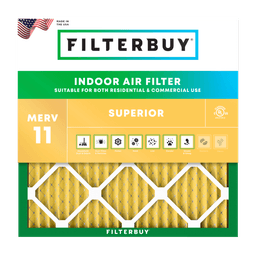
Shop MERV 11 filters→What's the Right Filter for Your AQI Level?



Check Today's Live Real Time Air Quality Index AQI Map in Regina, SK Now
Author: Michelle Wan | Reviewed by: David Clark, Licensed HVAC Technician | Published: August 1, 2026
TL;DR
Regina’s air quality is reported two ways, both correct. Environment and Climate Change Canada publishes the Air Quality Health Index (AQHI) on a 1-to-10+ scale; most apps show a US-EPA Air Quality Index (AQI) on a 0-to-500 scale, converted from the same Saskatchewan data. Read the live map above, then the action table below.
Key Takeaways
Canada reports Regina on the AQHI (1 to 10+), not the US AQI (0 to 500). The AQHI blends ozone, nitrogen dioxide and PM2.5 into one health-risk number. See the current reading.
The scales are not interchangeable. ECCC states they were built for different purposes and should not be compared.
The AQHI is a three-hour average, so it can lag a fast-moving smoke plume. If you smell smoke, act before the number moves.
Wildfire smoke is Regina’s biggest variable: 184 hours of it in 2021, the highest since records began in 1953 (Global News). Health Canada recommends MERV 13 or higher against smoke PM2.5.
AQHI 4 is the watch level for at-risk residents: asthma or heart conditions, seniors, young children, outdoor workers. Check if that is you.
What Is the Air Quality in Regina Today?
Regina’s current AQHI appears in the live map at the top of this page, updated hourly from the Saskatchewan monitoring network. Values of 1 to 3 mean low health risk, 4 to 6 moderate, 7 to 10 high, and above 10 very high. Most Regina days sit in the low band; summer smoke is the exception. For the official figure and forecast, see the ECCC Regina AQHI page.
Why Does Regina’s AQI Differ From the Official AQHI?
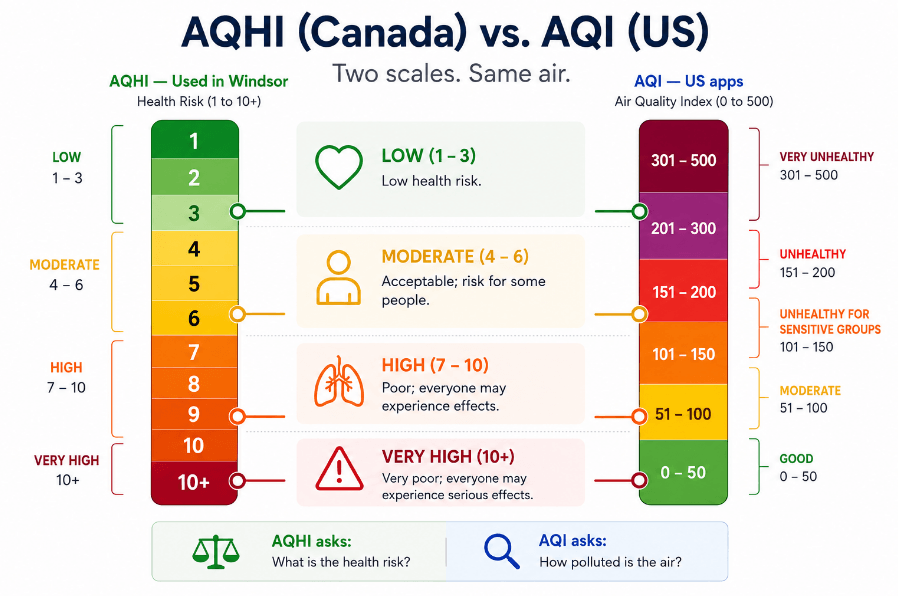
They are two indices measuring different things, and neither is wrong. The AQHI is Canada’s official measure, combining ozone, nitrogen dioxide and PM2.5 into one short-term health-risk score. The AQI is the American system, reporting whichever single pollutant is worst. Global apps pull raw readings from the Saskatchewan network and convert them to the US-EPA scale, so an app may read 69 while the official AQHI reads 3 in the same hour. Our Canada-wide map compares the scales in full.
Regina AQHI Bands and What They Mean
Band labels follow Environment and Climate Change Canada. The AQI column is an approximate action-band alignment only; the two indices were built for different purposes and are not directly convertible.
Why the Number Can Trail the Smoke
A low AQHI is not proof of clean air right now. It is an accurate summary of the last three hours. The classic index is calculated from a three-hour moving average of ozone, nitrogen dioxide and PM2.5, so a fast-arriving plume still carries two hours of cleaner air before it. British Columbia found the classic index showed low scores as plumes rolled in, and now runs a PM2.5-driven version, AQHI-Plus, adopted province-wide in 2021.
The Two-Minute Cross-Check for Regina
If you can see or smell smoke but the AQHI looks low, check the raw number before deciding your day.
Open the Saskatchewan station map and read the raw hourly PM2.5 for Regina.
Compare it with the AQHI on the map above.
If PM2.5 is climbing while the AQHI sits still, that is the lag, not clean air.
Act on the higher of the two: close the windows and start the fan.
This is why station-level pollutant data matters: it is the only way to watch PM2.5 move in real time. If you can smell smoke in Regina, you do not need a number to shut the windows.
What Affects Regina’s Air Quality Through the Year?
Wildfire smoke drives most of Regina’s air pollution today; the rest of the calendar loads a filter differently. In July 2026, ECCC meteorologist Stephen Berg reported smoke reaching Regina from B.C. and Pacific Northwest fires (980 CJME).
What Should You Do at Each AQHI Level in Regina?
Match your response to the band. This pairs ECCC’s outdoor guidance with the indoor step most Regina homes miss. At-risk residents (asthma or heart conditions, seniors, young children, outdoor workers) treat 4 as their watch level.
How Do You Protect Indoor Air Quality in a Regina Home?
Your furnace filter is the only whole-home air cleaner most Regina houses already own. Filterbuy is a filter manufacturer, not a monitoring agency: we have made pleated filters since 2013, in over 600 sizes, and every guide here is reviewed by David Clark, a Licensed HVAC Technician. What we can speak to is what happens indoors after the number goes up.
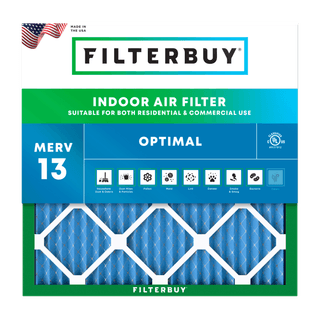
Health Canada’s cleaner air spaces guidance recommends filters rated MERV 13 or higher against smoke PM2.5. That guidance is written for community buildings; its home advice is to fit a high-quality filter and set the system to recirculate. Three things matter more than brand:
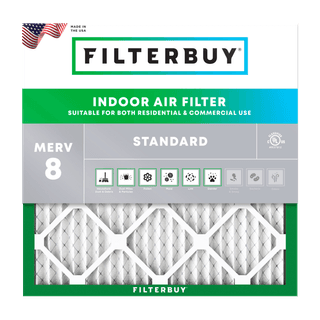
Rating. MERV 13 (Optimal) for smoke, MERV 11 (Superior) year-round for pets or allergies, MERV 8 (Standard) for everyday dust.
Fit. A gap lets air bypass the media entirely. Measure the slot, then find your size or order custom.
Timing. Regina furnaces run 6 to 8 months a year. During active smoke, inspect every one to two weeks instead of waiting out 90 days. Subscribe & Save keeps a spare on hand.
Confirm your system can take MERV 13 first. Older furnaces with PSC blower motors can struggle with the resistance, and a technician can check static pressure in one visit. If yours cannot, a DIY box-fan cleaner is a proven single-room fallback. For lingering smell, the Odour Eliminator adds activated carbon. Free shipping to Canada, prices in CAD.
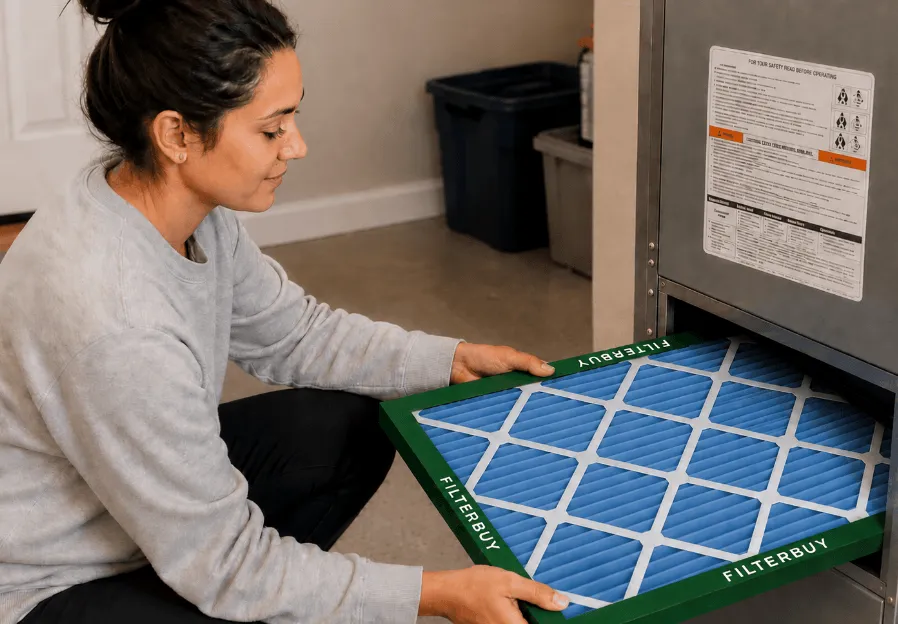
We make filters, not forecasts. Our vantage point is the second half of the story: what happens indoors after the number goes up. The reading outside your window is not yours to control. The air on your side of it is.
— Michelle Wan, Filterbuy
Essential Resources for Tracking Regina’s Air Quality
Seven official sources, in the order you need them.
Get Regina’s Official Number, Updated Hourly
Environment and Climate Change Canada, station skaq-001. The official hourly AQHI and forecast. The number of record when an app disagrees.
Compare Regina With the Rest of Saskatchewan
Environment and Climate Change Canada, provincial summary. Current values for every community, separating a Regina problem from a province-wide one.
See Which Pollutant Is Driving Today’s Reading
Government of Saskatchewan, Ambient Air Quality Data. Station-level readings by pollutant: the raw layer beneath both indices.
Check Whether Smoke Is Heading for Regina
FireSmoke.ca, BlueSky Canada, University of British Columbia. A 48-hour ground-level PM2.5 forecast. Experimental, so read it as direction of travel.
Find Active Smoke Alerts Before You Plan
Saskatchewan Public Safety Agency. Provincial alerts during an active fire or smoke event.
Work Out Whether Today’s Air Affects You
Government of Canada, AQHI health risks. Who is most affected, and at which value to change plans.
Learn Which Filter Rating Canada Recommends
Health Canada, cleaner air spaces guidance. The MERV 13 recommendation and indoor ventilation advice.
Supporting Statistics
1. Wildland fires produce 52% of all PM2.5 emitted in the United States.
Figure from the EPA 2020 National Emissions Inventory.
That is more than every industrial and transport source combined.
Source: 2020 National Emissions Inventory (NEI) Data – U.S. EPA
2. Closed windows still leave indoor PM2.5 at 55–60% of outdoor levels.
Measured during smoke events with no air cleaner running. Range across homes: 30% to 100%.
In Regina: shutting the windows is step one, not the answer.
Source: EPA, Strategies to Reduce Exposure Indoors
3. MERV 13 more than halved indoor particulate versus MERV 8.
Indoor-to-outdoor PM2.5 ratio 0.12 against 0.28 across 24 Alberta buildings in wildfire smoke. 71% breached Canada’s 27 µg/m³ daily limit.
In Regina: Prairie evidence for the rating Health Canada recommends.
Source: Afroz et al., ACS ES&T Air, 2025, via the National Library of Medicine
Frequently Asked Questions
Glossary
| Term | Definition |
|---|---|
| Air Quality Health Index (AQHI) | Canada's official 1-to-10+ scale measuring combined short-term health risk from ozone, nitrogen dioxide and PM2.5 using a three-hour average. |
| Air Quality Index (AQI) | The U.S. EPA's 0-to-500 scale reporting the single worst pollutant. Most global air quality apps convert Canadian data to this scale. |
| PM2.5 | Fine particulate matter measuring 2.5 micrometres or smaller. It is the dominant pollutant in wildfire smoke and the particle size that travels deepest into the lungs. |
| MERV | Minimum Efficiency Reporting Value, the North American filter efficiency rating system. Higher numbers capture smaller airborne particles. |
| MERV 13 (Optimal) | Filterbuy's highest residential filter rating and the minimum level recommended by Health Canada for wildfire smoke. |