
Sherbrooke Real-Time AQI Tracker
What's Actually In Sherbrooke Air Today?
What High AQI Means for Your Lungs in Sherbrooke
How to Read AQI
The Air Quality Index (AQI) measures how polluted the air is and how it may affect your health.
0–50 (Good): Air quality is satisfactory.
51–100 (Moderate): Acceptable, but some pollutants may pose minor concerns.
101–150 (Unhealthy for Sensitive Groups)
151–200 (Unhealthy)
201–300 (Very Unhealthy)
301+ (Hazardous)
Moderate
Still okay for most, but if you have asthma or allergies, take it easy and avoid long outdoor workouts.
Shop MERV 11 filters→What's the Right Filter for Your AQI Level?




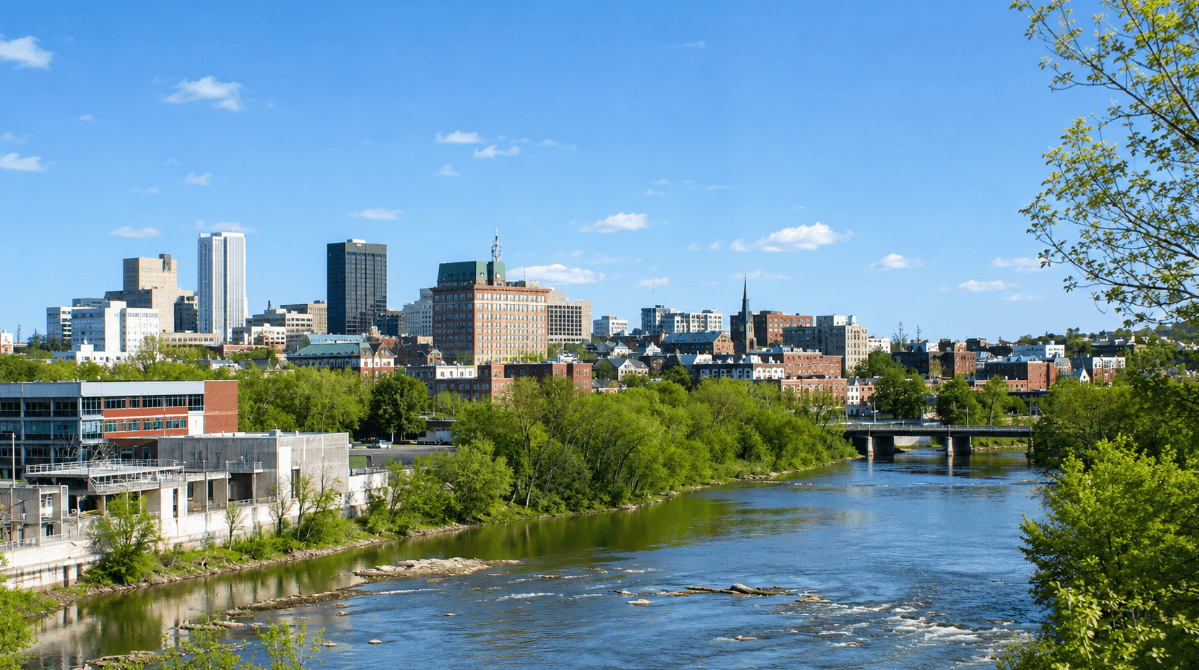
Check Today's Live Real Time Air Quality Index AQI Map in Sherbrooke, QC Now
By Michelle Wan | Reviewed by David Clark, Licensed HVAC Technician | Published 10 August 2026 | Updated 10 August 2026
TL;DR
Sherbrooke's air rates are good or acceptable on most days of the year, with poor-air episodes concentrated in winter evenings and wildfire smoke season, but the number you see depends on which index you read. Québec publishes an hourly IQA for the Sherbrooke – Parc Sylvie-Daigle station, rated in three bands: good, acceptable, or poor, while most international apps show the American-style AQI on a 0–500 scale. The IQA is an hourly reading of conditions right now, not a forecast. For warnings, Québec and Environment and Climate Change Canada issue Info-Smog bulletins covering southern Québec. Check the live map above, then match what you do indoors to the reading.
Sherbrooke's Live Air Quality Map
The map above shows conditions in and around Sherbrooke, in Quebec’s Estrie region, updated hourly. For the wider view, see the live air quality index AQI map for Canada.
Key Takeaways
Québec's official hourly index comes from the Sherbrooke – Parc Sylvie-Daigle station: 25 or below is good, 26 to 50 acceptable, 51 or higher poor.
Québec is the one province that doesn't use Canada's federal AQHI. It runs its own Air Quality Index (IQA) and the Info-Smog programme instead. Environment and Climate Change Canada publishes AQHI forecasts for just three Québec cities — Gatineau, Montréal and Québec — and Sherbrooke isn't one of them. Your local number is the IQA.
Residential wood heating accounts for 14.0% of Québec's human-caused fine particle emissions over a full year (2022 provincial inventory), and the Ministère de l'Environnement identifies it as the leading source of fine particles in winter specifically.
Wildfire smoke now produces Estrie's most severe poor-air episodes, while wood heating remains the steadier winter influence. Summer 2023 pushed Sherbrooke above Québec's 30 µg/m³ daily standard on three to four days — modest next to northern stations, but a record for a city that rarely exceeds it at all.
Why Sherbrooke Shows Three Different Air Quality Numbers
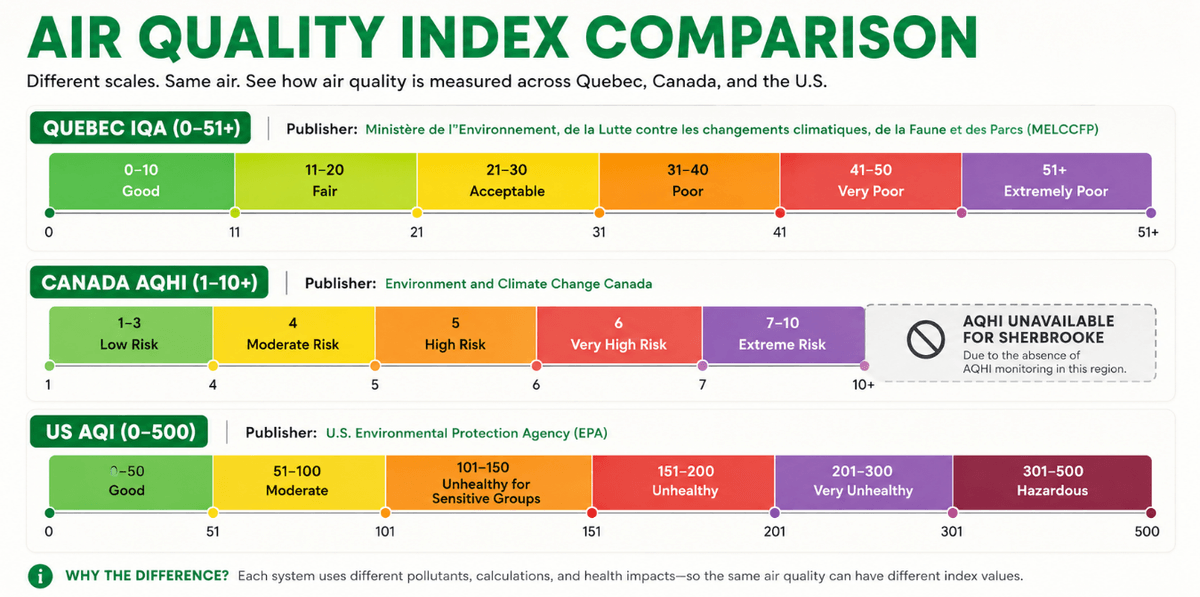
We started this page expecting to publish Sherbrooke’s AQHI. There isn’t one. We checked Environment and Climate Change Canada’s Quebec forecast list on 27 July 2026. It gave us Gatineau, Montreal and Quebec City, then stopped. That explains the confusion here. Two different numbers describe Sherbrooke's air, a third doesn't exist locally at all, and 46 on one scale is not 46 on another.
AQHI coverage confirmed against the Environment and Climate Change Canada Quebec summary, 27 July 2026. Re-verify at each content refresh.
For the official Quebec reading, look up the IQA for Sherbrooke - secteur est. An international app is showing a US AQI number. It runs on a wider scale, so it reads higher for the same air and more importantly, the two systems don't agree on where "good" ends.
One wrinkle we hit: the ministry's IQA explainer is available in English, but the live map opens in French. The station names are readable either way, look for Sherbrooke – Parc Sylvie-Daigle. Separately, Info-Smog bulletins for southern Québec are published in English and will tell you when a smog episode is underway.
“The gap that surprised me here is that Sherbrooke has no AQHI at all. Residents get a Quebec IQA number, their phone shows a US-scale number, and the two do not agree. Which one you are reading decides whether you shut the windows at the right time or shut them for nothing.”
Michelle Wan, Brand Manager and Air Quality Writer, Filterbuy
Source: Ministere de l'Environnement (Quebec), Le chauffage au bois; Environment and Climate Change Canada smog statements for the Estrie region.
Wood heating. Wood burning is 14.0% of human-caused fine particulate emissions in Quebec and leads in winter, per Quebec's guidance on residential wood heating. The ministry measured winter PM2.5 in Sherbrooke and five other Quebec cities from 2019 to 2021 and found two daily peaks, the longer one in the evening as households restart stoves. Winds drop, dispersion weakens, smoke settles near the ground. Rural stations show no such pattern, pointing to local burning. Read practically, that reshapes the advice most guides give. Across the six cities the ministry studied, Sherbrooke included, winter fine-particle levels peaked in the evening rather than at midday. On that pattern, late morning is the better window for airing out the house during heating season.
Wildfire smoke. Smoke travels hundreds of kilometres, so Sherbrooke can have a poor air day with no fire near the Eastern Townships. In June 2023, Environment and Climate Change Canada data put fine particle concentrations at Sherbrooke around 139 ug/m3, and Santé Québec Estrie – CHUS issued smoke-related public health guidance during that period. Santé Québec Estrie – CHUS, July 26, 2025
What To Do At Each Air Quality Level In Sherbrooke
Match your response to the reading. Guidance follows the health messages published with Québec's IQA by the Ministère de l'Environnement.
Smoke-specific advice from Santé Québec Estrie – CHUS. It is general information, not medical advice.
If your app shows a US AQI number instead. The two scales don't line up, and the gap matters most at the low end. Québec's "good" band runs up to roughly 67 on the US scale – well into what an American app calls "moderate." Québec's "acceptable" band tops out near 100. The scales also average over different periods: Québec uses a three-hour window for fine particles, US apps typically a 24-hour one, so during a fast-moving smoke plume the two numbers can disagree sharply even when the air is identical. Treat any conversion as approximate, and use the Québec reading when you need to decide something.
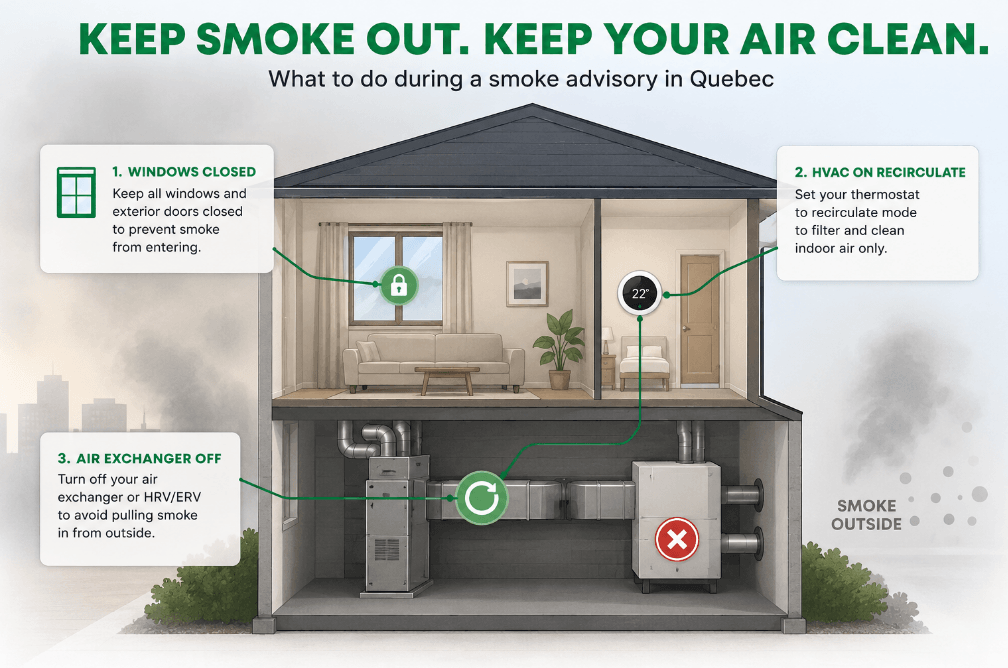
That last point matters more in Quebec than almost anywhere else in Canada. Air exchangers (HRV and ERV units) are common here and draw outdoor air in continuously. During a smoke advisory, Estrie public health recommends shutting the exchanger off.
Clean Indoor Air In A Sherbrooke Home
Your furnace filter is the one air cleaning system almost every Sherbrooke home already owns, and across an October-to-April heating season it moves a lot of air. We make these filters at Filterbuy, so treat the capture rates as ours.
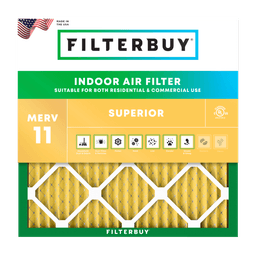
MERV 11 Superior filters capture 95% of airborne particles and suit most households through pollen season, pets included.
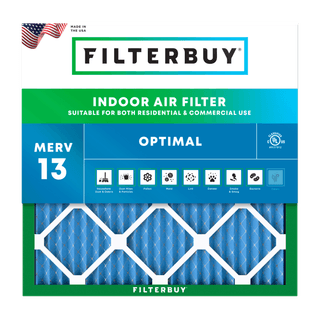
MERV 13 Optimal furnace filters capture 98% of airborne particles and are the choice for smoke season, catching what lower ratings let through.
Odour Eliminator carbon filters use carbon-infused media for wood smoke and cooking odours, useful when windows stay shut for months.
Change filters more often during smoke; a 90-day filter can load up in weeks.
Check airflow before moving up a rating; older furnaces struggle with denser filters. Our guide to how MERV ratings are measured explains it; the step-by-step filter replacement guide covers the swap.
Filterbuy makes pleated filters in 600+ sizes, including custom filter sizes, ships free across Canada, and prices in CAD. A Subscribe & Save delivery schedule can be edited, skipped, or cancelled anytime.
If you rent, or live in a condo
Most filter advice assumes you own the furnace. Plenty of Sherbrooke households do not. If the heating and ventilation are the building’s, three things still sit with you.
Keep windows shut on smoke days, and ask whether your unit has an air exchanger you can switch off.
Run a portable air cleaner in the room you sleep in. One well-placed unit beats none.
Ask your building manager when the central filter was last changed. If the answer is vague, EPA’s box fan and MERV 13 filter design is a cheap fallback. It calls for a 20x20x1 MERV 13, a size Filterbuy stocks, a 2012-or-newer fan, and a fresh filter as soon as the old one darkens.
Supporting Statistics
Canada and the US use the same MERV standard for filters, so American filtration research applies directly to a Sherbrooke furnace. Air quality standards differ between the two countries, so the three findings below are cited as supporting research, not as measurements of Sherbrooke air. Three US findings back the advice above.
1. People spend about 90% of their time indoors.
Indoors, some pollutants run 2 to 5 times outdoor levels.
Children, older adults, and people with heart or lung disease spend longer inside.
Why it matters: your furnace filter is the lever you control, not the outdoor number.
Source: EPA Report on the Environment, Indoor Air Quality
2. A high-efficiency filter cuts indoor PM2.5 by about 50%.
That assumes the HVAC fan runs continuously, not on auto.
A low-efficiency filter, run the same way, manages about 24%.
EPA also advises MERV 13 or higher and closing the fresh-air intake, echoing the Estrie air exchanger advice.
Source: EPA, Strategies to Reduce Exposure Indoors
3. 61.5 million people live in US counties graded F for particle spikes.
Down 15.6 million from the previous report, but still far above the 35.1 million low recorded in 2018.
The 2026 report links the elevated baseline to wildfire smoke, including smoke crossing from Canada.
Sherbrooke sits on the receiving end of the same smoke.
Source: American Lung Association, State of the Air 2026 key findings
US figures, cited as supporting research, not measurements of Sherbrooke air.
Frequently Asked Questions
Sources
Glossary
AQI (Air Quality Index): A 0–500 scale from the US Environmental Protection Agency, used by most international apps.
AQHI (Air Quality Health Index): Canada's federal 1 to 10+ scale for combined short-term health risk from ozone, nitrogen dioxide and fine particles.
IQA (Indice de la qualité de l'air): Québec's provincial hourly index, calculated from the highest pollutant sub-index at a station. Good is 25 or below, acceptable is 26 to 50, poor is 51 or higher.
PM2.5: Fine particulate matter 2.5 micrometres or smaller, small enough to reach deep into the lungs. Wood and wildfire smoke are major sources.
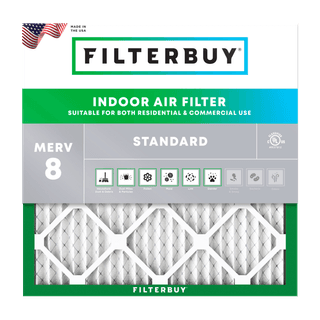
MERV (Minimum Efficiency Reporting Value): The ASHRAE scale for how well a filter captures particles. Filterbuy labels MERV 8 Standard, MERV 11 Superior, MERV 13 Optimal.
Sherbrooke – Parc Sylvie-Daigle: The Ministère de l'Environnement monitoring station produces Sherbrooke's official IQA. It opened in March 2023, replacing the Parc Adrien-Cambron station, and measures fine particles and ozone.
About This Page
Michelle Wan is Brand Manager and Air Quality Writer at Filterbuy, covering AQI trends, wildfire smoke, and indoor air quality across the resource library. She holds a B.A. in Sociology from the University of California, Santa Cruz, and also presents Filterbuy’s educational video content.
David Clark is a licensed HVAC technician and HVAC Specialist with Filterbuy HVAC Solutions. He reviewed the filtration and airflow guidance on this page for technical accuracy.