
Windsor Real-Time AQI Tracker
What's Actually In Windsor Air Today?
What High AQI Means for Your Lungs in Windsor
How to Read AQI
The Air Quality Index (AQI) measures how polluted the air is and how it may affect your health.
0–50 (Good): Air quality is satisfactory.
51–100 (Moderate): Acceptable, but some pollutants may pose minor concerns.
101–150 (Unhealthy for Sensitive Groups)
151–200 (Unhealthy)
201–300 (Very Unhealthy)
301+ (Hazardous)
Moderate
Still okay for most, but if you have asthma or allergies, take it easy and avoid long outdoor workouts.
Shop MERV 11 filters→What's the Right Filter for Your AQI Level?




Check Today's Live Real Time Air Quality Index AQI Map in Windsor, ON Now
TL;DR
Windsor's air quality is reported on Canada's Air Quality Health Index (AQHI), a 1 to 10+ health-risk scale, not the 0 to 500 AQI used by most American apps. Two provincial stations, Windsor Downtown and Windsor West, publish live readings hourly through Air Quality Ontario and Environment and Climate Change Canada. Most days Windsor sits at low risk, and ground-level ozone — not dust or smoke — usually pushes the number higher.
Key Takeaways
The AQHI is Canada's official air quality scale: 1 to 3 is low risk, 4 to 6 moderate, 7 to 10 high, above 10 very high.
Ontario replaced the Air Quality Index with the AQHI in June 2015. A Windsor “AQI” in an app is a US-style conversion, not the official provincial reading.
Windsor has two provincial monitoring stations, Windsor Downtown and Windsor West, which can report different values in the same hour.
Windsor's average daily AQHI was 2.9 from 2016 to 2019, with 82 per cent of days at low risk.
Ground-level ozone led Windsor's daily AQHI on 88 per cent of days. Fine particulate matter led on fewer than 1 per cent.
Air arriving from the west and southwest carries a 28 to 33 per cent chance of a moderate-risk day — roughly double the odds from the north.
What Is The Air Quality In Windsor Today?
Windsor's current air quality is published as an AQHI value from 1 to 10+ by the Ontario Ministry of the Environment, Conservation and Parks and by Environment and Climate Change Canada. Readings update hourly from two stations, Windsor Downtown and Windsor West. A reading of 1 to 3 means low health risk, and most people can carry on outdoors as usual.
The live module above pulls the current reading. To go straight to the source, Air Quality Ontario publishes Windsor readings at airqualityontario.com, and Environment and Climate Change Canada adds a forecast maximum at weather.gc.ca.
Here is what each band means for the two audiences the AQHI addresses.
Health messages adapted from Environment and Climate Change Canada, Understanding Air Quality Health Index messages.
Ontario designates the 4 p.m. reading as the official daily AQHI, so an afternoon check is closest to the number that enters the record.
Windsor AQI Vs. AQHI: Why The Two Numbers Never Match
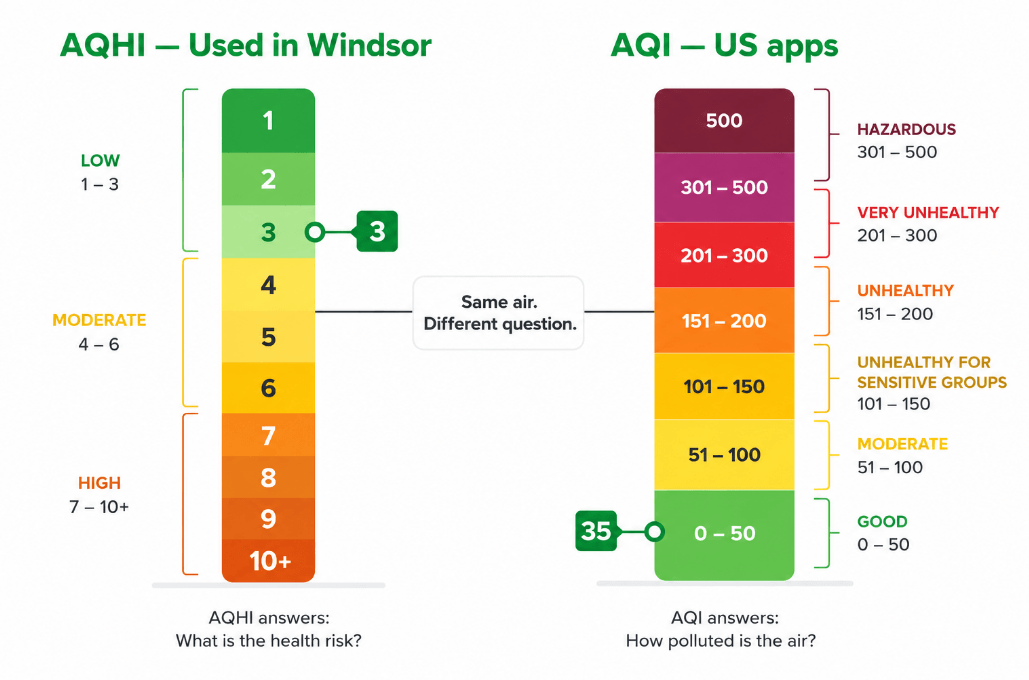
Windsor does not report a US-style AQI. Ontario retired the Air Quality Index in June 2015, replacing it with the Air Quality Health Index. The AQI is concentration-based and reports whichever single pollutant sits highest against its standard, on a 0 to 500 scale. The AQHI is risk-based and adds three pollutants together on a 1 to 10+ scale.
This is the biggest source of confusion for Windsor residents. An app built for an American audience may show Windsor at 35 while Air Quality Ontario shows 3 in the same minute. Both are correct; they answer different questions.
The two scales cannot be converted into each other with any precision, because they are built from different pollutants and different maths. For the number Ontario health advice is written against, use the AQHI.
Windsor Air Quality Map: Which Monitoring Station Is Closest To You
Windsor has two provincial ambient air monitoring stations. Windsor Downtown sits near the riverfront in a densely populated area, at roughly 42.316 degrees north, 83.044 degrees west. Windsor West sits in the west end, nearer the border crossings and the industrial corridor. Because nitrogen dioxide comes largely from nearby traffic and disperses within hours, the two stations can genuinely differ.
Downtown or Walkerville: use Windsor Downtown.
Sandwich, West Windsor, or near Huron Church Road: use Windsor West.
Worth watching: the Gordie Howe International Bridge opened on 27 July 2026, routing trucks to Highway 401 via the Herb Gray Parkway rather than Huron Church Road. Whether that shifts nitrogen dioxide readings at Windsor West is a question the monitoring data will answer in coming months.
What Actually Drives Windsor's Air Quality?
Ground-level ozone drives Windsor's air quality more than anything else. In a University of Windsor analysis of four years of Windsor Downtown readings, ozone led the daily AQHI on 88 per cent of days, nitrogen dioxide on 12 per cent, and PM2.5 on fewer than 1 per cent. Ozone is not emitted directly — it forms when sunlight cooks other pollutants, which is why Windsor's warmest afternoons carry its highest numbers.
Much of that raw material arrives from elsewhere. Ontario's transboundary assessment attributes more than 80 per cent of Windsor's annual PM2.5, and close to 40 per cent of ozone on high-ozone days, to sources outside Canada — chiefly the industrial American Midwest and Ohio River Valley upwind.
That leads to a rule of thumb you can use.
Trajectory analysis from Zhang, Chen, Tan and Xu (2021), Atmosphere 12(10), University of Windsor.
When a slow-moving high-pressure system parks over the lower Great Lakes and the wind swings southwest, Windsor's number climbs. A northerly flow brings it down. Checking wind direction alongside the AQHI tells you more about tomorrow than the number alone tells you about today.
Is The Air Quality Bad In Windsor Today, Or Generally?
Windsor's air quality is better than its industrial reputation suggests, and it has been improving. The Windsor Downtown station averaged an AQHI of 2.9 across 2016 to 2019, with 82 per cent of days in the low-risk band, and the annual average fell from 2.95 to 2.81.
The honest caveat is that Windsor still ranks near the top of Ontario for fine particulate matter, reporting the province's second-highest value against the Canadian Ambient Air Quality Standards among 24 stations in 2019. Windsor sits at the southern tip of the Quebec City to Windsor corridor, across the river from Detroit, and geography does not change.
Seasonally, the pattern runs opposite to expectation. Windsor's AQHI averaged 3.1 in the warm season, April through September, and 2.6 in the cold season. Summer, not winter, asks the most of sensitive residents.
What A Furnace Filter Can And Cannot Do About Windsor's Air
A pleated furnace filter captures particles. It does not remove gases. That distinction matters in Windsor, because ozone and nitrogen dioxide — the two pollutants driving most of the city's AQHI variation — are gases. No MERV rating changes that, and any filter marketed as if it does is overstating its case.
Ozone and nitrogen dioxide need carbon media, ventilation or source control, not particle filtration. Filterbuy's carbon-infused Odour Eliminator media targets the odour component.
So when does a better filter earn its keep here? On days when particles are the problem: wildfire smoke, spring pollen, road dust, pet dander, and the recirculated air of a house sealed up from October to April.
There is a second job worth naming. Your filter's original purpose is protecting the equipment behind it. Where furnaces run six to eight months a year, a clean filter keeps airflow steady and the blower in its design range.

Choosing A Filter For A Windsor Home
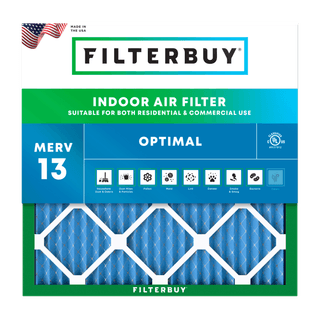
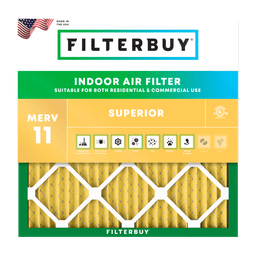
For most Windsor homes, MERV 11 Superior is the sensible default. It captures pollen, dust mites, mould spores, and pet dander without the airflow trade-off a higher rating can create in older equipment. MERV 13 Optimal is the upgrade to make before wildfire smoke season, since it captures fine smoke particles MERV 8 largely passes through.
Two practical notes. Check your filter monthly during heating season rather than trusting a calendar reminder — a Windsor furnace running October through April loads one faster than in a milder climate. And if you are upgrading to MERV 13 with older ductwork, ask your HVAC technician to confirm your blower can handle it.
Filterbuy makes every filter in our own American facilities and ships free to Canada with no minimum order, in over 600 sizes including custom. Prices are shown in CAD.
Supporting Statistics
Three findings behind this page, from U.S. federal and public-health sources. Windsor breathes largely American air, so American data describes it directly.
1. Detroit ranks 9th worst in the U.S. for year-round particle pollution.
Also 11th worst for short-term PM2.5.
Wayne County graded F for ozone, on 2022 to 2024 data.
Why it matters: that metro sits across the river, sharing Windsor's airshed.
Source: American Lung Association, State of the Air 2026
2. People spend about 90 per cent of their time indoors.
Indoor levels of some pollutants run 2 to 5 times outdoor levels.
Why it matters: the AQHI covers outdoor air. Your filter governs the rest.
Source: U.S. EPA, Report on the Environment
3. EPA rates MERV 13 at 50 per cent capture for the finest particles.
Finest means 0.3 to 1.0 microns.
MERV 11 manages 20 per cent of the same range.
EPA also states particle filters cannot control gases.
Why it matters: a real number for particles, nothing for ozone.
Sources: U.S. EPA MERV ratings and Guide to Air Cleaners in the Home
Frequently Asked Questions
Sources
Zhang, Chen, Tan & Xu (2021). Air Quality in Windsor (Canada) and Impact of Regional Scale Transport. Atmosphere, 12(10), 1300. University of Windsor.
Environment and Climate Change Canada — Understanding AQHI messages.
Air Quality Ontario — Windsor Downtown and Windsor West station data.
Ontario Ministry of the Environment — Transboundary Air Pollution in Ontario.
Windsor-Detroit Bridge Authority — Gordie Howe bridge opening, 27 July 2026.
Glossary
| Term | Definition |
|---|---|
| AQHI (Air Quality Health Index) | Canada's official air quality scale from Health Canada and Environment and Climate Change Canada. It combines ozone, nitrogen dioxide and PM2.5 into one number from 1 to 10+ representing short-term health risk. |
| AQI (Air Quality Index) | A concentration-based scale ranging from 0 to 500 in the United States, reporting whichever single pollutant is highest relative to its standard. Ontario used a version until June 2015. |
| PM2.5 (Fine particulate matter) | Airborne particles 2.5 micrometres or smaller, small enough to reach deep into the lungs. Sources include combustion, wildfire smoke and road dust. |
| Ground-level ozone (O3) | A gas formed when sunlight reacts with nitrogen oxides and volatile organic compounds. It is the leading contributor to Windsor's daily AQHI. |
| Nitrogen dioxide (NO2) | A traffic- and combustion-related gas with a short atmospheric lifetime, which is why readings vary between neighbourhoods. |
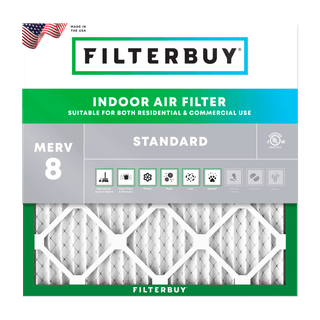
| MERV (Minimum Efficiency Reporting Value) | A 1 to 16 scale rating how well a filter captures particles of specified sizes. Filterbuy labels MERV 8 Standard, MERV 11 Superior and MERV 13 Optimal. |
| CAAQS (Canadian Ambient Air Quality Standards) | National outdoor air quality objectives for pollutants including PM2.5 and ozone, used to track long-term performance. |
| Air Quality Ontario | The Ontario Ministry of the Environment, Conservation and Parks service publishing real-time and historical AQHI readings. |
| Transboundary pollution | Air pollution crossing an international border. More than 80 per cent of Windsor's annual PM2.5 is attributed to sources outside Canada. |