
Burlington Real-Time AQI Tracker
What's Actually In Burlington Air Today?
What High AQI Means for Your Lungs in Burlington
How to Read AQI
The Air Quality Index (AQI) measures how polluted the air is and how it may affect your health.
0–50 (Good): Air quality is satisfactory.
51–100 (Moderate): Acceptable, but some pollutants may pose minor concerns.
101–150 (Unhealthy for Sensitive Groups)
151–200 (Unhealthy)
201–300 (Very Unhealthy)
301+ (Hazardous)
Moderate
Still okay for most, but if you have asthma or allergies, take it easy and avoid long outdoor workouts.
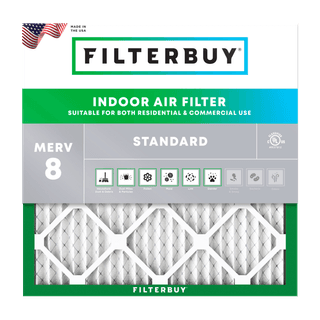
Shop MERV 11 filters→What's the Right Filter for Your AQI Level?



Check Today’s Live Real Time Air Quality Index AQI Map in Burlington, ON Now
By Michelle Wan · Reviewed by David Clark, Licensed HVAC Technician · Published 1 August 2026
TL:DR
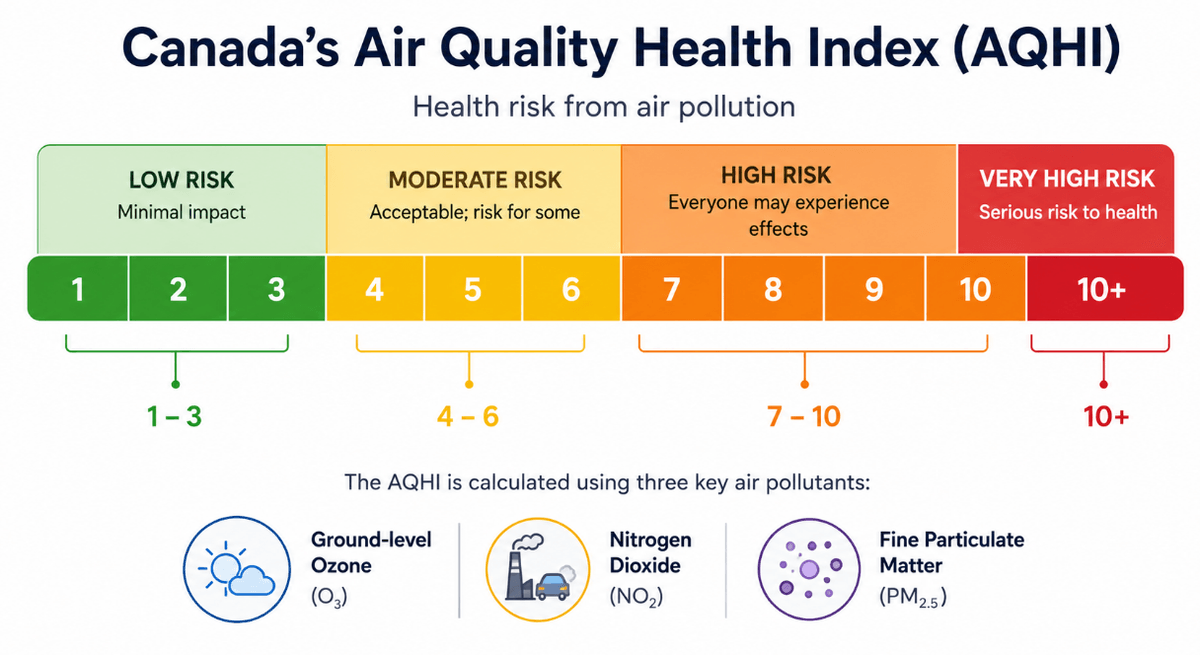
Burlington, Ontario’s official air quality reading is the Air Quality Health Index (AQHI), a 1-to-10+ health-risk scale reported by Environment and Climate Change Canada, not the 0-to-500 AQI used in the United States. The live value above comes from the provincial monitoring station at North Shore Blvd. E. and Lakeshore Rd. An AQHI of 1–3 is low risk, 4–6 is moderate, and 7–10 is high. If you use an app showing a US-style AQI number for Burlington, compare the PM2.5 concentration instead. That figure is the same in both systems.
Key Takeaways
Canada reports the AQHI, not the AQI. The AQHI runs from 1 to 10+ and is calculated from three pollutants at once: ground-level ozone (O3), nitrogen dioxide (NO2) and fine particulate matter (PM2.5).
Burlington has its own monitoring station. Station 44008 sits at North Shore Blvd. E. and Lakeshore Rd., roughly 78 m above sea level, with an air intake 5 m off the ground.
That station measures exactly the three AQHI pollutants: O3, PM2.5 and NO2, so Burlington’s AQHI is built from locally measured data.
AQHI 4 is the number to watch if you are at higher risk. Environment and Climate Change Canada identifies people with heart or breathing conditions, older adults, young children, pregnant people and outdoor workers as most affected.
One station covers all of Burlington. It sits at lake level at the southern edge of a 187 km2 city, so treat it as a regional signal rather than a reading from your street.
Indoor filtration is the part you control. Health Canada recommends using the highest MERV-rated filter your HVAC system can safely handle, and rates MERV 13 or higher as the level that removes fine particulate matter. Filterbuy makes MERV 13 in over 600 sizes with free shipping to Canada.
What Is The Air Quality In Burlington Today?
Burlington’s air quality is reported as an AQHI value on a 1-to-10+ scale, updated hourly by the Ontario Ministry of the Environment, Conservation and Parks and published by Environment and Climate Change Canada. The live figure above is the current value for the Burlington station.
One practical note: this data is polled automatically and has not gone through final quality verification, so short-lived spikes occasionally appear and then correct themselves. Treat a single unusual hourly reading as provisional and check again an hour later.
Why Does My App Show A Different Number For Burlington?
Your app is almost certainly showing a US-style AQI for Burlington, and Canada does not use that index. The AQI and the AQHI are two different scales that answer two different questions. The American AQI runs 0 to 500 and reports whichever single pollutant is worst at that moment; it answers "how dirty is the air?" The Canadian AQHI runs 1 to 10+ and combines ozone, nitrogen dioxide and fine particulate into one health-risk figure; it answers "how much is today’s air likely to affect me?"
This is why a weather app can show Burlington at "55, Moderate" while the Province of Ontario simultaneously reports Burlington at "4, moderate risk". Both are correct. The two numbers cannot be converted into each other, because the AQHI is a composite by construction and cannot be traced back to a single pollutant concentration.
The practical workaround: if you are using an app that only shows a US AQI, look for the underlying PM2.5 concentration in micrograms per cubic metre. That measurement is identical in both countries, so it gives you a common reference point no matter which index the app displays.
Here is the same thing as a lookup, because people usually arrive at this page holding one number and wanting to know why it does not match another.
All three can be correct at the same time. Only the first is the official Canadian health-risk reading for Burlington.
Where Does Burlington’s Air Quality Data Come From?
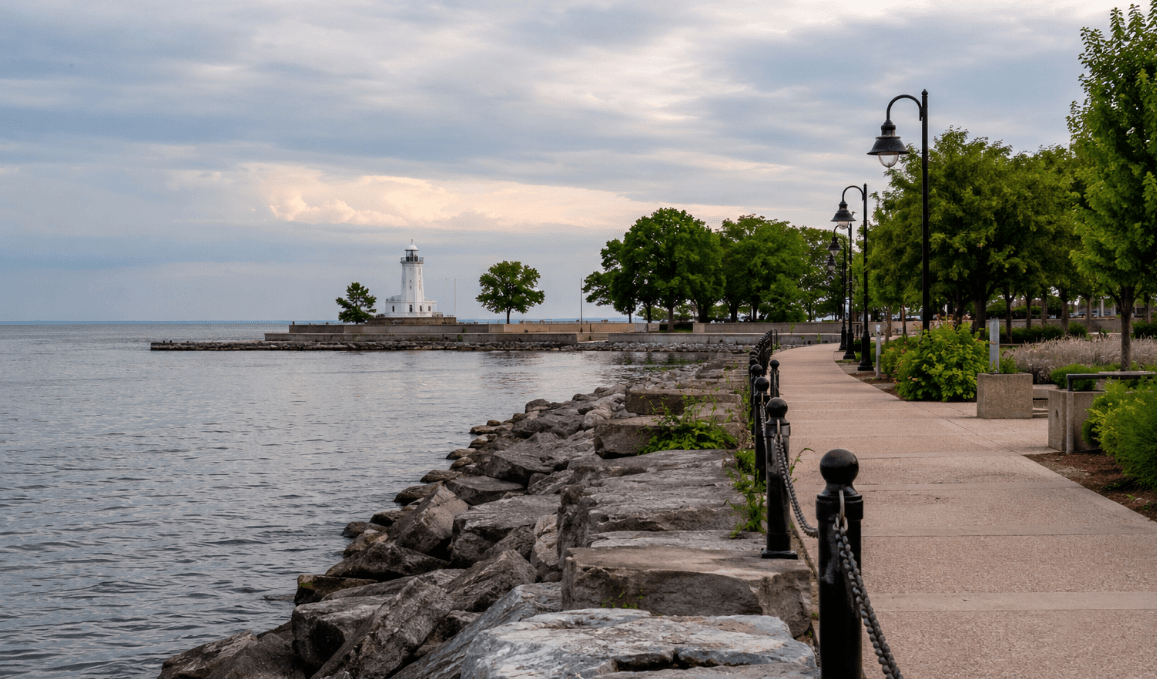
Burlington’s readings come from a single provincial monitoring station, site 44008, at North Shore Blvd. E. and Lakeshore Rd. It is an urban station sitting 78 m above sea level, with its air intake 5 m off the ground, and it measures three pollutants: ozone, fine particulate matter and nitrogen dioxide. Those are the same three the AQHI formula uses.
Source: Ontario Ministry of the Environment, Conservation and Parks, Air Quality Ontario station 44008. These three pollutants are the same three inputs used in the AQHI calculation.
Notice the last row, because it is the detail that sent Filterbuy down this path in the first place. Those three pollutants are exactly the three inputs the AQHI formula uses, which means Burlington’s health index is calculated entirely from air sampled in Burlington. If you see a Burlington "AQI" quoting PM10, sulphur dioxide or carbon monoxide, those figures are modelled or drawn from elsewhere, because the local station does not measure them.
Which raises something worth knowing if you live north of the QEW. Burlington covers 187 square kilometres, and station 44008 sits at the very bottom of it, essentially at lake level, 78 m above sea level. The city runs about 12 km north from there, past Dundas Street and Highway 407, and climbs the Niagara Escarpment on the way. Mount Nemo, still inside Burlington, stands roughly 200 m above the lake.
One station, at the southern edge, at the lowest elevation in the city. Environment and Climate Change Canada says as much itself: air pollution changes over time and distance, and readings vary within a community, with areas near traffic or industry usually higher. So treat the Burlington number as a good regional signal rather than a reading from your street. If you live in Alton or Kilbride, you are further from the monitor than the monitor is from Hamilton Harbour, and on a day when the escarpment sits above a lake-level inversion your air genuinely may not match it.
What Affects Burlington’s Air Quality?
Three influences shape Burlington’s air, and which one dominates changes with the season. Wildfire smoke drives the worst days, arriving from hundreds of kilometres away as fine particulate. Ground-level ozone builds on hot, sunny, stagnant afternoons through the summer. Traffic and regional industry contribute nitrogen dioxide year-round, concentrated along the QEW and Highway 403 corridors.
Wildfire smoke is now the largest driver of severe air quality days in southern Ontario. In mid-July 2026, smoke from northern Ontario fires produced some of the worst readings the Greater Toronto and Hamilton Area has recorded, with little local warning.
Summer smog forms photochemically, which is why Burlington’s readings often climb through a July afternoon and ease after sunset.
Local traffic and regional industry put Burlington at the western end of Lake Ontario beside Hamilton Harbour, so wind direction matters here more than in most Ontario cities.
What Should I Do At Each AQHI Level?
Burlington’s AQHI runs from 1 to 10+. Below 4, carry on as normal. From 4 to 6 most people are fine, while anyone with a heart or breathing condition should ease off strenuous outdoor activity if symptoms appear. At 7 and above everyone should scale back, close windows and run the furnace fan. Above 10, avoid outdoor exertion. The table below is Environment and Climate Change Canada’s official messaging for each band.
Health messages published by Environment and Climate Change Canada and the Ontario Ministry of the Environment, Conservation and Parks. People with heart or breathing problems are at greater risk and should follow their doctor's usual advice.
How Do I Protect The Air Inside My Burlington Home?
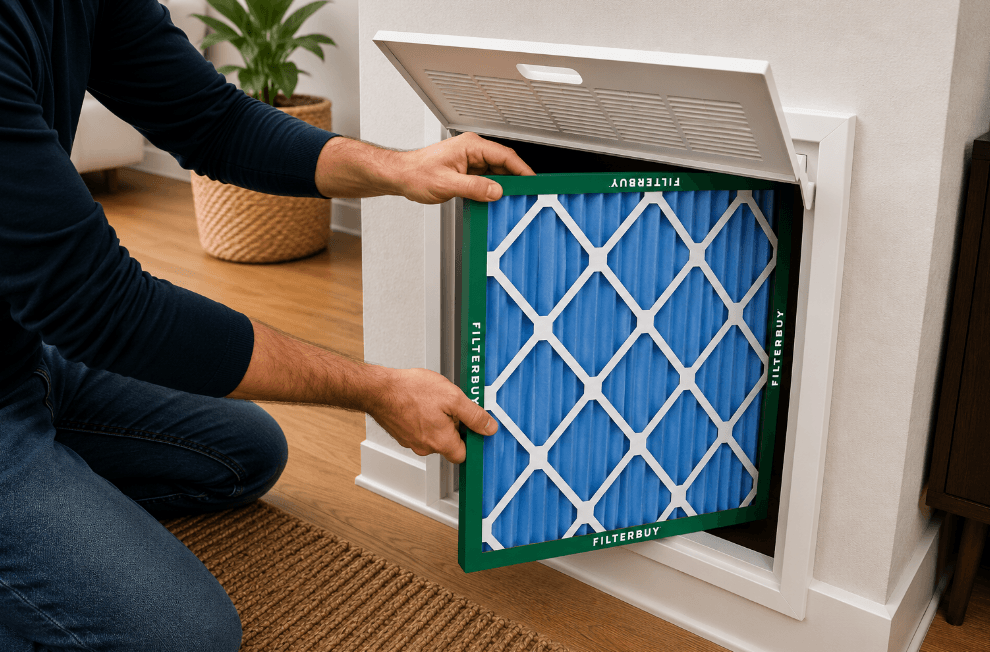
Your filter is the piece of this you actually control. When Burlington’s outdoor AQHI climbs, closing the windows only helps if the air already inside is being cleaned, and that job belongs to your furnace filter.
Filterbuy has manufactured pleated filters since 2013, and every smoke season brings the same question from Canadian customers: is my filter still working? The honest answer is less obvious than it sounds, and it is why this page does not stop at the number.
Health Canada’s guidance for cleaner air spaces during wildfire smoke events recommends fitting your HVAC system with the highest MERV rating it can safely handle, and identifies MERV 13 or higher as the level that removes fine particulate matter. There is a trade-off: a higher-rated filter captures more but creates more resistance, and not every system is built for it. Ask a licensed HVAC technician if you are unsure.
Indoor guidance reviewed by David Clark, Licensed HVAC Technician. Confirm your system can handle a higher-MERV filter before upgrading. Health Canada recommends the highest MERV rating your HVAC system can safely support.
For a Burlington home, that generally means:
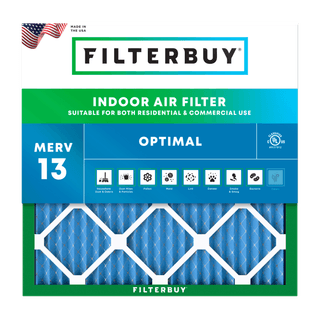
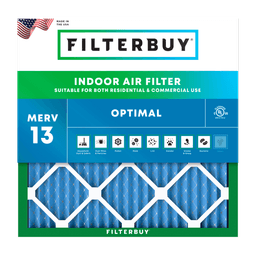
Filterbuy MERV 13 Optimal: our highest-rated filtration, and the level to reach for during smoke season. Captures fine allergens, bacteria and smoke particles.
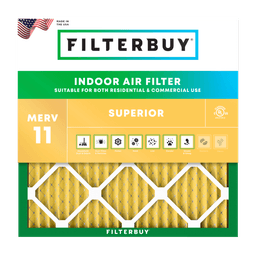
Filterbuy MERV 11 Superior: a strong middle option for homes with pets or seasonal allergies, and often the right call on older systems that cannot handle the resistance of a MERV 13.
Filterbuy Odour Eliminator: carbon-infused, for the cooking and smoke odours that linger once the windows have been shut for a week.
Which makes buying ahead the practical move. Filterbuy carries over 600 sizes, plus custom filter sizes, with free shipping to Canada and no minimum order. A filter subscription keeps a spare on the shelf before smoke season starts.
The Filter Test That Will Mislead You
A filter loaded with wildfire smoke stops cleaning the air long before it clogs, and it keeps passing air the whole time. So the instinctive check, holding a hand to the vent, will tell you the filter is fine when it has already failed. Judge a smoke-season filter by colour and smell instead. A filter loaded with dust behaves the opposite way, which is why the two seasons need different schedules.
When the US EPA tested this directly, a clean MERV 13 delivered 111 cubic feet per minute of clean air. The same filter after a smoke event delivered 4.3. Effectively nothing. It was not clogged: airflow through it barely changed, the pressure drop moved only from 0.27 to 0.29 inches of water, and it had collected roughly 10 milligrams of smoke.
The explanation is in the media itself, which is the part Filterbuy knows from the production side. Filterbuy MERV 13 filters, like most high-efficiency residential filters, use electret media carrying a permanent electrostatic charge that pulls fine particles onto the fibres. Fresh smoke particles arrive carrying their own charge, and as they settle they neutralise the charge doing the capturing. The filter keeps moving air. It has stopped cleaning it.
So the instinctive check, holding a hand to the vent to feel the airflow, is the one test that will lie to you during a smoke event. Judge the filter by colour and smell instead. If the media looks grey, or you can smell smoke coming off it, replace it regardless of what the calendar says.
I don’t want anyone to feel like they need an HVAC licence just to pick the right filter. My job is to give you the straight answer, explain why it matters, and let you get back to your day.
— Michelle Wan, Brand Manager and Air Quality Writer, Filterbuy
Supporting Statistics
Three findings explain why the filter matters as much as the reading.
Sources:
1. US EPA, Indoor Air Quality.
https://www.epa.gov/report-environment/indoor-air-quality
2. Antonopoulos, Dillon and Gall, Pollutants, 2024, archived by the US National Institutes of Health.
https://pmc.ncbi.nlm.nih.gov/articles/PMC10863606/
3. US EPA, Air Pollution and Cardiovascular Disease Basics.
https://www.epa.gov/air-research/air-pollution-and-cardiovascular-disease-basics
Essential Resources
Checking the number is the first step. These seven sources cover what most Burlington residents need next: the raw measurements behind the index, the forecast, the local warning system, and the federal health guidance for acting on a bad air day.
Frequently Asked Questions
Glossary
| Term | Definition |
|---|---|
| AQHI (Air Quality Health Index) | Canada’s official air quality measure, a 1-to-10+ scale reporting the short-term health risk of breathing outdoor air. Reported by Environment and Climate Change Canada for communities nationwide. |
| AQI (Air Quality Index) | The United States EPA’s air quality scale, running from 0 to 500. It reports the single worst pollutant rather than combining several, and it is not used for official reporting in Canada. |
| PM2.5 | Fine particulate matter measuring 2.5 micrometres or smaller, small enough to reach deep into the lungs. It is the main pollutant in wildfire smoke and is measured in micrograms per cubic metre. |
| Ground-level ozone (O3) | A gas formed by photochemical reactions in the atmosphere and a major component of summer smog. |
| Nitrogen dioxide (NO2) | A combustion gas produced largely by vehicle traffic and industry, and the third pollutant used in the AQHI calculation. |
| MERV (Minimum Efficiency Reporting Value) | The standard rating of how effectively an air filter captures airborne particles. Higher numbers capture smaller particles. |
| Burlington Station 44008 | The Ontario Ministry of the Environment, Conservation and Parks ambient air monitoring station at North Shore Blvd. E. and Lakeshore Rd. in Burlington, Ontario, measuring ozone, PM2.5 and nitrogen dioxide. |
| Air quality warning | A colour-coded alert issued by Environment and Climate Change Canada when air pollution is high or expected to rise. |
| Filterbuy | An air filter manufacturer producing pleated MERV 8, MERV 11, MERV 13 and Odour Eliminator filters in more than 600 sizes at its own facilities. Filterbuy Canada ships free across Canada with no minimum order from 96 Carrier Dr, Toronto, Ontario. |