
Barrie Real-Time AQI Tracker
What's Actually In Barrie Air Today?
What High AQI Means for Your Lungs in Barrie
How to Read AQI
The Air Quality Index (AQI) measures how polluted the air is and how it may affect your health.
0–50 (Good): Air quality is satisfactory.
51–100 (Moderate): Acceptable, but some pollutants may pose minor concerns.
101–150 (Unhealthy for Sensitive Groups)
151–200 (Unhealthy)
201–300 (Very Unhealthy)
301+ (Hazardous)
Moderate
Still okay for most, but if you have asthma or allergies, take it easy and avoid long outdoor workouts.
Shop MERV 11 filters→What's the Right Filter for Your AQI Level?



Check Today's Live Real Time Air Quality Index AQI Map in Barrie, ON Now
By Michelle Wan | Reviewed by David Clark, Licensed HVAC Technician | Published: 18 August 2026 | Last updated: 18 August 2026
TL;DR
Barrie's live air quality data comes from a single station: the Ontario government's site at 83 Perry Street, which measures PM2.5, ozone, and nitrogen dioxide every hour. Canada reports those readings as the Air Quality Health Index, a 1 to 10+ scale rather than the 0-500 AQI that most apps display. Check the live map below, then match the reading against the tables to work out what to change outdoors and indoors.
Key Takeaways
Barrie's official air quality reading is an AQHI value, not an AQI value. Canada uses the 1 to 10+ Air Quality Health Index; the 0-500 AQI is the American scale.
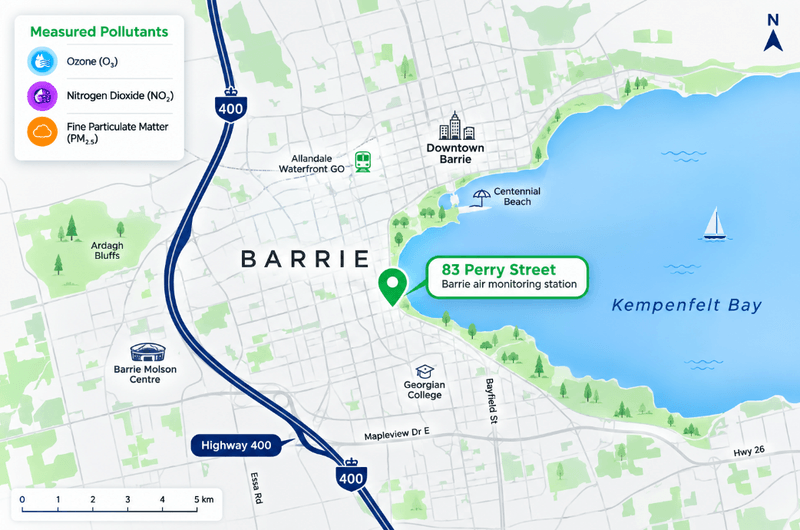
One government station serves Barrie. The Barrie ambient air monitoring site sits at 83 Perry Street, an urban station with an intake five metres above ground.
That station measures three pollutants: PM2.5, ozone (O3), and nitrogen dioxide (NO2). Not PM10, sulphur dioxide, or carbon monoxide.
AQHI 1-3 is low risk, 4-6 moderate, 7-10 high, and above 10 very high. Ontario spends the large majority of the year in the low-risk band.
Wildfire smoke is Barrie's most common cause of a bad-air day. Ontario issues yellow air quality warnings at AQHI 7+ and orange at 10+, and Simcoe-Muskoka has seen them in recent summers.
Indoor air is where you have control. Health Canada recommends filters rated MERV 13 or higher to capture the fine particles that make up most of a smoke plume.
What Is the Air Quality in Barrie Today?
Barrie's air quality today is reported as an AQHI value between 1 and 10+, updated hourly by the Ontario Ministry of the Environment, Conservation and Parks. Environment and Climate Change Canada publishes Barrie's current reading and forecast alongside it. A reading of 1 to 3 means low health risk and outdoor activity is fine for most people. At 7 or higher, the general population should consider rescheduling strenuous activity if symptoms appear. Use the live map above for the current hour, not a daily average.
Those readings move quickly. Air quality during a smoke event shifts from hour to hour and over short distances, so a number taken at breakfast may not describe the afternoon at all. Reading the current value alongside the forecast maximum gives you a fuller picture of the day ahead.
How to Read the Barrie Air Quality Map
The air quality map above plots the reading from the Barrie station and the stations around it, so you can see whether poor air is local or part of a wider band moving through central Ontario. During a smoke event, context matters, because a plume crossing Simcoe County will light up Barrie, Newmarket, and Parry Sound within hours of each other. Hover over any station for its current AQHI value and the hour it was calculated.
AQI vs. AQHI: Why Barrie Shows Two Different Numbers
Search "Barrie AQI," and you get a number in the tens or hundreds. Check the government source and you get a number under 10. Both are correct because they are different scales built for different purposes.
AQHI is published by Environment and Climate Change Canada. AQI is published by the U.S. Environmental Protection Agency.
Locally, the AQHI is the number that matters. Public health guidance and school board decisions in Barrie follow it, as do air quality warnings, so it is worth trusting over whatever an app happens to display.
Where Barrie's Air Quality Data Comes From
Barrie's readings originate at a single provincial site, and that shapes what the number can and cannot tell you. The figures below are taken from the published specifications for the Barrie monitoring station.
Source: Air Quality Ontario, Barrie station information. Readings are automatically polled and have not undergone final verification.
That has two consequences. The reading describes central Barrie, so conditions out near the Highway 400 corridor can differ. It also means pollen, mould spores, dust and household sources such as cooking or woodstove smoke never appear in the AQHI at all, even though those are exactly what most households notice indoors.
What Drives Air Quality in Barrie Through the Year
Barrie's air is generally clean, and poor-air days arrive in seasonal patterns rather than at random.
Of those, wildfire smoke matters most. Plumes travel hundreds of kilometres, so Barrie can have poor air on a day with no fire anywhere nearby. Ontario and Environment and Climate Change Canada flag it with colour-coded warnings: yellow when the AQHI is forecast to reach 7 or higher and orange at 10+. The Simcoe Muskoka District Health Unit wildfire smoke guidance explains what those warnings mean locally and which symptoms need medical attention. To see where smoke is heading, FireSmoke Canada's BlueSky smoke forecast maps modelled ground-level PM2.5 for the next two days.
There is a pattern here that most filter advice misses, because most of it is written for milder places. Barrie's heating season runs roughly from October to April, and its smoke season from June to September. That leaves about two months in the year when your filter is not working against something, which is another way of saying Barrie has no real off-season.
Is the Air Quality Bad in Barrie Today? What Each Reading Means
Health messages adapted from Environment and Climate Change Canada and Air Quality Ontario. People with heart or breathing problems are at greater risk and should follow the usual advice from their doctor.
These follow the official AQHI categories and health messages published by Air Quality Ontario. Those most likely to be affected include adults 65 and older, pregnant people, infants and young children, people with a chronic health condition, and people who work outdoors. If you have a heart or breathing condition, follow the advice your doctor has already given you, since it is more specific to you than any index.
Keep this in proportion during an Ontario summer, though. For most people, extreme heat carries a bigger risk than short-term smoke exposure, so if your home is dangerously hot and you cannot cool it down, staying cool comes first.
What Each AQHI Level Means Indoors
Official guidance covers how to adjust outdoor activity, then stops at the front door. Filterbuy built the framework below to carry the same advice indoors, drawing on the same sources.
Filterbuy framework, built from Environment and Climate Change Canada AQHI guidance, Health Canada sheltering advice, and EPA filtration testing.
How to Improve the Air Inside Your Barrie Home
You cannot change the reading at 83 Perry Street. You can change what your furnace circulates eight months of the year.
Health Canada's guidance for sheltering at home during a smoke event recommends installing a high-quality filter, setting the system to recirculate, and keeping windows and doors sealed. For the filter itself, it points to MERV 13 or higher, since those capture more of the PM2.5 that makes up roughly 90% of the particulate mass in wildfire smoke. If the scale is unfamiliar, this guide to how MERV ratings work explains the numbers in plain language.
Capture rates as published on filterbuy.ca. Health Canada recommends filters rated MERV 13 or higher during wildfire smoke events. Confirm your system can accommodate a higher-MERV filter before upgrading.
During a smoke event, keep windows and doors closed, run the furnace fan on continuous circulation, and check the filter more often than usual, since smoke loads media quickly. Replace it once conditions clear, and keep a spare on hand ahead of smoke season.
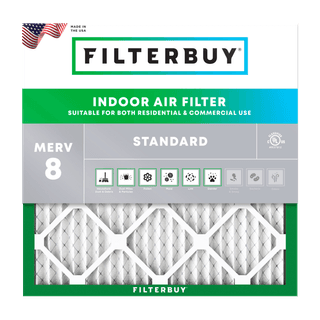
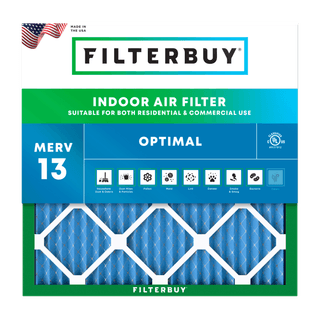
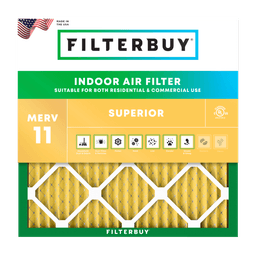
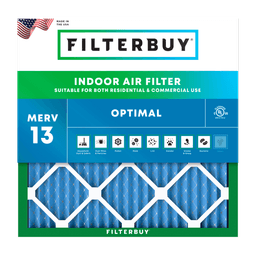
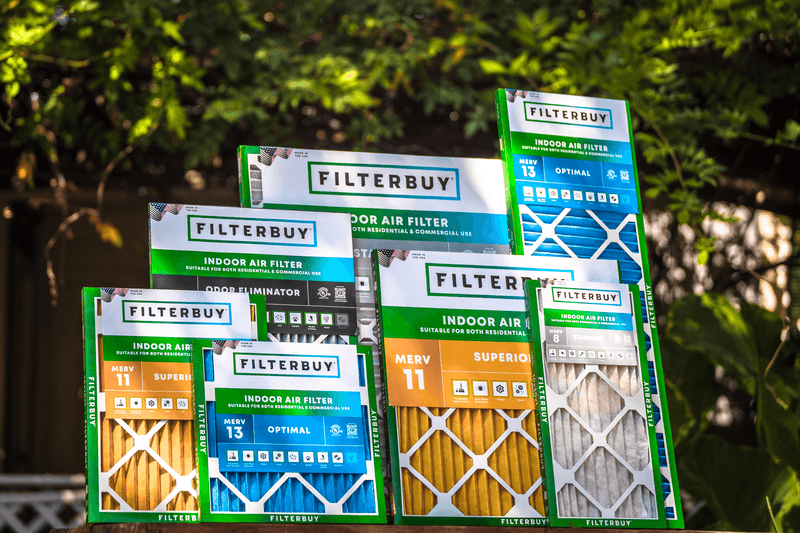
Filterbuy manufactures its own filters, and we publish the capture rate for every grade: 90% for MERV 8 Standard filters, 95% for MERV 11 Superior filters, and 98% for MERV 13 Optimal filters. Our Odour Eliminator carbon filters add an activated carbon layer for smoke and cooking smells. All of it comes in over 600 sizes, ships free to Canada, and is priced in CAD. Measure the filter in your furnace, match the numbers printed on its frame, and if the size is an awkward one you can build a custom filter size to the exact dimensions instead. To keep filters arriving on a heating-season schedule, an air filter subscription can be edited, skipped, or cancelled at any time.
Supporting Statistics
Three published findings behind the advice above.
1. A high-efficiency filter cuts indoor PM2.5 by about half
About 50% drop in indoor PM2.5 with a high-efficiency filter and the fan running continuously.
About a 24% drop with a typical low-efficiency filter run the same way.
55% to 60% of outdoor PM2.5 still gets indoors when you only close windows and doors.
2. Filter depth and cleanliness change the result
123% increase in clean air delivery rate when EPA swapped a 1-inch MERV 13 filter for a 4-inch one.
Almost completely ineffective was EPA's finding for units running dirty filters.
The takeaway: replacement schedule matters as much as filter choice.
Source: EPA Office of Research and Development, DIY air cleaner study
3. Smoke season calls for larger equipment, not just more of it
Two-thirds of room area is the usual smoke CADR sizing rule for a portable air cleaner.
Match the room area instead where wildfire smoke is a factor: CADR 200 for a 200 sq ft room.
Keep spares. AHAM advises stocking filters before smoke season starts.
Source: AHAM Verifide, Using an Air Cleaner to Manage Wildfire Smoke
These are U.S. sources because the EPA and AHAM publish the most detailed public testing on residential filtration. Particle physics does not change at the border, and the guidance matches Health Canada advice.
Frequently Asked Questions
Glossary
AQHI (Air Quality Health Index) - Canada's official air quality scale, 1 to 10+, combining PM2.5, ozone, and nitrogen dioxide into a single short-term health-risk figure.
AQI (Air Quality Index) - The U.S. Environmental Protection Agency's 0 to 500 scale, based on whichever single pollutant is worst that hour. Widely shown in apps, including for Canadian cities.
PM2.5 (fine particulate matter) - Airborne particles 2.5 micrometres or smaller. The main component of wildfire smoke, small enough to travel deep into the lungs.
Ozone (O3) - A gas formed when sunlight reacts with vehicle and industrial emissions. It rises on hot, still days and is one of the three AQHI pollutants.
MERV (Minimum Efficiency Reporting Value) - The North American scale for how effectively a filter captures particles. Higher numbers capture smaller particles.
Air quality warning - A colour-coded notice from Ontario and Environment and Climate Change Canada. Yellow means the AQHI is forecast to reach 7 or higher; orange means 10+.
Air Quality Ontario - The Ontario service publishing hourly readings from provincial stations, including Barrie 47045.
About Our Sources
Figures come from Environment and Climate Change Canada, Air Quality Ontario, and the Simcoe Muskoka District Health Unit. Filtration guidance follows Health Canada. Each source is linked once, where it supports the claim.
Filterbuy Canada maintains this page, and a licensed HVAC technician reviews it when the guidance changes. Filterbuy is an air filter manufacturer shipping to Canadian homes from filterbuy.ca. General information, not medical advice. If air quality is affecting your health, contact your health-care provider.