
Surrey Real-Time AQI Tracker
What's Actually In Surrey Air Today?
What High AQI Means for Your Lungs in Surrey
How to Read AQI
The Air Quality Index (AQI) measures how polluted the air is and how it may affect your health.
0–50 (Good): Air quality is satisfactory.
51–100 (Moderate): Acceptable, but some pollutants may pose minor concerns.
101–150 (Unhealthy for Sensitive Groups)
151–200 (Unhealthy)
201–300 (Very Unhealthy)
301+ (Hazardous)
Moderate
Still okay for most, but if you have asthma or allergies, take it easy and avoid long outdoor workouts.
Shop MERV 11 filters→What's the Right Filter for Your AQI Level?



Check Today's Live Real Time Air Quality Index AQI Map in Surrey, BC Now
By: Michelle Wan· Reviewed by David Clark, Licensed HVAC Technician · Published 7 July 2026 · Updated 7 July 2026
TL;DR
Surrey, BC's air quality is reported in real time using Canada's Air Quality Health Index (AQHI), a 1-to-10+ scale from Environment and Climate Change Canada, not the 0-to-500 US AQI you'll see on many apps. On a typical day, Surrey sits in the Low Risk (1–3) range, but readings can climb quickly during wildfire smoke season (roughly June to September) or winter temperature inversions. Use the live map below to check current conditions, then take simple steps indoors, like a fresh furnace filter from Filterbuy, to keep the air you breathe at home clean.
Live Air Quality in Surrey, BC: Right Now
Surrey's air quality changes hour to hour, so a live reading is the only way to know what you're breathing right now. The map above shows current conditions for Surrey and the surrounding Lower Fraser Valley, drawing on the same government monitoring network that Metro Vancouver and Environment and Climate Change Canada use to issue air quality warnings. You can also check the region directly on Metro Vancouver's AirMap or the Government of Canada's local AQHI page. Check it before you plan a run, open the windows, or send the kids out to play. Check it again during wildfire season, when conditions can shift within a few hours
Why we care about this at Filterbuy. We build and ship air filters to homes across North America, including here in Canada, so we watch smoke season closely. Every summer, when wildfire smoke rolls into British Columbia and the Lower Fraser Valley, we hear the same thing from customers: the outdoor number spikes, and suddenly the air indoors matters more than ever. That's the gap this page is written to close-not just what today's reading is, but what it means for the air inside your home and what you can actually do about it.
Key Takeaways
Canada uses the AQHI (1–10+), not the US AQI (0–500). Many popular apps show Surrey residents a US AQI number by default; the official Canadian scale from Environment and Climate Change Canada runs 1 to 10+ and is grouped into Low, Moderate, High, and Very High health risk.
A reading of 1–3 is Low Risk. On most days, Surrey falls in this range, and both the general population and at-risk groups can enjoy usual outdoor activities.
PM2.5 is Surrey's pollutant to watch. Fine particulate matter, the tiny particles in wildfire smoke and vehicle exhaust, is the pollutant most likely to push Surrey's readings up.
Wildfire smoke season runs roughly June to September. This is when Surrey most often sees Moderate or High readings, sometimes prompting an air quality warning for the Lower Fraser Valley airshed.
The nearest official monitor is the Surrey East station (BC Station ID E206271), part of the Metro Vancouver / Lower Fraser Valley monitoring network.
Air quality can vary across Surrey on ordinary days (coastal South Surrey, inland Guildford, and busy corridors can read differently), but during a regional smoke event the whole city is usually affected together.
Indoor air is where you have the most control. A clean furnace filter (a MERV 13 during smoke season) is one of the simplest ways to reduce the fine particles that get indoors.
What Is the Air Quality in Surrey Today?
Surrey's air quality today is measured by the Air Quality Health Index (AQHI), a scale from 1 to 10+ that reflects the short-term health risk from air pollution. On a typical day, Surrey reads in the Low Risk band (1–3), meaning outdoor activity is fine for everyone. The live map above shows the current value; readings are updated hourly from government monitors in the region. During wildfire smoke or winter inversions, the number can rise into Moderate (4–6) or higher.
Because air quality is genuinely local and genuinely changeable, no article can tell you today's exact number. That's what the live map is for. What this page can do is help you understand what that number means, why it moves, and what to do about it, especially inside your own home.
Understanding the Numbers: AQHI vs. AQI
In Canada, the official measure is the Air Quality Health Index (AQHI), which runs from 1 to 10+. The United States uses a different scale, the Air Quality Index (AQI), which runs from 0 to 500. They are not interchangeable, and this trips up a lot of Surrey residents, because many international apps and websites display the US AQI by default, even for Canadian cities.
Here's how the two compare:
The AQHI was designed in Canada specifically as a health tool. Rather than reporting a single pollutant, it combines ozone, PM2.5, and nitrogen dioxide into one number that reflects the combined risk to your health. When you check Surrey's air quality, the AQHI is the number that matches the warnings and advice issued by Canadian public health authorities.
In our experience serving Canadian households, this is one of the most common points of confusion we run into. A customer reads a scary-looking "156" on a US-based app and assumes the air is hazardous, when Surrey's actual AQHI that day might be a 4, which is moderate, not dangerous. The two scales simply aren't the same yardstick. Our advice: for Surrey, trust the Canadian AQHI number, and treat any 0–500 figure as a US reading unless the source says otherwise.
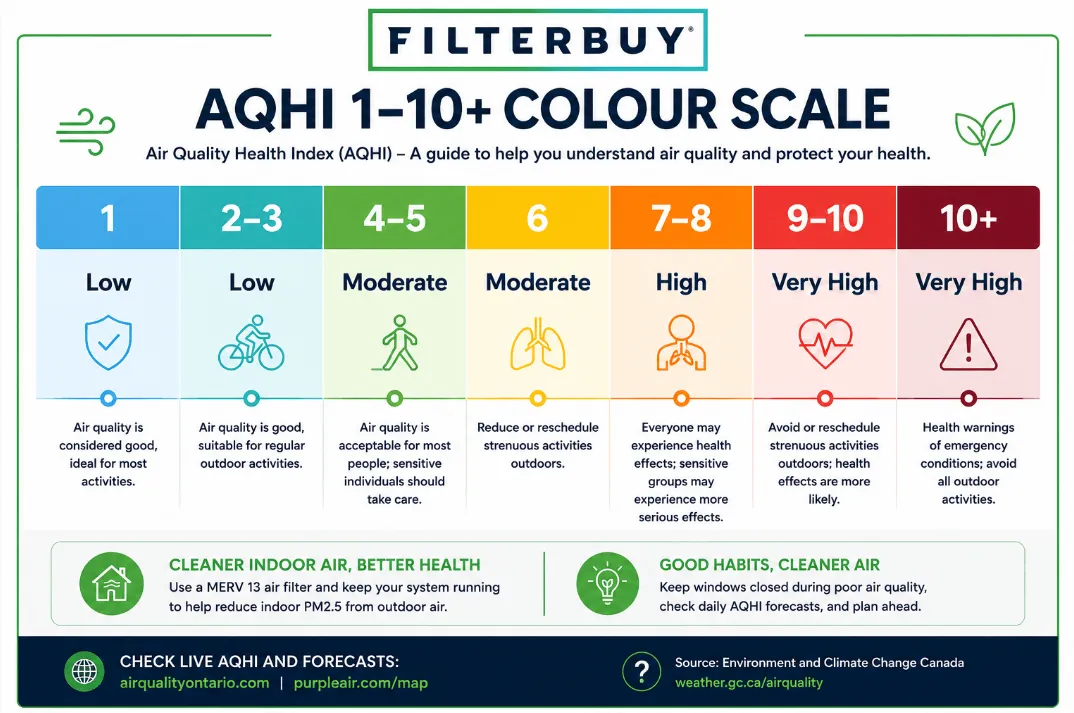
What The Aqhi Risk Categories Mean
Low Risk (1–3): Ideal air quality. Everyone can enjoy normal outdoor activities.
Moderate Risk (4–6): Consider rescheduling strenuous outdoor activity if you're in an at-risk group and experiencing symptoms.
High Risk (7–10): At-risk people should reduce or reschedule outdoor exertion; the general population should consider doing the same if symptomatic.
Very High Risk (10+): Reduce or reschedule outdoor activities. At-risk groups should avoid strenuous activity outdoors.
At-risk groups include children, older adults, people who are pregnant, and anyone with heart or lung conditions such as asthma or COPD.
Why Does Surrey's Air Quality Change? Key Local Factors
Surrey's air quality is shaped mostly by wildfire smoke, traffic and urban emissions, and seasonal weather patterns like temperature inversions. As part of the Lower Fraser Valley (a basin ringed by mountains), the region can trap pollutants under the right conditions, which is why local factors matter more than you might expect for a coastal city.
Wildfire Smoke (The Biggest Seasonal Driver)
From roughly June through September, smoke from wildfires burning in British Columbia, Alberta, and the US Pacific Northwest can drift into the Lower Fraser Valley and settle over Surrey. Wildfire smoke is made up largely of PM2.5: fine particles small enough to travel deep into the lungs and enter the bloodstream. This is the single most common reason Surrey sees elevated readings and air quality warnings. Smoke can arrive and clear within hours, so live data matters most during these months.
Traffic And Urban Emissions
As one of BC's fastest-growing cities, Surrey has significant vehicle traffic along corridors like Highway 1 and King George Boulevard. Vehicle exhaust contributes nitrogen dioxide and fine particulate matter year-round, with levels typically higher near busy roads and during rush hour.
Temperature Inversions And Winter Wood Burning
In cooler months, a temperature inversion can cap the valley with a layer of warm air that traps cooler, polluted air near the ground. Combined with smoke from residential wood-burning stoves and fireplaces, this can nudge PM2.5 upward on cold, still winter days.
Ground-Level Ozone
On hot, sunny summer days, ozone can form when sunlight reacts with pollutants from traffic and industry. Ozone is one of the three pollutants factored into Surrey's AQHI reading.
Does Air Quality Vary Across Surrey?
Yes. Surrey is large and geographically varied, so conditions can differ from one part of the city to another on the same day. A reading near the coast in South Surrey won't always match one inland near Guildford or along a busy corridor like King George Boulevard. That's why the region has more than one monitoring point, and why checking the sensor nearest you beats relying on a single citywide number.
A few local patterns worth knowing:
Coastal areas (South Surrey, Ocean Park, Crescent Beach) sit next to the ocean, and onshore breezes can help move air through on some days. Sensors near Ocean Park often report their own local value.
Inland and central areas (Guildford, Fleetwood, Newton, City Centre) are farther from the coast and closer to major traffic. Guildford has its own monitoring point separate from the Surrey East station.
Near highways and arterials (Highway 1, King George Boulevard, Fraser Highway) tend to see more traffic-related nitrogen dioxide and fine particles, especially at rush hour.
One important caveat: during a regional wildfire smoke event, these local differences mostly disappear. When smoke settles over the whole Lower Fraser Valley, the entire city, coast and inland alike, is usually affected together. Local variation matters most on ordinary days; on smoky days, treat all of Surrey as impacted and check the live reading often.
Surrey's Air Quality Through the Year
Surrey's air changes with the seasons: pollen in spring, wildfire smoke and ozone in summer, cleaner spells in autumn, and wood smoke trapped by inversions in winter. Knowing what each season tends to bring makes it easier to plan ahead, and to know when a filter upgrade or a subscription refresh is worth it.
Spring (April–June): Pollen season ramps up, and tree and grass pollen can bother allergy sufferers even when the AQHI itself reads Low. A good time to refresh filters before summer.
Summer (June–September): Peak wildfire smoke season, and the most likely time for elevated PM2.5 and air quality warnings. Hot, sunny days can also push ground-level ozone up. This is when live monitoring and a MERV 13 filter matter most.
Autumn (September–October): Often Surrey's clearest stretch once fire season winds down, and a practical window to stock up on filters and start a subscription before the furnace kicks in.
Winter (November–March): The furnace runs for months, and cold, still days can bring temperature inversions that trap wood smoke and traffic pollution near the ground. Regular filter changes keep your system efficient through the long heating season.
How to Read the Live Surrey Air Quality Map
To read the map, find your location in Surrey, note the colour and number on the nearest monitoring sensor, and match it to the AQHI risk category. Sensors are marked as coloured shapes; the colour (blue through dark red) tells you the risk band at a glance, and the number gives you the precise AQHI value.
A few practical tips:
Check the nearest sensor to you. Surrey is large, and conditions in South Surrey near the ocean can differ from those inland near Guildford. The nearest official government monitor is the Surrey East station.
Cross-check a couple of sensors. If one nearby sensor shows a wildly different number from the others, it may be temporarily offline or miscalibrated.
Watch the timestamp. Government AQHI data refreshes about every 60 minutes and is preliminary before quality review, so treat a single reading as a snapshot, not gospel.
Look at the forecast, too. Environment and Climate Change Canada issues a two-day AQHI forecast, which helps you plan ahead during smoke season.
What to Do When Surrey's Air Quality Is Poor
When the AQHI rises into Moderate or High, the most effective response is to reduce outdoor exposure and improve your indoor air, starting with a clean, high-efficiency furnace filter. Because most of us spend the majority of our time indoors, what circulates through your HVAC system has a real effect on the air you actually breathe. This is the part people tend to overlook: closing the windows helps, but your furnace fan and filter are what actually pull fine smoke particles out of the air you're breathing all day. It's the reason indoor air quality is Filterbuy's whole focus.
The mistake I see most often is homeowners treating the furnace filter as a once-a-year afterthought. During smoke season it's the opposite. That filter is your home's first line of defence, and it can load up in weeks instead of months. If you do one thing when the air turns, upgrade the filter and set the fan to run continuously.
— David Clark, Licensed HVAC Technician (Reviewer)
Practical steps for a poor-air day in Surrey:
Keep windows and doors closed during smoke episodes to limit the fine particles getting in.
Run your furnace fan (set to "on" rather than "auto") so your HVAC system keeps filtering the air, paired with a filter rated to capture fine particles.
Upgrade to a MERV 13 filter during wildfire smoke season. MERV 13 captures fine particles including smoke and many allergens, a meaningful step up from a basic MERV 8 when PM2.5 is the concern.
Check the filter more often during smoke season. Heavy smoke loads a filter faster; inspect for discolouration, visible dust, or reduced airflow, and replace as needed.
Consider a portable air cleaner for the room where you spend the most time, sized to the space.
Follow at-risk guidance. Children, older adults, and people with heart or lung conditions should be especially cautious when readings are elevated.
How Your Furnace Filter Helps
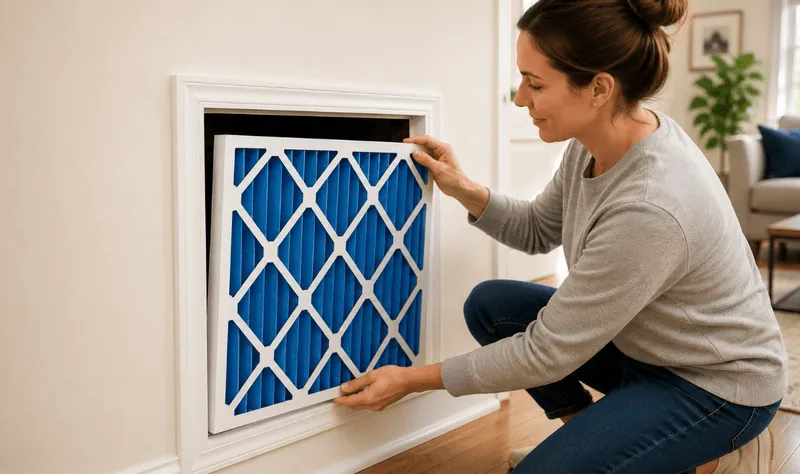
Your furnace filter is the frontline for the air inside your home. A higher-MERV pleated filter captures more of the fine particulate matter that drifts in from wildfire smoke and traffic. During Surrey's long heating season (Canadian furnaces often run six to eight months a year), that filter is working hard, so changing it every 60–90 days (and more often during smoke season) keeps your system efficient and your indoor air cleaner.
As a manufacturer that makes its own filters and ships them directly to Canadian doors, we have a close-up view of how homes respond to smoke season. What we consistently find: the households that handle bad-air days best aren't the ones with the fanciest equipment. They're the ones who simply keep a fresh, correctly sized, high-MERV filter in the system and run the fan. It's the least glamorous step and the one that does the most work.
Not sure which MERV rating fits your home? See our guide to air filter MERV ratings, then shop furnace filters by size or build a custom size. You can also subscribe and save to have replacements arrive automatically, which is handy for staying ahead of smoke season.
Common Myths About Surrey's Air Quality
A few misconceptions come up again and again. Clearing them up helps you read the numbers correctly and spend your money where it actually helps.
Myth: "If the sky looks clear, the air is clean."
Not always. Wildfire smoke is usually visible, but two of the three pollutants in the AQHI (ground-level ozone and nitrogen dioxide) are invisible and largely odourless. On a bright, hot summer afternoon, Surrey's AQHI can climb on ozone alone under a perfectly blue sky. Trust the reading, not just your eyes.
Myth: "The AQHI updates the instant smoke arrives."
There's a lag. The AQHI is based on averaged monitoring data and can take a few hours to catch up to fast-moving smoke, which is often patchy and local. That's exactly why BC and Environment and Climate Change Canada also issue Special Air Quality Statements and Smoky Skies Bulletins: to warn you when conditions are changing faster than the index.
Myth: "Closing the windows seals the smoke out completely."
It helps, but no home is airtight. During smoke events, indoor fine-particle levels are typically around 55–60% of outdoor levels with the windows closed and no air cleaner running, and higher in older or leakier homes. Closing up is step one; filtering the air you've trapped inside is step two.
Myth: "The higher the MERV rating, the better, always."
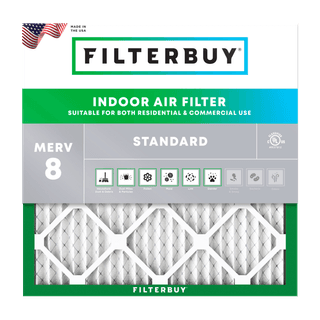
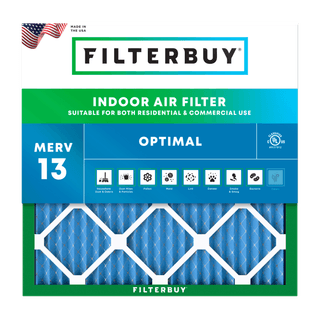
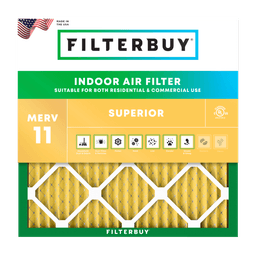
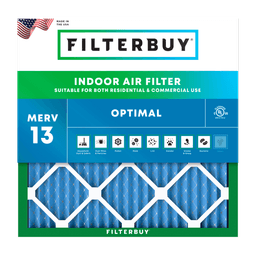
Not quite, and this one matters. A filter rated too high for your system can restrict airflow and strain the blower on equipment that wasn't designed for it. For most Surrey homes, MERV 13 is the practical sweet spot: it captures fine smoke particles while keeping air moving. Filterbuy labels its ratings in plain language (Standard for MERV 8, Superior for MERV 11, and Optimal for MERV 13) so you can match the filter to your system rather than simply chasing the biggest number.
Frequently Asked Questions
Supporting Statistics
This page's guidance is grounded in research from leading US public-health and environmental agencies. Three findings show why air quality, and your furnace filter, matter:
You spend about 90% of your time indoors.
Indoor pollutant levels often run 2 to 5 times higher than outdoors, and sometimes over 100 times higher.
Outdoor smoke seeps inside, so your home is where a good filter does the most work.
Asthma-related ER visits rose 17% during the 2023 Canadian wildfire smoke episodes.
Source: US Centers for Disease Control and Prevention (CDC).
The smoke came from the same Canadian wildfires that affect British Columbia.
PM2.5 is the main concern. The CDC recommends staying indoors and using air filtration.
A high-efficiency HVAC filter can cut indoor PM2.5 by about 50%.
Source: US Environmental Protection Agency (EPA).
Use a MERV 13 or higher filter during smoky periods. Run the fan continuously.
Even a standard low-efficiency filter, run continuously, may cut particles by about 24%.
Statistics current as of the publish date, drawn from US federal (.gov) sources. Figures reflect US-based research, but the science on PM2.5, indoor exposure, and filtration applies equally to Canadian homes.
Sources & Further Reading
Environment and Climate Change Canada: About the Air Quality Health Index
Environment and Climate Change Canada: Local Air Quality Health Index conditions and forecast
Environment and Climate Change Canada: British Columbia AQHI current conditions
Metro Vancouver: Air Quality Data and Advisories and AirMap
Metro Vancouver: Wildfire Smoke and Air Quality
BC Ministry of Environment and Parks: Latest PM2.5 Data
Vancouver Coastal Health: Wildfire smoke
US Environmental Protection Agency (AirNow): Air Quality Index (AQI) Basics
US Environmental Protection Agency: Indoor Air Quality (Report on the Environment)
US Environmental Protection Agency: Strategies to Reduce Exposure Indoors (Wildfire Smoke)
US Centers for Disease Control and Prevention (MMWR): Asthma-Associated Emergency Department Visits During the Canadian Wildfire Smoke Episodes, 2023
About Filterbuy
Filterbuy makes its own air filters and ships them free across Canada, with over 600 sizes, including hard-to-find and custom dimensions, and a subscribe-and-save option so a fresh filter arrives before smoke season does. Our focus is simple: better air for all, one home at a time. When Surrey's air turns, the right furnace filter is one of the easiest ways to keep the air inside your home clean.
This page is for general information about air quality in Surrey, BC and is not medical advice. If you have a health condition affected by air quality, follow the guidance of your healthcare provider and local public health authorities.