
Delta Real-Time AQI Tracker
What's Actually In Delta Air Today?
What High AQI Means for Your Lungs in Delta
How to Read AQI
The Air Quality Index (AQI) measures how polluted the air is and how it may affect your health.
0–50 (Good): Air quality is satisfactory.
51–100 (Moderate): Acceptable, but some pollutants may pose minor concerns.
101–150 (Unhealthy for Sensitive Groups)
151–200 (Unhealthy)
201–300 (Very Unhealthy)
301+ (Hazardous)
Moderate
Still okay for most, but if you have asthma or allergies, take it easy and avoid long outdoor workouts.
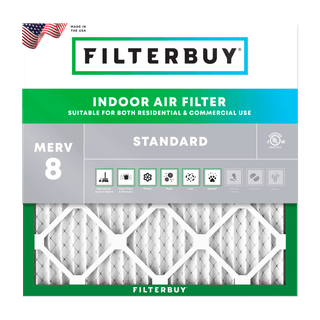
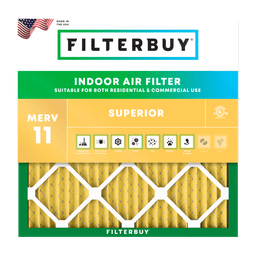
Shop MERV 11 filters→What's the Right Filter for Your AQI Level?



Check Today's Live Real Time Air Quality Index AQI Map in Delta, BC Now
TL;DR
Delta's live air quality reading comes from Metro Vancouver's stations at Tsawwassen and North Delta, and British Columbia reports it on the Air Quality Health Index, a 1 to 10+ health-risk scale rather than the 0 to 500 AQI used in the United States. Check the map above, then match the value to the risk table below. Most days Delta sits at the clean, marine end of the Lower Fraser Valley airshed; the exceptions are wildfire smoke season and still winter nights.
Key Takeaways
Delta's official air quality number is an AQHI value from 1 to 10+, not a US-style AQI value from 0 to 500, and B.C. reports an adjusted version of it.
Metro Vancouver, not the Province of BC, issues air quality warnings for Delta. Provincial warnings explicitly exclude the area Metro Vancouver manages.
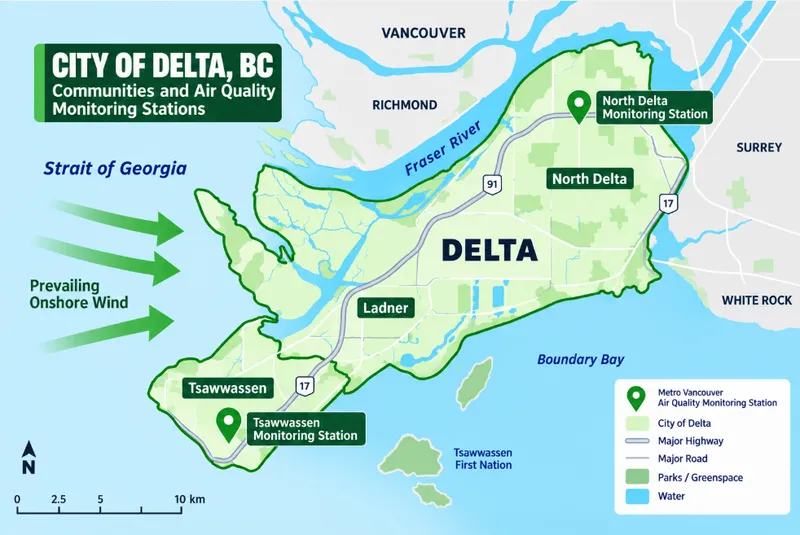
Two monitoring stations sit inside Delta, Tsawwassen and North Delta. They can read differently on the same afternoon.
Metro Vancouver identifies residential wood burning as the region's single largest source of fine particulate emissions, which makes winter a real air quality season in Delta.
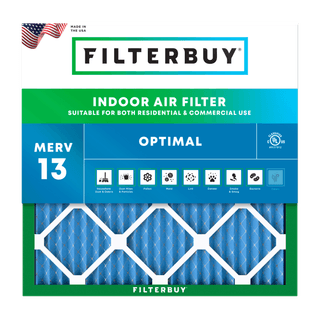
At AQHI 7 or higher, a MERV 13 filter on continuous fan is the most useful indoor step for most Delta homes, though it does nothing for ozone.
How to Read Delta's Live Air Quality Map Before You Head Out
Start with the number on the map above. It is a live reading from the nearest Metro Vancouver station, either Tsawwassen or North Delta. Find your value in the risk table below, take the matching action, and note whether it is climbing or falling. Direction matters more than the reading while smoke is moving through.
Metro Vancouver runs this network alongside the Fraser Valley Regional District and Environment and Climate Change Canada, and you can cross-check any reading on its AirMap. If you want Delta's PM2.5 concentration on its own rather than the combined index, the AirMap reports individual pollutant readings station by station. That matters during smoke events, because the AQHI-Plus formula B.C. uses is weighted toward fine particulate.
Why Delta's Number Runs 1 to 10+ Instead of 0 to 500
Canada’s scale works differently from the American one, and the difference matters more than it looks. The AQHI runs from 1 to 10+ and estimates the combined short-term health risk of three pollutants at once: ground-level ozone, nitrogen dioxide, and fine particulate matter. The US Air Quality Index runs 0 to 500 and reports only the single worst pollutant against fixed concentration limits.
The difference is not cosmetic. Environment and Climate Change Canada built the AQHI to answer a health question rather than a regulatory one, so the two scales cannot be converted with a formula. If Delta shows AQHI 8 while a US city breathing the same plume shows AQI 180, both are correct. Compare the risk bands, not the raw numbers.
British Columbia then goes a step further than the rest of the country. Because the standard AQHI was found to under-report health risk during smoky periods, the province reports an adjusted value called AQHI-Plus, adopted province-wide in March 2021 after two peer-reviewed studies.
The Same Air, Two Different Numbers
Delta happens to have a working demonstration of this on its own doorstep. Point Roberts, Washington sits at the tip of the Tsawwassen Peninsula just below the 49th parallel, home to about 1,200 people, and the only road into it runs through Delta and down 56th Street. Make that drive on a smoky August afternoon and the air does not change, but the scale reporting it does: Point Roberts falls under the US AQI, 0 to 500. Same plume, two different numbers, a few minutes apart.
That is also why a US-based app or a border-area sensor will not agree with Metro Vancouver. Neither reading is broken; they are answering different questions.
Delta AQHI Risk Levels and What to Do
Risk bands follow Environment and Climate Change Canada AQHI guidance. "Higher-risk" means people with asthma, COPD or heart disease, pregnant people, young children and older adults, the groups Fraser Health flags first. Base precautions on the live value above.
Why Delta's Reading Can Shift Within an Hour
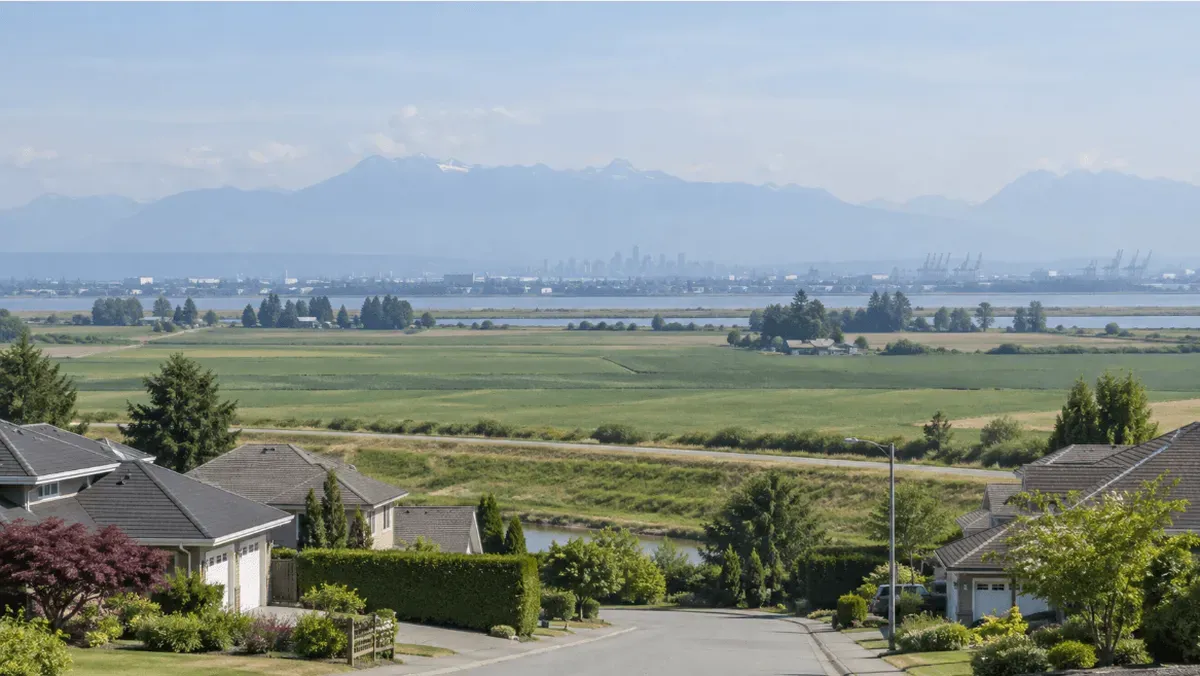
Delta sits where marine air meets a valley airshed, which makes readings unusually changeable. Onshore wind off the Strait of Georgia can flush smoke out of Tsawwassen and Ladner within hours, and Metro Vancouver has forecast exactly that during past smoke events. Once the wind drops, the smoke settles back in.
Geography splits the municipality too. Tsawwassen and Ladner sit on the open delta with direct marine exposure, while North Delta sits higher and further inland, closer to the Fraser River industrial corridor and the Highway 91 and 99 traffic. One municipality, two microclimates, and two stations that will not always agree.
Is the Air Quality Bad in Delta Today?
Delta’s air quality is good on most days, so the answer depends on the live value above rather than on any general rule. Air quality in Delta is best treated as an event rather than a condition. Two things cause those events: wildfire smoke from roughly July through September, and wood smoke on cold, still winter nights. If the map shows a low number and no warning is active, the air is fine to be outside in. For the mechanics behind a bad-air day anywhere, see why air quality goes bad and how long each cause lasts.
What's Actually in the Air Over Delta
Delta's air pollution comes from six main sources: the Roberts Bank port and rail terminals, Highway 17 truck traffic, residential wood burning, wildfire smoke, farm and soil dust, and summer ground-level ozone. The mix is unusual for a Metro Vancouver suburb, because heavy freight infrastructure sits directly beside farmland and housing.
Delta's Local Pollution Sources at a Glance
Metro Vancouver identifies residential indoor wood burning as the single largest contributor of harmful fine particulate emissions in the region.
Two rows carry more weight than the rest. The federal review panel for the proposed Roberts Bank Terminal 2 expansion concluded that construction-phase nitrogen dioxide and respiratory irritants would carry significant human health effects in western Delta, on Tsawwassen First Nation lands, and in the Tsawwassen community. On the wood smoke side, Bylaw 1303 bans wood heating between May 15 and September 15, and since September 2025 it has also required appliances to be registered for continued use.
Wildfire Smoke and Burns Bog: Delta's Two Smoke Problems
Regional wildfire smoke is the bigger driver, and it usually starts hundreds of kilometres away. Metro Vancouver recorded a then-record 22 days of air quality advisories in 2018, 18 of them wildfire-related, and in early September 2025 AQHI values hit the maximum 10+ category, prompting federal advisories and sending school districts indoors.
Delta also carries a smoke risk no other Metro Vancouver city has. Burns Bog, roughly 30 square kilometres of peatland in the middle of the municipality, burns periodically and stubbornly, because peat smoulders below the surface and produces smoke for days. A 2005 fire covered about 200 hectares and prompted a Metro Vancouver particulate advisory, and a fire on July 3, 2016 burned 78 hectares, closed Highway 17 and forced evacuation of the Tilbury industrial area.
The practical takeaway: have a smoke plan by June, and assume smoke can arrive from your own neighbourhood.
Where to Check the Forecast and Who Issues Delta's Warnings
Check Metro Vancouver first, because this is the detail most Delta residents get wrong. The Province and Metro Vancouver split responsibility for air quality notifications, and provincial warnings explicitly exclude the area Metro Vancouver manages, so a provincial map showing no warning does not mean Delta is clear. Metro Vancouver issues Delta's notifications itself, colour-coded yellow for high health risk and orange for very high.
For health guidance, Delta falls under Fraser Health, which recommends checking the AQHI often, keeping a clean filter in your ventilation system, and running a portable air cleaner in the rooms you use most. Bookmark its wildfire smoke page before fire season.
Our Take: What We'd Actually Change in a Delta Home
Outdoor air becomes indoor air. During smoke events, fine particulate works in around windows and through every door opening, then stays airborne long after the sky clears. That is where filtration earns its place.
Filterbuy has manufactured pleated filters since 2013, and our order data shows the same sequence playing out every fire season: filters move within hours of a fire igniting, which is exactly when shipping slows and MERV 13 sizes thin out. Delta has a harder version of that problem, because Burns Bog can put smoke over the municipality before any Interior fire reaches a forecast. The filter is worth buying in June rather than August.
What to Run at Each AQHI Level
No filter of any rating removes ground-level ozone. Confirm your system tolerates MERV 13 before switching.
The mistake I correct most often is someone reaching for a lower MERV because they are worried about airflow. In Filterbuy’s testing, a clean MERV 13 breathes easier than a MERV 8 that has sat in the slot six months. The rating is not what strains a system. A loaded filter is.
David Clark, Licensed HVAC Technician
The caveats we'd give a neighbour, not a customer. On older or undersized equipment a denser filter can restrict airflow, and a restricted system moves less air through any filter. If your Delta home runs on baseboard or radiant heat with no ducts, there is no filter slot to upgrade at all, so a portable HEPA air cleaner in the bedroom and main living space becomes the right answer, and the trade-offs against whole-home filtration are worth reading first.
Smoke also loads media far faster than household dust. In Filterbuy’s replacement guidance, a filter that would run 90 days in a normal Delta home drops to a 30 to 45 day cycle through an active smoke season, so judge it by colour and airflow rather than the calendar.
When to Open the Windows Again
Coming out of a smoke event matters as much as going in, and the instinct is to reopen too early. Wait until the AQHI has settled into the 1 to 3 band and stayed there, because plumes commonly return for a second and third pass as the wind shifts. Then reverse the order: open up on a clear evening, return the fan to AUTO, and replace the filter, which by that point is restricting airflow for nothing.
Ready before the next smoke event: shop Filterbuy MERV 13 air filters, find your furnace filter size, or set up auto-delivery so a spare is on the shelf by July.
Supporting Statistics
Three independent U.S. federal and peer-reviewed sources back the advice above.
Roughly 50%: the reduction in indoor PM2.5 from a high-efficiency HVAC filter with the fan running continuously. A closed-up home with no air cleaning still holds 55% to 60% of outdoor levels, so shutting the windows is not enough alone. U.S. EPA, Strategies to Reduce Exposure Indoors
Up to 24%: the drop in indoor particle concentrations from switching a thermostat fan from AUTO to ON, before any filter upgrade. The only step here that is free. U.S. EPA and AirNow, Indoor Air Filtration factsheet
1.3% to 10%: the rise in respiratory hospitalizations per 10 µg/m³ of wildfire-specific PM2.5 over 14 years of admissions data, against 0.67% to 1.3% for PM2.5 from other sources. That gap is the reasoning behind B.C.'s AQHI-Plus adjustment. Aguilera et al., 2021, Nature Communications, via PubMed
Frequently Asked Questions
Glossary
AQHI (Air Quality Health Index): Canada's official air quality scale, running 1 to 10+, combining ozone, nitrogen dioxide, and fine particulate matter into one estimate of short-term health risk. B.C. reports the AQHI-Plus variant of it.
AQI (Air Quality Index): The US air quality scale, running 0 to 500, reporting the single worst pollutant's concentration. Not the official scale in British Columbia.
PM2.5 (fine particulate matter): Airborne particles 2.5 micrometres or smaller, small enough to reach deep into the lungs. The dominant pollutant in wildfire and wood smoke.
Ground-level ozone (O3): A gas formed when nitrogen oxides and volatile organic compounds react in sunlight. A summer pollutant HVAC filters cannot remove.
MERV: Minimum Efficiency Reporting Value, the ASHRAE scale rating how effectively a filter captures particles. Residential filters typically run MERV 8 to 13.
AQHI-Plus: The adjusted AQHI formula British Columbia has reported province-wide since March 2021, developed because the standard AQHI under-reported health risk during smoke events.